


Who Is Responsible for Packaging EPR Under DDP, DAP and EXW Incoterms
Somebody on your team probably assumes the shipping contract already answers this. It does not. A DDP clause tells you who clears customs. It says nothing about who registers packaging with a national authority. Companies often find this gap the hard way. A warning letter arrives, and the fee is already backdated.
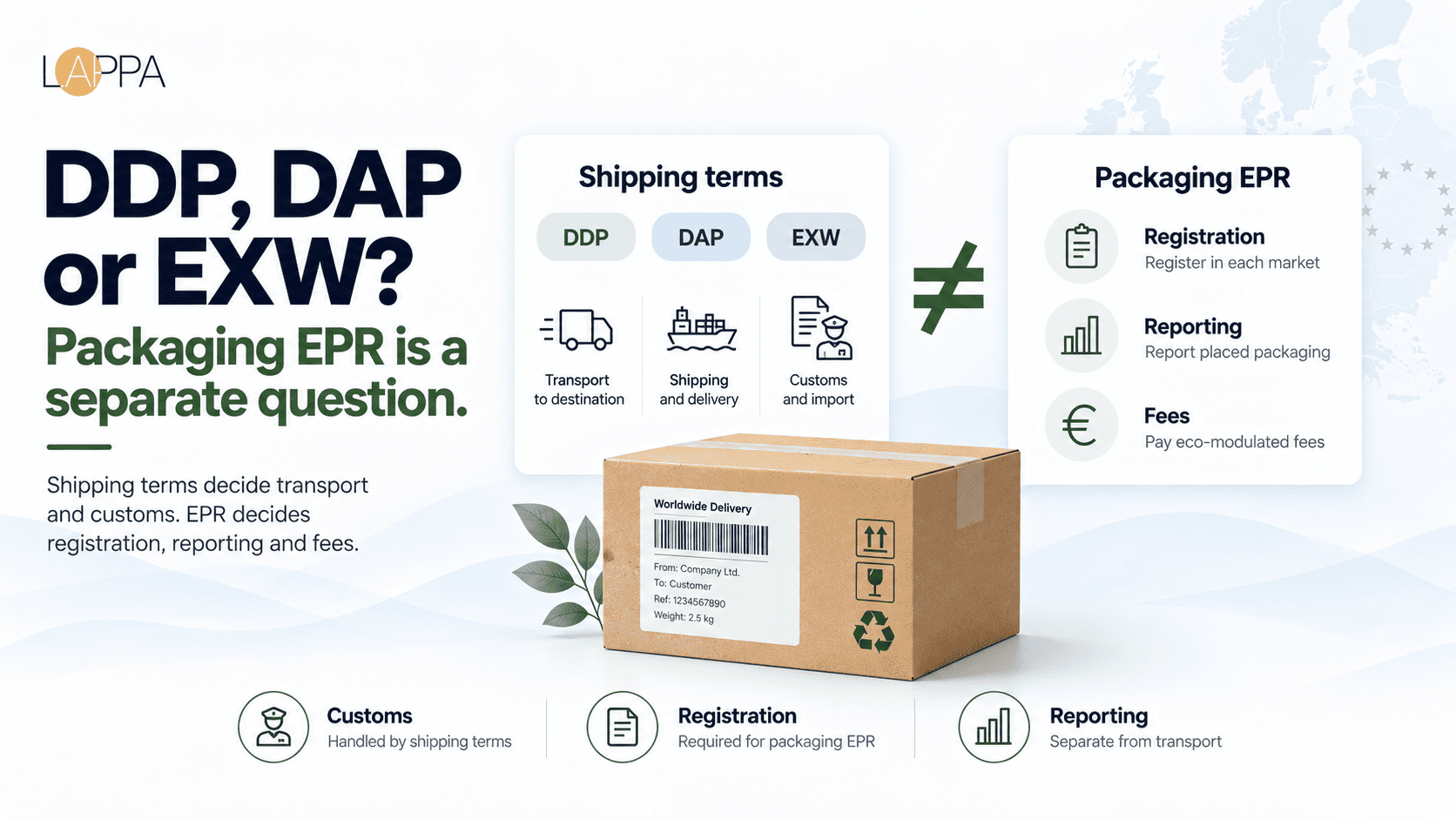
This guide untangles EPR obligations from Incoterms, drawing only on the PPWR regulation itself, national registers like LUCID, and the ICC’s own Incoterms® 2020 rulebook. No recycled definitions. No vague “it depends” without an actual answer.
Worried your contract leaves EPR unassigned? Get a free quote or book a demo and a Lappa specialist will walk through your specific supply chain.
What EPR Obligations Actually Require From a Company
Extended Producer Responsibility puts the cost of collecting and recycling packaging on one named party. Regulation (EU) 2025/40, the PPWR, calls that party the producer. The producer registers with a national scheme. It reports the tonnage placed on the market and pays a fee tied to material type.
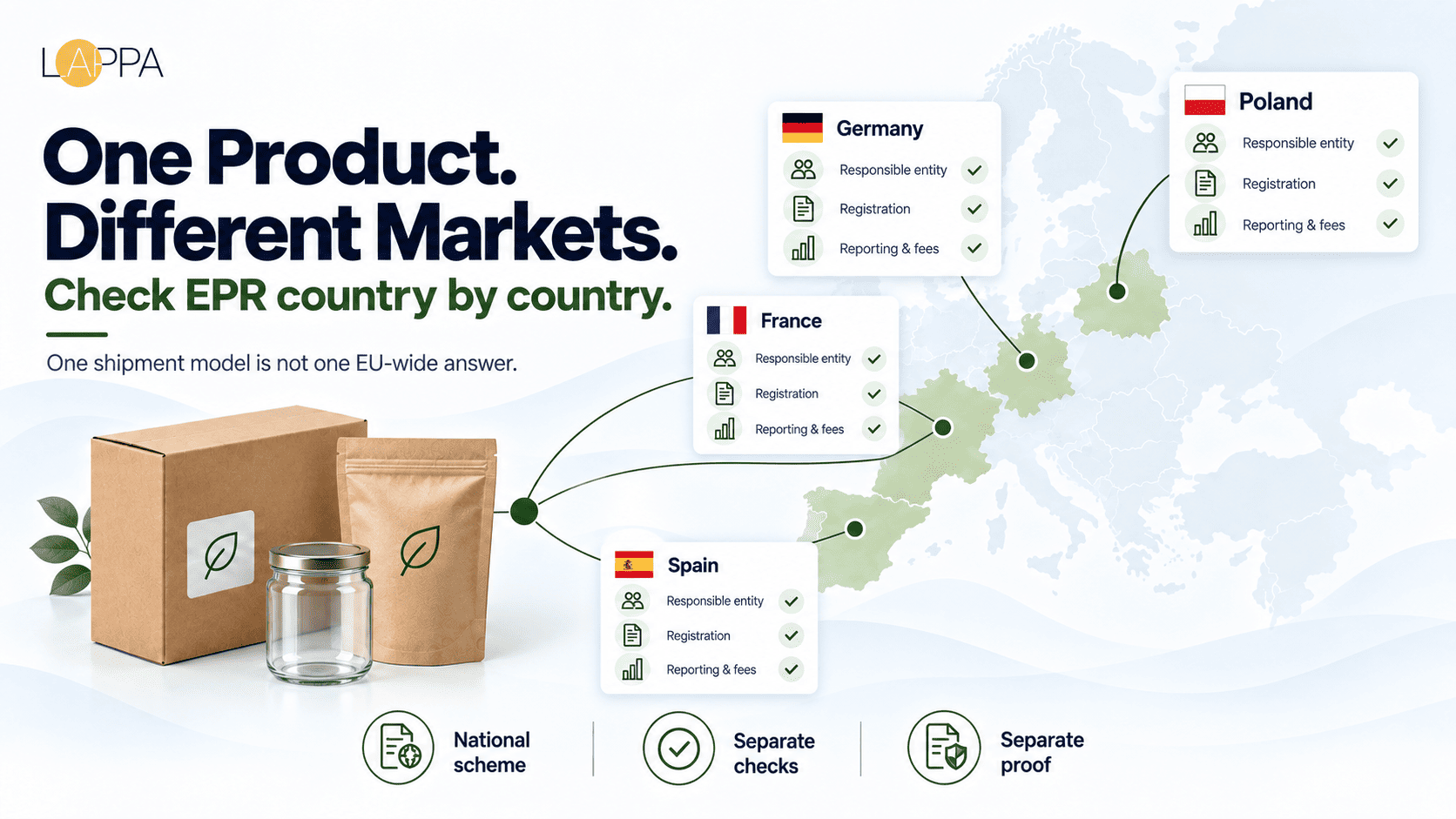
Freight terms play no part in any of that. EPR obligations are assessed country by country, not once for the whole EU. A business can carry producer status in Germany while holding none in Poland, selling the same product through a different distributor. Article 3, point 15, of the PPWR sets the test on economic function, and shipping terms simply do not figure in it.
The Real Reason DDP DAP and EXW Do Not Decide EPR Responsibility
The International Chamber of Commerce built Incoterms around a single goal. That goal is splitting cost and risk between a buyer and a seller. They fix who pays freight, who insures the goods, who clears customs. Environmental law was never part of the brief.
EPR responsibility comes from packaging legislation instead. Packaging law asks a completely different question. It asks who first makes the packaging available on a domestic market. A seller might cover every cost under DDP and still miss that mark in the destination country. A buyer picking up goods at the factory gate can pass that same test without realising it. Two frameworks, two separate answers. Most contracts only mention the first.
What Happens When a Freight Forwarder Says They Handle It
A common line from procurement teams sums up the problem. “Our logistics partner takes care of compliance.” Freight forwarders handle transport documents, EORI numbers, and duty payments. Almost none of them touch packaging registration, and most fulfilment providers never verify it either. It sits outside their mandate entirely.
An EORI number lets a company clear goods through EU customs. It is not an EPR registration number. Having one proves nothing about packaging compliance. Confirm this in writing before the first container ships. Ask exactly which party is registered with the national scheme. A vague answer is, in practice, the real answer.
Incoterms DDP and the Marketplace Registration Trap
Contracts drawn up on Incoterms DDP terms create a particular trap for online sellers. Marketplaces increasingly ask for a valid LUCID number before a listing goes live in Germany. That number is public and checkable. A seller shipping DDP often assumes paying German import VAT settles the matter. It does not.
Germany has run its packaging scheme without any minimum threshold since 1 July 2022. Placing a single packaged item on the German market can trigger the obligation. Company size makes no difference. A non-EU brand selling directly to German consumers under Incoterms DDP still needs its own LUCID registration. An Authorised Representative can hold that registration instead, unless a domestic intermediary already carries the status.
Why EXW Shipments Quietly Turn EU Buyers Into the Producer
Ex Works hands the seller almost nothing to do. The buyer collects the goods and arranges transport. Export and import formalities fall to the buyer too. That convenience carries a cost most buyers never budget for.
Under EXW, the EU-based buyer is usually the first party placing packaging on its own domestic market. National schemes read that fact as producer status, full stop. A retailer collecting stock on EXW terms should assume registration duties sit on its own side. That holds from the first shipment onward. Buying goods exworks is, in effect, buying the compliance obligation too.
How DAP Agreements Create a Silent Gap Between Seller and Buyer
Delivered At Place sits in the middle of the scale. The seller pays for transport to the named destination. The buyer still clears import formalities on arrival. Risk passes once the shipment is ready for unloading.
That split creates a gap neither side notices until reporting season. Import clearance under DAP usually falls to the buyer. National authorities often treat that buyer as the domestic entity placing packaging on the market. A seller shipping DAP should not assume the buyer registered, just because import clearance sat on their side. Ask for the registration number directly. Keep a copy on file.
The PPWR Producer Test Behind Every Incoterm
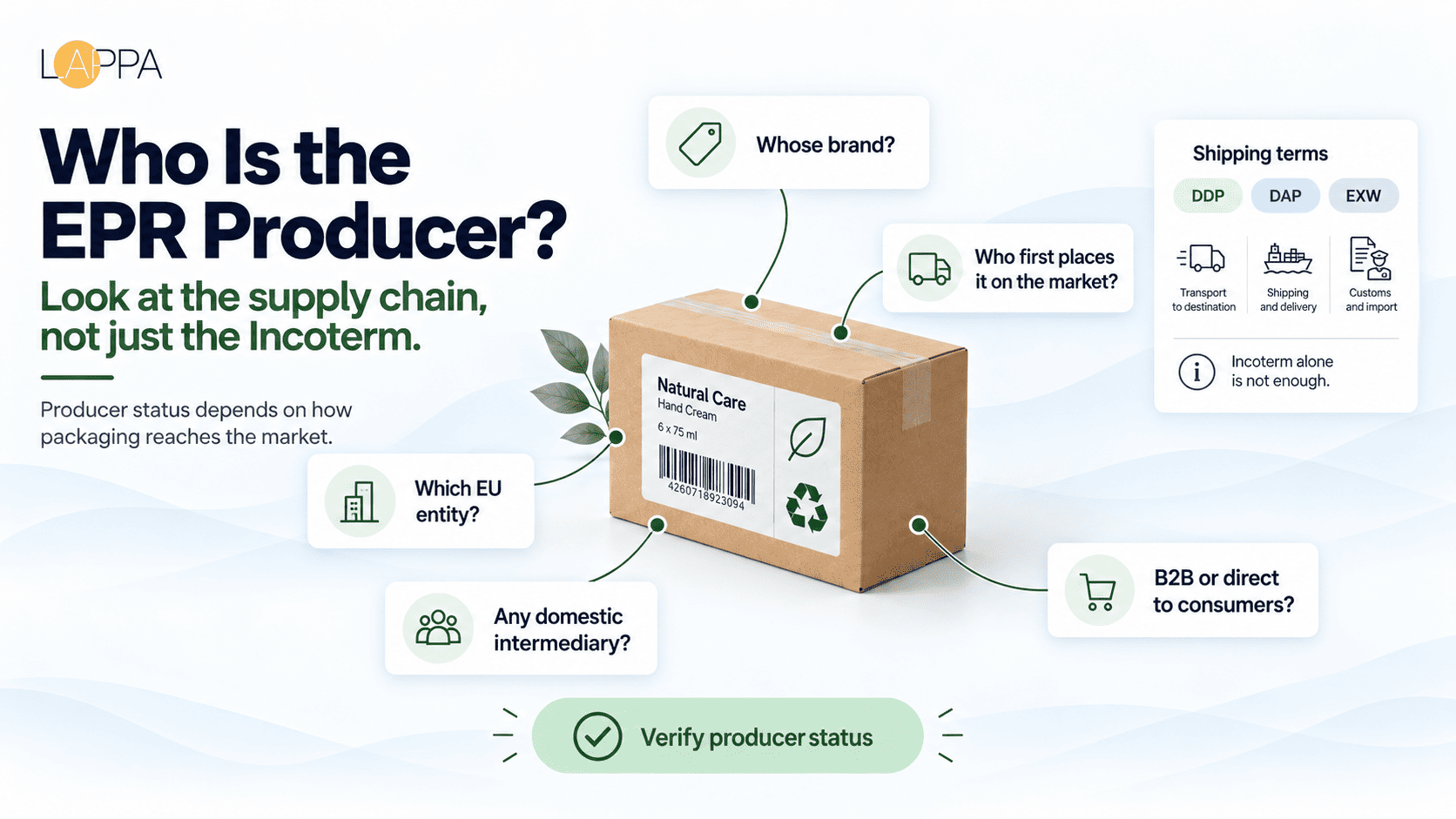
PPWR Article 3, point 1(15), sets out several routes to producer status. Two matter most for cross-border sellers. Knowing how PPWR and national EPR schemes differ confuses plenty of teams on its own. Point (c) and (d) catch any company that makes packaging available directly to an end user in a member state. This holds regardless of where the company is based. Incoterm choice has no bearing on the test.
Article 21 adds a second trap. An importer or distributor placing packaging under its own brand becomes the manufacturer. So does one that alters packaging in a way that affects compliance. Both then inherit the Article 15 duties. One narrow exception exists. Micro-enterprises with under ten employees and turnover below two million euros can shift that role onto a same-country supplier instead. Any company obligated under EPR law should run this test before signing, not after goods start moving.
Factors that decide producer status, whichever term sits in the contract:
- Whose brand or trademark appears on the finished packaging
- Which entity is legally established in the EU market in question
- Who first places the goods with a domestic buyer or end consumer
- Whether a domestic intermediary stands between the brand and that first buyer
- Whether the sale is business-to-business or direct to a consumer
Comparing DDP DAP and EXW Against the Producer Test
| Incoterm | Who Pays Duties and Freight | Who Clears Import | Effect on EPR Producer Status |
| EXW | Buyer, from origin onward | Buyer | Buyer usually becomes the producer by default |
| DAP | Seller, up to destination | Buyer | Producer role often follows the buyer, unconfirmed unless written down |
| DDP | Seller, including duties and taxes | Seller | Producer test can still land on the seller, buyer, or a distributor |
The Backdated Fee Risk Nobody Budgets For
This is the part that turns a paperwork gap into a real bill. Authorities look backward, not only ahead. Germany’s dual systems can raise back-payment demands covering prior years once a missing registration surfaces, and real non-EU sellers have already received such notices. Non-compliance can also carry fines of up to two hundred thousand euros. Marketplace suspension is a real risk on top of that.
None of this penalty depends on who arranged shipping. What matters is who was supposed to register and never did. Reviewing existing contracts now, not after a notice arrives, is the only way to catch it in time.
Already had a registration notice land unexpectedly? Explore EPR Registration to get compliant without the guesswork.
National Deadlines That Do Not Wait for Your Contract to Catch Up
Every member state runs its own calendar, and a supply chain review has to keep up with it, not the other way round. Germany’s LUCID register needs the prior year’s quantities confirmed by 15 May. Planned quantities for the coming year are due by 31 December. France’s CITEO scheme runs its own annual window, tied to tonnage placed on the market.
Worth tracking no matter which Incoterm sits on the contract:
- Each country’s registration deadline, wherever packaging reaches an end user
- Whether a domestic intermediary already holds a valid registration number
- Whether previous filings still match current sales volumes
- Renewal dates for any Authorised Representative mandate
- Fee changes tied to material type or recyclability grading
A Working Checklist Before You Sign the Next Contract
Work through this order before the next cross-border deal is signed, not after shipments begin.
- Confirm the destination country and its national packaging scheme
- Work out which party first places goods with a domestic buyer there
- Check whether a domestic intermediary breaks that chain
- Request a registration certificate or number as proof, not a verbal assurance
- Write the outcome into the contract as its own clause, separate from the Incoterm
- Revisit the answer whenever the Incoterm, market, or distributor changes
Contract Scenarios Mapped Against the Usual Registering Party
| Scenario | Likely EPR Producer | Action to Add to the Contract |
| Non-EU brand sells direct to EU consumers under DDP | Non-EU seller, via an Authorised Representative | Name the Authorised Representative and its mandate |
| Non-EU brand sells EXW to an EU distributor | The EU distributor | Request the distributor’s registration number in writing |
| EU manufacturer sells DAP to an EU retailer | Manufacturer or retailer, depending on branding | Name the registered party directly, inside its own clause |
When a Non-EU Seller Needs an Authorised Representative Regardless of Delivery Terms
A non-EU manufacturer selling directly to EU consumers generally cannot register itself. Most national schemes require a locally established entity. Article 45(3) of the PPWR is the legal basis for appointing someone who can. This rule stands regardless of the Incoterm written into the contract.
This applies under DDP, DAP, or EXW alike. None of the three changes where a company is legally established. Once appointed, the Authorised Representative handles registration, reporting, and fee payment for the manufacturer. Appoint one before the first sale into that market. Do not wait for a compliance notice to arrive.
No EU entity, but selling directly to EU consumers? See how Lappa’s EU Authorised Representative service works.
Keeping the Commercial Term and the Compliance Answer on Separate Lines
Treat the Incoterm clause and the packaging clause as two different lines. Never merge them into one. Update both whenever a distributor changes or a new market opens. Keep one register that tracks producer status per country and gets reviewed at every renewal. That stops the same question from resurfacing on every shipment.
Businesses running mixed Incoterms across several EU markets tend to outgrow spreadsheet tracking fast. Consolidating registration and reporting in one system removes that recurring guesswork.
Managing EPR across multiple EU markets and shipping terms? Explore Lappa’s EPR Consolidation service or try the EPR Calculator for a fee estimate.
FAQ



Whether shipping DDP puts packaging EPR fees automatically on the seller
No. DDP only settles who pays freight, duties, and import taxes. Producer status under the PPWR is decided separately. It asks who first makes packaging available on a given domestic market. A seller can clear every customs formality under DDP and still not meet that test. The obligation can then land on a distributor, or on the buyer instead.
Which party typically registers for EPR after an EXW purchase
Under EXW, the buyer takes over transport and import clearance from the seller’s dock onward. That typically makes the EU-based buyer the first party placing packaging on its own domestic market. The buyer generally carries EPR responsibility in that country as a result. Confirm this before the first shipment leaves the seller’s premises.
Might a DAP deal leave both sides unregistered by mistake
Yes, and this is one of the most common gaps found in contract reviews. Under a DAP-style agreement, the seller pays for transport, while the buyer clears import formalities on arrival. National authorities frequently treat that buyer as the domestic entity responsible for packaging. Without a written clause naming the registered party, each side may assume the other one dealt with it. The gap then only surfaces once a fee notice or audit request appears.
Does packaging EPR status change between EU countries for the same product
Yes. Producer status is assessed separately in every member state. This holds even though the PPWR’s underlying definition is now the same across the bloc. A company might hold recognised producer status in Germany for one shipment, yet count as only a distributor in France for that same product. Each country asks who first placed that packaging domestically. Businesses selling into several markets need a country-by-country record, not one company-wide answer.
When must a non-EU seller appoint an Authorised Representative no matter the Incoterm
A non-EU manufacturer selling packaging directly to EU consumers usually cannot hold its own EPR registration. Most schemes require a locally established entity. This holds whether the sale runs under DDP, DAP, or EXW, since none of those terms changes where a company is established. An Authorised Representative, appointed under Article 45(3) of the PPWR, then handles registration, reporting, and fee payments for the manufacturer.

