

How to Calculate Your Packaging EPR Fee
Ask three compliance teams how their packaging EPR fee gets calculated, and there’s a good chance you’ll hear three different answers — not because any of them is wrong, but because the calculation genuinely depends on more variables than a single formula suggests. Weight matters, but so does material type, packaging tier, the country it’s sold in, and — increasingly, under the PPWR — how recyclable the format is judged to be. Understanding how those pieces fit together is what turns an EPR fee from a mystery line item into a number a business can actually plan around.
What factors go into a packaging EPR fee calculation
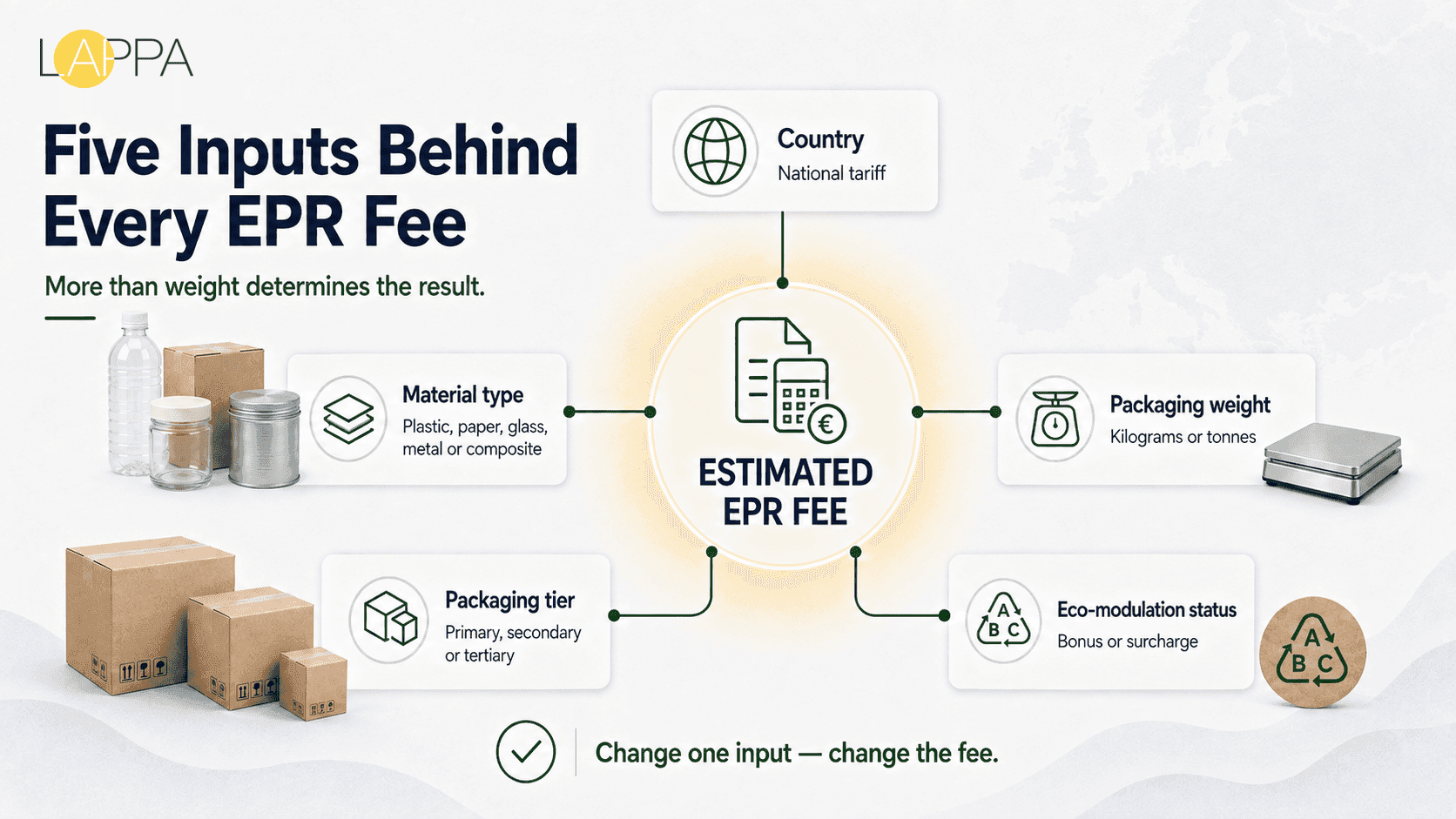
Before any number gets calculated, five inputs determine the outcome of a packaging EPR fee calculation:
- Country — each national scheme sets its own tariffs, so the same packaging generates a different fee depending on where it’s placed on the market
- Material type — plastic, paper, glass, metal, and composite materials are priced separately, often at very different per-kilogram rates
- Packaging weight — the base unit most schemes calculate from, usually expressed per kilogram or per tonne
- Packaging tier — primary packaging (in direct contact with the product), secondary (grouping packaging), and tertiary (transport packaging) are frequently reported and sometimes priced differently
- Eco-modulation status — whether the packaging’s design qualifies for a discount or incurs a surcharge, increasingly tied to the recyclability grade a format receives under the PPWR
Get any one of these wrong — the wrong country’s tariff, or a misclassified material — and the resulting fee estimate can be off by a meaningful margin, even if the weight figure itself is accurate.
The logic behind the calculation
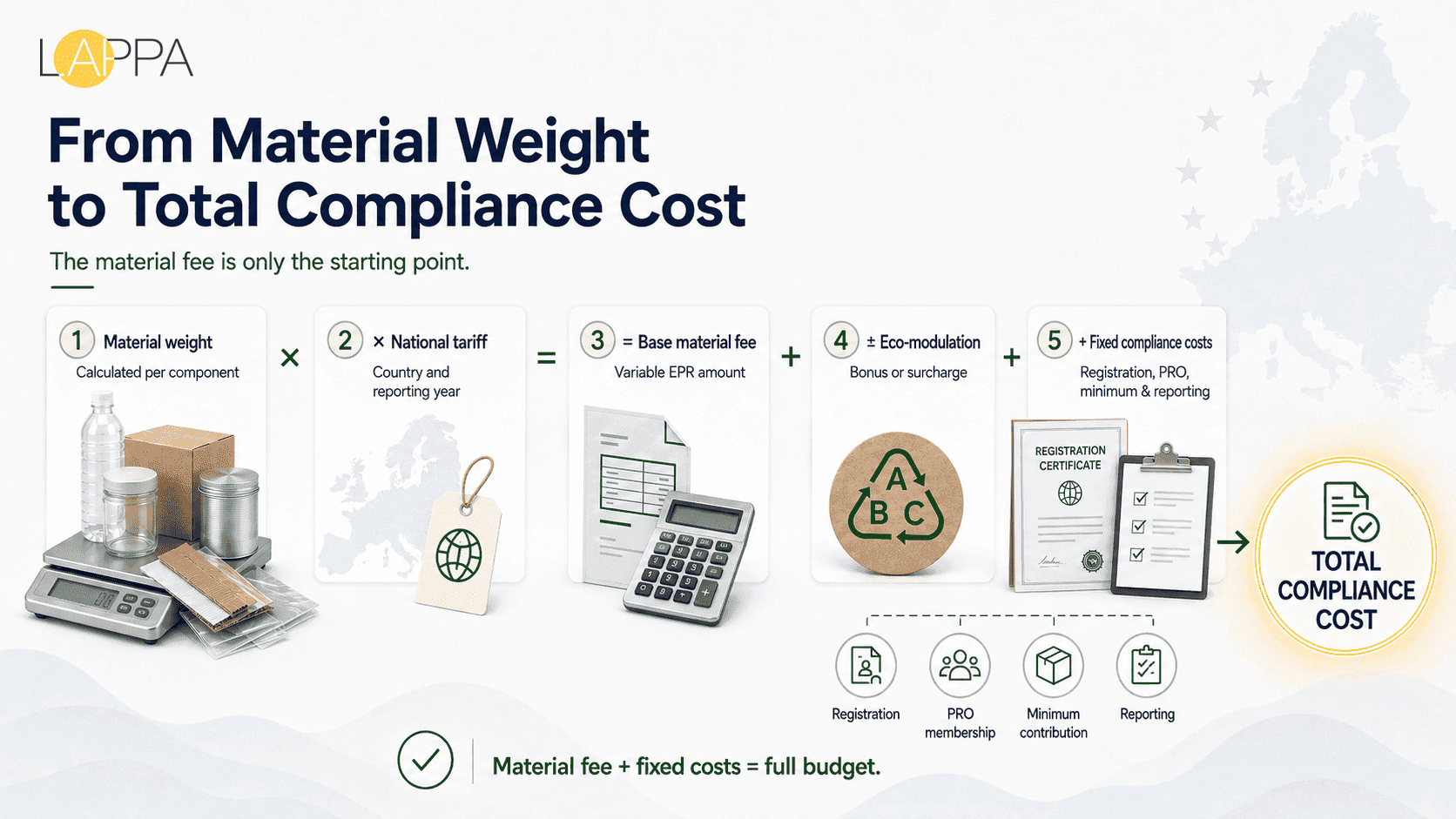
Stripped down to its basic mechanics, the EPR fee formula most packaging schemes follow has the same shape: the weight of each packaging material is multiplied by that material’s applicable tariff in the relevant country, for the relevant reporting year. Where a business places more than one material on the market — a cardboard box, a plastic film, an aluminium seal, for instance — each material is calculated separately against its own tariff, and the results are added together to reach a total base fee.
That base figure is then adjusted by eco-modulation, which raises or lowers it depending on how the packaging design scores against the scheme’s recyclability criteria, before any fixed costs — registration, membership, minimum contributions — are added on top to reach the full cost of compliance.
Want to see this logic applied to your own packaging mix? Try the EPR Fee Calculator.
How PPWR recyclability grades change the calculation
This is where the calculation is shifting, and where most explanations stop short. The PPWR (Regulation (EU) 2025/40) introduces formal PPWR recyclability grades — A, B, and C — that are set to become the backbone of eco-modulation across the EU, replacing the patchwork of national recyclability criteria that dual systems and PROs currently apply on their own terms.
Grade A, B, or C — Packaging is assessed against how well it can be collected, sorted, and processed without degrading the wider recycling stream. The Commission is due to publish the delegated acts defining the exact grading methodology by 1 January 2028, though the letter bands themselves are already fixed in the regulation’s text.
Below grade C — Packaging that doesn’t reach grade C is classified in law as technically non-recyclable. From 1 January 2030, that classification stops being a labelling issue and starts being a market-access issue: packaging below grade C loses its right to be placed on the EU market at all, which makes the fee calculation somewhat academic — there’s no fee to calculate for packaging that can no longer be sold.
Recyclable “at scale” — From 1 January 2035, a grade has to reflect packaging that is actually processed by real collection infrastructure, not packaging that could theoretically be recycled under lab conditions. Fees for formats that only pass on paper, rather than in practice, are expected to reflect that gap once this standard applies.
Grade C phase-out — By 1 January 2038, grade C disappears from the market entirely, leaving only A and B as valid classifications. For any business still relying on grade C-level packaging at that point, the relevant number won’t be a fee — it will be a redesign budget.
For a fee calculation today, the practical takeaway is this: eco-modulation bonuses and penalties that used to vary by scheme are gradually converging on this same A/B/C scale. A packaging format’s recyclability grade is becoming less of a “nice to check” input and more of a direct multiplier on the base material fee — one that a business will increasingly need to track per format, not just per material.
What sits outside the material-based calculation
The material-based calculation — weight multiplied by tariff, adjusted for eco-modulation — covers the variable portion of an EPR fee, but not the full cost of compliance. A few components are calculated and billed separately in most schemes:
- Registration fees, charged independently of the material-based fee
- Producer responsibility organisation membership costs, often a fixed annual charge regardless of volume
- Minimum annual contributions, which can apply even when the calculated material fee would otherwise be lower
- Administrative or reporting charges, tied to filing frequency or format
A calculation that only accounts for material and weight will typically understate the total cost of compliance — sometimes by a wide margin, depending on the scheme’s fixed-cost structure.
For a calculation that accounts for registration and reporting costs alongside the material fee, get an EPR fee quote or explore EPR Reporting Software.
Applying the logic to your own packaging
The mechanics above hold regardless of how many materials or markets are involved — the same weight-times-tariff logic, adjusted for eco-modulation and recyclability grade, applied consistently across a portfolio. Doing that by hand across several countries and materials at once, while keeping track of which grade each format falls into, is where the process becomes difficult to maintain manually.
A packaging EPR fee calculator applies this same method automatically, without the risk of using the wrong country’s tariff or missing a modulation adjustment. It’s a useful way to sanity-check figures before they go into a budget — for a number tied to an official declaration, that calculation still needs to run through the relevant national scheme or a compliance provider.
See how your own packaging mix calculates across the countries you sell in — try the EPR Fee Calculator, or book a demo to walk through a multi-country calculation with a Lappa specialist.
FAQ calculating packaging EPR fees
The material-based portion of most packaging EPR fees is calculated per kilogram or per tonne, not per unit. A scheme takes the total weight of a given material placed on the market during the reporting period — not the number of packages — and multiplies it by that material's tariff. Unit counts still matter for the calculation, since total weight is usually derived by multiplying the weight of one packaging component by the number of units sold, but the tariff itself is applied to weight. Some countries additionally report unit counts for administrative or traceability purposes alongside the weight-based figure, and a business can always divide the total fee by units sold to get an indicative cost per package, but that's a derived number rather than how the scheme itself prices the fee.


.jpg&w=3840&q=75)