

France Triman Labeling & EPR Compliance Guide
If you sell household products in France — furniture, packaging, toys, textiles, gardening tools, or virtually anything consumers bring home — there is a green-and-dark-teal mark you are legally required to display. It shows a human silhouette surrounded by arrows. It is called the Triman logo, and since January 1, 2015, placing it on your products or their packaging is not optional.
This article explains what the triman label is, why it exists, who must use it, how to apply it correctly, and what happens if you don’t. Whether you are a producer already registered with a French EPR scheme, an importer expanding into the French market, or a brand manager reviewing packaging for 2026, you will find the practical guidance here.
Why France created a unified sorting mark and the logic behind the Triman logo
France has had sector-specific take-back programs — known as Extended Producer Responsibility (EPR) schemes — since the early 1990s. The first covered household packaging. Over the following two decades, similar programs were added for graphic papers, tires, clothing and household linen, furniture, electrical and electronic equipment, batteries, and specific hazardous household waste.
Each scheme developed its own communication system. Eco-organisms running these programs placed different symbols on different products. By the mid-2000s, French consumers faced a patchwork of labels with no consistent message. Research consistently showed that fragmented signage leads to poorer sorting rates; when people are uncertain, waste ends up in the wrong bin — or in landfill.
The solution was a single, unified pictogram. The Grenelle Environnement framework, established through legislation in 2009 and 2010, explicitly called for harmonised sorting instructions across all product categories. The legal text was refined in 2014 and the Decree of December 23, 2014 gave the triman logo its official form.
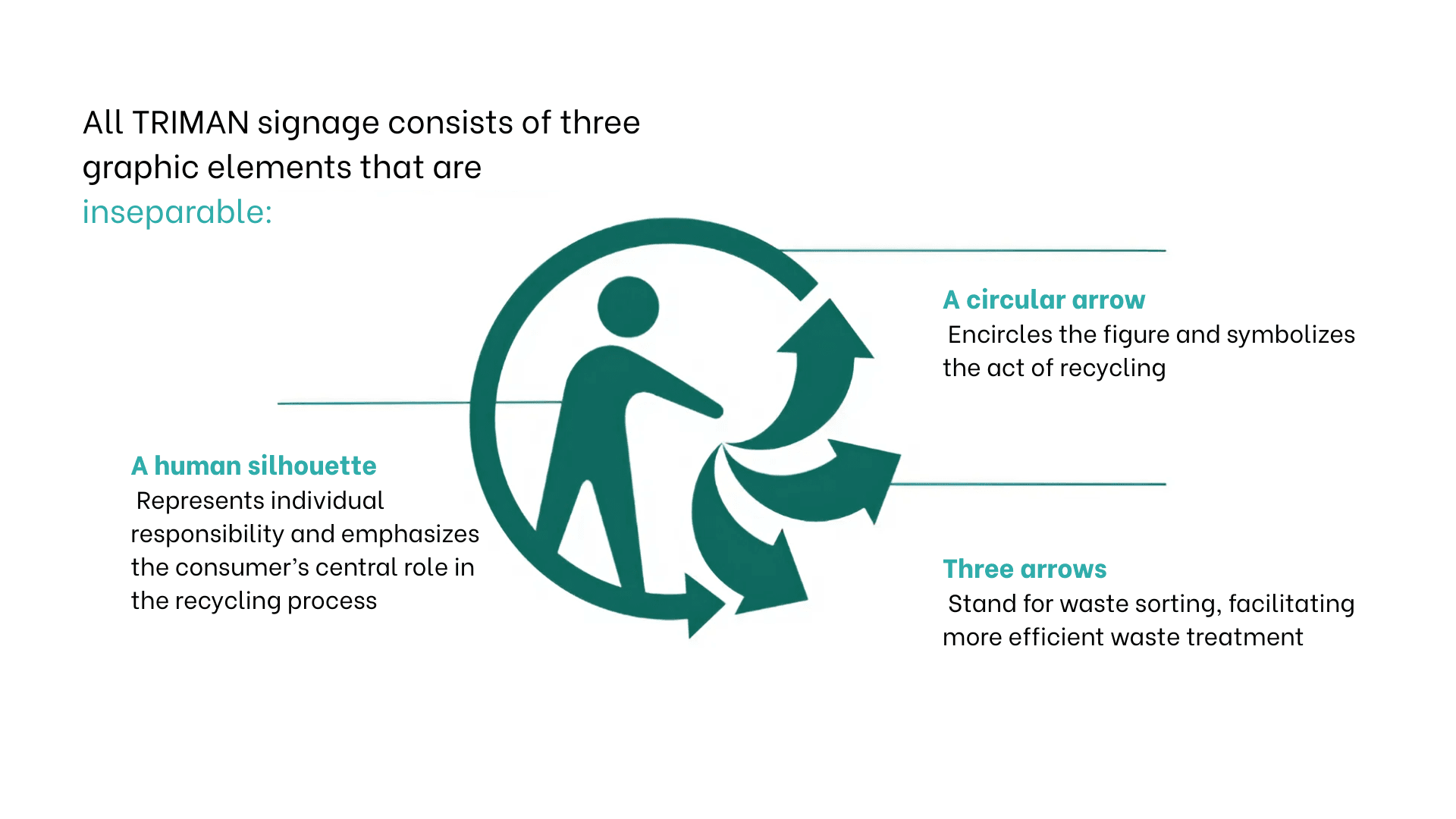
The logo triman is composed of three strictly inseparable graphic elements. First, a human silhouette facing forward — a deliberate design choice emphasising the central role of the individual consumer. Second, three directional arrows representing the act of sorting and the separation of waste streams. Third, a circular arrow enclosing the silhouette, representing recycling. Together, these elements communicate one idea: this product belongs in a separate collection stream when you are done with it.
Who must carry the Triman label and the legal scope of EPR compliance in France
The obligation to display the triman label france applies to all producers, importers, and own-brand distributors who place household-use products on the French market and who are subject to an EPR provision. The supervising authority is the French Directorate General for Consumer Affairs, Competition, and Fraud Prevention — the DGCCRF — which enforces compliance under Article L. 541-9-3 of the French Environmental Code.
Article L. 541-9-4 sets the penalty: a fine of up to €15,000 per legal entity for each product that lacks the required sorting signage. Inspectors can apply this for every non-compliant product found on the market.
The product categories currently covered by epr packaging and other EPR obligations that require the Triman mark include:
|
Product Category |
EPR Obligation Active Since |
|---|---|
|
Household packaging (excluding glass drinks containers) |
1992 / Triman mark required from Jan 2015 |
|
Graphic papers |
Jan 2015 |
|
Tires |
Jan 2015 |
|
Clothing, household linen and footwear (TLC) |
Jan 2015 |
|
Furniture and bedding |
Triman signage deadline: Dec 15, 2023 |
|
Decorative textiles (rugs, curtains, nets) |
Triman signage deadline: Aug 25, 2024 |
|
DIY and gardening products |
Triman signage deadline: Dec 6, 2023 |
|
Toys |
Triman signage deadline: Dec 6, 2023 |
Note that electrical and electronic equipment (EEE), batteries, and specific hazardous household products (DDS) are subject to a different marking — the crossed-out wheelie bin — and do not require the Triman pictogram itself, though their recyclable packaging may still require it.
One important clarification about international sales: the triman logo france obligation applies only to products destined for the French market. This is why the signage always carries the country code “FR” in a small bubble — it tells consumers the instructions apply in France specifically. Products imported from another EU member state that carry an equivalent sorting mark recognised under EU mutual recognition principles may satisfy the requirement without adding the French pictogram, but this equivalence must be verified carefully.
Not sure if your products are Triman-compliant? Lappa helps producers and importers across Europe handle EPR registration, reporting, and labeling compliance — so you don’t have to figure it out alone. From registering with the right French eco-organism to filing your annual EPR reports, we cover the full compliance cycle. Get started with Lappa today.
The anatomy of the Triman logo symbols and what every element means
The triman logo symbols are not arbitrary. Each was chosen to communicate a specific concept at the moment a consumer decides what to do with a used product.
The human figure faces right — toward the future — and holds its arms in a gesture of placing something down or handing something over. This visual immediately signals individual action: you, the consumer, are the actor in this process. The silhouette places the person at the center of the circular economy rather than making waste management feel like something that happens somewhere else.
The three arrows around the figure indicate sorting — the physical act of separating waste by type so that it can be directed to the correct processing stream. This is not the same as recycling; sorting is the prerequisite that makes recycling possible.
The outer circular arrow completes the loop, representing the transformation of sorted materials into new raw materials. Recycling closes the cycle that the other two elements begin.
The Ecomaison notes that all three elements are strictly inseparable. You cannot use the circular arrow alone, the human figure alone, or any cropped or modified version. The proportions and the composition must remain intact.
EPR Rules for the full signage block and what must accompany the logo
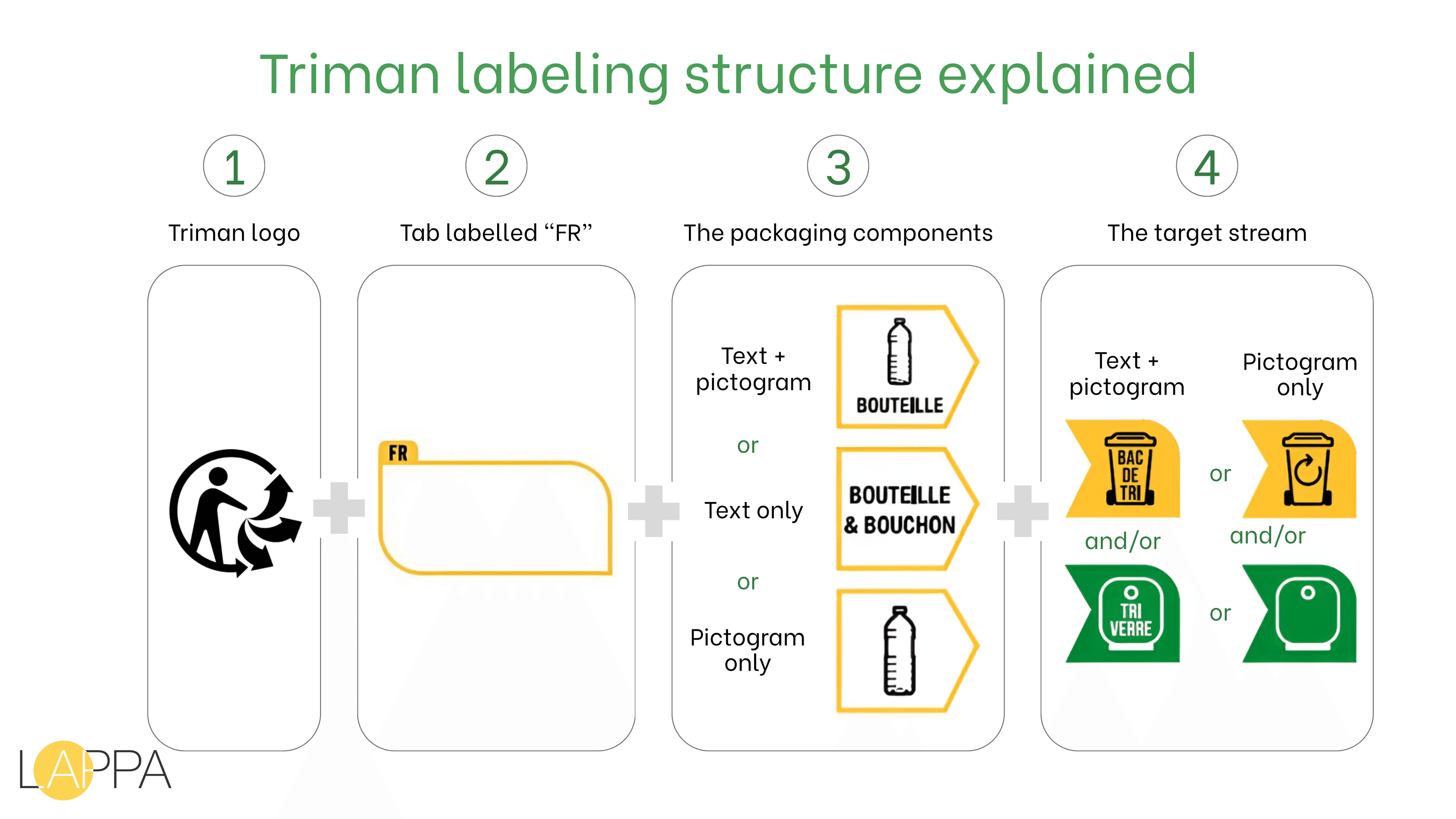
The pictogram alone is rarely sufficient. French epr rules require that the sorting mark be accompanied by instructions telling the consumer what to actually do with the product. The complete signage block developed by Ecomaison for the furniture and DIY/toys sectors consists of four parts:
The country code “FR” — displayed in a small bubble attached to the signage block. This indicates the territory where the instructions apply.
A message — chosen from two options validated through consumer research conducted by Ecomaison with Harris Interactive in September 2021. For most furniture and decorative textile products, the message reads “Donnez ou recyclez” (Give or recycle). For non-specialist contexts, “Pensez à donner ou recycler” (Think about giving or recycling) is used. The messages are rendered using the proprietary Ecomob font, which has been vectorised and must not be altered.
Sorting instructions with pictograms — showing the consumer where the product can go: a charitable association, a store drop-off (for applicable retailers), and a waste disposal centre (déchèterie). Curtains and nets have an additional option: textile containers. Products sold primarily by delivery may show a delivery recovery option instead of or alongside the store option.
A reference to quefairedemesdechets.fr — the ADEME-managed search engine that allows any French consumer to find the nearest collection point for any type of waste based on their location.
The order of these destinations is deliberate: donation comes first to prioritise reuse, then store or delivery recovery, then waste collection as a last resort. This hierarchy reflects France’s broader circular economy strategy under the 2020 Anti-Waste Act (Loi AGEC).
Where to place the Triman label and the physical and digital requirements
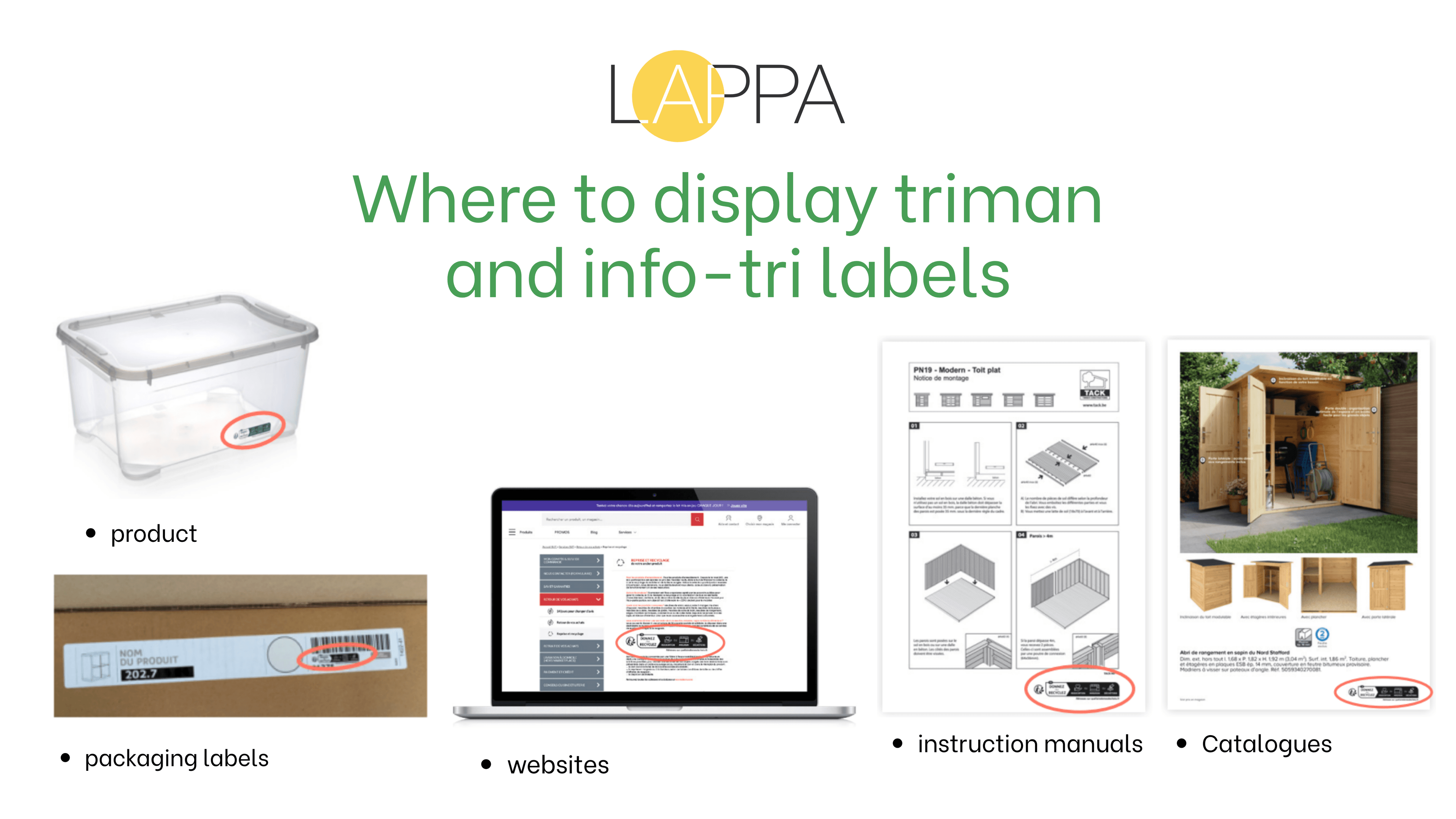
The label triman and its accompanying sorting information must appear in close proximity to the product, meaning on one of three things: the product itself, the product’s packaging, or documentation supplied with the product such as an assembly manual or user guide. A website alone does not satisfy the legal requirement — online information can supplement but cannot replace physical marking.
There is an important size-based exception system:
|
Largest face of product or packaging |
Obligation |
|---|---|
|
More than 20 cm² (or 40 cm² for cylindrical/spherical) |
Full signage: logo and text instructions |
|
Between 10 and 20 cm² (20–40 cm² cylindrical) |
Triman logo mandatory; text instructions may be dematerialised (e.g., QR code) |
|
Less than 10 cm² (20 cm² cylindrical) |
Both logo and instructions may be fully dematerialised |
Even when dematerialisation is permitted, Ecomaison and ADEME strongly recommend including the Triman pictogram on the physical product wherever technically feasible, because the mark is most effective at the moment a consumer decides to discard an item.
Signage may also appear on quotes, invoices, purchase orders, and catalogues, though these placements do not replace the mandatory physical marking. For assembly manuals and catalogues, the monochrome (black) version of the signage is recommended due to printing constraints.
Colour format and dimensions and the EPR compliance technical rules
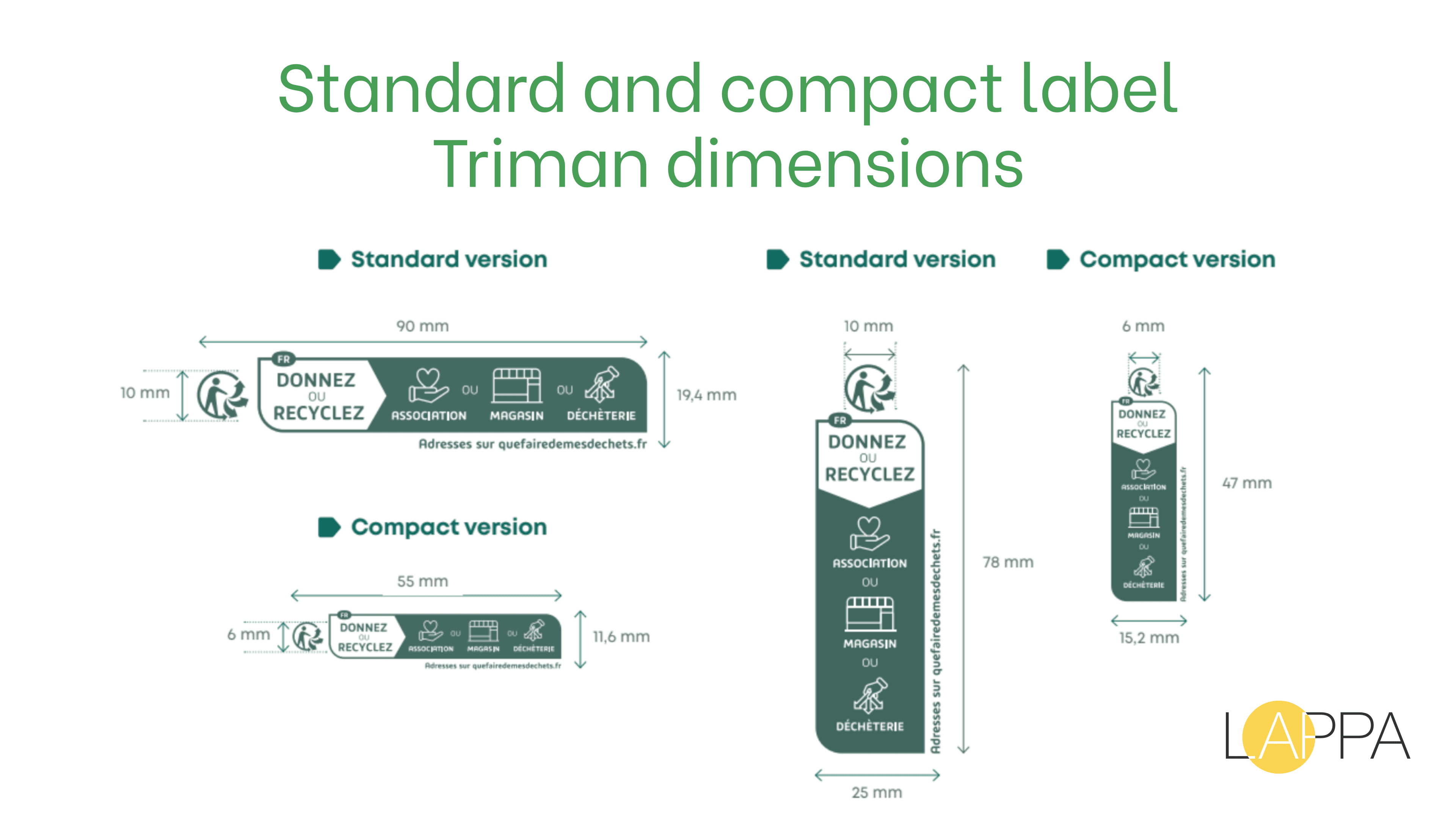
EPR compliance with the visual standards is as important as compliance with the legal obligation to display the mark. The Ecomaison user guide (updated September 2023) and the original 2015 ADEME guide together establish the following technical requirements.
Colour. The colour version uses a specific dark teal (Pantone 562C, CMYK 85-35-60-25, RGB 15-105-95). A monochrome black version is available for printing constraints. A reverse (white on dark background) version is used when the signage is placed on a coloured surface. Colour choice must ensure the pictogram remains clearly visible against its background — the regulatory obligation is always visibility, not a specific colour. Polychrome or poorly contrasted applications are explicitly prohibited.
Typography. The Ecomob font is proprietary and has been vectorised. The text within the signage block is not editable as live text — the native files provided in Ecomaison’s graphic kit (available in Illustrator, PDF, and PNG formats) must be used as supplied.
Dimensions — three-pictogram version (furniture, textiles, packaging):
|
Version |
Horizontal width |
Height |
Minimum permitted |
|---|---|---|---|
|
Standard horizontal |
90 mm |
19.4 mm |
10 mm height |
|
Compact horizontal |
55 mm |
11.6 mm |
6 mm height (cannot be reduced further) |
|
Standard vertical |
25 mm |
78 mm |
10 mm width |
|
Compact vertical |
15.2 mm |
47 mm |
6 mm width (cannot be reduced further) |
Dimensions — four-pictogram version (DIY, gardening, toys with delivery option):
|
Version |
Horizontal width |
Height |
|---|---|---|
|
Standard horizontal |
94.2 mm |
19.4 mm |
|
Compact horizontal |
58 mm |
11.6 mm |
|
Standard vertical |
25 mm |
98 mm |
|
Compact vertical |
15.2 mm |
66 mm |
The compact version exists for space-constrained packaging but may not be reduced below the stated minimum under any circumstances. When enlarging, the proportional relationship between all elements must be maintained.
Protected zone. A clearance zone around the logo — equal in thickness to twice the width of the circular arrow stroke — must be kept free of any other text, image, or graphic element.
Prohibited uses of the Triman logo and what EPR regulations compliance forbids
EPR regulations compliance requires not just using the mark, but using it correctly. The following applications are explicitly prohibited:
Changing the colour of the Triman pictogram so it differs from the colour of the accompanying logo block. Moving the pictogram to a different position within the signage block. Changing the size of the pictogram independently of the block. Altering the proportions of the overall signage. Using the signage without the Triman logo attached. Crossing out the logo. Rendering it in polychrome. Placing it on a background that provides insufficient contrast. Hiding it behind other elements. Associating it with messages that contradict or confuse the sorting instruction — phrases like “Do not sort” or vague environmental claims like “This company cares about the planet” are explicitly cited as prohibited accompaniments.
The mark must also not be placed on products that are not subject to an EPR sorting obligation. Applying it to products that neither belong to a regulated EPR stream nor carry a sorting obligation misrepresents the regulatory status of those products and confuses consumers.
Implementation timelines by sector
Each product sector covered by EPR has its own implementation schedule. The general process follows the same steps across all sectors: proposal presentation to public authorities, validation, a 12-month implementation period, and in some sectors an additional 6-month stock disposal grace period.
|
Sector |
Validation by authorities |
Signage deadline |
Stock disposal extension |
|---|---|---|---|
|
Furniture and bedding |
December 15, 2021 |
December 15, 2023 |
June 15, 2023 |
|
Decorative textiles (rugs, curtains) |
August 25, 2023 |
August 25, 2024 |
— |
|
DIY and gardening products |
December 6, 2022 |
December 6, 2023 |
June 6, 2024 |
|
Toys |
December 6, 2022 |
December 6, 2023 |
June 6, 2024 |
For furniture, the stock disposal grace period ended before the signage deadline, which means products manufactured prior to December 15, 2022 and transferred before June 15, 2023 were exempt — but anything manufactured or imported after those dates must carry the full logo triman 2026 compliant signage. For decorative textiles, the obligation fully took effect from August 25, 2024.
By 2026, all products in these sectors already placed on the French market must comply. If you are a retailer or marketplace operator, note that you are responsible for ensuring the mark is present even if a third-party seller has failed to apply it; the marketplace bears liability in lieu of the seller under Article L. 541-10 of the Environmental Code.
Sector specific versions and choosing the right signage for your product
The triman logo is not one-size-fits-all in terms of messaging. While the pictogram and its three graphic components are fixed, the accompanying message block varies by product type.
For furniture specialists selling exclusively furniture, the dedicated version reads “Donnez ou recyclez vos meubles” (Give or recycle your furniture). This version specifically names furniture in the message and is the preferred choice.
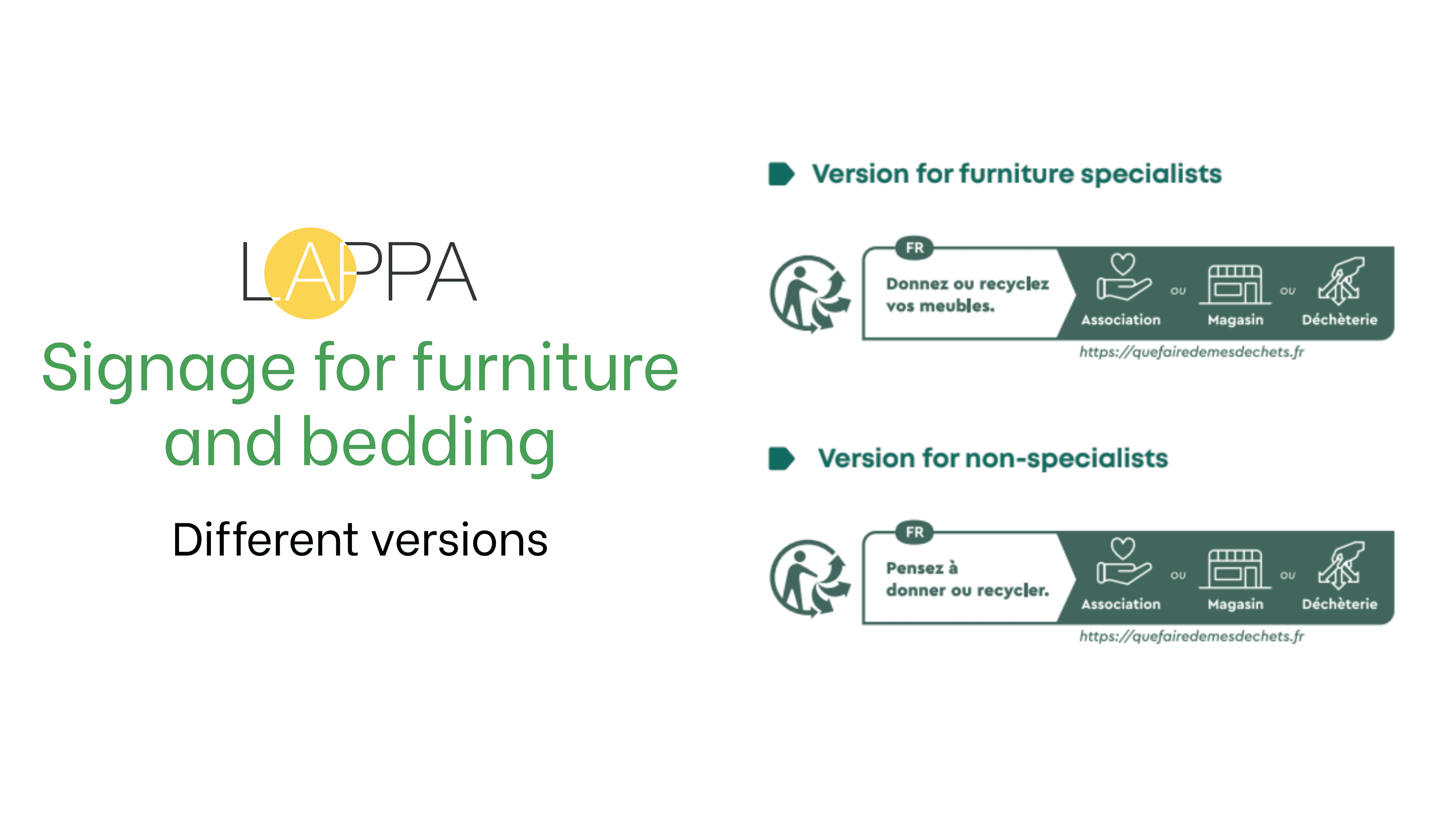
For non-specialists — including sellers of bedding, storage boxes, rugs, and accessories — a general version reading “Pensez à donner ou recycler” is used. Both versions are legally equivalent; the distinction is about communicating more precisely to the consumer.
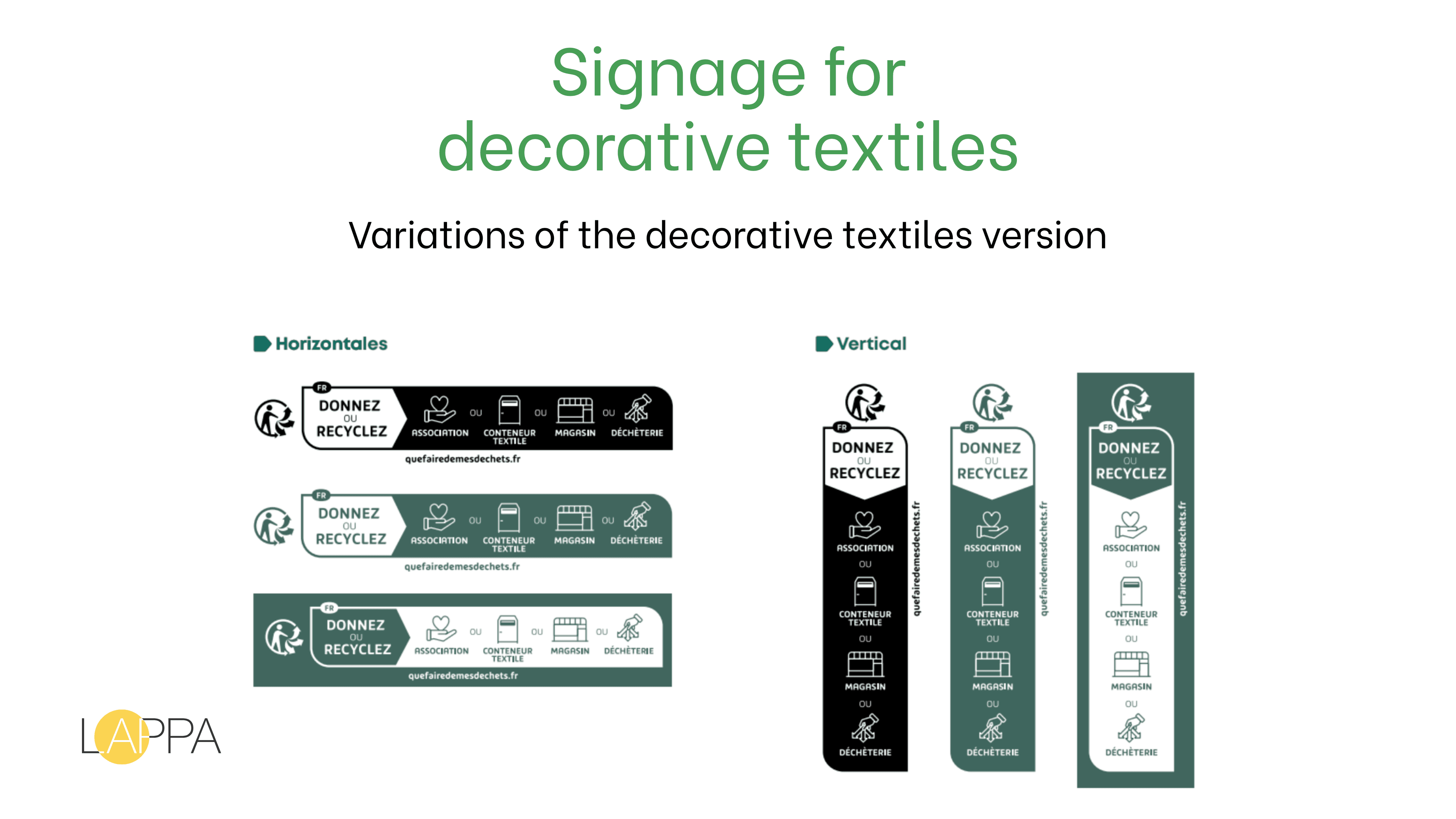
For curtains and nets, a four-pictogram version is required, adding a textile container as an additional collection option alongside association drop-off, store recovery, and waste disposal.
For DIY products and toys, the standard three-pictogram version covers association drop-off, store recovery, and waste disposal. Where products are sold primarily by delivery (distance selling), a delivery-recovery pictogram replaces or supplements the store option. A four-pictogram combined version is also available for sellers who offer both in-store and delivery channels.
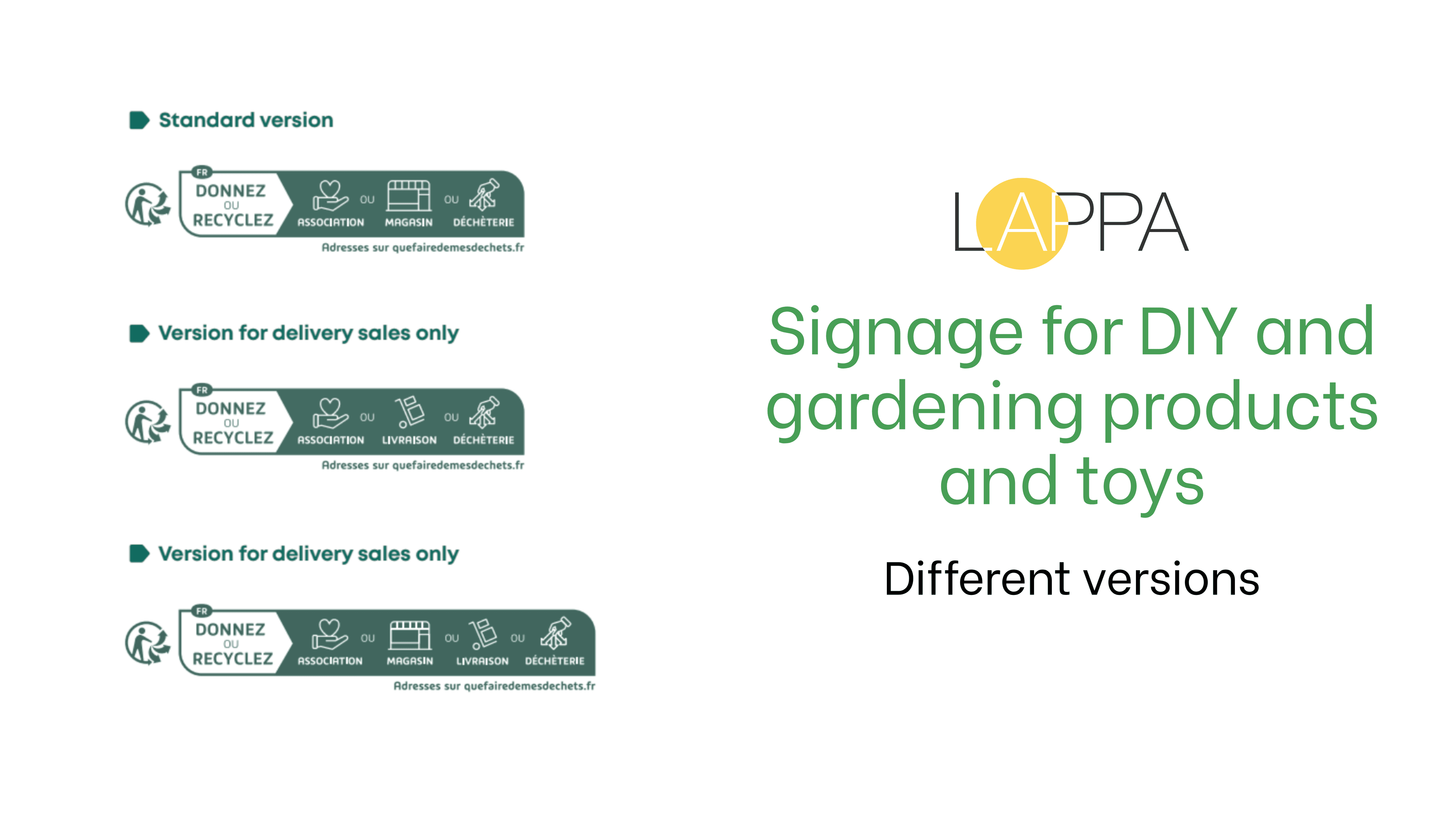
Since January 2023, distributors of DIY and gardening products and toys — whether individuals or companies — who are subject to the extended marketer responsibility have been bound by a physical or distance-selling recovery obligation. This obligation already applied to furniture sellers from January 2022 and to decorative textiles from January 2023.
The bigger picture and Triman within France’s circular economy strategy
The triman label sits within a broader legislative architecture. The 2020 Anti-Waste Act for a Circular Economy (Loi AGEC) expanded the scope of EPR in France significantly — adding new sectors, tightening producer obligations, and introducing new consumer information requirements. The act reinforced the Triman obligation and extended it to sectors such as toys, DIY, and decorative textiles that had not previously been covered.
France’s approach treats sorting in French — the physical act consumers perform at home — as a critical link in the recycling chain. Research shows that clear, consistent labelling directly improves sorting behaviour. A unified mark that appears across furniture, clothing, packaging, and toys removes the cognitive burden of learning multiple systems. The ADEME-managed website quefairedemesdechets.fr complements the physical label with a searchable database covering more than 850 waste types and over 50,000 collection points nationwide, helping consumers act on the information the Triman mark provides.
Ecomaison — the approved eco-organism managing the furniture, decorative textile, DIY, and toy sectors — works with over 400 social and charitable organisations that resell collected items. This gives the donation option in the signage real-world infrastructure: when the logo triman points a consumer toward “association,” there are actual organisations ready to receive and redistribute those goods, extending product life and reducing waste.
For producers and importers, epr compliance with the Triman system is not just a legal checkbox. It is an opportunity to demonstrate to French consumers that a product has been responsibly designed with its end of life in mind — and that visible commitment, displayed through the triman logo france, is increasingly something French buyers notice and expect.
Lappa works with producers, importers, and marketplace sellers who need EPR compliance done right. See how Lappa can help your business. Book a demo or get a fee quote
Frequently Asked Question
Yes. The regulatory obligation concerns visibility, not a specific colour. The Ecomaison kit includes green, black, and white versions. For coloured backgrounds, use the reverse version. Custom colours are permitted as long as the logo remains clearly legible.