


Spain EPR
What is Spanish EPR for Packaging
Spain’s Extended Producer Responsibility (EPR) for packaging is regulated under:
-
Law 7/2022 on Waste and Contaminated Soils
-
Royal Decree 1055/2022 on Packaging and Packaging Waste
It requires companies that place packaged products on the Spanish market to finance and organize the collection, recycling, and treatment of packaging waste.
The law fully applies to household, commercial, and industrial packaging.
The objective is to:
-
Increase recycling rates
-
Promote eco-design
-
Reduce packaging waste
-
Support circular economy goals
Does This Apply to E-Commerce & Online Sales
Yes. Absolutely.
EPR applies to:
-
Distance sellers shipping to Spain
-
Non-Spanish companies selling via marketplaces
-
Amazon, Shopify, eBay sellers
-
Cross-border B2C sellers
If you ship packaged goods to customers in Spain — you are in scope.
Who is the Producer Under Spanish EPR
The “producer” is the entity that first places packaging on the Spanish market.
This includes:
-
Spanish manufacturers
-
Importers into Spain
-
Distributors introducing packaged goods
-
Online sellers selling cross-border into Spain
-
Businesses using service packaging (bags, takeaway packaging, etc.)
For cross-border e-commerce, the foreign seller is considered the producer.
Who Must Register for Spanish Packaging EPR
All producers placing packaging on the Spanish market must:
-
Register with the Spanish Register of Product Producers (RPP) managed by the Ministry for Ecological Transition (MITECO)
-
Join an authorized Producer Responsibility Organization (PRO / SCRAP) OR establish an Individual Compliance System (SIRAP)
There is no minimum threshold exemption.
Even small sellers must register.
Spanish EPR Packaging Registration Threshold
There is no EPR Packaging thresholds in Europe de minimis.
If you place any amount of packaging on the Spanish market, registration is required.
Easy to use EPR Software to calculate Eco-fee
Manage All Countries with Lappa

EPR and PPWR for Spain
Companies selling packaged goods into Spain deal with two separate regulatory layers. First, there's SCRAP—Spain's collective system where you pay into a fund that finances waste collection and sorting. You register with the ministry, put down your annual volumes by material, and that satisfies Spain's domestic waste management rules. It's been working this way for years and isn't going anywhere. Register for PPWR and EPR in Spain with Lappa using our fee quote form or use EPR and PPWR compliance software from Lappa.
Then PPWR arrives in August 2026 and tackles something entirely different: what packaging actually looks like before it hits the shelf. The regulation cares about what materials are inside, how recyclable the design is, whether inks contain harmful chemicals, how much recycled plastic is baked in. None of that touches your SCRAP registration or fees. You're still paying into Spain's system; you've just got new rules about packaging engineering on top of it.
One thing that works in Spain's favour: unlike France, which has a national Triman logo requirement, Spain never mandated a single national labelling scheme. Spain asks for sorting symbols (the coloured bin icons), but there's no equivalent to France's legal battle over labelling. When PPWR's harmonised pictograms show up in 2028, there's less friction because Spain's existing system already sits lighter. That said, the transition still requires rethinking label designs and artwork placement.
PPWR Labels for Spain
PPWR labelling requirements for Packaging sold into Spain currently wears sorting symbols—four colour options telling consumers which bin it goes into. Yellow for plastic and metals. Blue for paper. Brown for compostables. Green for glass. These became mandatory on January 1, 2025, and there are no more extensions. If it's not physically printed on the package, you're not compliant with Spanish law. If you are interested in digital compliance labels from Lappa, we recommend to check our label manager.
PPWR flips that on its head starting 12 August 2028. Instead of "which bin," the new pictograms say "what is it" and "how recoverable." Material composition, recyclability grade, recycled-content percentage—all signalled through EU-wide standardised icons. It's solving a different problem than Spain's sorting system.
What happens in between 2028 and 2030? Probably both. Spanish retailers and online sellers will need to print sorting symbols (national law) and PPWR pictograms (EU law) on the same package. That's messier than ideal, but unavoidable. Eventually Spain may streamline or align the two, but for now, label real estate gets tighter and design costs climb.
PPWR Product Rules for Spain
Four separate rules land between now and 2030, each one a hard line, not a suggestion.
- Right now, August 2026: Certain chemicals used in inks, coatings, and barriers—specifically PFAS—are capped at 25 to 250 parts per billion. A food-contact surface with water-repellent coating that exceeds the limit? That shipment doesn't clear Spanish customs. No waivers for low volumes or phased timelines. It's immediate.
- January 2030: Every piece of packaging needs to be engineered so it actually recycles. That means the material choice, the glue holding labels on, the plastic closure snapped onto a glass jar—all of it gets tested or certified against PPWR criteria. Suppliers haven't widely done this work yet. Spanish companies should start now because the testing cycle takes months.
- January 2030: Recycled content hits hard minimums. Plastic packaging must be 30% recycled; cardboard 90%; glass 40%; aluminium 50%. It's not aspirational. Documentation proving where the recycled material originates is mandatory. Suppliers claiming recycled content without traceability get rejected.
- January 2030: Oversized or padded packaging draws scrutiny. The rule is simple: use what's necessary, nothing more. Air-filled boxes, excess cushioning, packaging that's bigger than the product inside—all of it faces enforcement action. The specific thresholds vary by product category and are still being defined, so early engagement with industry groups and SCRAP advisors makes sense.
Packaging Covered (and Excluded)
Covered Packaging
Spain applies EPR to:
-
Primary packaging (product packaging)
-
Secondary packaging (grouped packaging)
-
Tertiary packaging (transport packaging)
-
Household packaging
-
Commercial packaging
-
Industrial packaging
Materials Covered
-
Plastic
-
Paper & cardboard
-
Glass
-
Metals (steel, aluminum)
-
Wood
-
Composite materials
Not Covered Under This Scheme
-
Batteries (separate EPR)
-
WEEE (electronics)
-
Tyres
-
Other regulated waste streams
Producer Responsibility Organization (PRO / SCRAP)
Producers must join an authorized SCRAP (Sistema Colectivo de Responsabilidad Ampliada del Productor).
Major examples include:
-
Ecoembes – household packaging (plastic, metal, paper)
-
Ecovidrio – glass packaging
-
Procircular – multi-material packaging
Each PRO sets its own fee structure.
Alternatively, companies may establish an Individual System (SIRAP), though this is rare and complex.
EPR Registration in Spain – Step-by-Step
-
Obtain a Spanish tax ID (NIF)
-
Appoint an Authorized Representative (if non-resident)
-
Join a PRO (SCRAP)
-
Register in the official RPP register
-
Obtain your Producer Registration Number
-
Start reporting packaging volumes
-
Pay eco-fees
Authorized Representative
If your company is not established in Spain, you must appoint a Spanish Authorized Representative.
The representative:
-
Registers you in the RPP
-
Handles communication with authorities
-
Ensures reporting compliance
-
Assumes legal responsibility
This is mandatory for foreign distance sellers.
What Data Must Be Reported?
Producers must report annually:
-
Total weight of packaging placed on the Spanish market
-
Breakdown by material (plastic, paper, glass, etc.)
-
Type of packaging (household, commercial, industrial)
-
Recycled content (if applicable)
-
Reusable packaging (if applicable)
Reports are submitted to:
-
The PRO (for fee calculation)
-
The Spanish authorities (via RPP)
First Reporting Period
The packaging regulation became fully operational from:
1 January 2025
(Extension to commercial and industrial packaging included.)
Registration obligations started earlier (2023–2024).
EPR Reporting Deadlines
Deadlines vary depending on the PRO, but generally:
-
Annual reporting for previous year volumes
-
Reporting typically due in Q1 or Q2
-
Eco-fees payable annually (sometimes quarterly advances)
Always confirm with your specific PRO.
Labels & Marketing Claims
Spain does not have a single mandatory recycling logo for all packaging. However, the "Recicla" label — managed by Ecoembes, Spain's packaging PRO — is widely used and strongly recommended for producers placing packaging on the Spanish market.
An example of what a label looks like on packaging for Spain
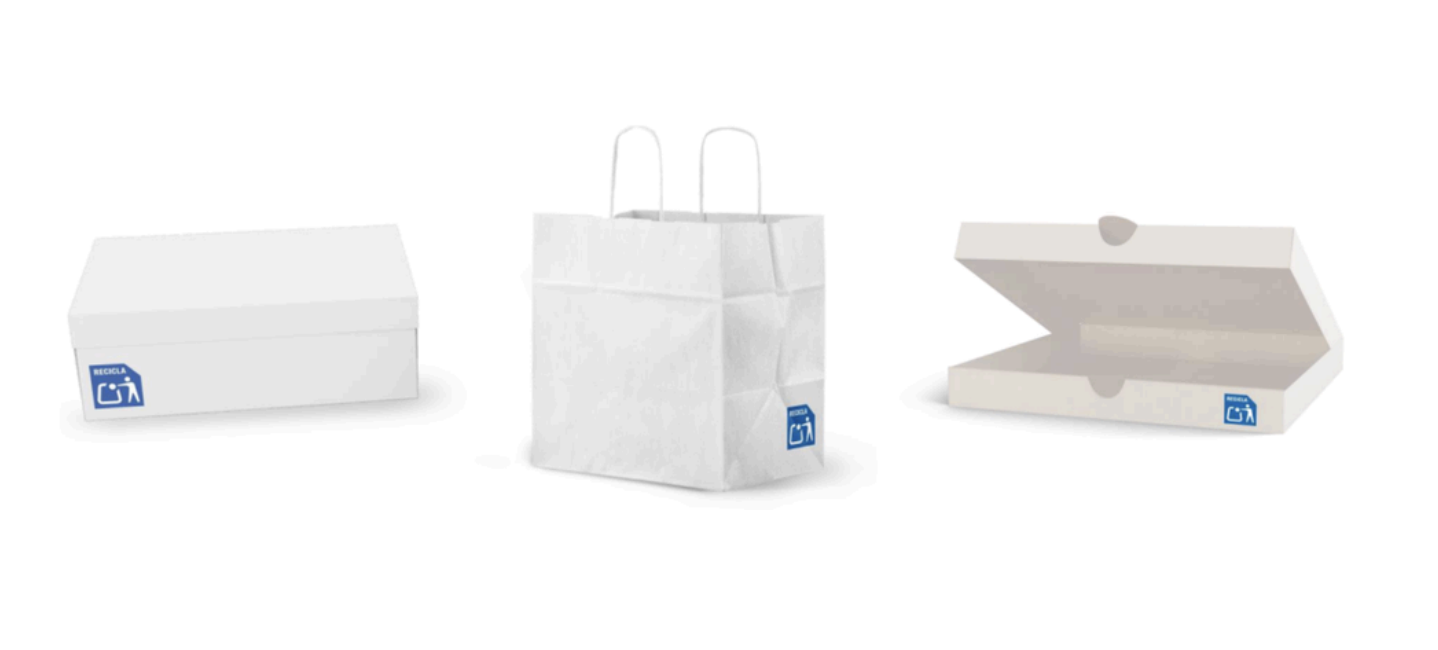
This packaging shows the blue "Recicla" label used for paper and cardboard packaging. The blue colour indicates that the packaging should be placed in the blue recycling bin (contenedor azul), which collects paper and cardboard across Spain. The label appears on boxes, bags, and cartons.
📎 Download the Recicla label for paper/cardboard:
Recicla label — yellow bin (plastic, cans, cartons)
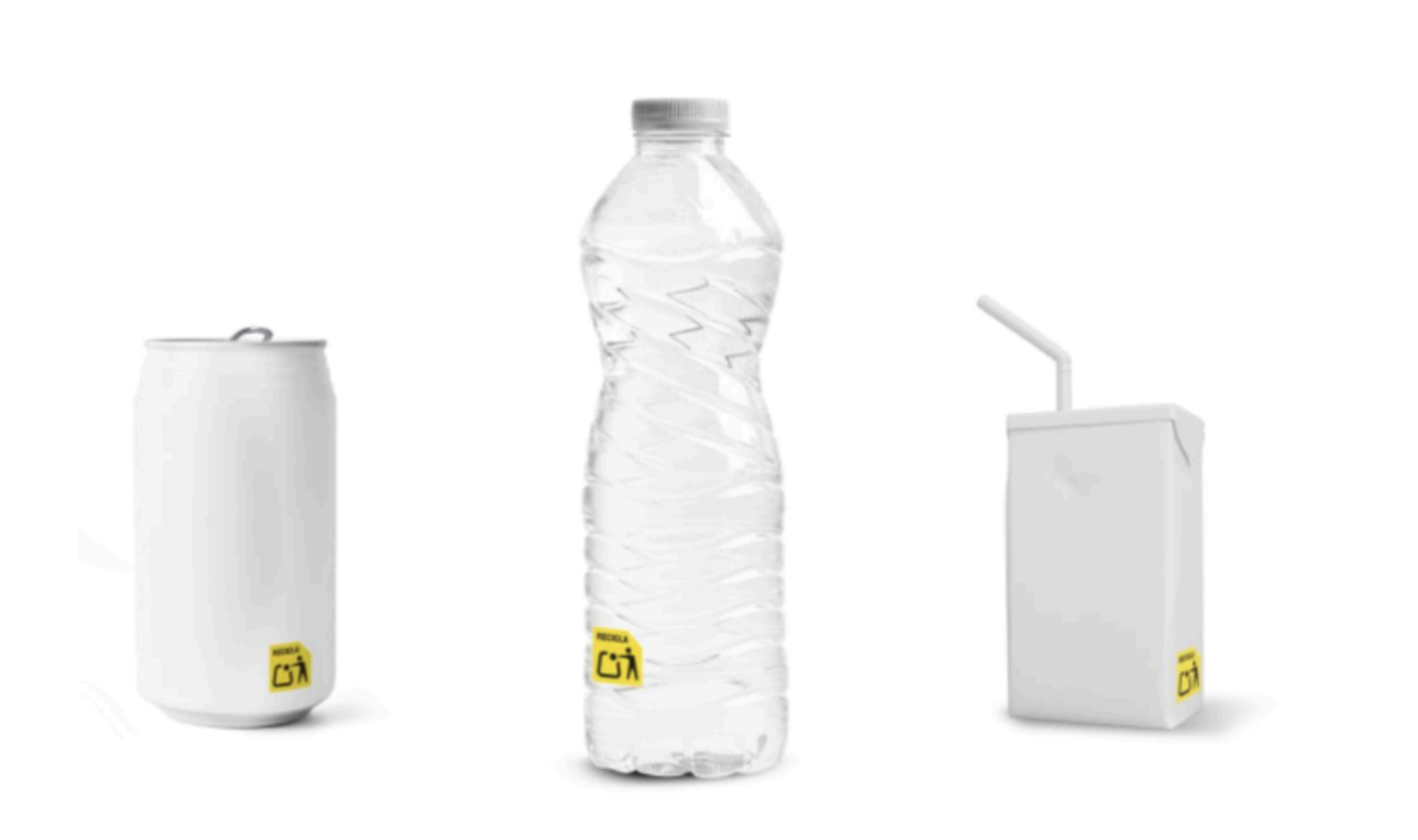
This packaging shows the yellow "Recicla" label used for plastic bottles, metal cans, and drink cartons. The yellow colour indicates that the packaging should be placed in the yellow recycling bin (contenedor amarillo). The label is applied per packaging component and helps consumers identify the correct collection stream.
📎 Download the Recicla label for plastic/metal:- PNG – best for digital use.
EPR Eco-Fees & Eco-Modulation
Eco-fees depend on:
-
Material type
-
Weight
-
Recyclability
-
Recycled content
-
Design sustainability
Eco-modulation means:
-
Better recyclable packaging = lower fees
-
Non-recyclable packaging = higher fees
Each PRO defines its own tariff tables.
Want to estimate your potential costs before registration? Use the EPR fee calculator to get an indicative estimate based on country, material type and packaging volume. For a broader overview of service costs, registration fees and ongoing compliance expenses, see our EPR pricing page.Risks, Penalties & Common Mistakes
Risks & PenaltiesNon-compliance may result in:
-
Significant administrative fines
-
Sales bans
-
Marketplace delisting
-
Legal enforcement actions
Fines can reach tens or hundreds of thousands of euros depending on severity.
Common Mistakes
-
Assuming e-commerce is exempt
-
Not registering industrial packaging
-
Not appointing an Authorized Representative
-
Underreporting packaging weights
-
Using incorrect material classifications
What E-Commerce Sellers Should Do Now
-
Audit your packaging materials
-
Calculate annual packaging volumes
-
Determine if you qualify as a producer
-
Appoint an Authorized Representative (if needed)
-
Join a Spanish PRO
-
Register in the RPP
-
Implement packaging data tracking systems
-
Review eco-design opportunities to reduce fees
Get a 20 min free consultation for EPR
Find all your answers and become part of Lappa
FAQ
Do I need Spanish VAT registration to register for EPR?- Not necessarily — but you need a Spanish NIF and possibly an Authorized Representative.
Does this apply to Amazon FBA sellers?
- Yes, if you sell to Spanish customers.
What happens if I don’t comply?
- You risk fines, blocked sales, and marketplace enforcement.
Is Amazon responsible for my packaging EPR?
- No. The seller remains responsible unless the platform assumes producer status under specific circumstances.
Is there a reporting threshold?
- No. Any quantity triggers obligation.
What is Spain EPR Batteries
Extended Producer Responsibility (EPR) for batteries in Spain requires producers to finance and manage the collection, treatment, and recycling of batteries placed on the Spanish market.
The legal framework is primarily governed by:
- Royal Decree 106/2008 on batteries and accumulators and the environmental management of their waste
- Law 7/2022 on waste and contaminated soils for a circular economy
- The transposition of the EU Batteries Directive (2006/66/EC)
The legislation applies to:
- Portable batteries
- Industrial batteries
- Automotive batteries
- Electric vehicle (EV) and light mobility batteries
Regulatory oversight is shared between:
- The Ministry for the Ecological Transition and the Demographic Challenge (MITECO)
- Regional environmental authorities
Producers must:
- Register in the national EPR register
- Finance collection and recycling systems
- Report quantities placed on the market
- Ensure compliance with labeling requirements
Does this apply to e-commerce & online sales
Yes, Spanish battery EPR rules apply to e-commerce and cross-border sales.
The legislation explicitly includes:
- Distance sellers placing batteries on the Spanish market
- Foreign companies selling directly to Spanish consumers
- Importers supplying batteries via online channels
Distance sellers are considered producers if they:
- Sell directly to end users in Spain without an intermediary
Online marketplaces:
- Are not typically classified as producers
- May require sellers to demonstrate EPR compliance
Who is the "producer" under Spain EPR?
Under Royal Decree 106/2008 and Law 7/2022, a "producer" is any entity that places batteries on the Spanish market for the first time, including:
- Manufacturers established in Spain
- Importers bringing batteries into Spain
- Companies placing batteries on the market under their own brand (private label)
- Distance sellers supplying batteries directly to Spanish consumers
This applies to:
- Standalone batteries
- Batteries incorporated into electrical or electronic equipment
Who must register for EPR batteries in Spain
All producers must register in the national producer register:
- Registro de Productores de Productos (RPP) managed by MITECO
Registration obligations include:
- Submitting company and product information
- Declaring battery categories and volumes
- Indicating the chosen compliance system (individual or collective)
- Obtaining a producer registration number
Producers must also:
- Join a Producer Responsibility Organization (PRO) or
- Establish an individual compliance system (less common)
Spain EPR Battery Registration Threshold
Spain does not provide a minimum threshold exemption:
- All producers must register regardless of volume or turnover
- Obligations apply from the first unit placed on the market
There is no de minimis threshold for battery EPR compliance.
-guide" variations="3"]
Batteries Covered (and Excluded)
Covered categories
- Portable batteries
- Sealed batteries under 5 kg
- Used in household and consumer devices
- Industrial batteries
- Used in industrial or professional applications
- Includes energy storage systems
- Automotive batteries
- Used for starting, lighting, or ignition
- EV / LMT batteries
- Used in electric vehicles and micromobility devices
Exclusions
Exemptions generally apply to:
- Batteries used in military equipment
- Batteries used in space applications
- Equipment necessary for essential security interests
Producer Responsibility Organization (PRO)
In Spain, producers typically comply through collective systems (PROs), known as SCRAPs (Sistemas Colectivos de Responsabilidad Ampliada del Productor).
Key organizations include:
- Ecopilas
- ERP España
- Ecolec
Responsibilities of PROs:
- Organizing nationwide collection systems
- Managing recycling and treatment processes
- Reporting compliance data to authorities
- Ensuring achievement of national recycling targets
Joining a PRO is the most common compliance route.
EPR Registration in Spain
The registration process involves:
- Registering with the Registro de Productores de Productos (RPP)
- Providing company identification and contact details
- Declaring battery categories and estimated volumes
- Selecting a PRO (SCRAP) or individual system
- Paying registration and service fees
- Receiving a registration number
Registration must be completed before placing batteries on the Spanish market.
Authorized Representative
Foreign companies without a Spanish establishment must appoint an Authorized Representative in Spain.
The Authorized Representative:
- Acts on behalf of the foreign producer
- Handles registration in the RPP
- Ensures reporting and compliance
- Serves as the contact point for Spanish authorities
This requirement is mandatory for cross-border sellers.
What Data Must Be Reported
Producers must report data to the RPP and/or their PRO, including:
- Total weight of batteries placed on the market (kg or tonnes)
- Battery category (portable, industrial, automotive)
- Chemical composition (e.g. lithium-ion, lead-acid, alkaline)
- Number of units (where applicable)
- Waste collection and recycling data (via PRO)
Accurate reporting is required to meet national and EU targets.
First Reporting Period & EPR Reporting Deadlines
Key timelines include:
- Registration must occur before market entry
- Reporting is typically annual, with possible periodic submissions via PROs
- Deadlines are defined by MITECO and regional authorities
Producers must ensure timely submission to avoid penalties.
Labels & Marketing Claims
Battery labeling requirements in Spain follow EU standards:
- Crossed-out wheeled bin symbol
- Chemical symbols (Pb, Cd, Hg) where thresholds are exceeded
- Capacity labeling for portable and automotive batteries
- Clear recycling and disposal instructions
Environmental claims must comply with Law 3/1991 on Unfair Competition and must not mislead consumers.
EPR Eco Fees & Eco-Modulation
EPR fees in Spain are determined by PROs and are typically based on:
- Weight of batteries placed on the market
- Battery chemistry and recyclability
- Operational costs of collection and recycling
Eco-modulation principles are being introduced under Law 7/2022, encouraging:
- Improved recyclability
- Reduced hazardous content
Fees are usually calculated per kilogram.
Risks, Penalties & Common Mistakes
Non-compliance is enforced by MITECO and regional authorities.
Common mistakes include:
- Failure to register in the RPP
- Not appointing an Authorized Representative (for foreign sellers)
- Incorrect reporting of battery data
- Missing reporting deadlines
- Non-compliant labeling
Penalties may include:
- Administrative fines
- Suspension of sales
- Inclusion in public non-compliance registers
What E-Commerce Sellers Should Do Now
- Determine if you qualify as a producer in Spain
- Register with the Registro de Productores de Productos (RPP)
- Appoint an Authorized Representative if based outside Spain
- Join a PRO such as Ecopilas or ERP España
- Implement systems for tracking battery volumes
- Ensure labeling compliance
- Monitor reporting deadlines and maintain documentation
-guide" variations="4"]
FAQ
- Is battery EPR mandatory in Spain?
Yes, under Royal Decree 106/2008 and Law 7/2022. - Do foreign sellers need to comply?
Yes, and they must appoint an Authorized Representative. - Is there a registration threshold?
No, all producers must register from the first unit placed on the market. - What labeling is required?
The crossed-out wheeled bin symbol, chemical symbols, and capacity labeling are mandatory. - Do marketplaces handle EPR compliance?
No, responsibility remains with the producer or seller.
What is Spain EPR EEE
Spain implements a mandatory Extended Producer Responsibility (EPR) system for Electrical and Electronic Equipment (EEE) under Royal Decree 110/2015 of 20 February on Waste Electrical and Electronic Equipment (known in Spanish as Residuos de Aparatos Eléctricos y Electrónicos, or RAEE). This decree transposed EU Directive 2012/19/EU (the WEEE Directive) into Spanish national law, repealing the former Royal Decree 208/2005 and introducing a significantly updated framework for WEEE management.
The broader legislative context includes Law 22/2011 of 28 July on Waste and Contaminated Soil, which establishes the general principles of extended producer responsibility in Spain, and Royal Decree 219/2013 on restrictions on hazardous substances in EEE (the Spanish RoHS implementation). The penalty regime for non-compliance falls under Law 7/2022 of 8 April on Waste and Contaminated Soils for a Circular Economy.
The purpose of the framework is to reduce the generation of WEEE, promote prevention and reuse, and ensure proper collection, treatment, and recovery of waste electrical and electronic equipment. Under the principle of extended producer responsibility, companies that place EEE on the Spanish market bear the environmental costs of managing that equipment once it becomes waste.
The system is fully mandatory. Compliance obligations cover a broad range of product types — household appliances, IT equipment, consumer electronics, lighting, power tools, toys, medical devices, monitoring instruments, and more.
Does This Apply to E-Commerce & Online Sales
Yes. Royal Decree 110/2015 explicitly covers distance sellers alongside traditional manufacturers and importers. Any company selling EEE directly to Spanish consumers or professional users through online channels — regardless of where the company is established — falls within the scope of the regulation.
This means that a foreign brand operating a website, a marketplace seller on Amazon.es or eBay, or a cross-border e-commerce operator dispatching EEE products to Spanish addresses is treated as a producer and must comply with Spanish WEEE EPR obligations. The rule applies whether the seller is established in another EU Member State or outside the EU entirely.
Online marketplaces operating in Spain, including Amazon.es, eBay, and AliExpress, are increasingly required to verify that third-party sellers on their platforms hold valid WEEE registration numbers before listings can remain active. Amazon in particular has been rolling out enforcement steps throughout 2025 requiring sellers to provide valid WEEE and battery registration numbers, with non-compliant listings subject to suspension or redirection to a pay-on-behalf arrangement.
The obligation is not limited to B2C sales. Distance sellers supplying professional users in Spain are also captured within scope.
Who is the Producer Under Spain EPR?
Under Royal Decree 110/2015, a producer is any natural or legal person who, in the course of commercial activity, places EEE on the Spanish market for the first time. The following categories of entity qualify as producers:
- Manufacturers established in Spain who produce and sell EEE under their own brand.
- Companies established in Spain that sell EEE manufactured by third parties under their own brand.
- Importers established in Spain bringing EEE into Spain from non-EU countries.
- Importers established in Spain introducing EEE from other EU Member States into Spain.
- Distance sellers — including companies established outside Spain — who sell EEE directly to domestic or professional users in Spain by any means of remote communication.
- Repackagers and rebranders placing products on the Spanish market under their own brand, regardless of who manufactured the equipment.
The key principle is that responsibility attaches to the entity that first places EEE on the Spanish market under its own commercial identity. In cross-border supply chains, where a foreign brand sells directly to Spanish end-users without an intermediary, that brand is the producer. Where a Spanish importer or distributor takes title and resells under its own brand, the obligation shifts accordingly.
Who Must Register for EPR EEE in Spain
All producers placing EEE on the Spanish market must register with the Registro Integrado Industrial — Aparatos Eléctricos y Electrónicos (RII-AEE), the national integrated industrial register for electrical and electronic equipment. This is the official state-level register managed under the authority of the Ministry for Ecological Transition and the Demographic Challenge (MITECO).
Registration in the RII-AEE must be completed before placing any EEE on the Spanish market. Producers who are not established in Spain must appoint an authorised representative before initiating registration.
Registration obligations include:
- Registering in the RII-AEE and obtaining an official producer identification number.
- Joining an authorised collective EPR system (SCRAP — Sistema Colectivo de Responsabilidad Ampliada del Productor) or establishing an individual EPR scheme.
- Displaying the producer identification number on invoices and commercial documentation.
- Submitting quarterly declarations of EEE volumes placed on the Spanish market.
- Paying eco-contributions to the SCRAP on a quarterly basis.
- Providing financial guarantees as required under the regulatory framework.
Customs enforcement is an additional dimension: under Royal Decree 993/2022, which came into force on 16 January 2023, Spanish customs authorities require the RII-AEE registration number in import documentation. The SOIVRE (Spanish Import and Export Inspection Agency) enforces this at the border, and goods without a valid registration number may be blocked at customs clearance.
Spain EPR EEE Registration Threshold
Royal Decree 110/2015 does not provide a general de minimis exemption or minimum turnover threshold below which producers are exempt from EEE EPR registration. All companies placing EEE on the Spanish market — regardless of volume, size, or origin — are subject to the full registration and reporting obligations.
There is no tiered registration system based on quantity or annual sales value for EEE. The obligation arises from the act of placing EEE on the market, not from reaching a particular volume or revenue threshold.
For companies placing very small quantities on the market, the practical financial impact may be modest, but the administrative obligation to register and report remains in full. Failure to register — even for minor volumes — is a compliance breach that can result in customs blockage, marketplace delisting, and administrative sanctions.
Detailed EPR Guidance for each Jurisdiction
We support 36 jurisdictions
EEE Categories Covered (and Excluded)
Royal Decree 110/2015 applies to EEE classified in the categories set out in its Annex III, with a non-exhaustive list of covered products in Annex IV. Spain transitioned to the open-scope framework aligned with the WEEE Directive from 15 August 2018, meaning that all EEE falls within scope unless explicitly excluded.
The ten categories defined in Annex III are:
- Large household appliances — refrigerators, freezers, washing machines, dishwashers, ovens, air conditioners, heat pumps, and other temperature exchange equipment.
- Small household appliances — vacuum cleaners, irons, toasters, coffee machines, clocks, hair dryers, electric shavers, and similar devices with a maximum dimension not exceeding 50 cm.
- IT and telecommunications equipment — laptops, desktop computers, mobile phones, tablets, printers, routers, and related peripherals.
- Consumer electronics — televisions, hi-fi equipment, video cameras, and audio equipment.
- Lighting equipment — fluorescent lamps, high-intensity discharge lamps, low-pressure sodium lamps, LED lamps, and luminaires.
- Electrical and electronic tools — drills, saws, sewing machines, and similar powered equipment, excluding large-scale stationary industrial tools.
- Toys, leisure and sports equipment — electric train sets, video game consoles, sports equipment with electrical or electronic components.
- Medical devices — radiotherapy and cardiology equipment, dialysis machines, ventilators, and other medical equipment with electrical or electronic components, with some exclusions for implanted and infected products.
- Monitoring and control instruments — smoke detectors, thermostats, industrial monitoring equipment.
- Automatic dispensers — hot and cold drink dispensers, cash dispensers, and similar automated vending equipment.
Products not falling into these defined categories but which are EEE under the broad definition are captured under the open-scope provisions effective from August 2018.
Key exclusions under Royal Decree 110/2015 include:
- Equipment designed exclusively for military or national security purposes.
- Equipment designed for use in space.
- Large-scale fixed industrial installations and large-scale fixed network infrastructure.
- Means of transport for persons or goods, excluding electric two-wheeled vehicles not type-approved.
- Non-road mobile machinery made available exclusively for professional use.
- Equipment specifically designed for research and development purposes made available on a business-to-business basis only.
Producer Responsibility Organization (PRO)
Spain operates a collective EPR system for WEEE managed through authorised SCRAPs (Sistemas Colectivos de Responsabilidad Ampliada del Productor). Producers may comply either through an individual EPR scheme or, more commonly, by joining an authorised SCRAP that manages WEEE collection, treatment, and reporting on behalf of its members.
SCRAPs are authorised by the competent authorities and coordinate the physical collection, transport, and recycling of WEEE across Spain. They report aggregated compliance data to MITECO and the autonomous communities, and administer the national electronic RAEE platform (plataforma electrónica RAEE) used for traceability and data reporting across all WEEE operators.
The principal SCRAPs active in Spain for WEEE include Ecolec, Recyclia (formerly Fundación Ecolum), Ecotic, AMBILAMP (for lighting), and ERP España, among others. Producers select a SCRAP appropriate to their EEE categories and product types.
The SCRAP submits the RII-AEE registration on behalf of the producer and provides the official producer identification number. Ongoing quarterly declarations and eco-fee payments are also managed through the chosen SCRAP.
The national coordination authority overseeing WEEE management and compliance is MITECO, operating through a WEEE Working Group under the Coordination Commission on Waste. The SOIVRE agency enforces registration requirements at the point of customs import.
EPR Registration in Spain
The registration process for EEE producers in Spain follows these steps:
- Determine whether your business qualifies as a producer under Royal Decree 110/2015 — this assessment should cover all product lines sold to Spanish consumers or professional users, including distance sales.
- If established outside Spain, identify and appoint an authorised representative established in Spain before initiating any registration steps.
- Select an authorised SCRAP appropriate to your EEE categories. The SCRAP will collect your company details, tax identification number, and product classification according to Annex III of Royal Decree 110/2015.
- The SCRAP submits the registration to the RII-AEE on your behalf and communicates with MITECO.
- Receive your official producer identification number from the RII-AEE registry upon successful registration.
- Ensure the producer identification number appears on all invoices and commercial documentation involving EEE sold into Spain.
- Upload your registration number to the seller portals of Amazon.es, eBay, AliExpress, and other marketplaces where you sell EEE in Spain.
- Register your import documentation in the SOIVRE/DOCUCICE system if importing goods into Spain from outside the EU, to enable smooth customs clearance through the green channel.
- Begin submitting quarterly declarations of EEE placed on the Spanish market through the SCRAP's reporting system.
Authorized Representative
Foreign companies not established in Spain must appoint an authorised representative (representante) established in Spain before they can complete registration with the RII-AEE and join a SCRAP. The requirement applies to companies established in both EU Member States and third countries outside the EU.
The authorised representative assumes legal responsibility for WEEE EPR obligations in Spain on behalf of the foreign producer. This includes managing the RII-AEE registration, joining and communicating with the chosen SCRAP, submitting quarterly declarations, paying eco-contributions, maintaining compliance records, and liaising with MITECO and the autonomous community authorities as needed.
The appointment must be documented in writing. The representative provides the legal address in Spain to which all official communications from the competent authorities are directed.
Without an authorised representative, a non-resident producer cannot complete registration, cannot obtain a valid producer identification number, and will be unable to clear goods through Spanish customs or list products on major marketplaces in Spain. Appointing a representative is therefore the first practical step for any foreign company entering the Spanish EEE market.
What Data Must Be Reported
Producers registered in Spain must submit quarterly declarations through their SCRAP covering the following information:
- Total weight (kilograms) and number of units of EEE placed on the Spanish market during the reporting quarter, broken down by EEE category according to Annex III of Royal Decree 110/2015.
- Brand names under which the EEE was placed on the market.
- Product type classification in accordance with the SCRAP's reporting format and the national RAEE electronic platform requirements.
- Data must be consistent with commercial invoices, customs documentation, and other accounting records to support traceability obligations under the electronic RAEE platform.
At the end of each year, producers must submit a final annual declaration covering any EEE volumes not previously declared in the quarterly cycle. Corrections to prior quarterly declarations can be submitted with the following quarter's declaration.
The data feeds into the national traceability system, which links placed-on-market data with downstream collection and treatment flows. Producers are expected to maintain records that allow competent authorities to audit the chain from market placement through to end-of-life management.
First Reporting Period & EPR Reporting Deadlines
WEEE EPR obligations have been mandatory in Spain since Royal Decree 208/2005, and the current framework under Royal Decree 110/2015 has been in force since 20 February 2015. All companies placing EEE on the Spanish market should already be registered.
Spain operates a quarterly reporting cycle for WEEE, which is more frequent than the annual cycle used in many other EU Member States. Key deadlines are:
- Q1 (January–March): Declaration due by 20 April.
- Q2 (April–June): Declaration due by 20 July.
- Q3 (July–September): Declaration due by 20 October.
- Q4 (October–December): Declaration due by 20 January of the following year.
- Annual final declaration: Due at year-end, covering any EEE not included in prior quarterly declarations.
Eco-contribution payments to the SCRAP are made on the same quarterly basis following receipt of the SCRAP's invoice.
Under Royal Decree 993/2022 (in force from 16 January 2023), customs documentation for EEE imports from outside the EU must include the RII-AEE registration number. Importers should ensure their DOCUCICE documentation is up to date before shipping goods to Spain.
Labels & Marketing Claims
- Crossed-out wheeled bin symbol All EEE placed on the Spanish market must display the crossed-out wheeled bin symbol (as specified in Annex V of Royal Decree 110/2015) to inform consumers that the equipment must be collected separately and not disposed of as mixed household waste. The symbol must be visible, legible, and indelible on the equipment itself. Where the size or function of the product makes it impractical to mark the product directly, the symbol may be placed on the packaging, the instructions for use, or the guarantee documentation.
- Producer identification The producer's identification number must appear on commercial invoices and documentation. For distance sellers, the identification number must also be displayed on the website or distance-selling interface where applicable.
- RoHS compliance EEE sold in Spain must comply with Royal Decree 219/2013 restricting hazardous substances, which implements the EU RoHS Directive. Products must not exceed permitted concentration limits for substances including lead, mercury, cadmium, hexavalent chromium, and certain flame retardants.
- CE marking CE marking is required for EEE falling within the scope of relevant EU product safety directives, including the Low Voltage Directive and Radio Equipment Directive, and must be affixed before placing EEE on the market.
- Battery-in-equipment labelling Where EEE contains batteries or accumulators that cannot be manually removed, the equipment must clearly indicate that fact, along with instructions for proper disposal. Where batteries are removable, instructions must indicate that they must be removed and disposed of separately.
- Language requirements Consumer-facing information provided with EEE sold in Spain must be in Spanish (castellano), and in the co-official language of the relevant autonomous community where required. Instructions, safety information, and disposal guidance must comply with Spanish consumer protection law.
- Environmental claims Any sustainability or environmental claims on EEE or its packaging must comply with the Unfair Commercial Practices Directive as transposed into Spanish law. The Empowering Consumers for the Green Transition Directive (2024/825/EU) is being transposed across EU Member States, after which unsubstantiated green claims will be prohibited.
EPR Eco Fees & Eco-Modulation
Spain's WEEE eco-contributions are administered through the authorised SCRAP that the producer has joined. Contributions are calculated based on:
- Weight (kilograms) of EEE placed on the Spanish market, by product category.
- EEE category — fee rates differ across the ten Annex III categories, reflecting the varying costs of collection and treatment for different product types. Larger and heavier equipment typically carries higher per-unit treatment costs than small consumer electronics.
- Specific product characteristics — some SCRAPs apply differentiated rates based on product type within categories.
The fees collected by the SCRAP finance the physical collection, transport, treatment, and recovery of WEEE across Spain. Producers pay quarterly following declaration of volumes placed on the market.
While Royal Decree 110/2015 does not prescribe a detailed statutory eco-modulation framework for WEEE contributions in the same manner as the packaging decree, the broader Spanish legislative framework under Law 7/2022 encourages eco-design and product design considerations. Specific fee schedules and any eco-modulation applied should be confirmed directly with the chosen SCRAP at the time of membership, as rates are set and updated by each authorised collective system.
Financial guarantees are required from producers as an element of the extended producer responsibility framework, ensuring that funding for WEEE management is secured even if a producer exits the market.
Risks, Penalties & Common Mistakes
- Operating without RII-AEE registration. Placing EEE on the Spanish market without valid registration is a compliance breach. Under Law 7/2022, serious infringements can result in fines up to €100,000. Very serious infringements — including repeated non-compliance or providing false information — can attract substantially higher penalties. Backdated eco-fees for all volumes placed on the market since the date of first sale may also be assessed.
- Blocked customs clearance. Since 16 January 2023, under Royal Decree 993/2022, SOIVRE checks RII-AEE registration numbers at customs. Goods entering Spain from outside the EU without a valid registration number may be blocked and cannot be released for free circulation.
- Marketplace delisting. Amazon.es, eBay, and AliExpress actively enforce WEEE registration requirements. Sellers who cannot provide a valid producer identification number face listing suspension or transfer to a pay-on-behalf arrangement.
- Failing to appoint an authorised representative. Non-resident producers must appoint a Spanish-established representative before registration is possible. Attempting to trade without one means registration cannot be completed and legal obligations cannot be fulfilled.
- Assuming one EU WEEE registration covers Spain. WEEE EPR registration is national. Registration in Germany, France, or any other EU Member State does not satisfy Spanish obligations. A separate RII-AEE registration is required for the Spanish market.
- Missing quarterly reporting deadlines. Spain's quarterly cycle (due by the 20th of the month following each quarter) is more demanding than annual systems. Missed declarations result in gaps in the traceability record and potential sanctions.
- Incorrect product category classification. Misclassifying EEE under the wrong Annex III category leads to incorrect eco-fee calculations, inaccurate declarations, and potential corrections with associated administrative burden.
- Not registering before first sale. The obligation to register arises before placing any EEE on the Spanish market. Retrospective registration does not eliminate the liability for unregistered volumes already placed on the market.
- Assuming the same registration covers both WEEE and batteries. Battery EPR under Royal Decree 106/2008 is a separate obligation requiring separate registration. Products containing embedded batteries require both WEEE and battery registration.
What E-Commerce Sellers Should Do Now
- Audit your product catalogue to identify all EEE sold to Spanish consumers, including products containing batteries or electronic components.
- Confirm whether your business qualifies as a producer under Royal Decree 110/2015, accounting for all distance sales to Spain regardless of where your company is established.
- Appoint an authorised representative established in Spain if your company is not established in Spain.
- Select an authorised SCRAP appropriate to your EEE categories and initiate the registration process through the SCRAP with the RII-AEE.
- Obtain your official producer identification number and update all invoices, commercial documentation, and your distance-selling website accordingly.
- Register your import documentation in the SOIVRE/DOCUCICE system if importing from outside the EU, to avoid customs delays.
- Provide your registration number to Amazon.es, eBay, AliExpress, and any other marketplace where you list EEE products in Spain.
- Set up a quarterly data collection process tracking the weight and number of units of EEE placed on the Spanish market by category.
- Verify that all EEE carries the crossed-out wheeled bin symbol, CE marking, and complies with RoHS substance restrictions.
- Assess whether your battery-containing products also trigger separate obligations under Royal Decree 106/2008.
Register online
Start your EPR Reporting within 24 hours
FAQ
Is Spain's WEEE EPR mandatory for all EEE producers?
- Yes. Registration in the RII-AEE and membership in an authorised SCRAP (or an individual EPR scheme) are mandatory for all producers placing EEE on the Spanish market. There are no volume or turnover thresholds that exempt a producer from registration. Obligations apply from the date of first sale into Spain.
Do foreign online sellers need to register for WEEE EPR in Spain?
- Yes. Royal Decree 110/2015 explicitly captures distance sellers selling EEE to Spanish consumers or professional users, regardless of where the seller is established. Foreign companies — whether based in the EU or outside the EU — must appoint an authorised representative established in Spain, register in the RII-AEE through an authorised SCRAP, and comply with all quarterly reporting and payment obligations.
Is there a minimum volume or turnover threshold for exemption?
- No. Royal Decree 110/2015 does not establish any de minimis exemption. All producers, including those selling small quantities, must register and report. The financial impact may be modest at low volumes, but the administrative obligation remains regardless of scale.
What labelling must appear on EEE sold in Spain?
- EEE must carry the crossed-out wheeled bin symbol in a visible, legible, and indelible manner on the product or, where impractical, on its packaging or documentation. CE marking is required where applicable. Products containing hazardous substances must comply with RoHS restrictions. Consumer information and disposal instructions must be provided in Spanish. The producer identification number must appear on invoices and commercial documents, and on the distance-selling website where applicable.
Do online marketplaces handle WEEE compliance on behalf of their sellers in Spain?
- No. Marketplaces do not automatically assume the producer's WEEE EPR obligations. Each seller remains individually responsible for registering with the RII-AEE, joining a SCRAP, and submitting quarterly declarations. Marketplaces such as Amazon.es and eBay enforce compliance by requiring sellers to provide valid producer identification numbers as a condition of listing — but this enforcement does not transfer the underlying legal obligation from the seller to the platform.
Packaging EPR law in Spain: None enacted
Spain is not among the countries with enacted textile EPR legislation.Want to be first to know when new EPR will issued?
Only important news!