

Green Dot 2027: What Changes on 12 February and What Brands Must Do
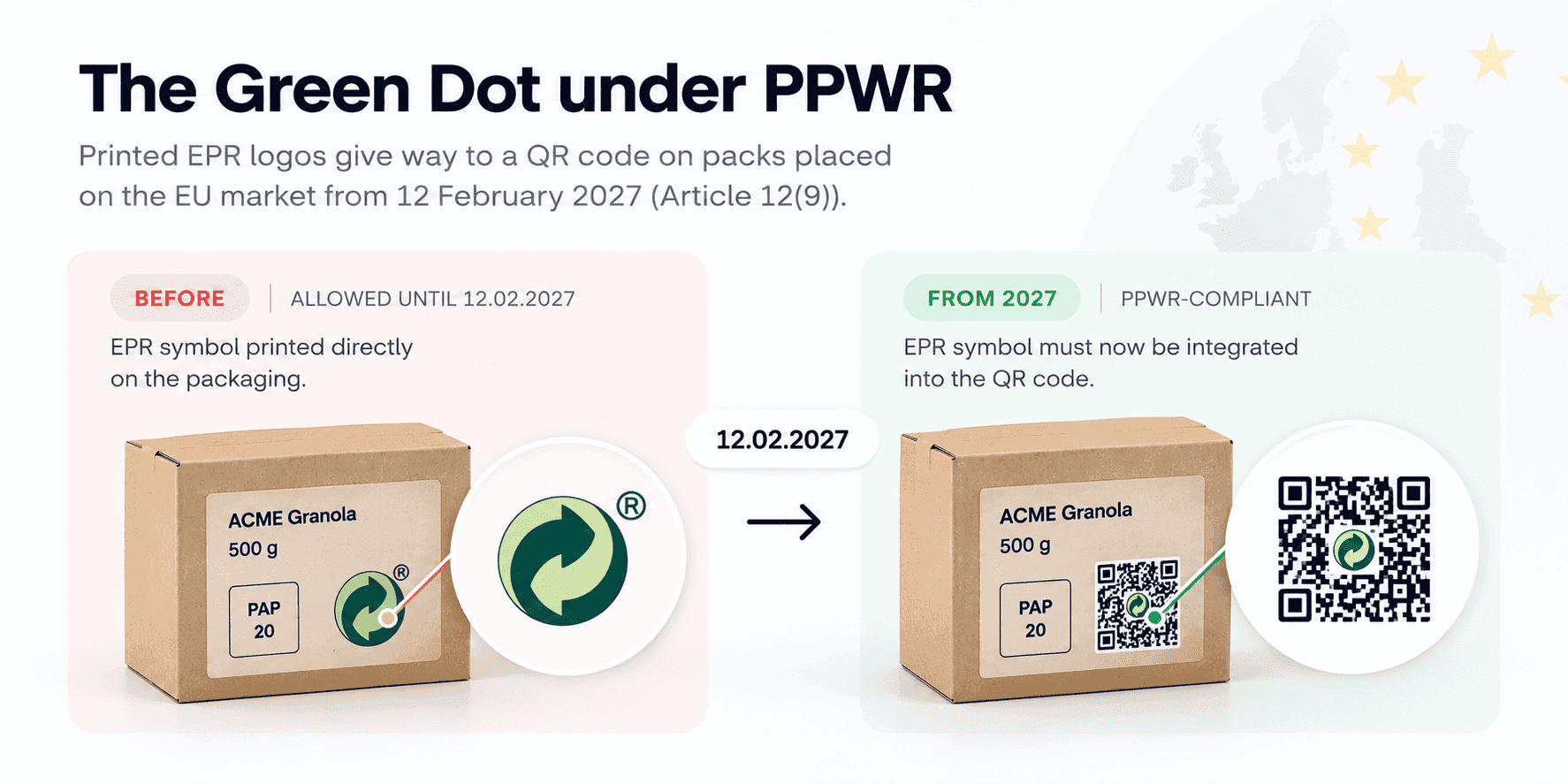
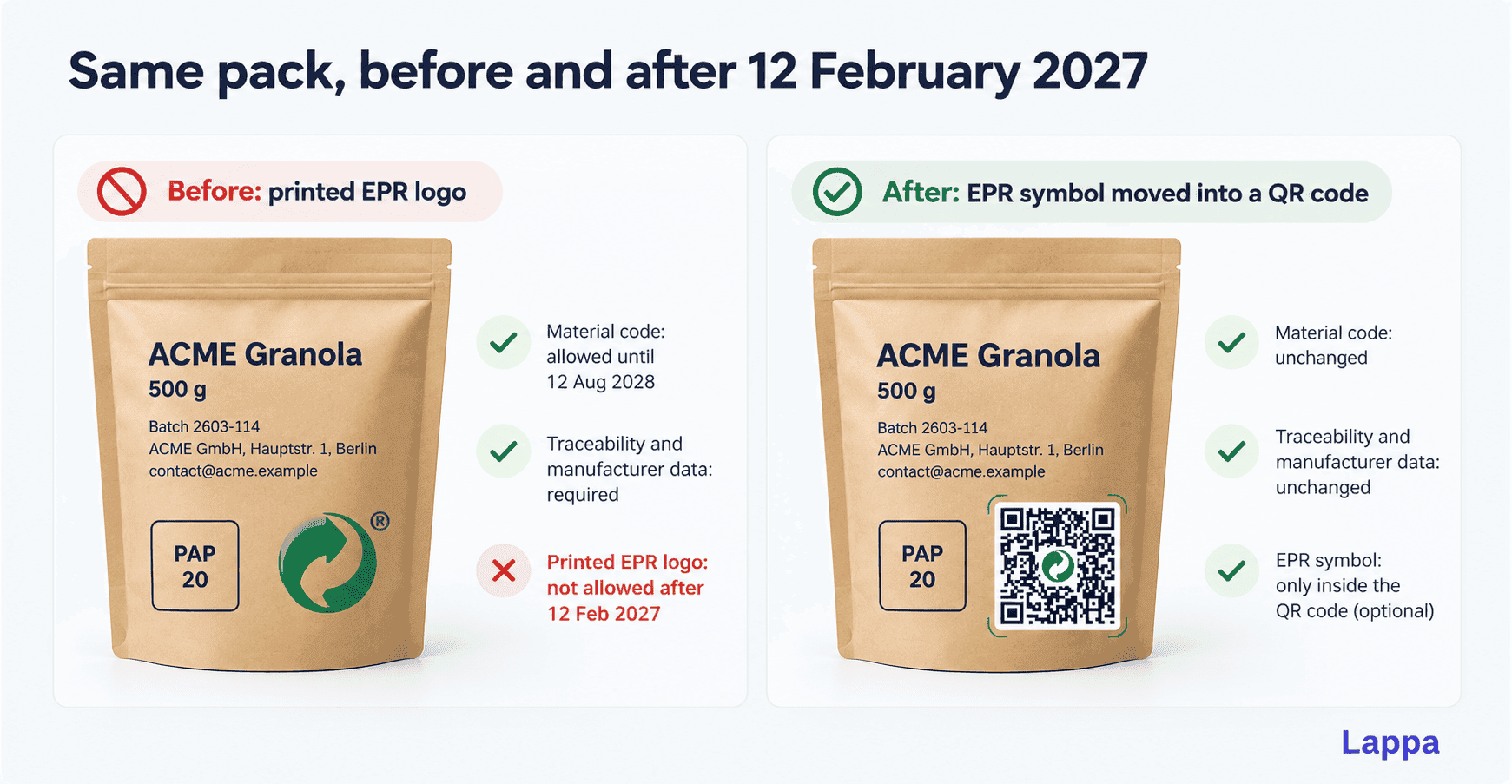
Green Dot 2027 comes down to one rule. From 12 February 2027, the Green Dot and other EPR-scheme logos can no longer be printed on their own on packaging placed on the EU market. Under Article 12(9) of the Packaging and Packaging Waste Regulation (EU) 2025/40, they may only appear inside a QR code or another open digital marking. Showing them stays optional, and the EPR obligations behind them do not change.
The Green Dot has been printed on packs across Europe for more than 30 years, so the change reaches almost every consumer goods brand that sells in the EU.
The date matters for a second reason. 12 February 2027 is also when EU Member States must have national penalties for PPWR breaches in place. The current "warn first" period, which followed the 12 August 2026 go-live, effectively closes.
For a brand selling in one country, this is a small artwork change. For a group with 2,000 SKUs, ten markets and a 4–6 month print cycle, it is a project that should already be running.
The timing is tighter than it looks. Across 1,200 client SKUs Lappa reviewed in Q3 2026, 38% still carried a printed Green Dot or national EPR logo, and an artwork change took 14 weeks on average from brief to first print run. That is almost exactly the time left before 12 February 2027.
Key points for 2027:
- Printed Green Dot and other EPR-scheme logos can no longer stand alone on packaging first placed on the EU market after 12 February 2027.
- You do not have to show an EPR symbol at all. If you do, it must sit in a QR code or similar digital carrier.
- Packaging placed on the market before that date can usually be sold off, but national positions differ.
- EPR schemes disagree on the successor: some back DigiDot, others work with GS1 or advise removing the logo entirely.
- National PPWR penalty rules are due by the same date, and Germany starts fining PPWR breaches from 12 February 2027.
Already planning the switch? Lappa maps every SKU against EPR and PPWR labelling rules in one place. Explore the Packaging Label Manager
Is the Green Dot still required? What Article 12(9) PPWR says
In most EU markets the Green Dot is already a voluntary mark, and from 12 February 2027 it cannot be printed on its own. Article 12(9) of Regulation (EU) 2025/40 allows packaging in an EPR scheme to be identified as such only through a symbol in a QR code or another standardised, open digital-marking technology. The word "only" is what removes the printed logo.
The article never names the Green Dot. It covers any mark that tells the market a producer pays into an extended producer responsibility scheme: Der Grüne Punkt in Germany, the EKO-KOM mark in Czechia, the Green Dot licensed by Fost Plus in Belgium and similar national logos.
Two readings, one practical outcome
Compliance writers split into two camps on how to describe the rule:
|
Reading |
What it says |
Who uses it |
|---|---|---|
|
"It is optional" |
Showing EPR participation is voluntary; Article 12(9) only sets the format if you choose to show it |
Several PPWR legal blogs that push back on "QR code mandatory in 2027" claims |
|
"Printed EPR logos are banned" |
Physical EPR marks can no longer be applied from 12 February 2027 |
European Commission PPWR guidance, as quoted by EKO-KOM, and most national EPR schemes |
Both are correct. Nobody forces you to show an EPR symbol. But if a printed Green Dot sits on a pack placed on the market after the deadline, it breaches Article 12(9). For a brand with the logo on thousands of SKUs, the outcome is the same: the artwork has to change.
What Article 12(9) does not cover
The rule is narrow, which is why it gets confused with other PPWR labelling dates:
- Material codes and recycling symbols (PET 1, PAP 20, the Möbius loop) are not EPR symbols. Material codes under Decision 97/129/EC stay allowed until 12 August 2028.
- National sorting labels such as France's Triman and Italy's environmental labelling are a separate topic. They are expected to give way to the harmonised EU sorting label, which applies from 12 August 2028 at the earliest. See our Triman labelling guide.
- There is no general QR code obligation in 2027. A QR code becomes mandatory for reusable packaging from 12 February 2029 at the earliest.
For the full timeline of PPWR labels, read our guide to PPWR label requirements.
What else changes on 12 February 2027: PPWR penalties and German fines
On 12 February 2027, three things change at once: printed EPR logos are no longer allowed, every Member State must have PPWR penalty rules in place, and Germany starts fining PPWR breaches. Only the first concerns the Green Dot, but all three land on the same brands.
National PPWR penalties are due
Under Article 68, each Member State must lay down penalties for PPWR breaches by 12 February 2027. They must be effective, proportionate and dissuasive, and breaches of the reuse and empty-space rules (Articles 24–29) must carry administrative fines.
Until then, the Commission's second-edition PPWR FAQ (August 2026) sets a warning-first approach. An authority that finds non-compliant packaging must first ask the operator to fix it and give a reasonable timeline. Packaging is not pulled from the market on day one.
Authorities will not switch to fines overnight, but from February the legal basis for them exists in every Member State. A gap found in a 2027 inspection is far more likely to end in a penalty than one found in October 2026.
Germany starts fining PPWR breaches
Germany is the clearest case. Its new Packaging Law Implementation Act (VerpackDG) replaced the VerpackG on 12 August 2026. Breaches of national duties, such as LUCID registration and system participation, can be fined from that day. Breaches of PPWR duties, such as a missing conformity assessment or technical documentation, can be fined only from 12 February 2027.
In practice, any brand selling in Germany has until mid-February to close gaps in Declarations of Conformity, technical files and traceability marking.
The Green Dot rule takes effect
Article 12(9) applies to packaging first placed on the market from the same date. Because artwork changes, supplier approvals and print runs take months, this is the deadline most likely to be missed by accident.
|
Change on 12 February 2027 |
Legal basis |
Who is affected |
|---|---|---|
|
EPR symbols only via QR code or open digital marking |
PPWR Art. 12(9) |
Every brand printing the Green Dot or a national EPR logo |
|
National PPWR penalties in place |
PPWR Art. 68 |
All producers, manufacturers and importers in the EU |
|
Fines for PPWR breaches in Germany |
VerpackDG § 66(2), § 68(17) |
Anyone placing packaged goods on the German market |
Not sure which of your markets will fine first? Lappa tracks EPR and PPWR obligations country by country on one dashboard. See EPR & PPWR software
Green Dot rules by country: what EPR schemes are telling producers
PPWR sets one rule for the whole EU, but the schemes that own or license EPR logos are reacting in different ways. A single artwork decision now has to work across markets that point in opposite directions.
|
Country |
Scheme |
Position on the Green Dot from 12 February 2027 |
|---|---|---|
|
Austria |
ARA |
The Green Dot may only be used inside a QR code, for example through DigiDot |
|
Belgium |
Fost Plus |
Members may use the logo until 12 February 2027. Fost Plus will not license DigiDot and is working with GS1 instead |
|
Czechia |
EKO-KOM |
Remove the Green Dot and the EKO-KOM mark from packaging by February 2027; stock placed on the market earlier can be sold off |
|
Luxembourg |
Valorlux |
Printed symbol allowed until 12 February 2027, then recommends DigiDot |
|
Netherlands |
Verpact |
Has advised producers against the Green Dot and recommended removing it by 12 February 2027 |
|
France |
Citeo |
Green Dot voluntary since 2017. A planned penalty for using it was annulled by the Conseil d'État in 2023. Article 12(9) now applies on top. Triman remains a separate obligation |
|
Germany |
Dual systems |
Printed Green Dot not allowed from 12 February 2027 on the Commission's reading; DigiDot was developed by Der Grüne Punkt as the digital successor |
|
Spain and Italy |
Ecoembes, CONAI |
PRO Europe material states that QR codes can already replace printed national logos on international packaging in these markets. No scheme statement on the Green Dot after 12 February 2027 published yet |
For a brand selling in several of these markets, this means:
- There is no single successor. A DigiDot that works in Austria or Luxembourg has no backing from Fost Plus in Belgium. If you need one EU-wide pack, the safest default is to remove the printed logo rather than swap it for a scheme-specific QR code.
- Removing the logo does not remove the obligation. The Green Dot only ever showed that you pay into a scheme. Your duty to register and report in each country stays the same. See how to manage packaging EPR across multiple EU countries.
Guidance is still being issued, so confirm the current position of each scheme you belong to, including Ecoembes, CONAI and the Polish schemes, before you sign off artwork.
Selling into several markets with different scheme rules? Lappa handles EPR registration and reporting across 40+ countries from one account.
What happens to packaging already printed with the Green Dot
Packaging that is placed on the EU market before 12 February 2027 can generally stay on sale. The Czech Ministry of the Environment states that Article 12(9) applies to packaging placed on the market for the first time after that date, and EKO-KOM cites the Commission's PPWR guidance in support.
The key phrase is "placed on the market", not "printed" or "produced". Under EU product law, a unit is placed on the market when it is first supplied for distribution in the EU. This creates a trap for large brands:
- Goods already supplied to an EU distributor or retailer before the deadline can generally be sold through.
- Finished goods held in a non-EU factory or bonded warehouse are not on the EU market until they are released for free circulation, so they fall under the new rule if released after 12 February 2027.
- Printed packaging sitting with you or your packer, not yet filled, is the grey zone. Whether it already counts as placed on the market depends on who supplied it and where. Treat it as at risk until your scheme or legal adviser confirms otherwise.
The Commission's August 2026 FAQ adds a related point for the August deadline: packaging produced before 12 August 2026 but not yet placed on the market does not need to be destroyed or re-labelled for traceability, as an accompanying document can carry that data. No equivalent relief has been published for Article 12(9) yet, so do not assume it.
Three questions to settle with your supply chain now
- How many printed Green Dot units (packaging and finished goods) will still be outside the EU market on 12 February 2027?
- Can those volumes be shipped and supplied to EU customers before the date, or should the next print run already drop the logo?
- Do any co-packers, contract manufacturers or private-label suppliers print the logo on your behalf? Their stock counts as yours.
Because sell-off positions are national, confirm them with the scheme in each market where you hold large stock.
Green Dot QR code options: DigiDot, GS1 or no EPR symbol at all
If you want to keep showing EPR participation, you need a QR code or another open digital carrier. Three routes are on the table.
|
Option |
What it is |
Works well for |
Watch out for |
|---|---|---|---|
|
DigiDot |
The digital Green Dot from Der Grüne Punkt and PRO Europe. One QR code leads to local sorting guidance in the user's language |
Brands that value Green Dot recognition and sell mostly in markets whose schemes support it |
Not licensed by every scheme; in Belgium, members must sign with PRO Europe directly. The code stops working if the DigiDot contract ends |
|
GS1-based QR code |
A QR code built on the GS1 standard that many brands already use for product data |
Groups that already run GS1 barcodes and want one code for product, EPR and future PPWR data |
Scheme-specific EPR symbol content is still being defined |
|
No EPR symbol |
Drop the logo, keep the obligation |
Multi-market brands that want one EU-wide pack |
Some retailers or B2B customers may still ask for proof of scheme membership in documents |
The DigiDot lock-in risk most guides miss
A DigiDot QR code only works while you hold a valid contract. According to Der Grüne Punkt's own DigiDot FAQ, the code is deactivated if the contract expires without renewal or is terminated. Packs already in circulation would then lead consumers to a dead link.
For a brand with long-life products or large printed stock, that turns a labelling choice into a supplier dependency. Before you print a scheme-owned code, check three things: who controls the URL behind it, what happens to printed packs if you switch scheme, and whether your own domain or a GS1-based code could carry the same EPR symbol.
Whichever route you pick, plan for one code that will carry more over time. From 12 August 2028 at the earliest, harmonised sorting labels arrive, and reusable packaging needs a digital data carrier from 12 February 2029. A QR code you design now should be able to point to that information later, rather than adding a second code to the pack.
Also keep the QR code separate from claims. Article 12(8) bans markings that could mislead consumers about packaging, and Article 14 restricts environmental claims. A QR code that says "recyclable" without the evidence behind it creates a new risk.
Need a QR-ready label without rebuilding artwork from scratch? Lappa generates digital compliance labels linked to your packaging data.
A 15-week Green Dot action plan for multi-market brands
There are about 15 weeks between late October 2026 and 12 February 2027. For a portfolio with a 3–6 month artwork and print cycle, that is just enough if the work starts now.
- Weeks 1–2: inventory every EPR symbol. List each SKU, pack level (sales, grouped, transport) and market, and flag every printed Green Dot or national EPR logo. Include private-label and co-packed lines.
- Weeks 2–3: map scheme positions per market. Record what each scheme you belong to says about the logo, DigiDot and sell-off. Use the country table above as a starting point.
- Week 3: choose your route. Decide between removing the symbol, DigiDot or a GS1-based QR code. For one EU-wide pack, removal is usually the lowest-risk default.
- Weeks 3–6: prioritise SKUs. Rank by volume, number of markets and the date of the next print run. SKUs printing after January 2027 must be fixed first.
- Weeks 4–10: update artwork in batches. Remove or replace the logo, and use the same change to check traceability marking, manufacturer details and any misleading claims under Article 12(8).
- Weeks 6–12: brief suppliers. Send updated artwork and a written instruction to every printer, co-packer and private-label supplier. Ask for confirmation of their stock levels.
- Weeks 10–14: plan the sell-off. Move remaining Green Dot stock onto the EU market before the date where possible, and document when each batch was placed on the market.
- Weeks 12–15: close PPWR documentation gaps. Penalties follow on the same date, so check Declarations of Conformity, technical files and EPR registrations for every market, starting with Germany.
Do not treat this as a design project alone. Compliance, procurement, packaging development and marketing all touch the same artwork. Give one owner the deadline and the SKU list.
Want the SKU inventory done for you? Lappa's team maps your packaging portfolio against EPR and PPWR labelling rules and flags which SKUs to fix first. Book a demo
How Lappa helps brands get Green Dot and PPWR labelling right
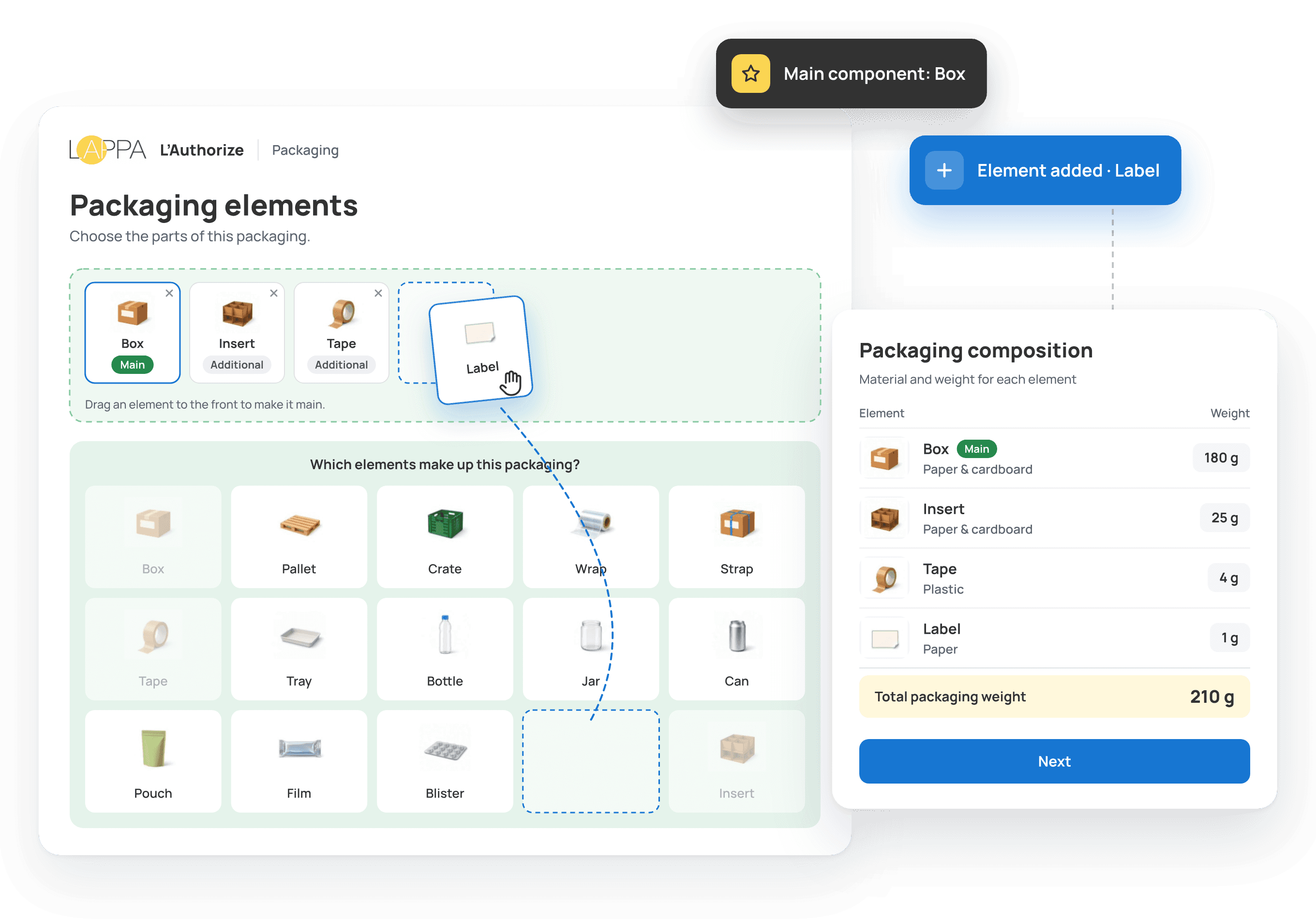
The Green Dot change looks like a logo swap, but it touches every market, scheme and SKU you sell. Lappa connects the three in one platform.
- Packaging Label Manager keeps material data, EPR symbols and artwork versions per SKU, so you can see in one view which packs still carry a printed EPR logo.
- Digital compliance labels generate QR-ready labels from your packaging data, ready for future PPWR sorting and reuse information.
- PPWR labelling services cover traceability marking, manufacturer details and Declarations of Conformity alongside EPR labels.
- Multi-country EPR registration and reporting keeps your obligations covered after the logo is gone. Timing matters: in Lappa's Q3 2026 data, EPR registration took anywhere from 2 days to 6 months depending on the country.
- Non-EU brands can appoint Lappa as their EU authorised representative for packaging.
Generate your PPWR-ready label in minutes Traceability, material codes and digital EPR marking in one workflow. Sign up now or watch a video
Frequently Asked Questions
The Green Dot shows that the company behind a product has paid into a packaging recovery scheme in at least one country. It is a financing symbol, not a recycling symbol. It says nothing about whether the pack itself can be recycled or which bin it belongs in, which is why many consumers misread it.