


PPWR Label Requirements and EU Packaging Labelling Rules
Two years from now, a carton leaving your warehouse will need to say a lot more than it does today. PPWR labelling converts an ordinary wrapper into a document customs and retailers can inspect. Regulation (EU) 2025/40 spells out precisely what has to sit on that surface, field by field, and by which date. Retailer audits and border checks already scan for the earliest wave of these markings. Below sits every stage of that schedule, the specific fields each phase demands, and the way it feeds back into genuinely circular packaging rather than a cosmetic pictogram swap.
The PPWR labelling timeline
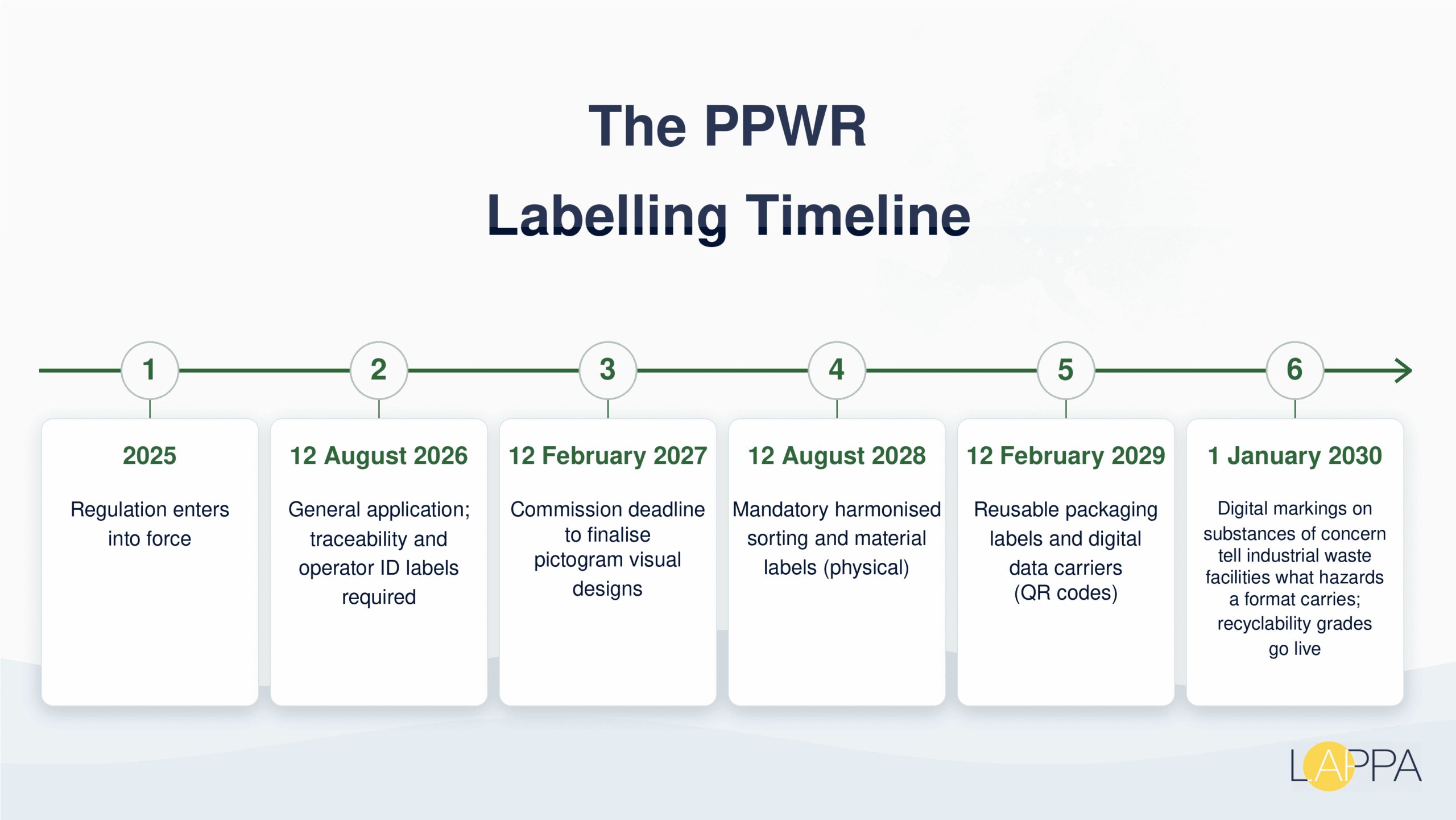
One harmonised system now sits where 27 separate national packaging label schemes used to operate. Treating the packaging labelling requirements as a single cutover date is the mistake almost every team makes first, because the rollout unfolds in stages, with a handful of dates pinned to implementing acts the Commission has not yet signed off.
- 2025: the regulation enters into force
- 12 August 2026: general application; traceability and operator ID labels required
- 12 February 2027: deadline for the Commission to finalise pictogram visual designs
- 12 August 2028: mandatory harmonised sorting and material labels (physical)
- 12 February 2029: reusable packaging labels and digital data carriers (QR codes)
- 1 January 2030: digital markings on substances of concern tell industrial waste facilities what hazards a format carries, and recyclability grades go live
Nothing gets pulled off shelves the moment a deadline passes. Stock already placed on the market before a given date usually keeps a three-year sell-through window. Freshly produced goods do not get that grace; they must match the rule in force from the day they are made.
What PPWR labelling means under regulation (EU) 2025/40
Regulation (EU) 2025/40 became law on 11 February 2025, and its main provisions turned generally applicable on 12 August 2026, closing out the older packaging directive for good. A PPWR label is really shorthand for several duties scattered through Article 12, Article 15 and Article 18, not a single sticker you design once. Labels, waste marking and environmental claims sit in Chapter III, while manufacturer and importer duties sit in Chapter IV. Since the regulation binds every member state without local transposition, the same packaging labelling requirements govern a shipment leaving Hamburg and one leaving Lisbon. Wedged between the first two milestones is a design finalisation window: by 12 February 2027, Brussels has to publish exact visual rules and a methodology for the sorting icons, and nothing gets printed until that piece lands.
Traceability and operator identification from August 2026
Starting 12 August 2026, every unit needs a type, batch or serial number that lets it be traced back through the supply chain. Consumer-facing sorting icons are not yet part of the deal at this point, though border agents already look for this identity data during customs checks. Traceability is the layer everything else in the system leans on. Skip it, and a recall or a contamination finding has no production run to point back to. Manufacturer and importer name, trade name and postal address need to show up too, either printed directly or reachable through a linked digital carrier. That data sits beside the declaration of conformity, not in place of it; the two work as a pair.
Declaration of Conformity Packaging Requirements
Printing a correct label solves only half the problem: paperwork still has to accompany the goods, or a shipment simply will not clear an EU border. Every format placed on the EU market needs an EU Declaration of Conformity drawn up under Annex VIII, and legal teams should have this drafted well before goods travel, not scrambled together at the last checkpoint. A declaration of conformity packaging file states, in legal terms, that a given format meets the essential requirements set for it. Market surveillance bodies can ask to see it at any moment, and importers are on the hook for confirming one exists before customs releases anything. A properly built declaration of conformity packaging record usually contains:
- Identification of the format, including type, model and batch reference
- Name and address of the manufacturer or authorised representative
- The harmonised standards or technical specifications applied
- Confirmation, backed by a technical file kept under Article 11, that heavy metal limits (lead, cadmium, mercury, hexavalent chromium) and restricted PFAS thresholds have not been exceeded
Companies without a physical EU footprint usually hand this file to an authorised representative to hold and keep current. Non-EU manufacturers need an EU Authorised Representative for packaging under the PPWR. See how Lappa’s AR service works.
Harmonised sorting pictograms and material composition codes
Every consumer-facing format has to carry a harmonised sorting label once 12 August 2028 arrives, telling shoppers exactly which stream a component belongs to, paper, plastic or glass among them. Draft pictogram designs have already been through consumer testing at the Commission’s Joint Research Centre, replacing national text codes with icons, so a shopper in Warsaw sees the same symbol a shopper in Lisbon does for identical material. Country-specific marks, France’s Triman logo among them along with Italy’s decree-based scheme, are due to vanish once the unified layout takes hold; Brussels has already launched infringement proceedings against Paris over keeping its own national mark going. Transport and industrial formats keep their exemption from this consumer pictogram, unless the same box ends up used for e-commerce delivery.
Recyclability label requirements and the grading scale
Recyclability drives much of this framework, and it eventually lands on the printed surface too. A recyclability label hooks into a scale that sorts formats into grade A, B or C. Fall short of grade C, and market access is at risk from 2030 onward; this eco-modulation link also feeds directly into Extended Producer Responsibility fee schedules, since national schemes tend to charge less for a higher grade. A poor recyclability label score raises per-unit cost long before any regulator issues a fine. Rigid plastic, bottles and trays especially, usually clears grade A or B without a heavy redesign. Flexible multi-layer film stays the tougher case, mostly because sorting infrastructure for that material remains patchy across the bloc.
Recycled content and biobased plastic labels
A voluntary mark showing the share of recycled content inside a plastic component becomes possible under Article 12(4) once the Commission finalises its specification. Expect many brands to adopt it early, as a marketing signal, well before the 2030 threshold takes hold; PET contact-sensitive formats face a 30% floor by that date, climbing again in 2035 and 2040 for other plastic categories. A separate, still voluntary, mark can flag biobased content. The realistic starting point is getting suppliers to declare recycled content by weight rather than by unverified claim.
Reusable packaging labels and the digital product passport
Reusable formats get their own label from 12 February 2029, one that signals the item belongs to a formal circular reuse loop rather than a single-use stream. Collection point locations and trip counts live behind a QR code or another open digital carrier, which lines up with the Digital Product Passport approach the EU is rolling out across several product categories. A digital product record rides alongside the item instead of replacing what’s printed on it; units that fall below the minimum printable surface threshold can skip the physical sorting icon altogether and rely on that QR code instead, though core identity data still needs to stay on the physical item itself.
Comparing PPWR label types side by side
| Label type | Mandatory from | Main purpose | Physical or digital |
| Traceability and operator ID | 12 Aug 2026 | Identify manufacturer, batch, importer | Physical, or accompanying document |
| Harmonised sorting pictogram | 12 Aug 2028 | Guide consumer waste sorting | Physical |
| Recyclability grade reference | From 2030 | Show recyclability (A, B or C), tied to EPR fees | Physical or digital |
| Reusable packaging label | 12 Feb 2029 | Flag items designed for reuse | Physical, plus QR code |
| Substances of concern marking | From 2030 | Disclose regulated substances | Digital carrier only |
Example label content for a shipping carton
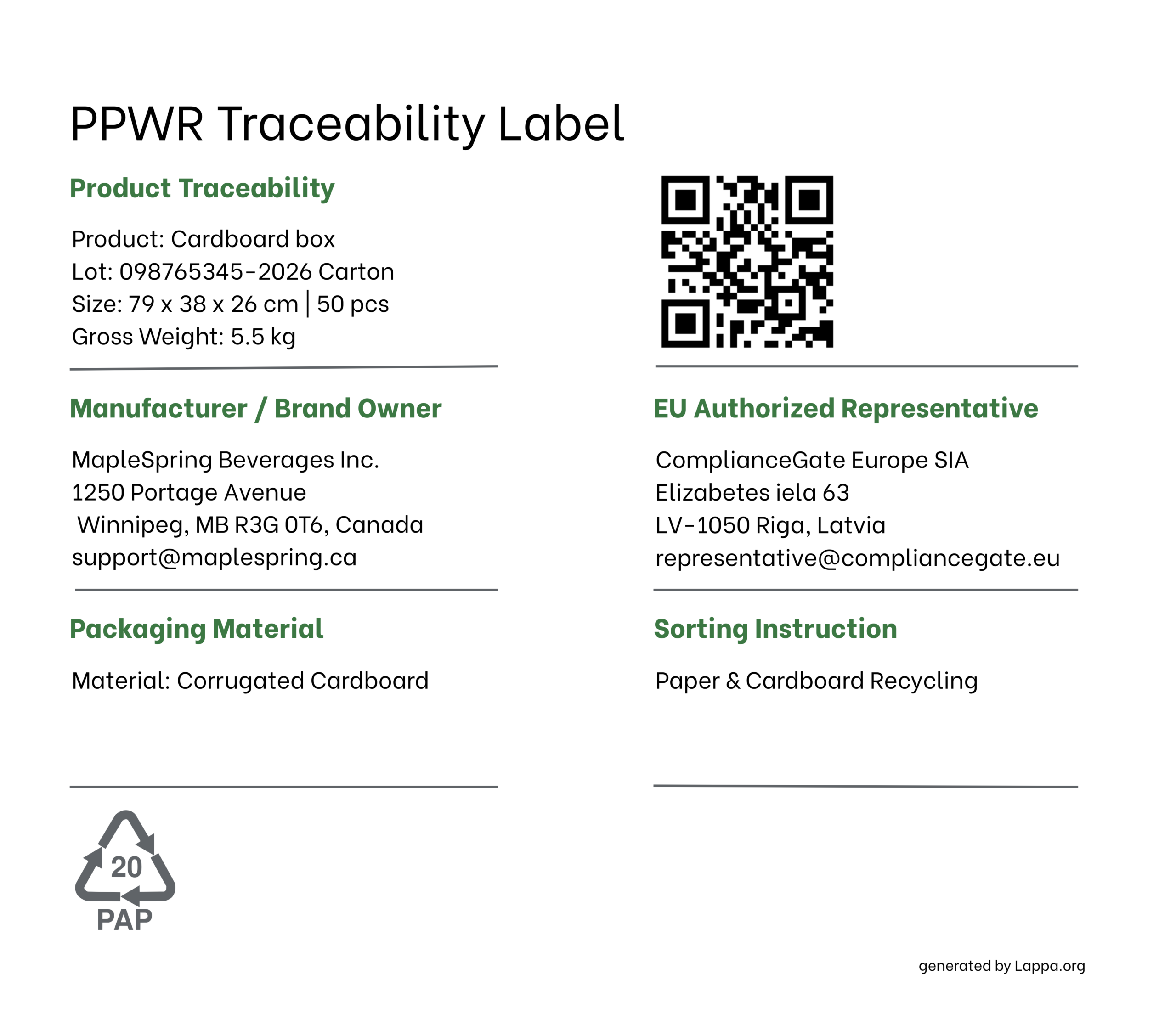
Fifty water bottles moving in one shipment show how these fields actually stack up in practice.
| Label field | Outer carton (from 12 Aug 2026) | Inner poly bag (from 12 Aug 2026) |
| Product and batch data | Water Bottles, batch/lot 098765345-2026, carton 79x38x26cm, 50 pcs, gross weight 5.5 kgs | Water Bottles (inner pack), batch/lot 000987670-2026 |
| Manufacturer | Full legal brand name plus registered street address and a monitored support inbox | Same manufacturer block, repeated on the inner unit so it survives if the outer box is discarded first |
| EU Authorised Representative | Only needed once the brand owner sits outside the EU | Same rule carries over to the inner unit |
| Material label (mandatory by Aug 2028) | Corrugated Cardboard, recycling code, paper and cardboard sorting instruction | Low-Density Polyethylene, recycling code, plastic sorting instruction |
Map the outer and inner levels back to a single product record, or batch numbers start to drift out of sync further down the chain.
Generate your PPWR-compliant label in minutes
Traceability, material codes and batch data — done for you

Building a packaging artwork workflow that survives audits
Every one of the deadlines above eventually ends up on the same desk, whoever happens to own packaging artwork. A packaging artwork process built to scale tends to follow a loop closer to this than a straight line:
- Lock down which fields apply to this specific tier, since a sales unit, a grouped case and a transport pallet do not share the same rulebook
- Pull recyclability and material figures from suppliers first, well before anyone opens a design file
- Leave open placeholders for each language market, then send the draft through a compliance pass measured against Article 12
- Freeze one master template, so the next regulatory tweak means editing a single source file instead of chasing dozens of regional copies
Treat artwork as a pure design exercise, and a single delegated act rewriting a pictogram detail forces a redo of everything.
Managing packaging artwork across multiple EU markets? Lappa’s Packaging Label Manager keeps material data, recyclability status and artwork versions in one place. Explore the Packaging Label Manager.
Environmental claims and article 14 risks
Under Article 14, an environmental claim only stands if it goes beyond the regulation’s own minimum floor and can be backed by the required methodology behind it. It also has to be specific about scope, the whole item versus one component alone. Article 12(8) separately outlaws marks that could mislead a shopper about sustainability, and several unofficial recycling symbols sit uncomfortably close to that line. This sits inside wider packaging compliance risk, since greenwashing claims remain a stated enforcement priority for consumer protection regulators.
Manufacturer and importer obligations
Packaging compliance duties never rest on manufacturers alone; importers pick up a parallel set the moment goods cross into the EU:
- Manufacturers ensure batch data, corporate details and a Declaration of Conformity exist before shipping
- Importers verify manufacturer labelling under Article 12 before customs clearance
- Importers add their own name, address and electronic contact point
- Distributors check for obvious gaps before listing a format
Let a gap slip through at any one of those stages, and a shipment can sit at the border regardless of whose mistake caused it.
Circular packaging and where companies still get this wrong
None of this exists purely to satisfy a checklist. The point behind it is circular packaging: material genuinely collected, sorted and turned back into new packaging at scale. Getting PPWR labelling right early spares a business from costly artwork redesigns later on. As Olga Maksimova, founder and CEO of Lappa, puts it: “The circular economy doesn’t start at the bin.” A label only earns its keep if the material and recyclability data behind it was captured correctly at the design stage, rather than patched in the week before a deadline.
The same handful of gaps keeps showing up across compliance reviews: waiting on final pictogram artwork before starting supplier data collection, treating a Declaration of Conformity like static paperwork instead of a living file, and assuming a QR code can stand in for every printed field. Lappa’s platform pulls material classification, recyclability status, Declaration of Conformity drafting and batch code generation into one system, so a single change updates every linked record instead of a dozen separate files.
With Lappa’s L’Autorize platform, you can generate digital labels, draft Declarations of Conformity and manage dynamic batch codes for EU packaging. Sign up or watch a video
Frequently Asked Questions


When do PPWR labelling requirements start applying to my packaging
Traceability and operator identification turned mandatory on 12 August 2026, sitting alongside the Declaration of Conformity obligation. Harmonised sorting pictograms and material codes come into force from 12 August 2028, though the precise date rides on the Commission’s implementing act. Reusable packaging labels and QR code data carriers arrive roughly six months after that, around February 2029.
Does a QR code replace printed packaging labels under PPWR
No, a QR code adds to the physical label rather than standing in for it. Manufacturer identity and batch data still need to be printed or otherwise permanently fixed to the item itself. Digital carriers mostly carry extended digital product detail, sorting instructions per component being one example, that would never fit on a small surface anyway.
What must a declaration of conformity for packaging include
It has to identify the format and point back to the technical file kept under Article 11. It should list exactly which harmonised standards or specifications were used to demonstrate compliance. Manufacturer or representative details also need to be there, since authorities and importers lean on that record before a shipment can move further down the chain.
How does a recyclability label affect Extended Producer Responsibility fees
National EPR schemes already tie fee rates to a format’s recyclability grade in several member states, a link that should tighten further once the A, B or C scale turns binding from 2030. A format graded highly tends to attract a lower per-unit fee, while a weaker one costs more to place on the market. That is precisely why recyclability assessment work belongs early in the process, not squeezed in as a last-minute artwork fix.
Are small businesses exempt from PPWR packaging labelling requirements
Nothing in the regulation carves out an exemption based on company size. Any business placing goods on the EU market, whatever its turnover or headcount, has to meet the same core obligations a large multinational does. Narrower exemptions do exist, but they hinge on packaging type, transport or industrial formats kept out of e-commerce, rather than how big the company behind them happens to be.
What happens if my packaging is not labelled correctly by the deadline
Customs can stop non-compliant goods right at the EU border, or a national surveillance authority can pull them from the market after the fact. Fines get set at national level rather than centrally, so the financial hit differs from one member state to the next. Repeated slip-ups also tend to damage a brand’s standing with retailers and marketplaces, many of which now run their own packaging checks before a product goes live.
How can Lappa help with PPWR labelling and packaging compliance
Lappa’s platform brings material classification, recyclability data, Declaration of Conformity drafting and label generation together in one workspace built specifically around EU packaging rules. It cuts down the manual back-and-forth between compliance, design and procurement teams every time a detail shifts. Businesses already running EPR registration and reporting through Lappa can extend that same underlying data straight into their labelling and artwork process.

