

Behind on PPWR What Businesses Should Do Now
The PPWR application date has come and gone. Regulation (EU) 2025/40 became binding on 12 August 2026. It replaced the old Packaging Directive outright. No national transposition was required. Some obligations already carry real weight for exporters. Others are still years away, despite the headlines. This guide sorts the two apart. It focuses on packaging waste compliance that matters today.
Packaging waste rules already in force under PPWR
Regulation 2025/40 did not wait for delegated acts to start biting. Several duties became binding the moment it applied. Food-contact packaging now faces hard PFAS limits. A single PFAS above 25 parts per billion is banned outright. The combined threshold sits at 250 parts per billion. Polymeric PFAS faces a separate 50 parts-per-million cap.
Every packaging format on the EU market needs a Declaration of Conformity. That document must exist per format, not per shipment. It confirms the packaging meets current essential requirements. Supporting technical documentation must back up any PFAS or heavy-metal claim.
Minimising packaging weight and volume is not a future duty. That duty was carried over from the outgoing Directive. It stays active until the end of 2029. PPWR’s transitional rules keep it alive that long. A fixed empty-space percentage gets mentioned constantly online. The common claim is 40% from August 2026. That figure is outdated. The real cap is 50%, starting 1 January 2030 at the earliest. A calculation methodology has to be finalised first.
The revised manufacturer definition also took effect immediately. It widens who counts as a producer under EPR. Some companies assumed a distributor carried these packaging waste obligations. That assumption is worth checking again.
Not sure whether your business needs to register? Check PPWR Registration requirements with Lappa.
Waste packaging regulations businesses must track now
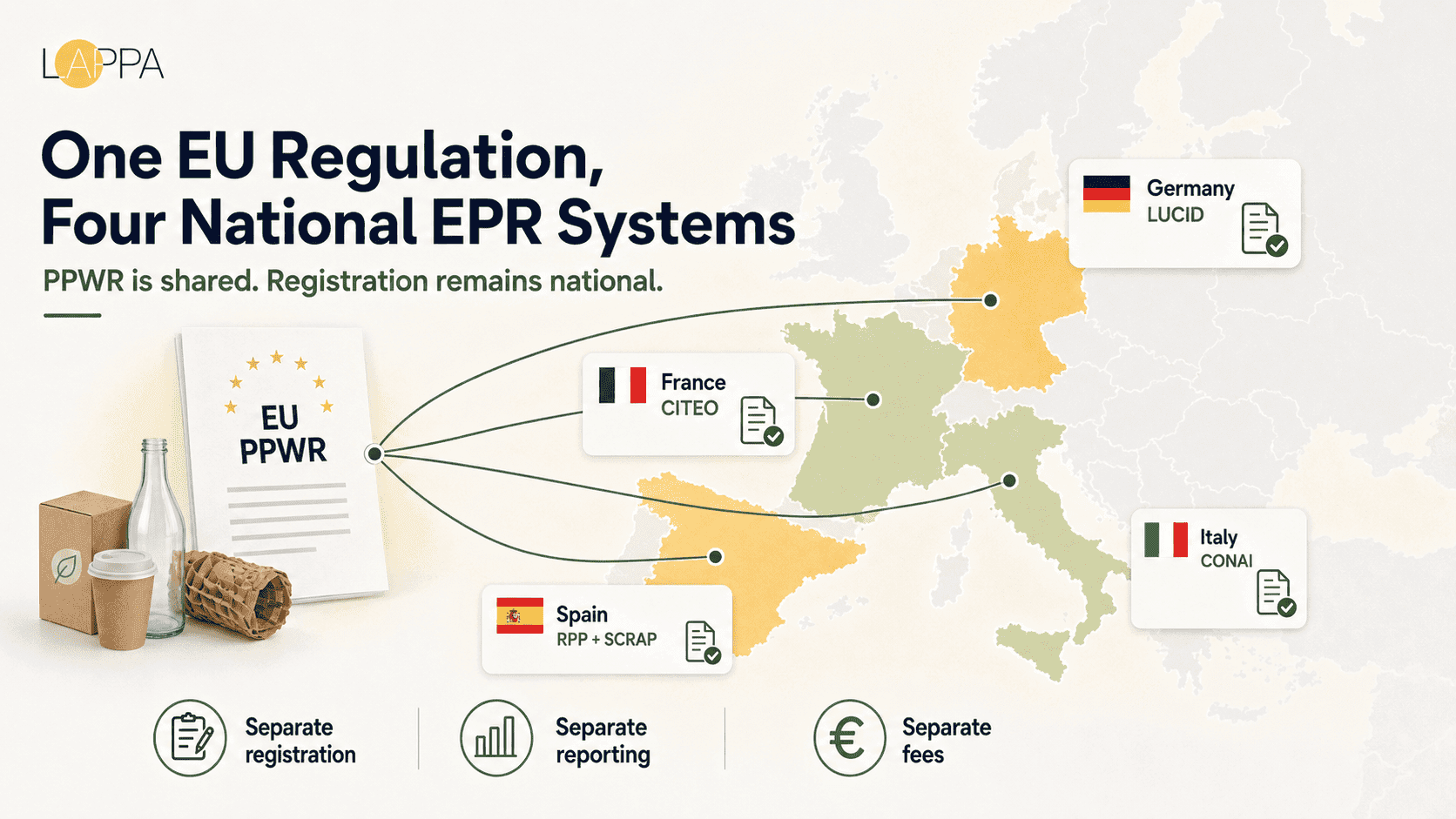
National EPR schemes never went away under the PPWR. Each EU member state still enforces its own waste packaging regulations. These sit alongside the broader PPWR framework. Germany, France, Italy, and Spain all require separate registration. Each follows its own timeline and format.
Germany channels producers through the LUCID register. Reporting there runs down to sub-material level. France routes tonnage through CITEO instead. Declarations go by component, not finished weight. Spain requires RPP registration plus SCRAP membership, most often through Ecoembes. Italy runs its system through CONAI, which federates six material-specific consortia. National waste packaging regulation requirements rarely align. They rarely share a single data format either.
A company selling into six EU markets often misses one registration. Getting waste packaging regulations wrong is rarely a small problem. Usually a local distributor handled market entry originally. EPR was simply never written into that arrangement. That gap becomes a real liability once authorities check.
Non-EU businesses face an added layer on top. They may need an EU Authorised Representative for EPR. A Commission proposal would delay part of this until 2035. That proposal has not become law yet. Treat it as pending, not adopted.
Selling into several EU countries without local registration? See how Lappa’s EU Authorised Representative service works.
Packaging waste regulations and upcoming deadlines
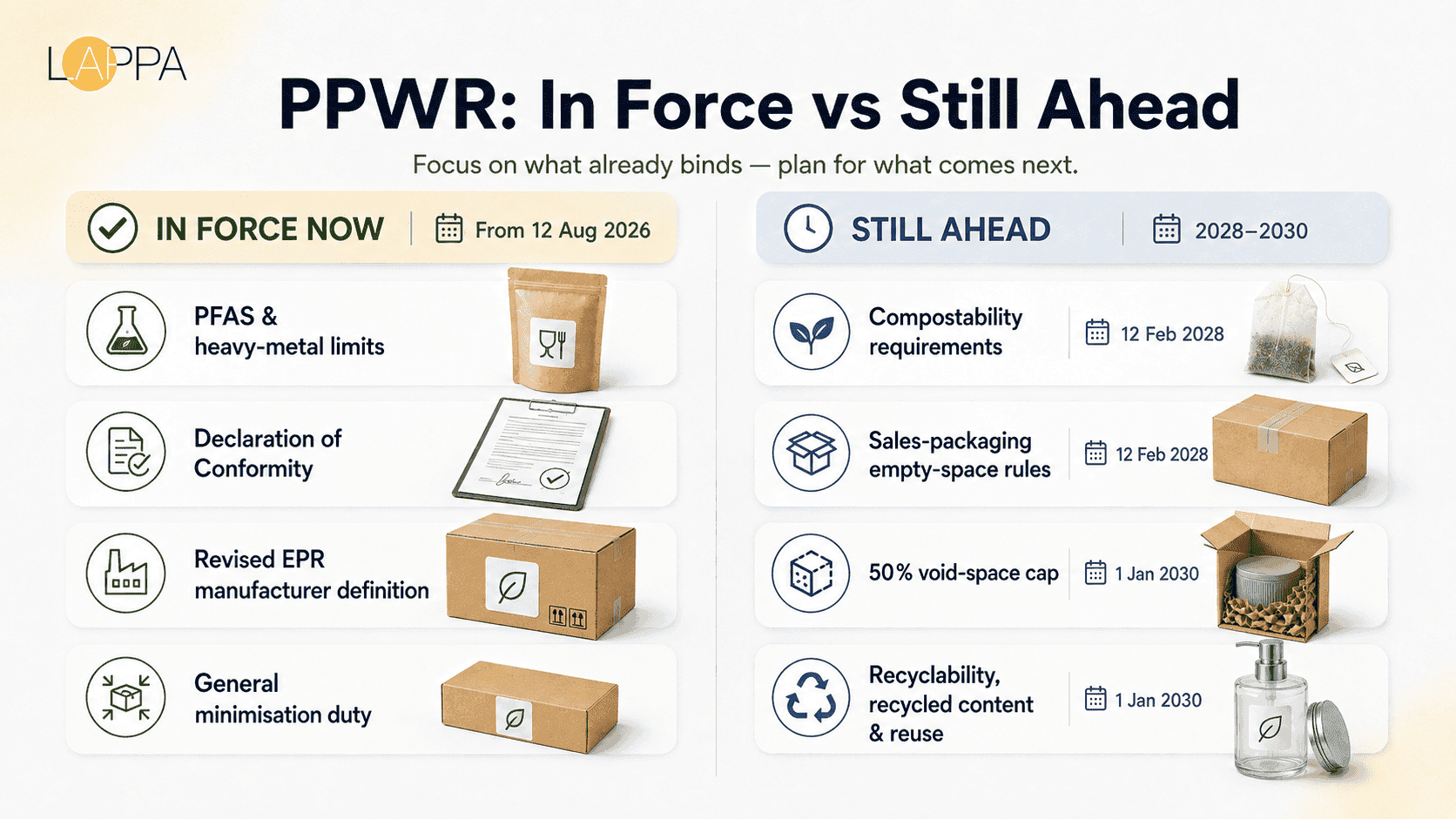
Not every PPWR duty started on 12 August 2026. Some packaging waste regulations phase in gradually. Others arrive years after the general application date. Confusing the two is a common, costly mistake.
The comparison below separates current rules from future ones.
|
Requirement |
Status as of August 2026 |
Applicable From |
|
PFAS and heavy-metal limits (food-contact packaging) |
Already applies |
12 August 2026 |
|
Declaration of Conformity per packaging format |
Already applies |
12 August 2026 |
|
Revised EPR manufacturer definition |
Already applies |
12 August 2026 |
|
General packaging minimisation duty (functional minimum) |
Applies now, transitional |
Until 31 December 2029 |
|
Compostability for tea bags, fruit stickers, and similar items |
Not yet mandatory |
12 February 2028 |
|
Empty-space reduction for sales packaging (documented, no fixed %) |
Not yet mandatory |
12 February 2028 |
|
50% empty-space cap for e-commerce, transport, grouped packaging |
Not yet mandatory |
1 January 2030 (earliest) |
|
Recyclability grading (A-E) and minimum recycled content |
Not yet mandatory |
1 January 2030 |
|
First wave of reuse targets |
Not yet mandatory |
1 January 2030 |
|
Harmonised labelling and pictograms |
Delayed, acts pending |
Expected 2028 or later |
The 40% empty-space figure still circulates widely online. It is simply outdated at this point. Article 24 sets the actual cap at 50%. That cap only starts on 1 January 2030. A calculation methodology must be finalised first. Until then, only a general minimisation standard applies.
Harmonised pictogram design missed its own deadline too. An implementing act was due before 12 August 2026. That act has now slipped past its date. A draft is expected later this year.
Packaging waste regulations across the EU rarely stay fixed. Energy is better spent on obligations that already bind. These packaging-waste regulation shifts still reward early planning. Late scrambling rarely produces the same result.
Packaging and waste compliance actions for companies
Good packaging and waste compliance starts with a short checklist. Waiting for total certainty is not a strategy. Enforcement is already underway across several member states.
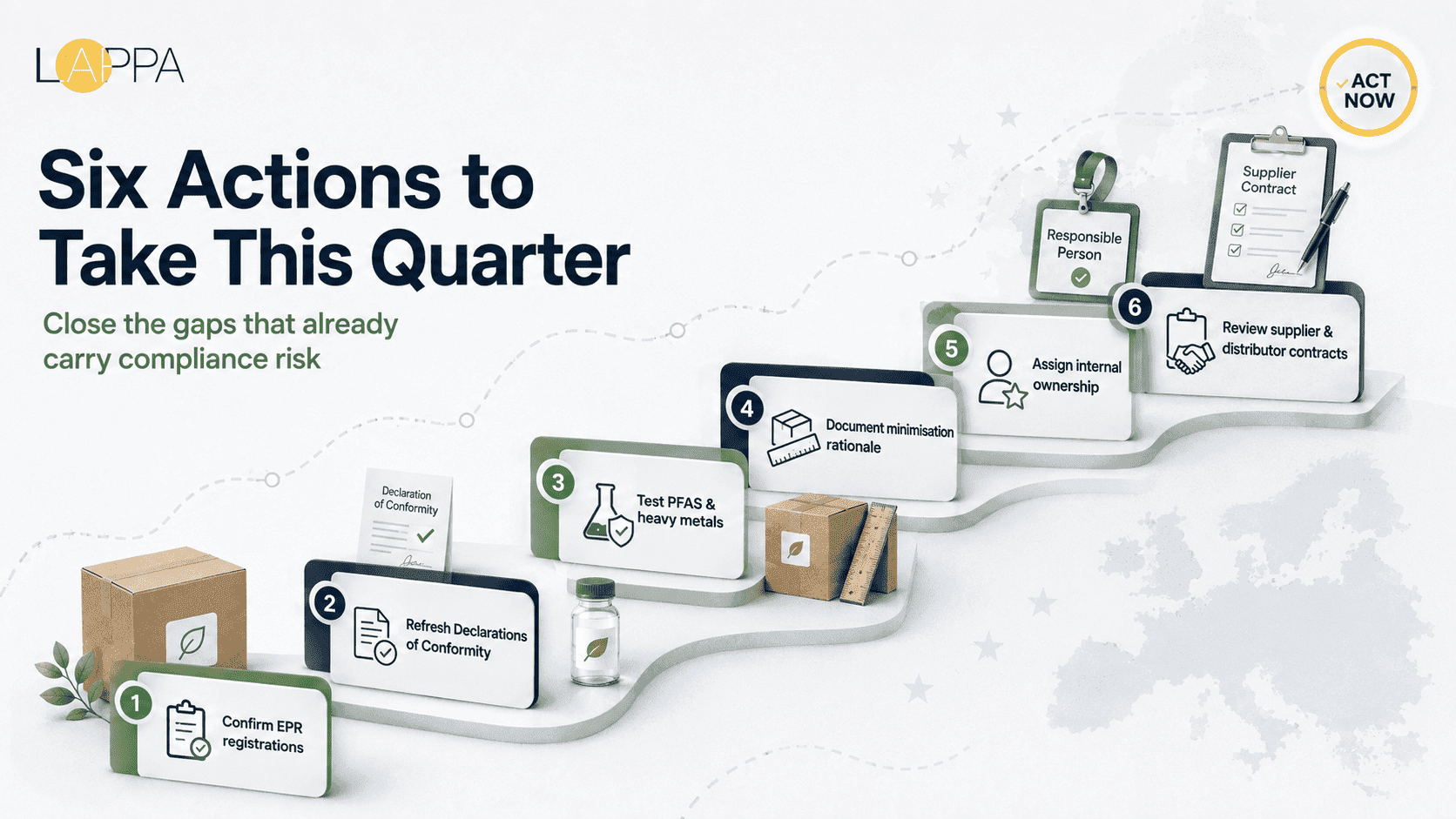
This quarter’s priority list:
- Confirm EPR registration status in every market sold into.
- Draft or refresh the Declaration of Conformity for each format.
- Test food-contact packaging against the PFAS and heavy-metal limits.
- Document why current packaging weight and volume are minimums.
- Assign clear internal ownership for ongoing monitoring.
- Review supplier and distributor contracts for compliance clauses.
None of these six steps wait on a future act. They rely on obligations already in force. Companies postponing them carry avoidable, needless risk.
Need one platform to manage registrations across the EU? Explore Lappa’s EPR & PPWR software.
Packaging and waste regulations documentation you need
Documentation is where most audits actually happen. Packaging and waste regulations are enforced through paperwork first. Physical inspection is usually a second step.
Records worth keeping close at hand:
- Declaration of Conformity, one per packaging format
- Technical file supporting any recyclability or material claim
- Supplier declarations confirming substance compliance
- EPR registration certificates for every national scheme in play
- Prior-year tonnage and fee reporting submissions
Missing documentation is the single most common finding. Many companies hold no technical file at all. Building one after an inspection starts costs more.
Labelling artwork needs its own approval trail too. Current label claims still need support behind them. Vague supplier declarations create direct exposure.
Enforcement risk for businesses still catching up
Market surveillance authorities gained sharper teeth in August. They can request documents on short notice now. A missing Declaration of Conformity is a direct finding.
Packaging and waste compliance risk keeps climbing for laggards. National EPR fees increasingly track recyclability performance. Registration gaps can trigger multi-year back-payments.
Industry groups have lobbied Brussels for more time. The Commission has held its line regardless. Companies should plan around confirmed dates only.
Guidance published through 2026 helps with interpretation. It does not change the underlying legal text. Cutting packaging wastes remains the real point of PPWR. Waiting for clarity is not a compliance strategy.
Frequently Asked Questions
Yes, it did, despite pressure to delay it. Packaging and waste regulations across the EU rarely move in sync. Yet this deadline held firm anyway. Regulation 2025/40 applied exactly as scheduled. The Commission confirmed no general postponement was planned. Businesses should treat this date as final.