


How to Manage Packaging EPR Across Multiple EU Countries
Selling packaged goods into several EU countries creates a new file every time. Each country runs its own recycling law. Registration always comes first. It has to happen before a single unit ships. Missing one market is the costliest mistake we see in cross-border sales.
EU packaging EPR obligations now apply from the very first cross-border sale. The Packaging and Packaging Waste Regulation, known as PPWR, entered into force in February 2025. It became directly applicable on 12 August 2026. It replaced the old Packaging Directive with no transposition step. That single change reshaped how compliance teams work.
Not sure which countries still need registration? Get a free quote or book a demo to map your exposure with an EPR specialist.
What EU Packaging EPR Means for Your Business
Extended Producer Responsibility puts the cost on whoever sells first. That company pays for collection and recycling. Under PPWR, this company is called the producer. A brand owner, an importer, or a marketplace can all hold that role.
PPWR sets one design and labelling floor for the whole EU. Recyclability grading now applies the same way everywhere. So do recycled content minimums and substance restrictions. National governments still run their own registers on top. Most of the actual paperwork still sits at that national level.
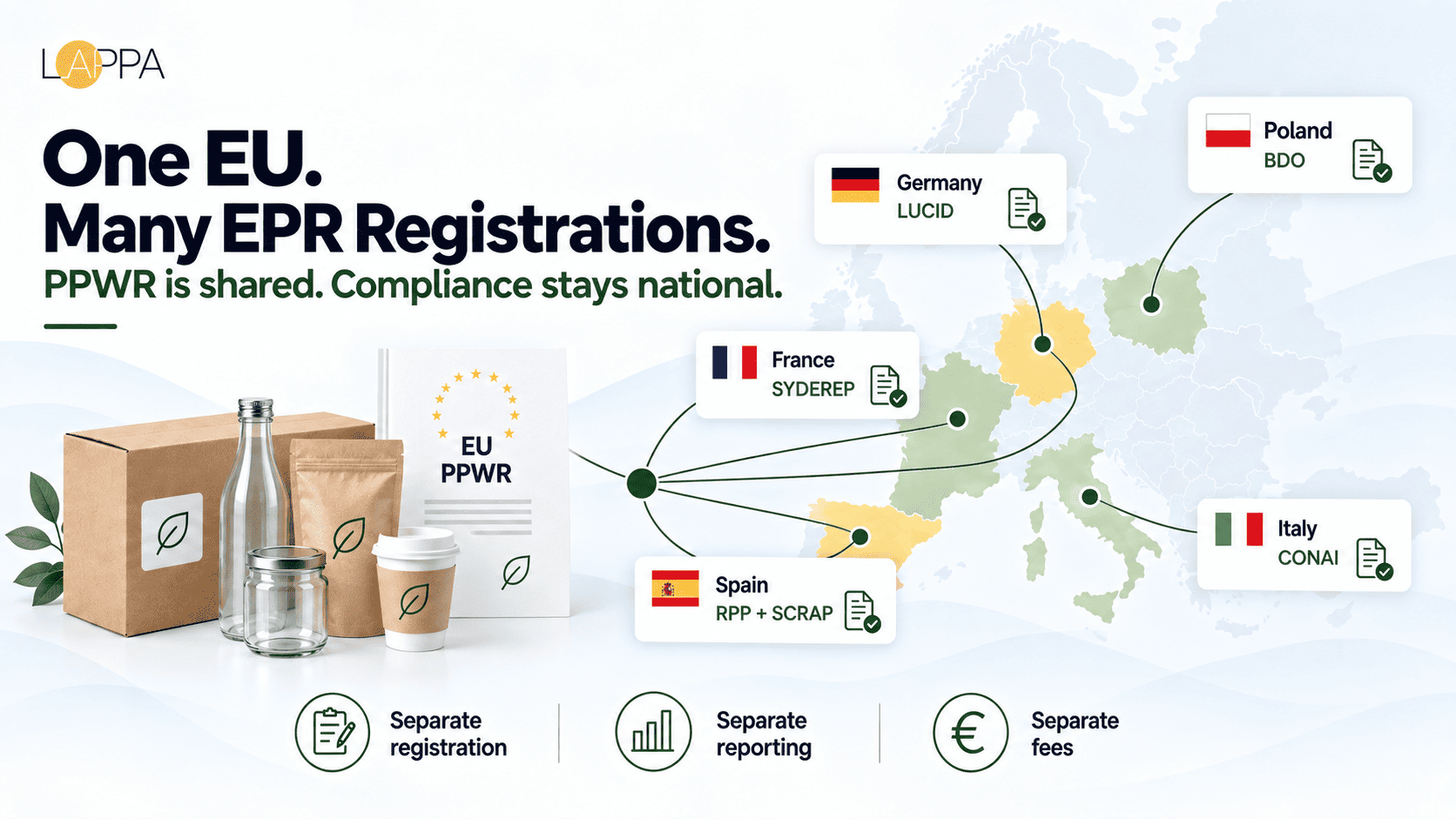
The EU packaging EPR framework does not remove national registration. It adds one shared rulebook above 27 separate systems. A company selling into six countries still needs six registrations. It also needs six reporting calendars and six fee invoices.
Non-EU manufacturers face an extra step under PPWR Article 45. Most markets now require a local authorised representative. See how Lappa’s EU AR service works.
How Packaging EPR Registration Works Across the EU
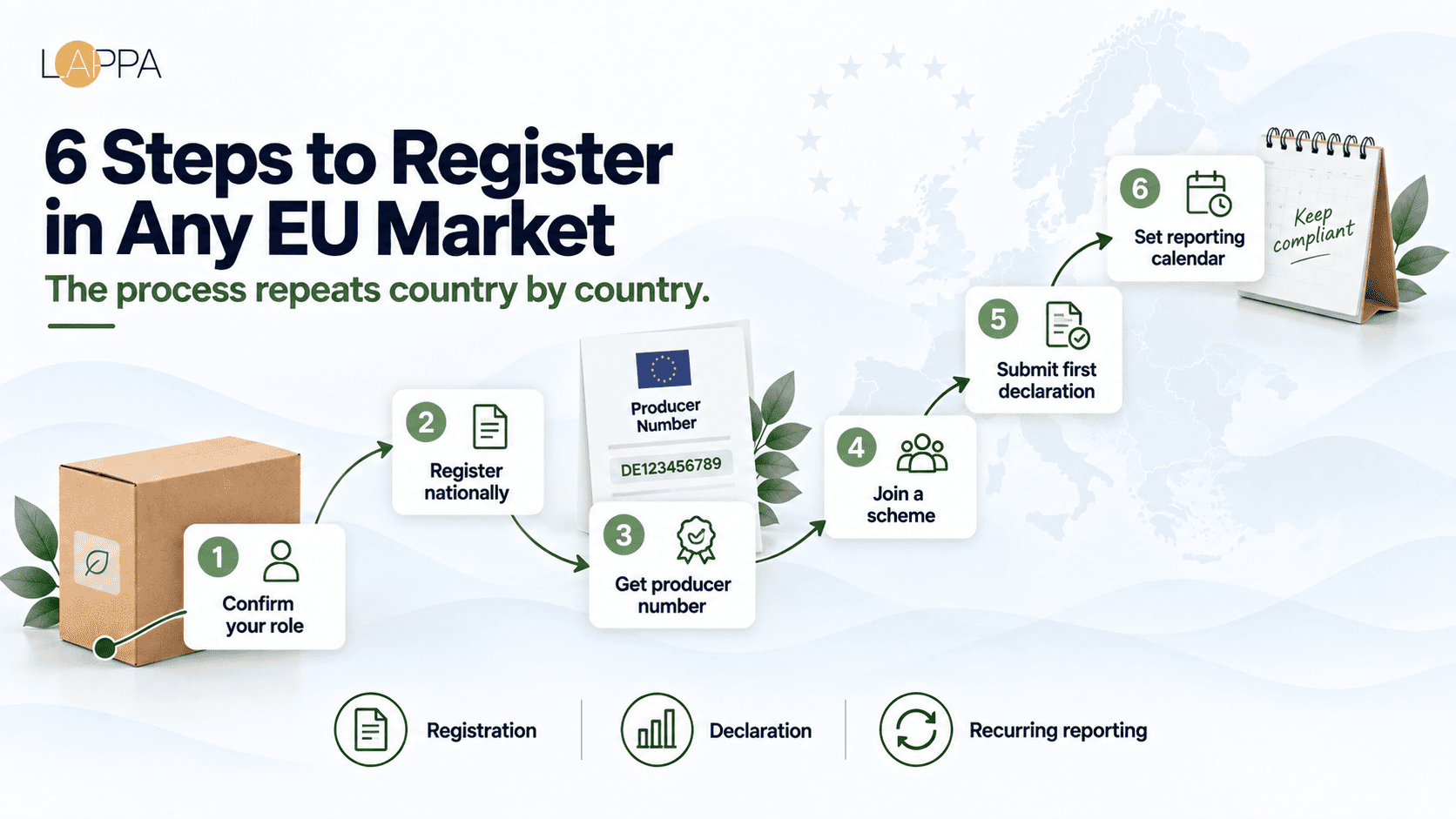
Packaging EPR registration always happens before the first sale, never after. The steps rarely change from country to country. Only the register names and scheme names differ.
- Confirm your role in each target market: producer, importer, or deemed producer through a marketplace
- Register with the national authority or public register for that country
- Obtain your producer identification number
- Sign a contract with a compliance scheme where the market requires one
- Submit your first packaging declaration by material and weight
- Set up recurring reporting on that country’s own calendar
Germany runs the free LUCID register under the ZSVR. A paid dual-system contract follows after that. France requires enrolment with Citeo, Léko, or Adelphe first. Our France Triman labelling guide covers the on-pack side. Italy takes a different path. One umbrella body, CONAI, covers every material stream there.
| Country | Register or authority | Scheme model | Volume threshold |
| Germany | LUCID (ZSVR) | Competing dual systems | None from the first unit |
| France | SYDEREP (ADEME) | Citeo, Léko, or Adelphe | None, a single sale counts |
| Italy | CONAI | Single umbrella consortium | None, all placers must join |
| Spain | RPE (MITECO) | Ecoembes or other SCRAPs | None, first-drop principle |
| Netherlands | Verpact / RVO | Single national scheme | 50,000 kg (zero for single-use plastic) |
| Poland | BDO | Rekopol and other PROs | None stated, register before sale |
Building packaging EPR registrations one country at a time is slow. Lappa’s EPR Registration service handles the paperwork for every market you sell into.
Comparing EPR Compliance Schemes Across the EU
EPR compliance schemes fall into two broad models. Some countries run one national body with no alternative. Others let several private schemes compete for the same customers.
- Single-scheme markets: Italy’s CONAI, the Netherlands’ Verpact, and most smaller member states
- Competing-scheme markets: Germany’s dual systems, France’s Citeo, Léko, and Adelphe, and Spain’s Ecoembes alongside more than a dozen alternatives
Picking between EPR compliance schemes changes the annual bill. It changes far more than just the paperwork trail. Rates and eco-modulation rules differ between operators. Our country-by-country fee breakdown compares the published rates.
Every EPR compliance scheme prices materials on its own scale. Comparing quotes before signing genuinely pays off. A scheme switch is rarely quick once contracted.
Who Pays EPR Fees and When Liability Shifts
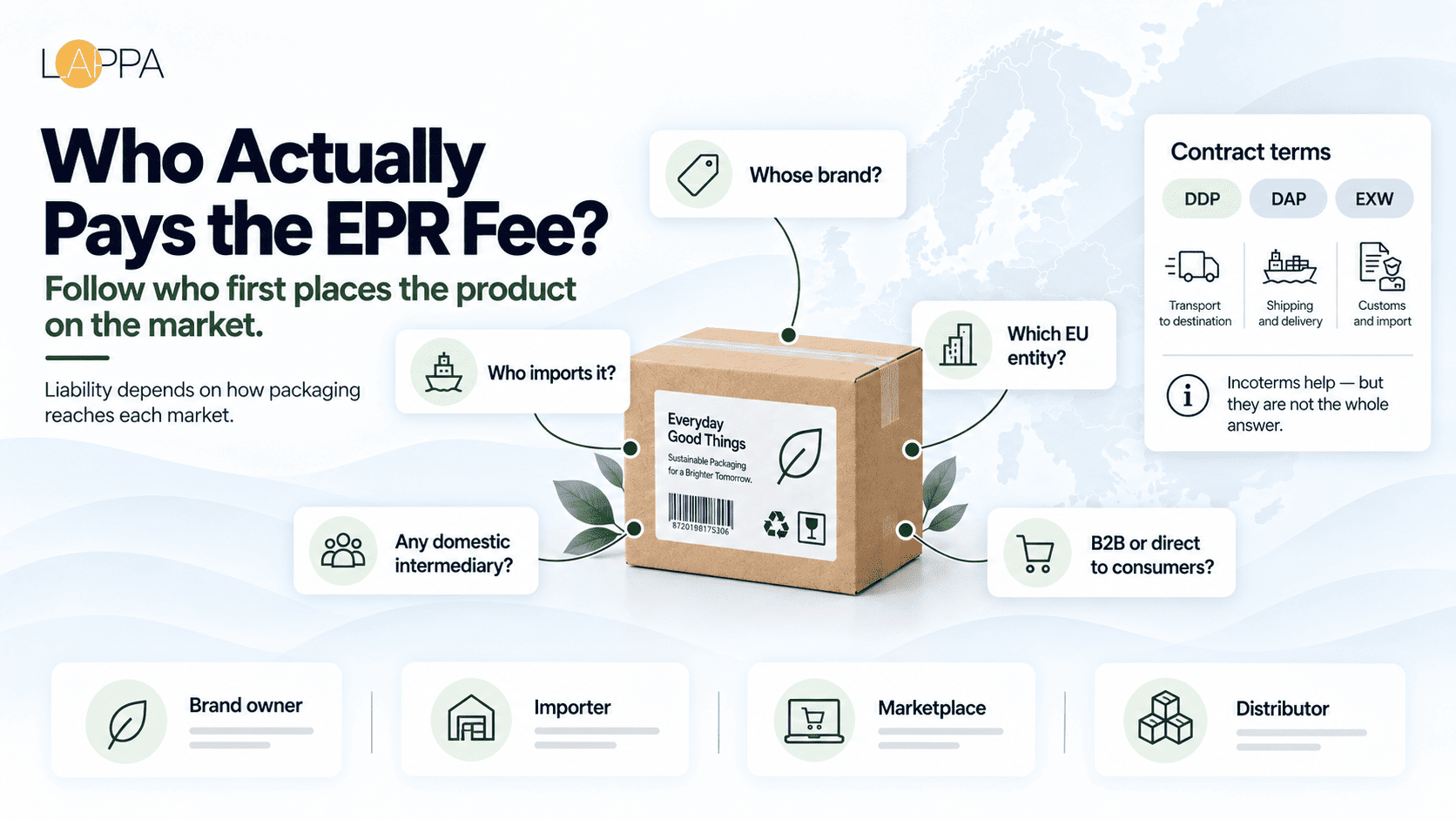
Who pays EPR fees is the first question finance teams ask. The honest answer depends on the sale structure. The obligation follows whoever first places the product on that market.
- The brand owner, when goods carry that company’s own name
- The importer, when goods enter the EU from outside the bloc
- The marketplace, when it is deemed the producer for third-party sellers without a local presence
- The distributor, in some business-to-business supply chains
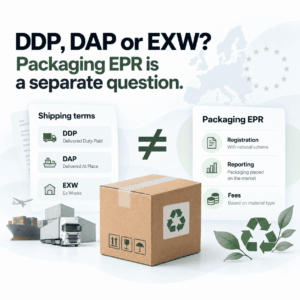
Who pays EPR fees also depends on the Incoterms in the contract. A seller trading on DDP terms usually keeps the duty. One trading on EXW terms may pass it on entirely. Our guide to EPR responsibility under DDP, DAP, and EXW walks through each case.
Determining who actually pays the EPR fee starts with that clause. Check it before checking any register.
Understanding EPR Fees and Eco Modulation
EPR fees are charged per tonne or per kilogram. Rates vary sharply by material type. They vary again by recyclability grade. Composite and hard-to-recycle plastics usually sit at the top.
| Country and scheme | Material | Indicative 2026 rate | Note |
| France (Citeo) | Glass | €20 per tonne | Lowest published tier |
| France (Citeo) | Rigid recyclable plastic | €770 per tonne | Standard bonus available |
| France (Citeo) | Rigid hard-to-recycle plastic | €1,400 per tonne | Malus surcharge applies |
| Italy (CONAI) | Wood | From about €4 per tonne | Lowest CAC bracket |
| Italy (CONAI) | Plastic, top bracket | Up to about €660 per tonne | Eco-modulated by recyclability |
Working out your own EPR fees by hand is error-prone. Try Lappa’s EPR fee calculator to see the modulated rate per market.
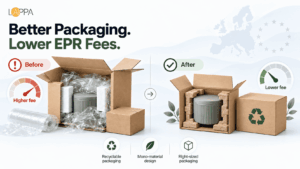
Eco-modulation lowers the EPR fee for easy-to-sort, mono-material designs. It raises the same fee for laminated films and dark pigments. From 2030, PPWR’s own A-to-E grade will feed into more national tariffs.
Registration Deadlines You Cannot Miss
Deadlines differ by country. One rule holds everywhere though. Registration must happen before the first packaged sale, never after it.
- Germany: LUCID registration before shipping; large producers file a completeness declaration by 15 May
- France: enrolment with an éco-organisme before the first sale; invoicing follows that scheme’s own calendar
- Italy: CAC declared annually, quarterly, or monthly, based on prior-year turnover
- Netherlands: Verpact declaration due 31 March, with a zero threshold for single-use plastic items
- Poland: annual BDO reporting due 15 March each year
- Spain: no threshold at all, registration required before the first unit is placed
Common Mistakes Multi Country Sellers Make
The same handful of errors shows up in almost every review we run.
- Treating one country’s registration as if it covers the whole EU
- Letting a local distributor register informally, with nothing written into the contract
- Reporting the same tonnage twice, once to a marketplace and once to the national scheme
- Underestimating composite materials that trigger a higher tariff bracket
- Missing the shift from older national rules to PPWR’s harmonised recyclability grading
Multiple packaging EPR registrations rarely follow the same calendar. That gap is exactly why these mistakes appear.
Building a Repeatable Multi Country Compliance Process
A central data register beats a folder of spreadsheets. Keep SKU weights and material types in one place. Add registration numbers and reporting dates too. Update it the moment a new market opens.
Set fixed review dates ahead of every national deadline. Do this quarterly, not once a year. A short check catches a missed market early. It works far better than an audit or a marketplace block.
Managing registration, reporting, and fee payments from one dashboard is what Lappa’s EPR Consolidation and Consolidated EPR Eco-Fee Payments services are built for.
FAQ
on EU Packaging EPR



What is EU packaging EPR and who does it apply to
EU packaging EPR makes a producer pay for collecting and recycling its packaging. It applies to manufacturers, importers, and online sellers alike. Since PPWR took direct effect, marketplaces can be treated as the producer too. This happens for sellers without a local presence. The duty follows the sale, not the factory location.
How does packaging EPR registration differ from country to country
Packaging EPR registration always sits with a national body. PPWR sets shared design rules above that layer. Germany uses LUCID, France uses SYDEREP, and Italy uses CONAI. Each has its own forms and identifiers. Thresholds vary too, since Spain applies no minimum at all. The Netherlands exempts sellers under 50,000 kilograms for most materials. A company selling in several countries needs a separate file for each one.
What are the main EPR compliance schemes companies choose between
EPR compliance schemes split into single bodies and competing operators. Italy and the Netherlands run one scheme each. There is no choice to make in those markets. Germany, France, and Spain instead offer several licensed schemes. Each one sets its own tariff and eco-modulation rules. Comparing quotes before signing a multi-year contract is worth the extra week it takes.
Who pays EPR fees when a marketplace is involved
Who pays EPR fees in a marketplace sale depends on the seller’s setup. It also depends on how the listing itself is structured. Some marketplaces register as the deemed producer for certain sellers. This usually applies when the seller has no local presence. Even then, many brand owners keep a parallel registration in their own name. Confirming the exact arrangement in writing is always the safer path.
How are EPR fees calculated under eco modulation
EPR fees are calculated per tonne or kilogram of packaging. The base rate is split out by material type. Eco-modulation then adjusts that rate up or down. It depends on how recyclable the format actually is. Mono-material, easily sorted packaging usually earns a bonus. Composite or dark-pigmented plastic attracts a surcharge instead. PPWR’s own recyclability grading should tie into more tariffs. This will matter most as the 2030 deadlines approach.

