


EPR Reporting After Registration – What, When and How Businesses Must Report
Getting your registration number feels like the finish line. It is not. It is the starting gun. Once you hold a producer number, a recurring duty kicks in, and skipping it undoes the whole point of signing up. Miss a filing window and the fines, back-charges, and frozen listings arrive fast. This guide walks you through what to report, when each market expects it, and how to keep the whole thing calm across borders.
What EPR Reporting Means After Registration
EPR reporting is the recurring act of telling a scheme or authority exactly how much packaging you put on a market. Registration proves you exist in the system. It does not, on its own, satisfy a single obligation. The real work starts the moment your number lands in your inbox.
Plenty of teams stop at registration and assume they are done. They are not, and an audit finds them quickly. Your number simply opens an account that expects regular filings. Think of it as a tax registration: the register entry is step one, and the returns never stop.
Warehouse staff scanning cartons on a pallet for EPR volume data. Source to add: a Creative Commons image from Unsplash, Pexels, or Wikimedia Commons. Alt text: Warehouse staff scanning packaging for EPR volume data.
Extended Producer Responsibility Reporting Beyond the Number
extended producer responsibility reporting turns your registration into an ongoing account of what you sell. Each period you disclose volumes, materials, and markets. The scheme then bills you and funds the recycling those figures imply. Stop filing and the account falls out of good standing.
The gap between signing up and filing trips up new entrants constantly. A number without returns is a red flag, not a shield. We see this happen often with brands that expanded fast and never built a filing routine.
The EPR Registration Reporting
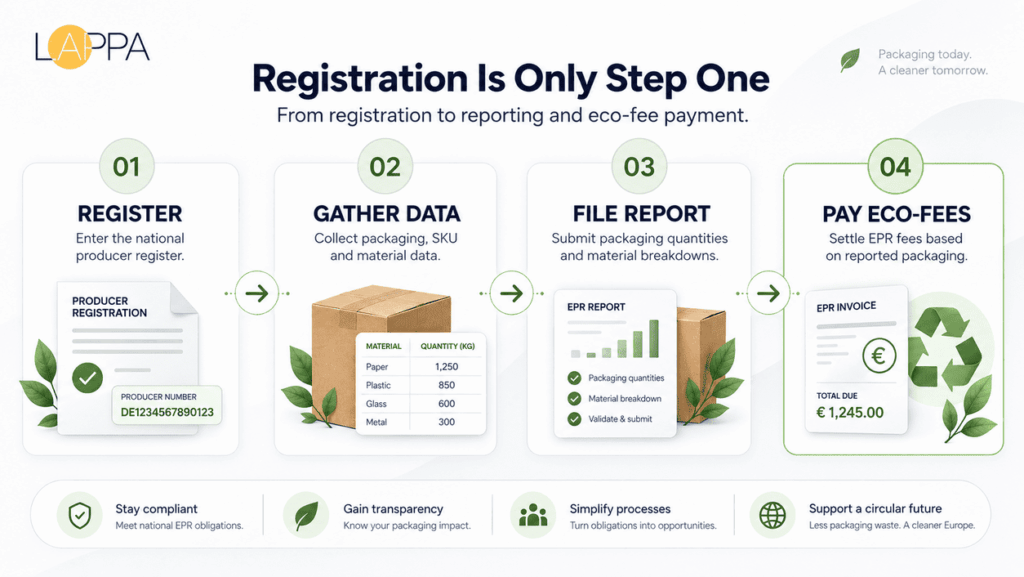
The epr registration reporting chain runs in one direction, and each link depends on the last. You register, you gather data, you file, and you pay. Break the chain at the data stage and everything downstream stalls. That is why a clean data process matters more than the sign-up itself.
Keep your registered categories and your filed categories aligned. A mismatch between what you registered for and what you report invites questions. Regulators cross-check the two, and gaps stand out immediately.
What Businesses Must Include in an EPR Report
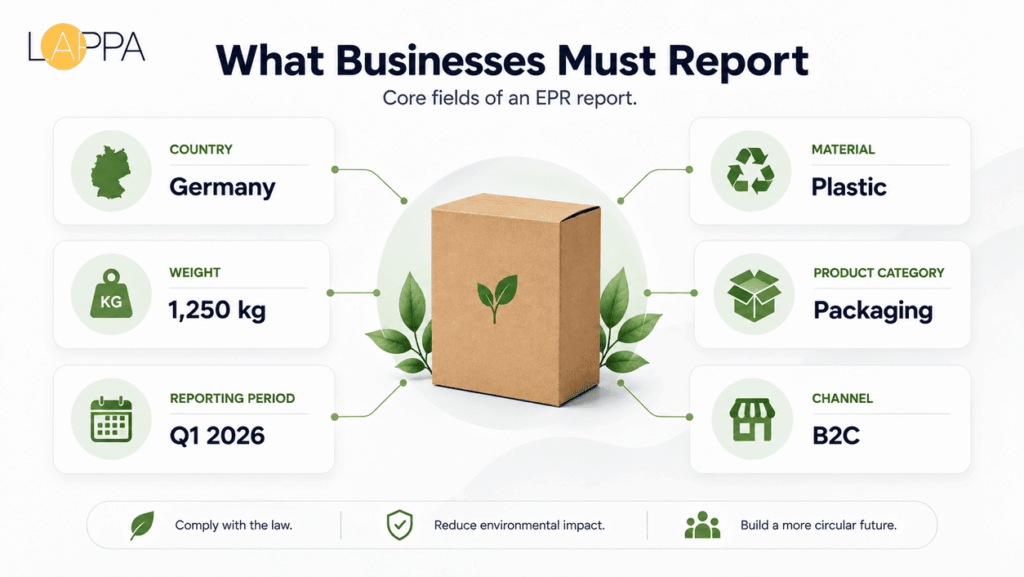
An epr report is more granular than most first-timers expect. You break volumes down by material, by format, and often by market and channel. A single product line can span several material rows. The table below shows the core fields most schemes demand for packaging data requirements
| Data | Example | Why it matters |
| Country | Germany | Determines the applicable scheme and rules |
| Material | Plastic | Drives the fee band and category |
| Weight | 1,250 kg | The core reported quantity |
| Product category | Packaging | Fixes the waste stream |
| Reporting period | Q1 2026 | Sets the filing window |
| Channel | B2C |
Splits household from commercial duties |
EPR Reporting Requirements Every Business Faces
The epr reporting requirements share a common spine across markets, even when the forms differ. You report placed-on-market quantities, not what you sold. You split by material so fees can be modulated. You tie each figure back to evidence you can defend.
Granularity is the theme. A scheme wants to know plastic from paper, primary from transport, household from commercial. Rolling everything into one number will not pass. Build your data model to that level from the start.
How to Report Packaging Data Correctly
Getting the numbers right is where most effort goes. To report packaging data accurately, you need weights and material types for every component you place on a market. Estimates crumble under audit, so measure real samples. A wrong weight or a missed material line quietly distorts the whole return.
The unit trap catches people constantly. Some schemes want kilograms; others want piece counts alongside weight. Confuse the two and your figures swing wildly. Read each scheme’s spec before you map a single field.
Packaging Reporting Data Sources
Solid packaging reporting starts with knowing where your numbers live. Rarely does one system hold everything you need. You stitch the picture together from several places, each with its own quirks.
Typical sources you will pull from:
- Your ERP or accounting system for volumes and SKUs
- A product or SKU database for weights and materials
- Marketplace back-ends such as Amazon for cross-border sales
- Warehouse and logistics records for shipped quantities
- Supplier specifications for material composition
A dashboard of SKU weights and materials. Source to add: a Creative Commons image from Pexels or Wikimedia Commons. Alt text: Packaging data dashboard showing material weights per SKU.
Companies operating across several markets can manage registrations, reporting periods and compliance data through EPR compliance software.
EPR Returns and How Often You File
Filing cadence is not one-size-fits-all. EPR returns land annually, quarterly, or monthly depending on the market, the waste stream, the scheme, and your volume. High-volume producers face tighter, more frequent windows. A small seller may file once a year while a large one files every month.
Volume usually decides the rhythm. Italy’s CONAI, for instance, moves a member from annual to quarterly to monthly as declared fees climb. Sweden flips producers from quarterly to monthly once fees pass a set threshold. Check where your volumes place you before you assume an annual cycle.
EPR Reporting Deadlines Across Europe
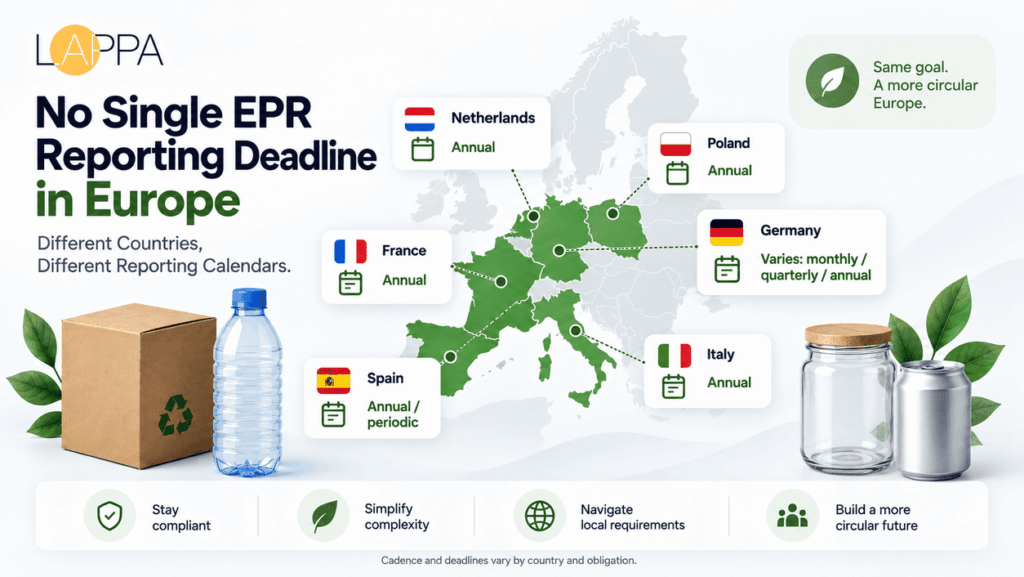
There is no single European due date, and pretending otherwise gets brands fined. epr reporting deadlines are set nationally, market by market. A February date in one country sits beside an April or May date in the next. You track them individually or you miss them.
The table below sketches the pattern across six large markets. Treat these as indicative and confirm every date against the current authority or scheme, since they shift year to year.
| Country | Waste stream | Reporting frequency | Typical reporting deadline | Where report is submitted |
| Germany | Household and commercial packaging | Ongoing volumes plus annual completeness | Declaration of Completeness by 15 May, once thresholds are passed | LUCID register plus your dual system |
| France | Household packaging | Annual, with pre-declaration for large filers | Around end of February for the prior year | Citeo, the éco-organisme |
| Spain | Household packaging | Annual | Late February to 31 March for the prior year | Ecoembes plus the national producer register |
| Italy | All packaging | Annual, quarterly, or monthly by volume | By the 20th of the month after each period | CONAI |
| Netherlands | All packaging | Annual, above a 50,000 kg threshold | Before 1 April for the prior year | Afvalfonds, now Verpact |
| Poland | All packaging | Annual | 15 March for the prior year | The BDO register |
How to Prepare and Submit an EPR Report
A repeatable routine beats last-minute scrambling every period. Map the flow once, then run it each cycle without reinventing the steps. The order matters, because each stage feeds the next.
A clean submission runs through these stages:
- Confirm your active registration and categories in each market
- Pull volume and material data from every source system
- Classify each item by material, format, and channel
- Calculate placed-on-market quantities, not sales figures
- Validate the totals against last period for obvious errors
- Submit through the scheme or authority portal on time
- Pay the eco-fees the return generates
- Retain the records and evidence for the required years
Want the calculation done for you before you file? Estimate your fees and walk into each deadline knowing the number.
EPR Reporting Through a PRO vs Direct Filing
You will meet two routes, and they are not interchangeable. Some duties go straight to a public register or authority. Others flow through a producer responsibility organisation, or PRO, that files and funds recycling on your behalf. Which one applies depends on the country and the stream.
The table below draws the contrast.
| Aspect | Via a PRO | Direct filing |
| Who files | The scheme, using your data | You, into the register |
| What it covers | Fee funding and recycling | The legal register entry |
| Best for | Operational recycling duties | Statutory registration steps |
| Your job | Supply clean, timely data | Own the filing end to end |
Most cross-border sellers end up doing both at once. You register directly, then feed a PRO for the recycling side. Knowing which channel a given duty uses saves a lot of confusion at deadline time.
Common EPR Reporting Mistakes
The same errors recur across industries, and they are avoidable. Catching them before you file is far cheaper than fixing them under audit. Master data is the usual culprit behind most of them.
Watch for these frequent slips:
- Assigning the wrong material category to a component
- Confusing piece counts with weight in kilograms
- Omitting marketplace sales shipped into a country
- Declaring sales figures instead of placed-on-market volumes
- Filing the same volumes twice through two channels
- Using the wrong filing period for the data
- Skipping a required zero return when you had no volume
- Reporting categories that do not match your registration
IMAGE 3 (place here) — A compliance manager reviewing figures against a checklist. Source to add: a Creative Commons image from Unsplash or Pexels. Alt text: Compliance manager reviewing an EPR return against a checklist.
Managing EPR Compliance Across Multiple Countries
Scale multiplies the moving parts fast. Strong epr compliance across markets means juggling different registration numbers, PROs, periods, formats, and deadlines at once. One product sold in six countries can carry six separate filing rhythms. A single tracker is the only sane way to hold it together.
Here is where the pain concentrates for growing brands. Each market speaks its own data language and keeps its own calendar. Miss one country’s window and that market alone can freeze your sales. Centralising the data and the dates turns chaos into a routine.
Selling into several markets at once? Manage your EPR returns from one dashboard, or book a demo to see it run on your own numbers.
What Happens After an EPR Report Is Submitted
Filing is not the end of the cycle. The scheme calculates your eco-fee from the volumes you declared. You settle that invoice, and the money funds collection and recycling downstream. Then the clock resets for the next period.
Corrections and audits can still follow. A scheme may query a figure, or an authority may request your evidence months later. Retained records, kept for the legally required years, are what protect you then. Treat each submission as a document you may have to defend, not a form you file and forget.
For registration, reporting and ongoing compliance service costs, see Lappa’s EPR pricing page.
FAQ



Does registration alone make me compliant
No, registration only opens your account in the system and records that you exist as a producer. Real compliance depends on filing accurate returns on time and paying the fees they generate. Treat your number as the first step of a recurring cycle, not the finish line.
What quantities do I actually report
You report placed-on-market quantities, meaning what you introduced to that country’s market, not your total sales. The figures are split by material and often by channel, such as household versus commercial. Declaring sales instead of placed-on-market volumes is one of the most common and costly mistakes.
How often will I need to file
Frequency depends on the country, the waste stream, the scheme, and your volume, so it ranges from annual to monthly. A small producer might file once a year, while a high-volume seller in Italy could file every month. Check where your volumes place you in each market rather than assuming a single cadence.
Are the deadlines the same across Europe
They are not, because each member state sets its own dates and rules. France often falls around late February, the Netherlands before 1 April, and Poland on 15 March, to name a few. Always confirm the current date with the national authority or scheme, since these shift from year to year.
What is the difference between reporting to a PRO and reporting directly
What is the difference between reporting to a PRO and reporting directly? Direct reporting means you file into a public register or authority yourself, usually for the statutory registration duty. Filing through a PRO means a compliance scheme files and funds recycling using the data you supply. Many businesses do both at once, registering directly while feeding a PRO for the operational side.

