

Packaging EPR Costs in Europe: Registration, AR, PRO and Reporting Fees by Country
Every company selling packaged goods into the EU eventually asks the same question. What does compliance actually cost. The honest answer is that EPR cost is never a single number. It is a stack of separate charges — registration, authorised representative fees, producer responsibility organisation contributions, and reporting obligations — and each layer is priced differently in every member state. This guide breaks down each cost component, explains where fees are fixed and where they scale with material or weight, and lists the deadlines that trigger penalties if missed.
Not sure what your packaging portfolio actually costs across the EU? Get a free quote or book a demo to walk through your obligations with a Lappa specialist.
What drives packaging EPR cost across EU markets
Extended Producer Responsibility exists to shift the financial burden of packaging waste from municipalities onto the businesses that place packaging on the market. That principle is EU-wide. The mechanics behind it are not. Each country runs its own register, its own producer responsibility organisations (PROs), and its own tariff structure, so EPR cost for the same product line can differ sharply between Germany and Spain.
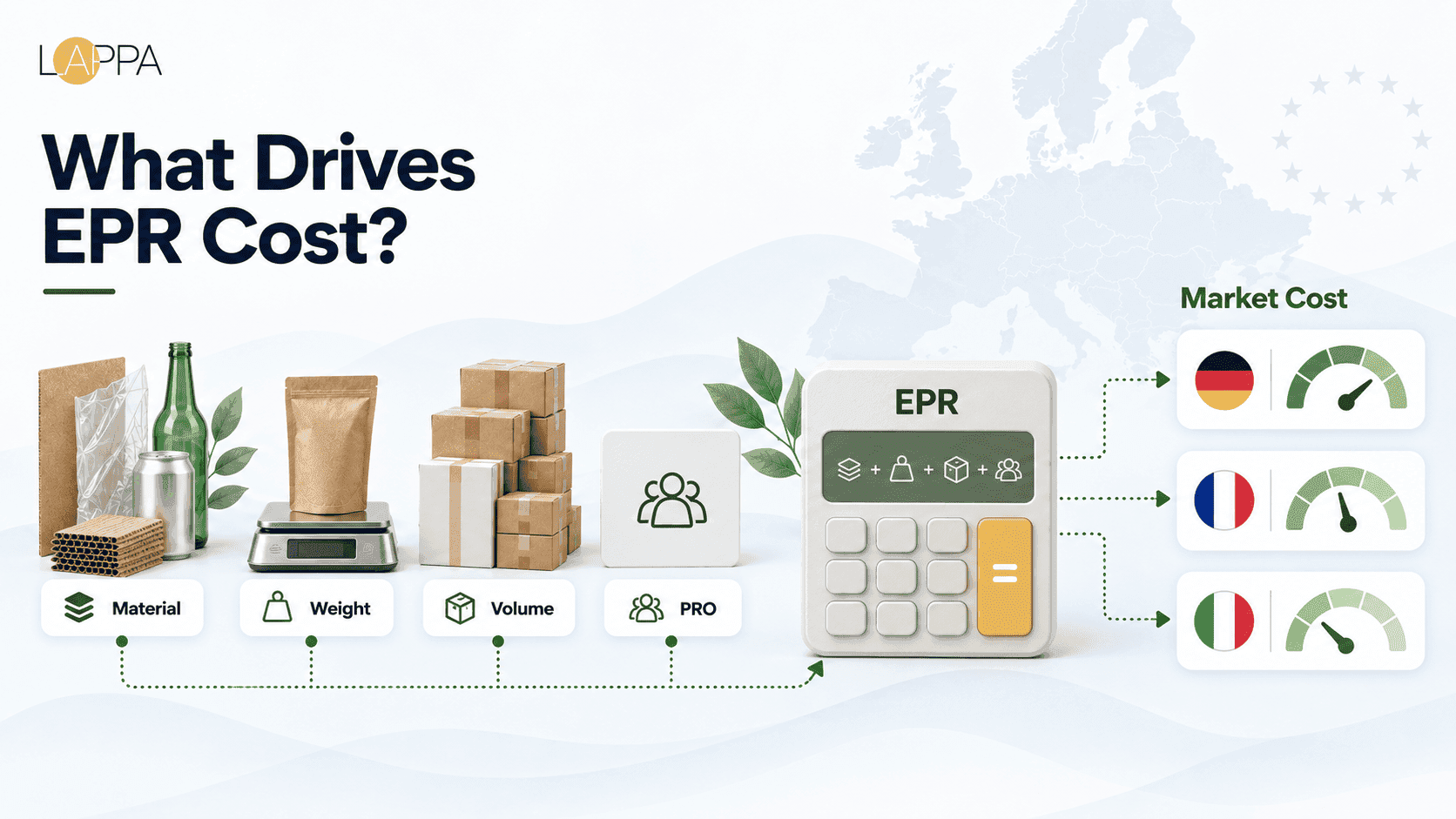
Four variables shape the final bill almost everywhere. Material type matters, since plastic, glass, paper, and metal typically sit on different tariff bands. Weight matters, because most schemes charge per tonne or per kilogram declared. Sales volume determines whether a business qualifies for a simplified declaration or a full one. And the chosen PRO matters too, particularly in dual-system markets like Germany, where several operators compete on price for the same packaging category. None of this can be reduced to one flat figure, and any source quoting a single EU-wide rate should be treated with caution.
The Packaging and Packaging Waste Regulation, Regulation (EU) 2025/40, adds a further layer from 12 August 2026. It does not replace national EPR schemes — it sits above them, introducing recyclability grading, substance restrictions, and a harmonised labelling system that several countries are already tying to eco-modulated fees. Businesses budgeting for EPR costs this year need to plan for national fees now and PPWR-linked adjustments from the second half of 2026 onward.
How EPR registration fees work country by country
Registration is usually the cheapest part of the process, and in several major markets it costs nothing at all. Germany’s LUCID Packaging Register, run by the Zentrale Stelle Verpackungsregister (ZSVR), is free to join. Producers still need a system participation agreement with a dual-system operator once they distribute packaging subject to system participation, and that agreement carries its own fee based on material and declared volume.
Other countries follow a similar split. France requires adherence to an eco-organisme such as Citeo, which issues a Unique Identifier Number through ADEME; joining itself has no separate registration charge, but the contribution that follows is tariff-based. Spain requires two parallel registrations — one with a SCRAP such as Ecoembes, and a statutory information filing with the Registro de Productores de Producto managed by the Ministry for Ecological Transition (MITECO) under Royal Decree 1055/2022. Italy channels registration through CONAI, the national packaging consortium, which combines enrolment with the environmental contribution (Contributo Ambientale CONAI) rather than treating them as separate steps.
The lesson across all four markets is consistent: the act of joining a register rarely carries a meaningful price tag on its own. The EPR register step is mostly administrative — proving legal identity, VAT status, and packaging categories. Real cost begins once volumes are declared and tariffs applied. Confirming EPR register status in every market before the first shipment avoids the retroactive fines that follow late enrolment. For a closer look at where registration ends and paid obligations begin, see PRO vs Authorised Representative vs EPR Registration.
EPR price components producers must budget for
Breaking down EPR price into its parts helps avoid budget surprises later in the year. Four cost lines recur across almost every EU market.
- Registration or enrolment cost, which is free or nominal in most schemes reviewed here
- Ongoing PRO membership or system participation fees, tied to material and weight
- Authorised representative fees, required for non-EU or non-local producers
- Administrative and consultancy costs tied to data collection, corrections, and reporting
The second line is where the real EPR price volatility sits. In Germany, dual-system tariffs for plastic packaging vary by operator and by whether the packaging is classified correctly — misclassifying composite packaging as paper, for instance, triggers a retroactive correction once the ZSVR cross-checks recycler data. In France, Citeo’s 2026 tariff structure combines a weight-based rate per material with a separate per-unit component that differs by business sector, so two companies selling the same tonnage can face different totals. Italy’s CONAI applies tiered contribution bands by material, updated annually, meaning the applicable rate for plastic in 2026 is not the same as the rate that applied in 2025.
None of these figures should be treated as fixed. Every fee referenced above depends on the material declared, the weight placed on the market, and in Germany’s case, the specific PRO contracted. This is exactly why EPR pricing needs a live calculation rather than a remembered rate — Lappa’s EPR Calculator applies current tariffs to a company’s own packaging data, and the worked logic behind it is set out in How to Calculate Your Packaging EPR Fee. Businesses should always confirm current rates directly with the relevant scheme before budgeting a final number.
Authorised representative fees for non-EU and non-local sellers
Non-EU manufacturers placing packaged goods on the EU market cannot register directly in every country. Regulation (EU) 2025/40 requires these businesses to appoint an EU Authorised Representative who accepts the extended producer responsibility obligations on their behalf. Germany’s own registration guidance confirms this explicitly: companies without a German establishment must name an authorised representative, a Bevollmächtigter, before the LUCID registration can be completed.
Authorised representative fees sit outside the national PRO tariff entirely. They are commercial charges set by the AR provider, not the government or the PRO, and they typically cover legal representation, correspondence with the local register, and liability for reporting accuracy. Because this fee is set by private providers rather than a public tariff sheet, it varies significantly by provider, contract length, and the number of markets bundled together. A company selling into six EU countries without local entities should expect six separate representation relationships unless it consolidates them under one provider.
Selling into the EU without a local entity? See how Lappa’s EU Authorised Representative service works and consolidate representation across multiple markets in one contract.
PRO membership and system participation fees explained
Producer responsibility organisations are the bodies that actually collect the eco-contribution and fund collection, sorting, and recycling infrastructure. Every EU market now has at least one PRO for household packaging, and several run separate schemes for commercial and industrial packaging.
Germany’s dual-system model is the most complex, since ten or more competing operators each publish their own tariff sheet for the same packaging categories, and producers can switch operators between contract periods. France’s Citeo dominates household packaging, with a 2026 tariff built from a per-material weight rate plus a sector-specific per-unit charge, and a professional packaging EPR scheme that entered into force on 1 July 2026 for packaging outside the household stream. Italy’s CONAI applies environmental contribution bands that differ by material and are revised annually, with fresh 2026 rates already published in the consortium’s adherence guide. Spain requires enrolment with a SCRAP such as Ecoembes for the ongoing eco-payment, separate from the statutory MITECO filing.
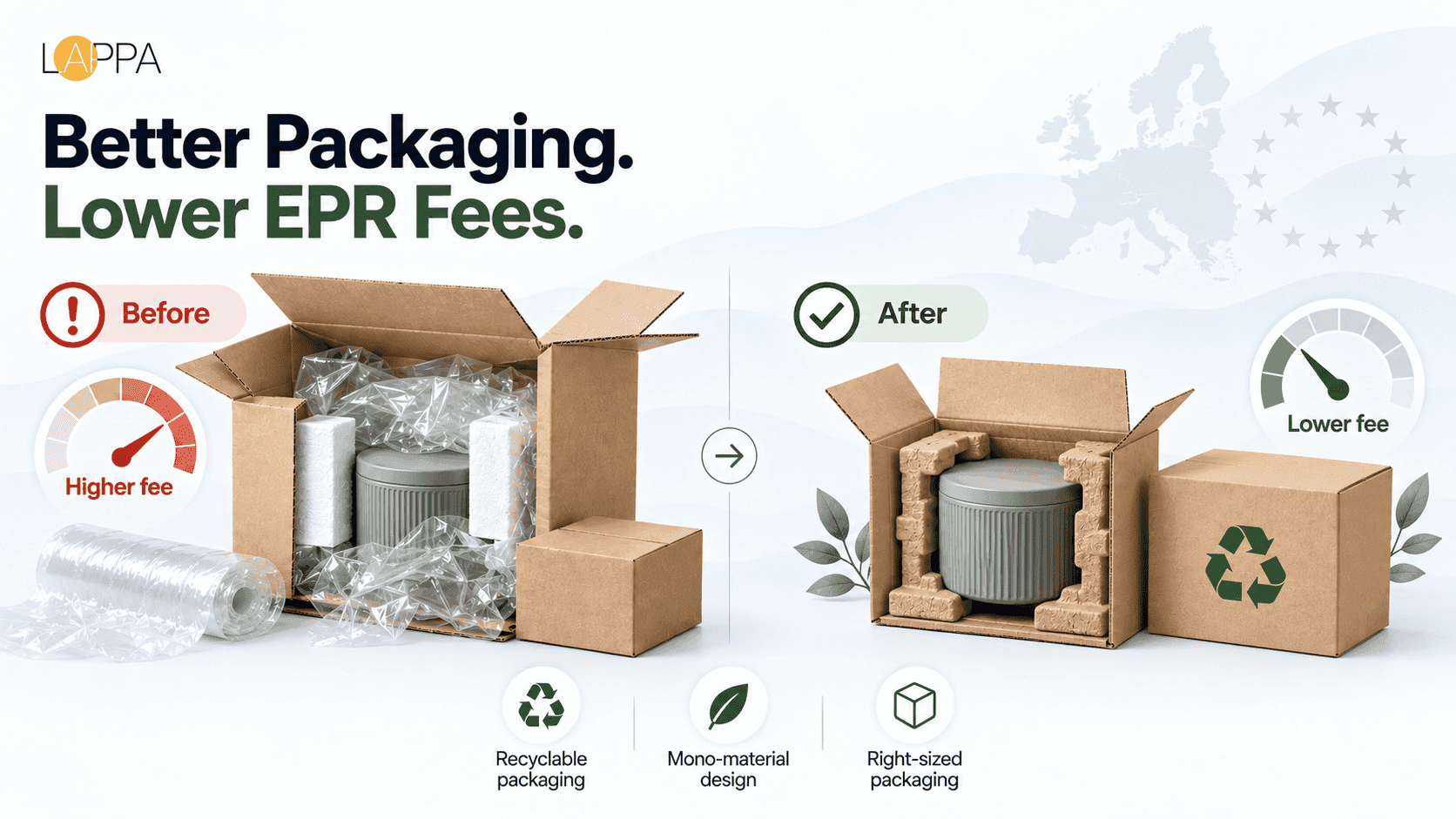
EPR packaging fees charged by PROs are structurally different from flat government charges. They function more like insurance premiums, calculated against declared tonnage and adjusted through eco-modulation — bonuses for genuinely recyclable formats, penalties for hard-to-recycle ones. A company redesigning packaging to improve its recyclability grade under PPWR criteria can, in several schemes, reduce its EPR packaging fee exposure directly, since bonus-malus systems are already active in France and expected to expand under the PPWR framework elsewhere.
How to EPR register in major EU markets
The practical sequence for getting compliant looks broadly similar everywhere, even though the platforms differ.
- Confirm producer status. Anyone placing packaging on a given market for the first time — manufacturer, importer, or online seller — usually qualifies, regardless of company size in most schemes.
- Choose the correct EPR register or PRO. Germany routes through LUCID plus a dual-system contract; France and Italy combine PRO enrolment with the contribution mechanism; Spain requires both a SCRAP and the MITECO filing.
- Gather packaging data by material, weight, and packaging tier — sales, grouped, or transport — since every scheme classifies these differently.
- Submit the initial declaration and, where applicable, sign the system participation agreement before any stock ships.
- Set a recurring reporting calendar, since most obligations repeat annually, and some — Germany’s dual-system reporting among them — repeat monthly or quarterly.
Businesses that complete these steps out of order tend to face the same problem: they start selling before the local contract is signed, and fines apply from the date of the first unregistered sale rather than from the date the gap was discovered.
Managing registrations across several EU countries at once is easier through one platform. Explore EPR Registration with Lappa or see how Consolidated EPR Eco-Fee Payments simplify multi-market billing.
EPR report deadlines and late filing penalties
Deadlines are national, not harmonised, and missing one typically triggers a fixed percentage surcharge rather than a warning. Every EPR report follows a different calendar depending on the country and the scheme involved. A few confirmed dates illustrate how differently the calendar runs across the bloc.
|
Country |
Authority or scheme |
Typical reporting deadline |
Fee basis |
|
Germany |
LUCID (ZSVR) plus dual system |
Year-end volume report by 1 June; annual completeness declaration by 15 May |
Material and weight, set by contracted dual-system operator |
|
France |
Citeo, under ADEME oversight |
Declaration and contribution cycle set annually by Citeo; reused-packaging declaration due by 29 May 2026 |
Weight per material plus a sector-specific per-unit rate |
|
Italy |
CONAI |
Annual declaration and Contributo Ambientale payment by 20 January for the prior year; monthly or quarterly filings also apply above certain volumes |
Material-based contribution bands, revised yearly |
|
Spain |
SCRAP (for example Ecoembes) and MITECO |
SCRAP declaration typically due by 28 February; statutory MITECO filing due by 31 March under Royal Decree 1055/2022 |
Weight and material declared to the SCRAP |
An EPR report filed late in France picks up an automatic surcharge once the scheme’s own deadline passes — Citeo-linked guidance describes a fixed penalty applied beyond the cut-off date. Germany’s LUCID system works differently: high-volume producers who file their completeness declaration after 15 May face fines even when the underlying figures are correct, because the deadline itself is the compliance trigger, not just the data. Spain’s dual-filing structure catches out businesses that assume enrolling with a SCRAP is sufficient; the separate MITECO submission is a distinct legal obligation with its own deadline and its own penalty exposure.
Consistent EPR reporting across multiple markets is one of the few controllable costs in this entire framework, because unlike tariff rates, deadlines and data formats are known well in advance.
Comparing EPR packaging fees across key countries
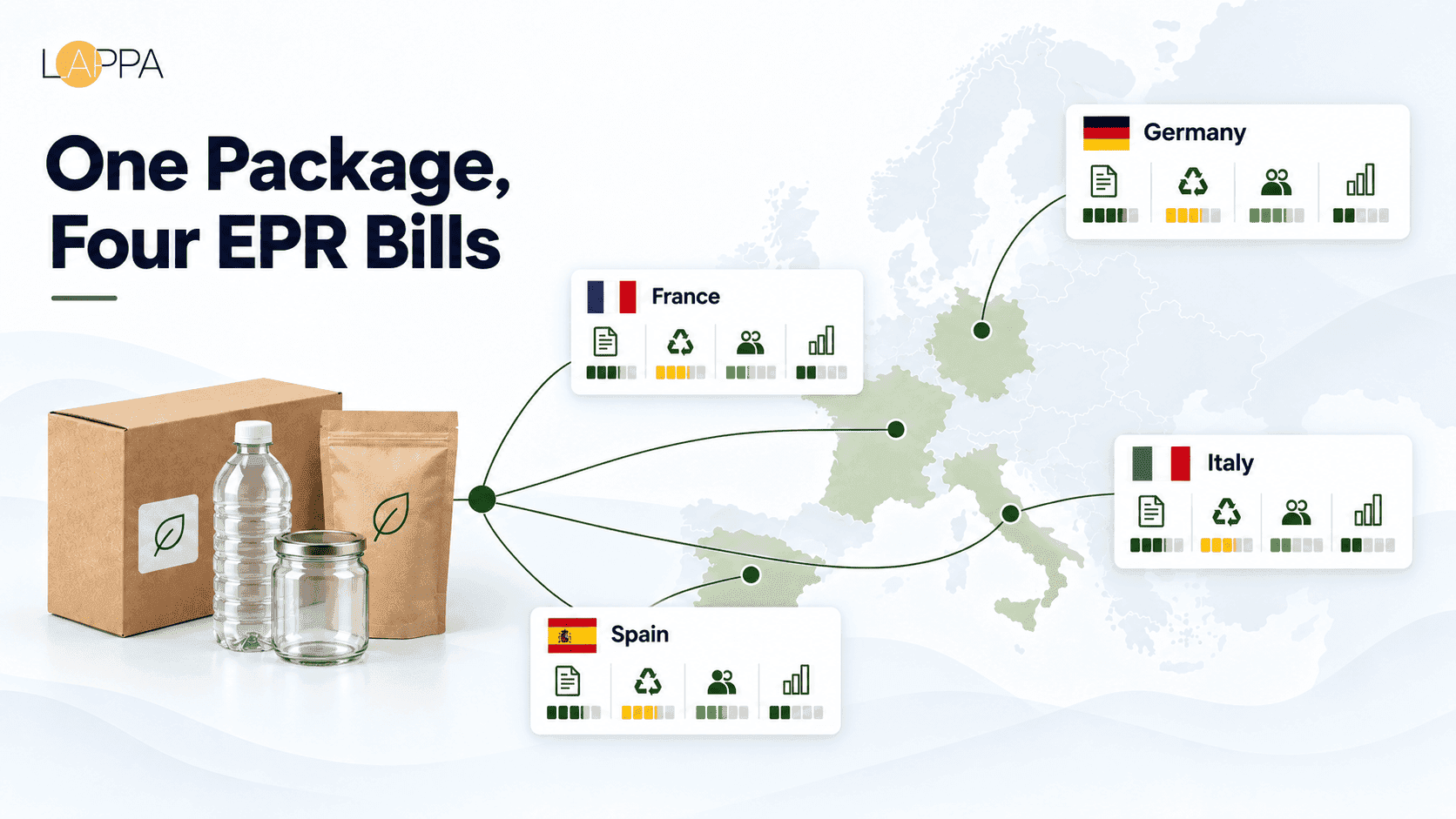
No two countries structure their fee calculation the same way, which makes side-by-side budgeting difficult without a shared framework. Comparing EPR packaging fees only works once every rate is converted to the same reporting year and currency. A few patterns hold across the markets reviewed here.
Germany’s dual-system competition means the same packaging category can carry different rates depending on which of the licensed operators a company contracts with — there is no single national tariff sheet to consult. France applies eco-modulation aggressively, so EPR fees cost country-wide averages mean little without knowing a specific format’s recyclability bonus or malus. Italy publishes clear contribution bands by material each year through CONAI, giving more upfront visibility than Germany’s negotiated model, but the bands themselves change annually. Spain’s cost structure depends on which SCRAP a business joins, since Ecoembes is the dominant household scheme but not the only registered option.
The practical takeaway is that any EPR fees cost country comparison has to be rebuilt every year, market by material by weight. Working out the cost of EPR fees by country from scratch each cycle is exactly why multi-market sellers increasingly move to a consolidated EPR compliance setup instead of tracking each scheme separately. A rate that applied last year is not a safe assumption for this year’s budget, particularly with PPWR-driven eco-modulation expanding into more countries through 2026 and 2027.
Building an accurate EPR fees cost country budget
Budgeting well means treating EPR cost as a moving target rather than a fixed line item. A few practical habits reduce the risk of underestimating it.
- Rebuild the packaging weight and material register every year before declarations open, since last year’s figures are rarely still accurate.
- Track PRO tariff publications directly — Citeo, CONAI, and Ecoembes all publish updated rate sheets annually, usually in the first quarter.
- Separate authorised representative costs from PRO contributions in internal budgets, since one is a commercial fee and the other is a regulated tariff.
- Flag PPWR recyclability grading work as a cost-reduction lever, not just a compliance task, since eco-modulated schemes reward better-scoring formats with lower fees.
- Assign ownership for each country’s deadline calendar, because missed dates cost more than the underlying fee itself in most schemes reviewed here.
Running EPR across five or more EU markets? Lappa’s EPR Reporting Software and EPR Calculator bring registration status, deadlines, and fee estimates into a single dashboard — book a demo to see it against your own packaging data.


.jpg&w=3840&q=75)