

How to Organize Packaging Information for EU Compliance
A single water bottle carries a dozen data points. Weight, material, recycled content, batch code, market of sale. Each one belongs somewhere specific. Information on packaging is the raw material behind every registration. It also feeds every report and every label a producer files. Companies scatter this data across spreadsheets, emails, and design files. That habit breaks down fast. This guide sets out what to collect. It shows where to store it and which deadlines depend on getting it right.
Not sure where your packaging data currently lives? Get a free quote or book a demo to map it with a Lappa compliance expert.
Why information on packaging decides your EU market access
Regulation (EU) 2025/40, the PPWR, took direct effect from 12 August 2026. It applies across the whole bloc. It replaced the old packaging waste directive without national transposition. Article 44 makes registration a precondition for selling pac
A producer cannot register without organized data first. Information on packaging has to sit ready before a form even opens. Material type, weight, and market volume all need a home. Teams that start pulling this data late are already behind schedule.
Every EU market also runs its own EPR scheme. Germany, France, Italy, and Spain each demand annual registration. Fee payment and tonnage reporting follow on separate timetables. None of it works without a solid record of what a company places on each market.
Requirements for packaging that every producer must track
Producers need a clear picture before building any data system. Meeting requirements for packaging starts with one habit. Treat each SKU as a data record, not a design file.
The following fields form the baseline most EU markets ask for:
- SKU identifier and product family name
- Packaging tier — sales, grouped, or transport
- Material type and composite breakdown by weight
- Recycled content percentage per plastic component
- Country-by-country volume placed on the market
- Existing EPR registration numbers and PRO contracts
- Declaration of Conformity reference under Article 39
- Batch or lot traceability code
A missing weight figure can stall registration fast. So can an unclear material split. Ireland and Poland apply similar requirements for packaging moved through fulfilment centers. Gaps rarely stay isolated to one country.
The requirement for packaging data only grows over time. Every new SKU adds a row to the register. So does every supplier change or market launch. A fixed template beats a one-off spreadsheet every time.
How to register in a national packaging waste database
Every member state runs its own national packaging waste database. None of them share a login. Germany’s version is called LUCID. It sits under the Zentrale Stelle Verpackungsregister. France, Italy, and Spain each run separate systems. Fields and file formats differ across all three.
A workable registration process usually follows this order:
- Confirm which member states receive shipments of packaged goods
- Identify the national register for each market and its entity requirements
- Appoint a local Authorised Representative where no EU establishment exists
- Submit producer and packaging category data before the first sale
- Link every registration number back to the SKU records it covers
Once live, the national packaging waste database becomes a reference point. Every annual filing gets checked against it first. Auditors and PROs look here before anything else a company presents.
Building a packaging report your PRO and authorities accept

A packaging report is the annual proof that registration still matches reality. Producers must file by 1 June each year. The filing covers everything placed on the market during the previous calendar year.
Weight figures get broken down by material category. They also get split by country, never lumped into one global total. Businesses placing under ten tonnes per market can usually file a simplified version. Everyone else needs the full breakdown ready well ahead of the deadline.
National databases for packaging waste rarely align on field names. A submission built for Germany’s LUCID format often needs reshaping. It has to fit France’s CITEO system or Spain’s SCRAP platform instead. Treating each market’s report as one export from the same source data helps. It avoids rebuilding the numbers from scratch every year.
Late packaging reports trigger real penalties in several member states. Registration status can be suspended until the gap is corrected. Building the report from live SKU data removes most of that risk.
Packaging requirements shift across every EU market
Packaging requirements differ sharply once a company sells in more than one country. A material classification that satisfies Germany’s reporting can still fall short elsewhere. France’s CITEO scheme wants detail down to component level.
A study commissioned by Amazon reviewed ten member states in early 2026. It found 64 distinct data fields across those systems. Only a small share of them aligned with the PPWR’s own draft format. Fragmentation stays the working reality until the Commission finalises one implementing act under Article 44.
Every packaging requirement traces back to a documented source in practice. That might be a supplier declaration, a weighed sample, or a prior filing. Keeping that source attached to the figure is what survives an audit.
Comparing packaging data types and what to store
Packaging requirements rarely spell out how to store data internally. That gap is exactly where confusion starts. Different fields serve different purposes. Mixing them into one flat list slows audits down. The table below separates the main categories a compliance record should hold.
|
Data Type |
Example Information to Store |
Primary Use |
|
Product and material data |
SKU, component list, material grade, weight in grams |
Classification, recyclability grading |
|
Market and volume data |
Country, annual units sold, tonnage per material |
National registration, annual reporting |
|
Compliance documentation |
Declaration of Conformity, technical file, supplier certificates |
Audits, customs checks |
|
Registration references |
Producer register number per country, PRO contract ID |
Linking reports to active registrations |
|
Label and artwork records |
Batch code format, pictogram version, language variants |
PPWR labelling, packaging artwork control |
Keep these five categories in separate, linked tables. One flat spreadsheet tab makes every audit question take longer to answer.
A practical example of organizing packaging information
Picture a cosmetics brand selling a moisturiser in three countries. Sales run through Germany, France, and the Netherlands. The product ships in a PET jar with a cardboard outer box. A workable record for that one SKU holds several fields. The jar’s plastic grade and recycled content share come first. The box’s material and weight in grams follow. So does the batch code format printed on both. Three separate registration numbers complete the picture, one per market.
Each new retailer or supplier change updates only the affected fields. The rest of the record stays untouched. When France’s annual filing comes due, the team exports tonnage straight from that table. No one rebuilds a spreadsheet from memory.
A second example involves an electronics importer selling in six EU countries. A review found two markets were never registered. A local distributor had handled market entry in both cases. Centralizing information about packaging across all six markets surfaced the gap. It happened before a customs check could find it first.
Building this kind of central record from scratch? Lappa’s Packaging Label Manager keeps material data, recyclability status, and artwork versions in one system. Explore the Packaging Label Manager.
Where PPWR labelling data fits into your packaging records
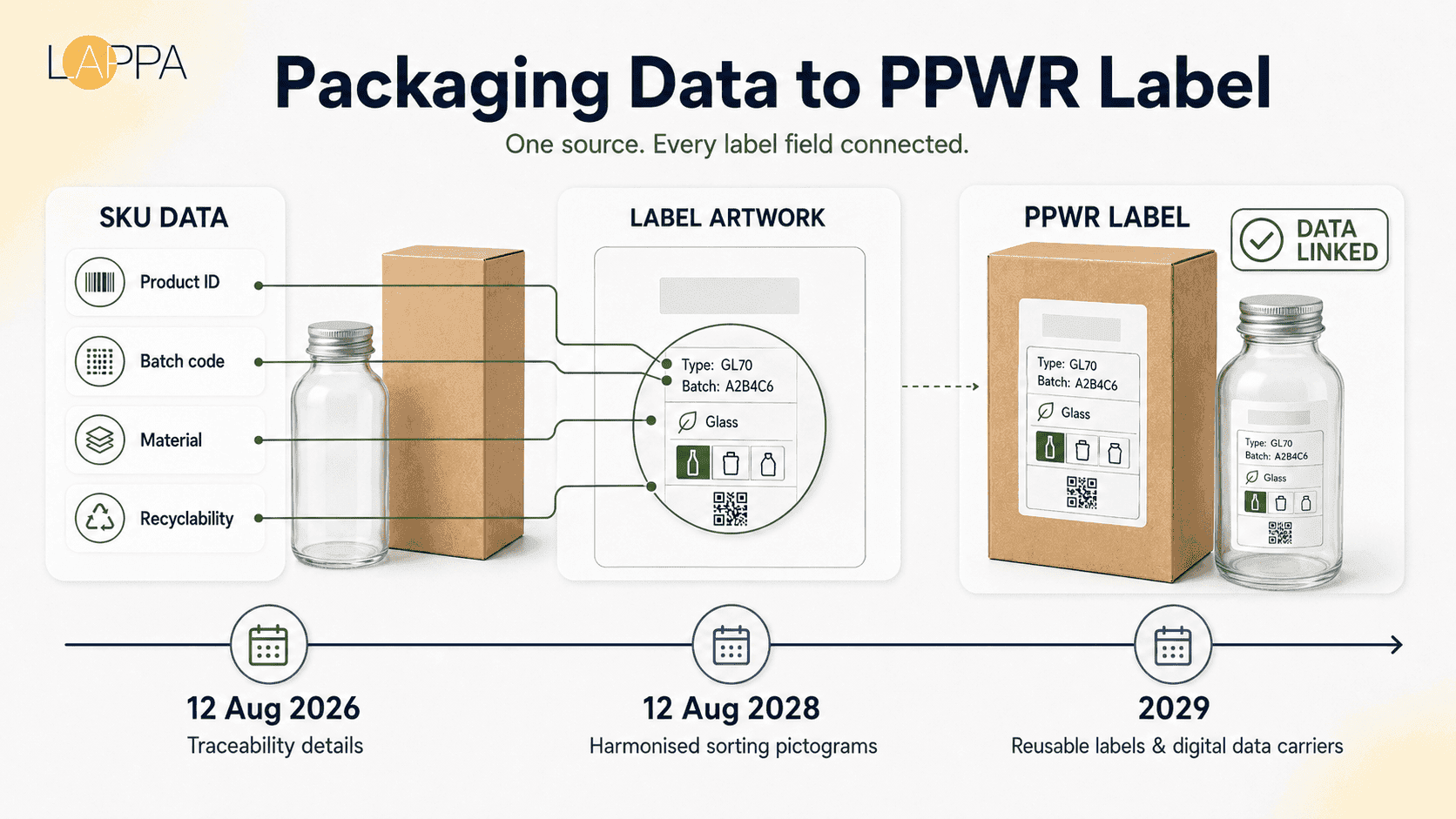
Packaging labels draw on the same underlying data as registration and reporting. They just present it differently. From 12 August 2026, every unit needs traceability data. That means a type, batch, or serial number, plus identification details. From 12 August 2028, harmonised sorting pictograms join that requirement. Reusable packaging labels and digital data carriers follow in 2029.
None of those label fields exist on their own. A batch code on a label should trace back to the same SKU entry. That entry is the one already used for registration and reporting, not a separate design file. Our full breakdown of label fields and deadlines sits in PPWR Label Requirements and EU Packaging Labelling Rules, including a sample carton layout.
Ready to generate PPWR-compliant labels straight from your packaging data? See Lappa’s PPWR Labelling tools.
Common gaps in packaging information management
The same handful of issues shows up across compliance reviews. Sector and company size rarely change the pattern.
- Weight and material data held only in supplier emails, never centralized
- Registration numbers stored separately from the SKUs they cover
- Annual reports rebuilt manually each year instead of exported from live data
- No documented source behind a recycled content or recyclability figure
- Label artwork updated without updating the material record it depends on
Fixing these gaps rarely needs new software on its own. It needs one owner for the data. It needs a fixed template per market. It also needs a habit of updating records the moment something changes, not at filing time.
Want a second set of eyes on your current packaging data setup? Book a demo and walk through it with our team.
FAQ about organizing packaging information
It covers everything a regulator or a PRO could ask to see. That includes material composition, weight, recycled content, and market volume. Registration numbers and conformity documentation belong on that list too. Different PPWR articles pull on different slices of this same data. A well-organized record keeps all of it linked to the SKU it describes.


.jpg&w=3840&q=75)