

Germany EPR registration process costs and deadlines
If you sell packaged goods, electronics or batteries to German consumers, you are legally obliged to comply with EPR Germany rules before the first shipment leaves your warehouse. The country has one of the strictest producer responsibility frameworks in the EU and the authorities are actively enforcing it.
Three laws govern the scheme: the Verpackungsgesetz (VerpackG) for packaging, ElektroG for electrical equipment, and the Battery Act (BattG) for batteries. Each statute appoints its own authority, uses its own portal, and sets its own calendar. This guide covers EPR registration in Germany, actual cost figures, and every key date you need to track in 2026.
What extended producer responsibility Germany means
Germany extended producer responsibility shifts end-of-life waste costs onto the businesses that first place products on the market. Producers fund collection, sorting, and recycling directly, rather than passing that bill to local councils.
The principle comes from EU directives converted into national law. The result is a well-funded, publicly monitored system. Material recovery rates for packaging exceed 70 percent. Battery collection beats EU targets consistently.
Two big legal changes altered the landscape heading into 2026. ElektroG4 came into force on 1 January 2026 expanding scope and penalties. The EU Packaging and Packaging Waste Regulation (PPWR) takes effect on 12 August 2026, superseding VerpackG with the new VerpackDG. Both changes impact active enrollments, so keeping an eye on updates from ZSVR and Stiftung EAR is mandatory.
Who falls under EPR in Germany
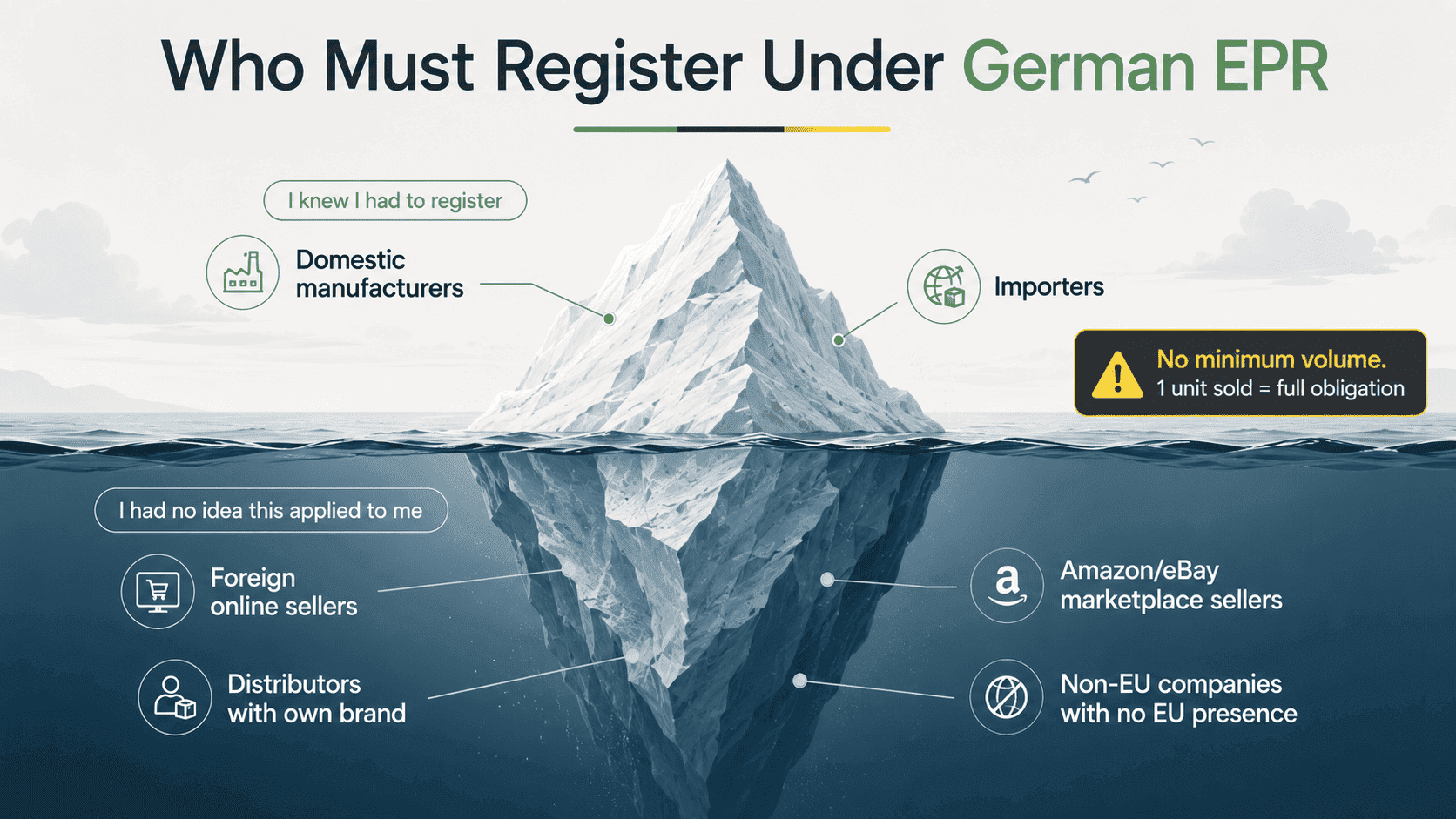
The definition of a producer under EPR in Germany is intentionally wide. It covers anyone who, for the first time commercially, places a regulated product on the local market. Headquarters location is irrelevant.
These types of businesses all carry enrolment obligations:
- Domestic manufacturers who pack goods and sell directly to end consumers
- Importers bringing products from outside the EU
- Foreign online sellers shipping directly to addresses in the country
- Marketplace sellers on Amazon, eBay, Zalando, or comparable platforms
- Distributors placing goods under their own brand for the first time
No minimum volume applies. A single unit sold triggers the duty. Non-EU companies without any EU presence must appoint a locally based authorised representative (Bevollmachtigter). Since July 2022, marketplaces must verify sellers’ EPR registration number Germany automatically before listings go live.
Selling into Germany via Amazon, eBay, or direct shipping? Lappa handles your EPR registration and secures all required identifiers. Find out the cost
The three laws behind EPR compliance Germany
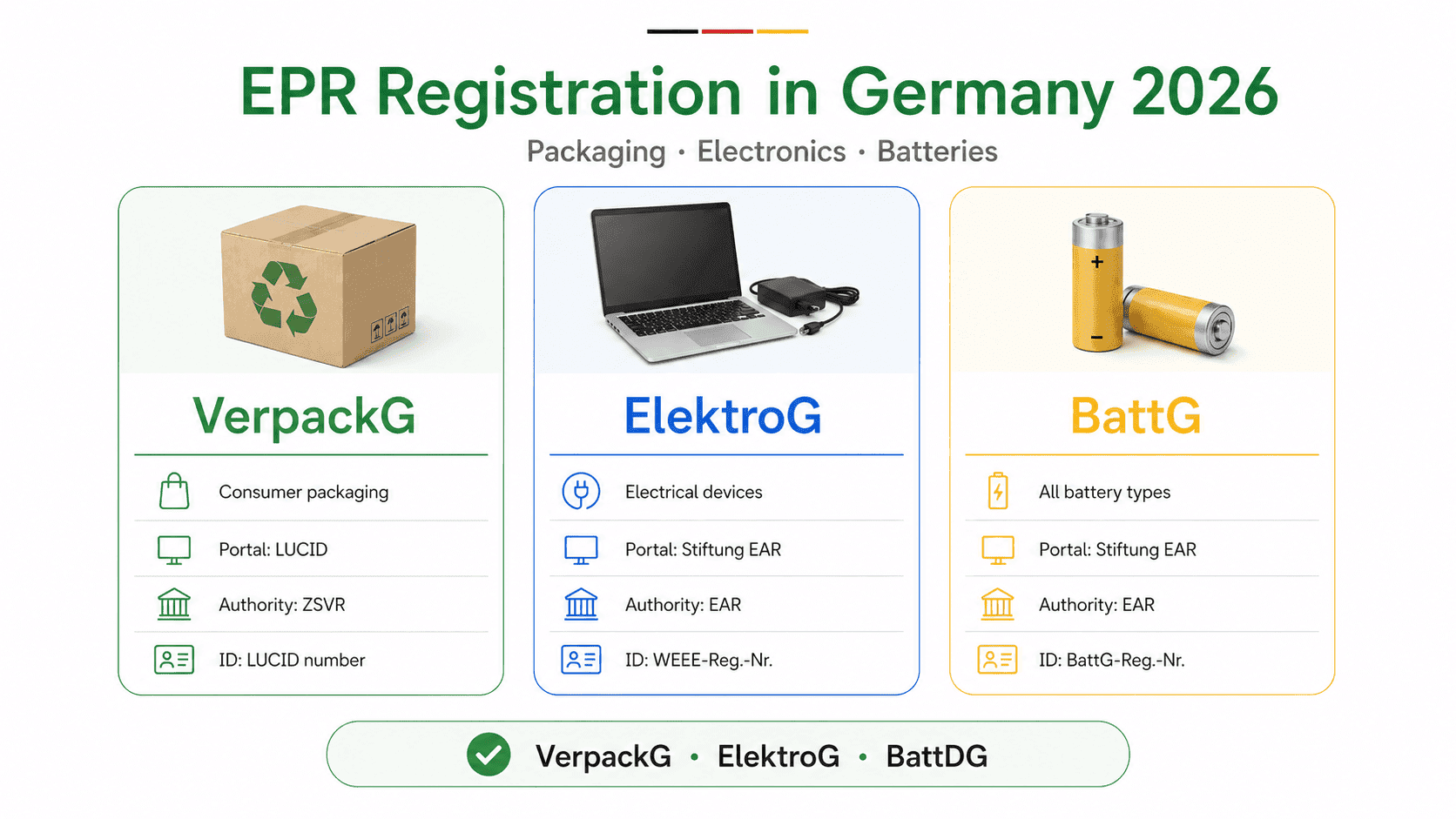
EPR compliance Germany rests on three separate statutes. Each has its own authority, portal, and fee structure.
|
Law |
Product Scope |
Authority |
Portal |
|
VerpackG |
Consumer-bound packaging |
ZSVR |
verpackungsregister.org (LUCID) |
|
ElektroG |
Electrical and electronic devices |
Stiftung EAR |
stiftung-ear.de |
|
BattG / BattDG |
All battery types, incl. in-device |
Stiftung EAR |
stiftung-ear.de |
A seller shipping a battery-powered appliance in branded packaging must satisfy all three sets of rules simultaneously. No single-window enrolment exists.
EPR registration Germany for packaging under VerpackG
Packaging is the most common entry point into EPR registration Germany. VerpackG splits the obligation into two steps that must happen in a fixed order.
Register with LUCID first
LUCID is the central public register at verpackungsregister.org, run by ZSVR. Joining costs nothing. Provide your company name, managing director, VAT or tax ID, brand names, and material categories. The system issues your identifier immediately on approval. Share it with your dual-system partner and every marketplace where your products appear.
Contract a dual system before selling
After receiving your LUCID number, sign a dual-system contract before the first sale. Operators such as Interzero, Der Grune Punkt, and Reclay handle physical collection on your behalf. Their fees are charged per kilogram by material type. Backdated agreements are not accepted.
Report volumes accurately and on time
Ongoing EPR registration reporting requires identical volume data in both LUCID and your dual system. Discrepancies trigger audits. High-volume producers above 30 tonnes of plastics or metals, 50 tonnes of paper, or 80 tonnes of glass per year must submit a Vollstandigkeitserklarung by 15 May, signed by an authorised auditor.
Electronics enrolment and Germany compliance under ElektroG
ElektroG4 entered into force on 1 January 2026 and is the most important revision since the statute was introduced. It includes tougher retailer take-back rules, expanded marketplace enforcement powers and increased penalties for non-enrolment.
Please apply for each brand and product category separately through the Stiftung EAR portal. Each brand per category receives a WEEE identifier (WEEE-Reg-Nr.) from EAR. That number should be on invoices, websites and customs paperwork. List blocks from platforms, and customs can hold shipments without.
For Germany compliance in electronics, five obligations apply:
- Enrolment by brand and category
- Annually renewed insolvency-proof recycling guarantee
- Monthly or annual quantity reports depending on volume and category
- Take-back logistics coordination
- The crossed-out wheelie-bin label on all products and listings
Battery act obligations and EPR Germany enrolment
The revised BattDG amendment, in force since 2025, extended producer responsibility Germany for batteries to the full product lifecycle under EU Battery Regulation principles. Filings, collection targets, and volume updates all became more demanding.
Open an EAR account and submit a BattG application for each brand and battery chemistry. EAR issues a BattG-Reg-Nr., separate from any WEEE identifier even where the same item contains a battery. Both codes must appear on invoices and customs documents.
15 January 2026 was the final deadline for assigning existing battery EPR registration number Germany entries to a producer responsibility organisation (OfH). Filings not assigned by that date expired automatically, removing market authorisation.
Looks like a lot? Lappa walks through all 8 steps on your behalf — from LUCID setup to BattG-Reg-Nr. issuance. Book a demo
EPR costs Germany explained
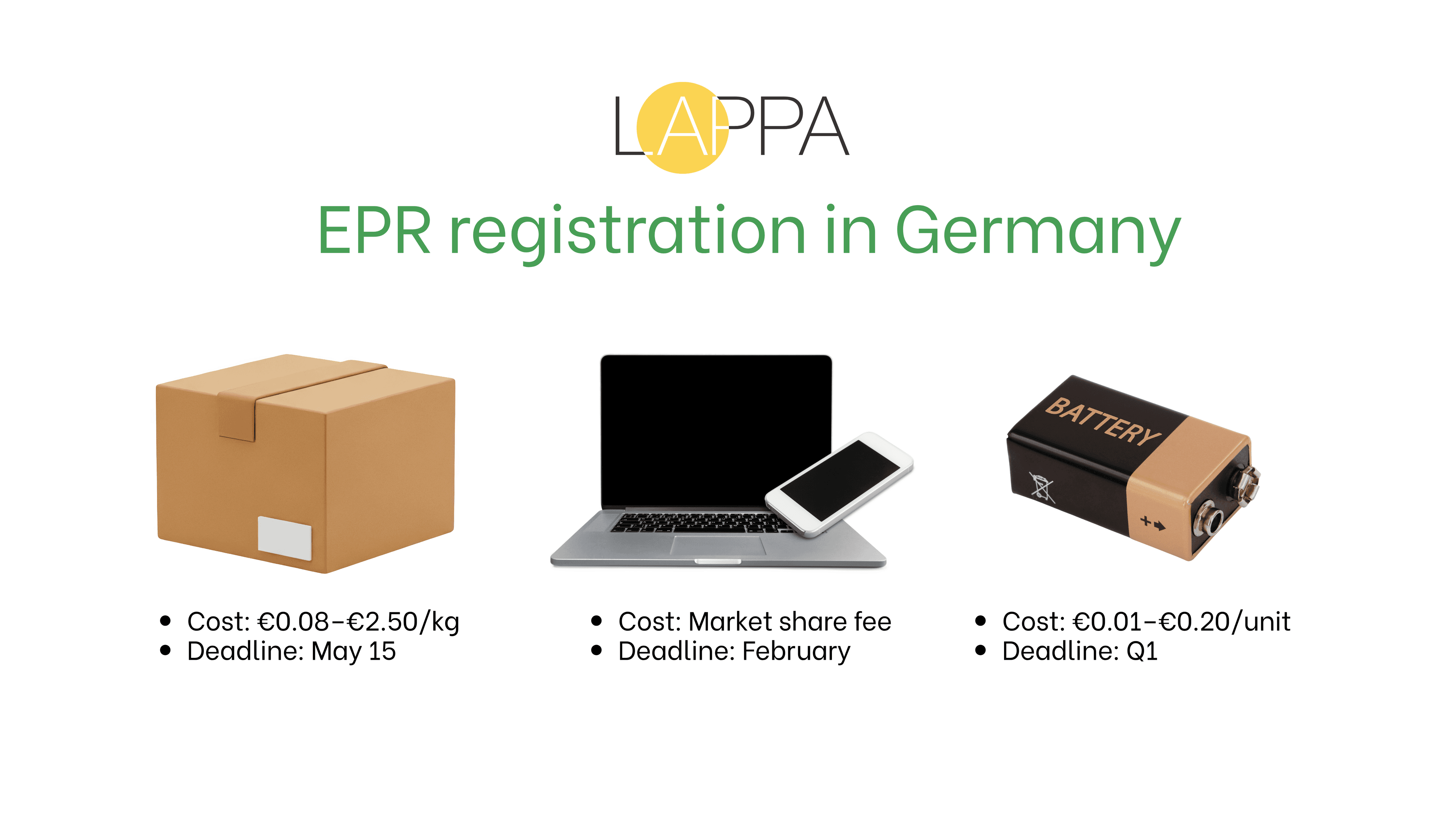
A clear view of EPR costs Germany separates fixed from variable obligations. Joining LUCID costs nothing. The real spend sits in licensing, guarantees, and periodic filings.
|
Cost Category |
VerpackG |
ElektroG |
BattG |
|
Government enrolment |
Free (LUCID) |
Annual EAR handling fee |
Annual EAR handling fee |
|
Scheme / system fee |
Licensing per kg by material |
Insolvency-proof guarantee |
Take-back scheme membership |
|
Small business floor |
From ~€39 per year |
~€200 per product category |
Variable by volume |
|
Penalties (non-adherence) |
Up to €200,000 |
Up to €100,000 |
Up to €100,000 |
Small sellers placing under 500 kg per year can find bundled annual licences with affordable registration fees starting around €39. Mid-sized businesses with mixed materials typically spend between €500 and €5,000 per year on packaging licensing alone. Electronics and battery adherence adds the EAR handling fee plus the recycling guarantee on top.
Germany registration fees by packaging material
These indicative figures, based on market rates in early 2026, show how material choice directly affects annual registration fees.
|
Material |
Rate Range (€/kg) |
Notes |
|
Paper / Cardboard |
€0.05 – €0.15 |
Cheapest category |
|
Glass |
€0.02 – €0.08 |
Low rate but heavy; total spend can be significant |
|
Metal (aluminium/steel) |
€0.15 – €0.35 |
Moderate; strong recycling infrastructure |
|
Plastic (standard) |
€0.20 – €0.60 |
Higher due to sorting complexity |
|
Plastic (composite) |
€0.40 – €1.00 |
Most expensive material type |
|
Natural fibre / wood |
€0.05 – €0.12 |
Treated as renewable material |
Eco-modulation is required under VerpackG but was not yet active as of May 2026. Once PPWR takes effect in August 2026, container design will directly shape EPR costs Germany going forward.
EPR Germany deadlines for 2026
Every missed entry in this calendar of EPR Germany deadlines can trigger a sales ban or a fine. The table covers the critical dates for the current compliance year.
|
Date |
Obligation |
Statute |
Authority |
|
15 Jan 2026 (passed) |
Final date to assign battery filings to an OfH |
BattDG |
Stiftung EAR |
|
15 Feb (annual) |
ElektroG annual report: weight by category for prior year |
ElektroG |
Stiftung EAR |
|
30 Apr (annual) |
BattG mass-balance annual report to UBA |
BattDG |
UBA |
|
15 May (annual) |
VerpackG packaging volume declaration via LUCID |
VerpackG |
ZSVR |
|
15 May (annual) |
BattDG: exact battery weight via DIVID platform |
BattDG |
Stiftung EAR |
|
15 May (large producers) |
Vollstandigkeitserklarung via authorised auditor |
VerpackG |
ZSVR |
|
Monthly / Quarterly |
Volume updates to dual system and EAR (B2C electronics) |
VerpackG / ElektroG |
Dual system / EAR |
|
12 Aug 2026 |
PPWR binding: new design and labelling rules apply |
EU PPWR |
ZSVR |
The core rule: enrolment always comes before the first sale. EPR registration reporting cycles run throughout the year. Set calendar reminders for February, April, and May as recurring annual milestones, not one-time tasks.
Don’t want to manually track every LUCID, EAR, and UBA deadline? Lappa manages your EPR reporting — accurately and on time.
Step-by-Step EPR registration process for new entrants
Follow this sequence the first time you apply. Skipping any step or reversing the order creates gaps that attract enforcement action.
- Map your product categories against all three statutes. Determine whether packaging, electronics, batteries, or a combination applies.
- Collect company data: legal name, managing director, VAT or tax ID, and all brand names used in the country.
- Open a LUCID account at verpackungsregister.org and complete the declaration. Your identifier is issued on the spot.
- Request quotes from at least two dual-system operators and sign a contract before any stock is dispatched.
- For electronics: apply on the Stiftung EAR portal per brand and category to receive your WEEE-Reg-Nr.
- For batteries: file a BattG application on the EAR portal and obtain a BattG-Reg-Nr. for each battery brand.
- Non-EU sellers: appoint a locally based Bevollmachtigter and log the mandate in the EAR portal before filing.
- Build a volume-tracking workflow by material type and device category for ongoing filing accuracy.
How to get your EPR registration number Germany
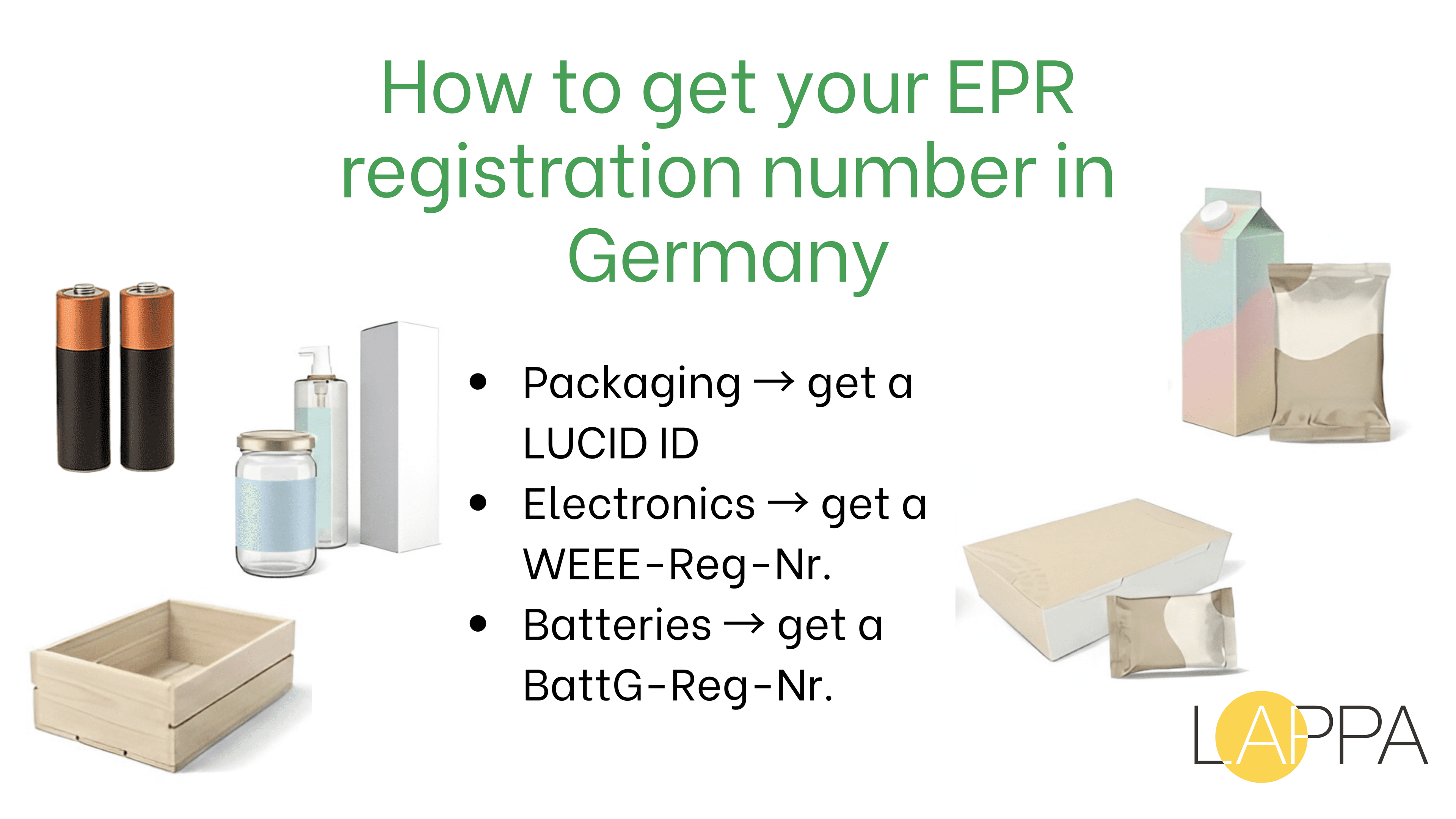
The phrase EPR registration number Germany actually covers three distinct identifiers, each issued by a different authority.
- LUCID identifier: issued by ZSVR, free of charge. Required before any consumer-bound packaged goods enter the market.
- WEEE-Reg-Nr.: issued by Stiftung EAR per brand per electronics category. Carries an annual EAR handling fee. Must appear on invoices, website listings, and customs paperwork.
- BattG-Reg-Nr.: also from Stiftung EAR. Needed for any product containing a battery. Separate from the WEEE code even when both apply to the same item.
Marketplaces run automated checks against all three codes at listing. A missing or expired identifier means automatic deactivation with no manual review.
EPR compliance Germany for cross-border sellers
Cross-border businesses face a unique challenge. The VerpackG “first placement” rule imposes liability on anyone shipping packaged goods to a local address. For EPR compliance Germany, a Polish seller shipping to consumers in Poland is treated as a domestic producer.
Non-EU companies must have a Bevollmachtigter in place before they can submit anything. This representative is responsible for the obligations of the foreign producer. The cost of a representative service for all three schemes is usually €800 to €3,000 per year, depending on the complexity and volumes of products.
Headquarters location does not affect Germany compliance requirements for cross-border businesses. A single shipment to a local address triggers the full enrolment requirement.
Frequent mistakes in EPR registration reporting
Most enforcement actions stem from a handful of recurring errors. Here are the patterns that EPR registration reporting auditors flag most often.
- Starting sales before enrolment is complete: the most common and costly mistake. No grace period applies.
- Signing the dual-system contract retroactively: operators reject backdated coverage. Fines run from the first unregistered sale.
- The false classification of materials: packaging that is actually composite is declared as paper, which results in a lower fee. The ZSVR will make a retroactive correction when it compares the data of recyclers.
- Wrong ElektroG category chosen. The device is functional to determine the class, not the product name.
- Omitting mid-year updates: VerpackG requires an amendment to LUCID when actual volumes diverge significantly from the initial forecast.
- Missing the Vollstandigkeitserklarung: high-volume producers who file after 15 May face fines even when the underlying figures are accurate.
PPWR and what changes for EPR Germany in August 2026
On 12 August 2026, the PPWR replaces VerpackG with the new VerpackDG. For businesses already enrolled in LUCID, the transition adds requirements rather than replacing everything. The scope of Germany extended producer responsibility expands to include container design criteria, harmonised recyclability grades, and PFAS restrictions in food-contact materials.
Packaging will be classified across the EU by harmonised recyclability performance grades. With eco-modulation enabled under PPWR, more recyclable containers will pay higher licensing fees. Single-use PET bottles will have to contain 25 per cent recycled content from January 2025 and 30 per cent of all single-use plastic bottles by 2030.
Mandatory QR-code labelling arrives for all new packaging from 2028. Businesses that audit their material portfolio now will face far fewer corrections after the cutover date.
Final compliance checklist for EPR Germany
- Prior to your first sale of any regulated product within the country, ensure that each of the following are true:
- Identified all product categories triggering obligations: packaging, electronics, batteries.
- Registered with LUCID and got your ZSVR ID.
- You sign a dual-system contract before any stock ships to a local address.
- Stiftung EAR applied for and received a WEEE-Reg-Nr. for each brand and electronics category.
- EAR BattG application filed, BattG-Reg-Nr. received for each battery-containing product.
- Bevollmächtigter (bei fehlender EU-Niederlassung Ihres Unternehmens vor Ort bestellt).
- Track volume by material type and device category for accurate filing over time.
- Annual milestones all due 15 February (ElektroG) 30 April (BattG) 15 May (VerpackG)
- Transition deadline: 12 August 2026 Prior to transition, compare your packaging portfolio with PPWR recyclability grades.
- Verified that all marketplace listings contain valid identifiers for each relevant statute.
The EPR Germany framework is demanding but the rules are clearly written and publicly documented. Businesses that enrol before selling, file accurately on schedule, and monitor legal updates avoid the penalties that catch unprepared operators every year.
Lappa helps producers, importers, and online sellers manage the full adherence lifecycle, from EPR registration Germany through to annual filings and PPWR transition planning.
Frequently Asked Question
The trigger is the first commercial placement of a regulated product on the local market. A single packaged shipment to a consumer in the country is sufficient. Under VerpackG, anyone who fills containers and dispatches them to a local address qualifies as a producer. There is no minimum quantity. The duty attaches immediately to the entity making that first placement, whether based domestically, in the EU, or anywhere else in the world.
For electronics and batteries, EPR in Germany operates the same way: one unit sold requires a valid identifier. Authorities and platforms verify adherence before sales begin, not after the fact.