

Lithuania EPR compliance for non-EU companies: GPAIS and TIN requirements
A manufacturer in Shenzhen, a consumer brand in Ohio or an exporter in Birmingham decides to supply packaged goods to Lithuanian customers. It already files in Germany and France, so this market looks like a small add-on. Then the questions start:
• Is the foreign manufacturer responsible, or the local importer?
• Does anyone need to enter GPAIS?
• What does the 500 kg packaging threshold actually change?
• Is a Lithuanian tax identification number (TIN) needed?
• Are translations, a Power of Attorney or an authorised representative required?
Here's the short answer. Lithuania EPR registration for non-EU companies begins by identifying the producer or importer that's legally responsible. Only then do you check GPAIS, packaging records and tax identification for that particular business. The 500 kg threshold doesn't switch off every obligation, and the rest depends on legal structure, product categories and route to market. For the basics of the national scheme, see our overview of Lithuania EPR requirements.
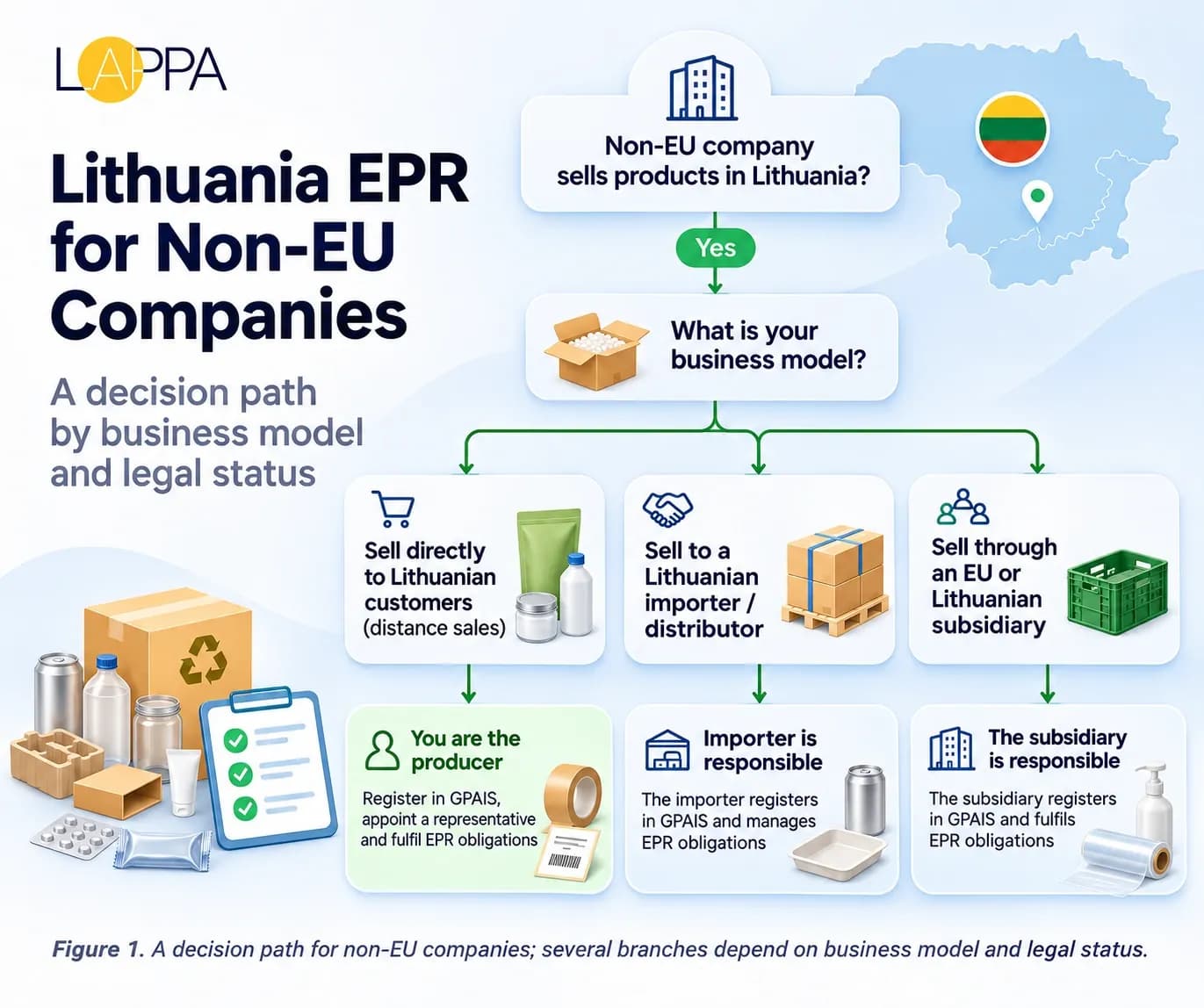
Who is responsible for EPR when a non-EU company sells in Lithuania
Get this wrong and every document you prepare belongs to the wrong firm. Under Regulation (EU) 2025/40, the Packaging and Packaging Waste Regulation (PPWR), the producer is broadly whoever first makes packaged goods available on a Member State's market. A business outside the EU fits that definition when it sells directly to end users there. The national Environmental Protection Agency (AAA) requires producers and importers alike to register, keep records and submit reports.
Foreign manufacturers, local importers and EU subsidiaries
Three set-ups come up again and again. A non-EU manufacturer sells to an independent Lithuanian importer. A non-EU brand ships straight to consumers, often from its own web shop. Or a multinational group trades through an EU or Lithuanian subsidiary. In none of them is the manufacturer automatically the producer, so trace the real flow of goods and invoices first.
|
Business model |
Potential responsible entity |
Information to verify |
Registration considerations |
|
Sells to an independent local importer |
Usually the importer |
Delivery terms, who first supplies the market |
Importer enrols; manufacturer may only supply data |
|
Sells directly to consumers |
The non-EU brand, as distance seller |
Seller of record, shipping boxes |
Producer entry plus a representative under PPWR Article 45(3) |
|
Sells through an EU subsidiary |
Often the subsidiary |
Intra-group sales, stock location, invoicing |
Subsidiary's own entry; parent may need none |
|
Sells through a local subsidiary |
The local subsidiary |
Import role, local packing |
Standard local entry |
|
Sells on an online marketplace |
Depends on seller of record |
Platform terms, fulfilment model |
Platforms may ask for proof before listing |
These rows are illustrations, not legal conclusions. Once the responsible entity is clear, Lappa's registration services can take the filing from there.
What is GPAIS registration in Lithuania
GPAIS is the Unified Product, Packaging and Waste Record Keeping Information System, sometimes shown in English as PPWIS. Since 2 January 2018 it has held the Register of Producers and Importers, and that data is public.
GPAIS and the Register of Producers and Importers
GPAIS is the system; the register is one function inside it. When people search for GPAIS registration Lithuania, they usually mean entering a firm in that register for the streams it supplies. Packaging accounting and reports then run through the same account. Packaging sits beside electrical equipment, batteries, tyres and other streams, each selected separately.
Foreign firms face specific mechanics. The platform doesn't support eIDAS log-in, so a person acting for the business first opens a foreign-user account. That person, an employee or a service provider, then creates an account for the foreign firm and enters it in the directory, as the GPAIS guide for foreign users explains. One representative can handle several firms, but each is entered separately.
Is GPAIS registration the same as PRO membership
No. Three processes interact here without merging:
• GPAIS entry is administrative: the firm sits in the national register and keeps its records there.
• PRO participation is a contract with a licensed organisation that takes on agreed waste duties. The AAA lists licensed packaging organisations, including Žaliasis taškas and Gamtos ateitis.
• Taxpayer registration identifies a foreign legal entity for Lithuanian tax purposes.
Joining a PRO doesn't remove the duty to register, keep records and report. The AAA treats those as obligations of every producer and importer.
|
System or arrangement |
Main purpose |
What must be checked |
|
GPAIS / producer register |
Producer identification and statutory records |
Entry and reporting requirements |
|
PRO arrangement |
Packaging waste management obligations |
Participation, contract and reporting conditions |
|
Lithuanian taxpayer registration |
Tax identification and administration |
Whether VMI registration is necessary |
|
Authorised representation |
Acting under a legal mandate |
Whether appointment is required and how it is recorded |
How does the 500 kg packaging threshold affect EPR compliance
This is the part most often misread. The Lithuania EPR 500 kg threshold is a tax rule, not an enrolment threshold.
What happens below 500 kg
National pollution tax law exempts producers and importers placing no more than 0.5 tonnes of packaging on the domestic market in a tax period, provided they keep packaging records. According to Ministry of Environment guidance, the relief covers single-use packs outside the deposit system. The same guidance indicates that low-volume firms may still need to file the FR0524 pollution tax declaration.
So the tax bill can vanish below 500 kg. Register entries, records and reports don't, unless a separate exemption applies. In July 2026 GPAIS said its guidance on when entry is needed, and on exemptions, was still being prepared. Check the current position first.
What changes above 500 kg
Above the line, the money side becomes real. Review:
• whether waste management runs through a PRO or individually
• pollution tax treatment, which depends on how those duties are met
• accounting by material and pack type
• reporting duties and their timing
• any extra identification steps
Crossing 500 kg doesn't automatically trigger a Lithuanian TIN for every non-EU firm. It does make contact with VMI more likely.
Does the threshold work differently for non-EU producers
The figure itself treats EU and non-EU firms alike. What differs is everything around it: how a foreign business is identified, who signs for it and whether a representative is needed.
|
Scenario |
GPAIS / registration |
PRO / waste management |
TIN |
|
EU company, up to 500 kg |
Check entry rules and exemptions |
Assess obligations |
According to tax status |
|
Non-EU company, up to 500 kg |
Check entry rules and exemptions |
Assess obligations |
Confirm identification needs |
|
EU company, above 500 kg |
Check entry and reporting duties |
Confirm the arrangement |
According to tax status |
|
Non-EU company, above 500 kg |
Check entry and reporting duties |
Confirm the arrangement |
Verify whether VMI registration applies |
When does a non-EU company need a Lithuanian TIN
Not always. It depends on what the business does in the country and which procedures it must complete, so treat blanket rules with suspicion.
Part of the confusion comes from numbers that look alike but do different jobs. A home-country company number, a home tax identifier, a Lithuanian taxpayer code, an EU VAT number and a GPAIS identifier are not interchangeable.
Registering a foreign legal entity with VMI
The State Tax Inspectorate (VMI) adds foreign legal persons to the Taxpayer Register using form FR0227. Per VMI's guidance, the form goes in online through My STI or on paper. It's accompanied by a legalised copy of the foreign registration certificate or register extract.
Documents not in Lithuanian need a translation signed and sealed by the translator. If an authorised person files, the original authorisation and a certified translation go with it. VMI says it decides within five working days of a complete application. FR0227 is a tax form, though. It puts nobody on the producer register.
Is a Lithuanian TIN always mandatory
Not necessarily. A practical trigger is the pollution levy itself: a foreign firm that must declare or pay pollution tax in its own name will be dealing with VMI. If a local importer is the producer, the manufacturer may never face a TIN registration Lithuania procedure. Settle the Lithuania EPR TIN question with VMI or a qualified adviser, and keep the answer on file.
Can Chinese companies use their Unified Social Credit Code
China makes a useful example, though the logic applies to any non-EU country. The Unified Social Credit Code (USCC) identifies a Chinese entity and, per China's tax authority, also serves as its taxpayer number. It has 18 characters and can include letters, mostly in the last ten positions, so it isn't always 18 digits. It appears on the business licence.
Does the USCC replace a Lithuanian TIN
No, not automatically. The USCC proves who the business is at home, which makes it useful evidence in the register, a PRO contract or a VMI application. Where local taxpayer registration is required, it doesn't stand in for it.
Say a Shenzhen manufacturer submits its licence and USCC. Its team should then check whether the rules point at the manufacturer or its importer, whether VMI is involved and what translation the recipient expects. A Turkish tax number or a US EIN raises the same questions.
What documents may non-EU companies need for EPR registration
Requirements vary by recipient, so treat this as a starting list
Company identification documents
• certificate of incorporation or a recent register extract
• exact legal name and registered office
• home-country tax identifier
• authorised signatories
• a Power of Attorney, where someone acts for the firm
Power of Attorney, sworn translations and apostilles
A Power of Attorney shows a representative may act for the business. A certified or sworn translation meets the receiving institution's rules; VMI, for instance, wants translations signed and sealed by the translator. An apostille authenticates public documents from countries in the Hague Apostille Convention, while others may need full legalisation.
Most rejections trace back to small mismatches. A legal name spelled two ways, an ID missing a character, an unauthorised signatory or an expired extract will all bounce.
|
Document |
Why it may be requested |
Translation required? |
Apostille/legalisation required? |
Verification owner |
|
Certificate of incorporation or extract |
Proves the firm exists |
Confirm* |
Confirm* |
Legal team |
|
Business licence with USCC (China) |
Home-country identifier |
Confirm* |
Confirm* |
Legal team |
|
Power of Attorney |
Authority for a representative |
Confirm* |
Confirm* |
Legal team and representative |
|
Signatory list or board resolution |
Shows who may sign |
Confirm* |
Confirm* |
Company secretary |
|
Home tax certificate |
Supports identification |
Confirm* |
Confirm* |
Tax team |
*Confirm with the receiving authority; nothing here is automatically required.
Need help preparing Lithuania EPR registration documents

Do non-EU companies need an authorised representative in Lithuania
When authorised representation may be required
Four roles get mixed up: the foreign producer, a local importer (which may itself be the producer), a representative appointed by written mandate and a contracted provider that simply files or advises. A local consultant isn't automatically a representative.
Under PPWR Article 45(3), a producer selling directly to end users in a Member State where it isn't established must appoint a representative there. So a non-EU brand selling online needs an EPR authorised representative Lithuania recognises. A manufacturer selling only to a local importer usually doesn't, because the importer is the producer.
How PPWR affects foreign producers
The PPWR's main provisions have applied since 12 August 2026. On 2 September 2026 the AAA announced that GPAIS couldn't yet enter foreign producers through an appointed representative; the workflow will be published on the GPAIS site.
Check the status before planning the filing. Amendments to Article 45(3) have also been proposed at EU level. Lappa offers authorised representative services across EU markets, so ask the team about the Lithuanian route for your structure.
How to register for EPR in Lithuania as a non-EU business
Lithuania packaging waste registration goes smoothly when the order is right. For non-EU producer registration, here's the sequence we'd follow:
1. Identify the responsible producer or importer, meaning whoever first makes goods available in the country.
2. Assess product categories. Packaging, WEEE and batteries have separate rules.
3. Calculate volumes by material, then see whether the 500 kg relief matters.
4. Confirm GPAIS duties, from the register entry to the reports that follow.
5. Review PRO and representation arrangements.
6. Verify tax identification and prepare translations and authentication.
7. Set up ongoing management: reporting owners, records and deadlines.
How multinational groups can manage Lithuanian EPR across multiple legal entities
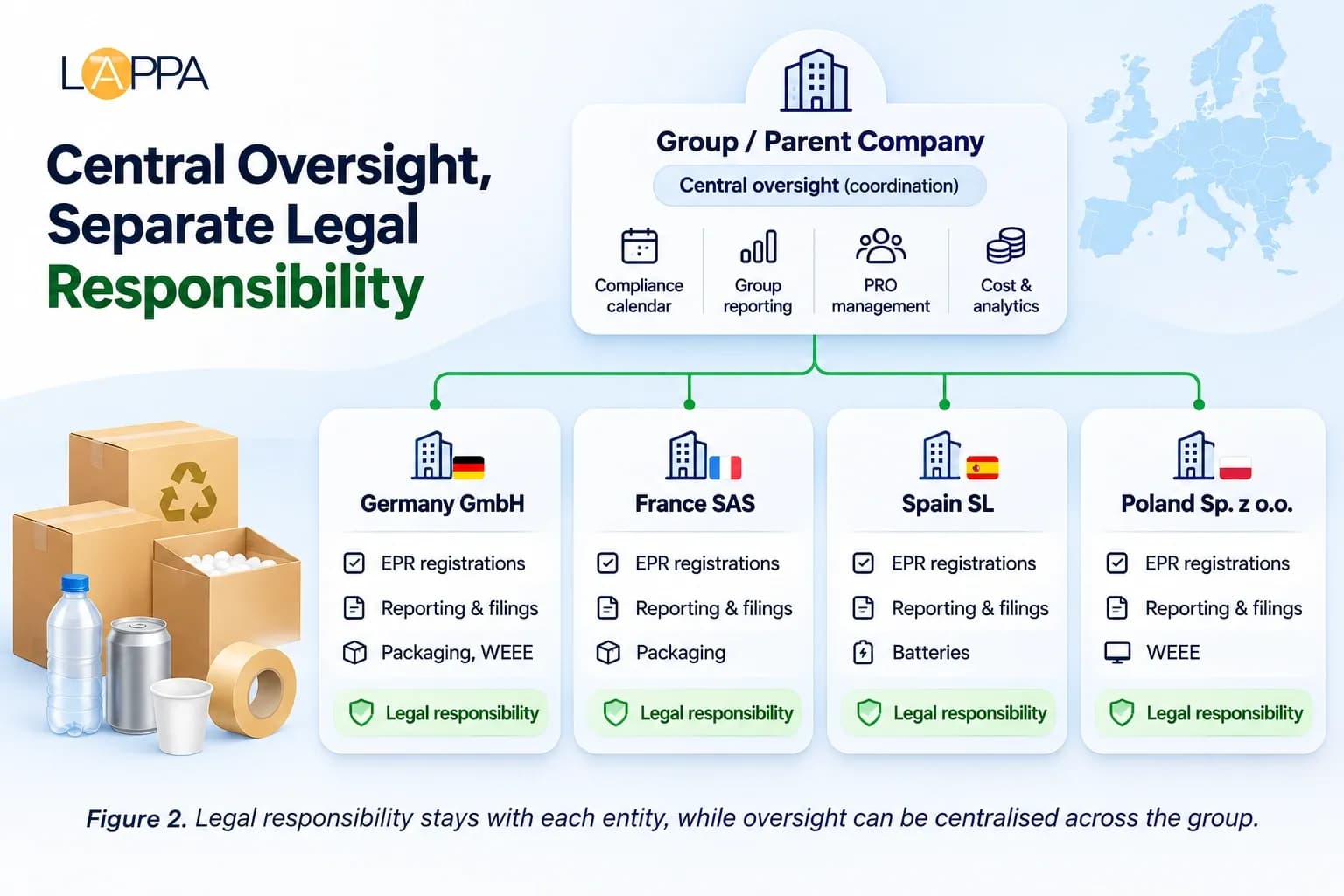
Which entity should be registered?
Take a hypothetical electronics group. Its US parent owns the brand and manufactures in Vietnam. A German subsidiary imports into the EU and supplies an independent distributor in Vilnius, while the parent also sells online to consumers there. Packaging, WEEE and batteries all apply.
The country isn't one obligation for this group. The distributor may be the producer for what it buys, the German subsidiary for goods it ships to local retailers and the US parent for web-shop orders. That's why EPR compliance for foreign companies gets complicated. Our guide to managing obligations across multiple legal entities covers the mapping method, and multi-entity EPR software keeps each firm's records separate.
|
Group entity (hypothetical) |
Market |
Product / packaging stream |
Potential responsible producer |
Registration status |
Reporting owner |
|
US parent, web shop |
Lithuania |
Packaging, incl. shipping boxes |
US parent as distance seller (verify) |
Not assessed |
Group compliance |
|
US parent, web shop |
Lithuania |
Batteries in devices |
Verify for this stream |
Not assessed |
Group compliance |
|
German subsidiary |
Lithuania |
Packaging and WEEE |
Subsidiary, for direct retail sales (verify) |
To assess |
EU compliance lead |
|
Independent distributor |
Lithuania |
Packaging |
Distributor as importer (confirm by contract) |
Its own |
Distributor |
|
German subsidiary |
Germany |
Packaging |
Subsidiary |
Existing (example) |
EU compliance lead |
Centralising reporting across Europe
The compliance director's job is folding Lithuania into the European programme without blurring who files what. One calendar, one packaging data set, separate declarations per entity. Headquarters sees everything; each firm keeps its own duties.
Groups doing this at scale often move to centralised compliance across Europe. Procurement can compare providers with our enterprise software RFP checklist, and security reviewers usually start with Lappa Security & Trust. For published multi-market work, see the Geely customer story.
Managing EPR across several European markets?
EPR reporting and environmental fee management in Lithuania
Packaging data and reporting
Getting listed is the start, not the finish. Quantities are then recorded by material and type and reported through GPAIS for each period. Someone must own the data, validate it and submit on time. Periods and deadlines come from national rules and from any PRO contract, so diarise both.
Environmental fees and PRO payments
Four costs often get lumped together. Pollution tax is statutory and runs through VMI, while PRO contributions are contractual. Administrative charges may apply in some cases, and service fees are separate again.
Paying a PRO or provider doesn't remove statutory duties such as entry and reporting. Lappa's reporting software tracks deadlines across markets, and consolidated eco-fee management checks invoices against reported data.
Keep Lithuanian EPR reporting aligned with your European obligations
Lithuania EPR compliance checklist for international companies
Use it as a working list, not a recap.
Before you register
• Identify the responsible entity.
• Confirm the applicable streams.
• Review packaging quantities.
• Determine GPAIS requirements.
• Assess tax identification needs.
While registering
• Confirm the route.
• Prepare company documents.
• Verify translation and authentication rules.
• Arrange PRO and representative services where needed.
• Check the submitted details.
After registration
• Maintain packaging records.
• Track reporting deadlines.
• Review environmental charges.
• Monitor legislative changes.
• Keep evidence for each legal entity.
Frequently asked questions about Lithuania EPR registration
Often, though not always the non-EU business itself. A Lithuanian importer usually holds the duty for goods it brings in, while a non-EU brand selling straight to consumers is likely to be the producer. Groups trading through an EU subsidiary may find the subsidiary is responsible instead. The answer can also differ by stream, so packaging, WEEE and batteries each need their own check. Map the supply chain before anyone registers.