

Best Software for Automated Packaging EPR Reporting Across Multiple EU Countries
Best Software for Automated Packaging EPR Reporting Across Multiple EU Countries
There isn't one. Not in the way buyers want to hear it, anyway. Take a Berlin homeware brand filing in two countries. Now take a marketplace with producer numbers in twelve. Nothing that suits the first will suit the second. Any article handing you a single winner is selling something.
What settles it is narrower. Duller, too. Does the thing cover your markets? Does it read the systems your pack data already lives in? Does it hold every national deadline? Can it put a number on your eco-fees per material? Answer those four and your shortlist collapses in an afternoon.
Short answer if you're comparing tools right now. You file in several EU markets. You want packaging records, country-level transactions, declarations, registration status, eco-fee position and compliance documents in one workspace. Lappa covers that ground today. It's built for multi-market producers and ecommerce sellers. Not for someone filing once a year in a single country. The capability table further down sets out what the platform actually holds, field by field.
What Is Packaging EPR Reporting Software
EPR reporting software takes raw sales and packaging data and turns it into the declarations national schemes expect, then keeps the filing calendar from drifting. It sits between your commerce stack and whoever you answer to. Repeatability is the whole point. You file the same shapes of data every period without rebuilding the work from scratch, which sounds unglamorous until you've done it the other way.
Spreadsheets handle one country perfectly well. I'd never tell a single-market seller to buy software. They stop coping around the third country. Faster than teams expect, too. Different material categories. Different units, a different file layout, a different due date. All of it in one workbook nobody wants to inherit when its author leaves. Version drift is how the errors get in. Always.

Why Packaging EPR Compliance Is Difficult Across EU Countries
Germany and France do not use identical packaging reporting rules. A workflow built for one market may not satisfy the other. Strong packaging EPR compliance means running several national processes side by side, and that's a different job from running one process six times.
The duties stack in layers. Register in each national producer register. Join or contract a producer responsibility organisation where the country insists on one. Declare placed-on-market data by material and weight. Then pay fees that move with how recyclable the format is.
Here's where it gets tricky. Filing rhythms shift by country and by your own volume, which catches people out. Italy's CONAI moves a member between annual, quarterly and monthly declarations as declared fees grow. So the cadence you set up in year one may be wrong by year two. Poland runs a single annual return through BDO. Treat all six markets as one yearly exercise and you'll miss a quarter somewhere.
One distinction worth keeping straight, because plenty of articles blur it. Everything above applies now. The Packaging and Packaging Waste Regulation, Regulation (EU) 2025/40, has been applicable since 12 August 2026. It layers harmonised design and conformity duties on top of the reporting you already do. More detail is still coming through delegated acts. So treat recyclability grades and the 2030 thresholds as planning horizons, not as this quarter's filing rules.
How Automated EPR Reporting Works
Automated EPR reporting runs a fairly predictable chain, and knowing the chain tells you exactly what to poke at during a demo. Data in, classified, calculated, validated, out on a schedule.
The stages look like this in practice:
• Collection — sales and SKU data pulled from your ERP, webshop, marketplace, or warehouse records
• Classification — each component mapped to the right material and category per market
• Calculation — placed-on-market quantities worked out by weight and material, never by sales value
• Validation — totals checked against scheme rules and the prior period before anything is filed
• Submission and payment — the return lodged in the right portal, with the eco-fee invoice tracked after
For a retailer selling into eight EU markets, automation strips out the repetitive preparation. It also helps a compliance team keep country-specific obligations in view. It won't remove judgement. Anyone promising that is overselling. Someone still owns the material mapping. Get a category wrong at that stage and the mistake quietly propagates into every return downstream.
Where EPR Reporting Automation Pays Off
EPR reporting automation earns its keep in two places. Deadline coverage, and eco-fee calculation. Missing a national window is the expensive failure — far more expensive than the licence — and holding calendars is precisely what software is good at.
We see this happen often with fast-growing brands. Sales creep into a new country. Nobody updates the filing calendar. The first anyone hears about it is a frozen listing on a Tuesday morning. Automated deadline tracking turns that from a nasty discovery into a reminder three weeks out.
Key Features to Look for in EPR Compliance Software
Five practical criteria separate a useful platform from another reporting spreadsheet. Good EPR compliance software clears all five before it earns a place on the shortlist.
• Multi-country coverage that genuinely includes every market you sell into
• Integrations with your actual stack, whether NetSuite, Shopify, BigCommerce, or a marketplace export
• A deadline calendar with alerts, broken down per country and per waste stream
• Validation rules that catch unit and material errors before submission, not after
• An audit trail showing who filed what, when, and from which data
Scalability deserves its own look. It rarely gets one. A tool that handles packs but not batteries forces a second system. That happens the moment you ship a device with a cell in it. So ask the awkward question: what breaks when I add a market, a stream, or ten thousand SKUs?
Best Packaging EPR Software Solutions for EU Businesses
Comparing packaging EPR software honestly starts by sorting tools into types rather than brand names. Much of the ranking content out there is written by the vendors themselves. Worth remembering as you read it. The categories will tell you more than the league tables do. There are four broad approaches. Most teams climb this list as they add markets.
|
Approach |
How it works |
Suits |
Where it strains |
|
Spreadsheets and internal trackers |
Manual collection, classification and filing |
A single market at low volume |
Breaks around the third country, and version drift creeps in |
|
Scheme and authority portals |
You file directly in each national system |
Businesses active in one or two markets |
One login per country, with no consolidated view |
|
Design and fee-modelling tools |
Model recyclability and estimate eco-fees |
Packaging design and PPWR readiness work |
Many calculate rather than file returns |
|
Consolidated compliance platforms |
One workspace for records, registrations, declarations and documents |
Multi-market producers, ecommerce sellers and groups |
Scope differs by market, so coverage needs checking |
The fourth row is where multi-market teams generally end up. Not because anyone set out to buy a platform. Once you hold producer numbers in five or six countries, the bottleneck stops being any individual return. It becomes keeping records, deadlines and documents aligned across all of them at once. That's a consolidation problem. Spreadsheets were never going to fix it.
Whichever category you shortlist from, test it the same way. Your SKUs, your markets, a real reporting period. A demo running on tidy vendor sample data tells you almost nothing about your own catalogue.
Comparing EPR Reporting Across EU Countries
Software has to absorb the national differences, because you can't. Useful EPR reporting across EU countries rests on the platform knowing each register, each format and each rhythm. The table shows why a single template won't stretch across the bloc.
|
Country |
Register or scheme |
Filing rhythm |
Practical note |
|
Germany |
LUCID, plus a dual system contract |
Ongoing volumes, plus annual completeness |
Two separate steps, often mistaken for one |
|
France |
Citeo, with a unique identifier |
Annual, with pre-declaration for larger filers |
The identifier gets requested constantly |
|
Spain |
Ecoembes, plus the national register |
Annual |
Producer and scheme duties sit apart |
|
Italy |
CONAI |
Annual, quarterly or monthly by declared volume |
Cadence changes as your fees grow |
|
Netherlands |
Verpact, formerly Afvalfonds |
Annual, above a weight threshold |
The threshold decides whether you file at all |
|
Poland |
BDO |
Annual |
Return typically due in mid-March |
Dates and thresholds move. Check each one against the national authority or scheme before you file — not against a blog post, including this one. Lappa's EPR guides and its compliance blog track the changes market by market.

How to Choose Packaging EPR Software for Your Business
Start with your market map, not a feature list. Write down every country where your goods first reach a customer. Then every waste stream those goods touch. Packaging, electronics, batteries, whatever is in the box. One page. It eliminates most vendors before you've sat through a single call.
Ecommerce businesses in two or three markets should weigh integration quality above all else. Can the tool read your Shopify or Amazon data cleanly? If not, you've bought a spreadsheet with a login screen. Growing retailers should test the mid-year scenario, because that's the one that hurts: what happens when a market is added in August? Enterprise teams should press hardest on audit trails, user permissions and security documentation. Internal audit will ask. They always ask.
Price the whole picture, not the licence. Scheme fees and local representation usually dwarf the software line. The admin wrapped around both adds more again. Published EPR pricing helps you model the service layer. An EPR fee calculator gets you a working figure for the fees themselves.
How Lappa Supports Packaging EPR Reporting
Lappa L'EPR is an EPR reporting platform for businesses tracking obligations in several markets at once. Everything in the table below is visible in the product interface, reviewed in October 2026. Treat it as a straight answer to the question buyers really ask. Can one platform hold the whole compliance operation?
|
What multi-market teams need |
Does Lappa provide it |
How it appears in the platform |
|
SKU-level packaging records |
Yes |
A seven-step builder covering name and type, elements, composition, dimensions, eco-modulation, store and category, then review |
|
Component-level material data |
Yes |
Each element carries a material type, a component weight and its share of total weight |
|
Composite and multi-layer packs |
Yes |
Single-material, composite and multi-layer compositions are all selectable |
|
Primary and shipping packs apart |
Yes |
Separate sections manage each packaging type |
|
Country-level transaction records |
Yes |
Transaction ID, date, category and subcategory, country, quantity and unit, filterable by country and period |
|
Declaration tracking per market |
Yes |
Reporting period, document type, country, declared quantity, filing date and submission status |
|
Eco-fee and payment visibility |
Yes |
Fee amount, fee due date and payment status shown as Paid or Not Paid |
|
A multi-market reporting calendar |
Yes |
Deadlines by country, category, frequency and reporting period on the dashboard |
|
Registration progress tracking |
Yes |
Awaiting Documents, Under Internal Review, Ready for Filing, Registration Issued |
|
Registration records per market |
Yes |
Number, jurisdiction, category, system operator, periodicity, first period due, validity and representative |
|
Compliance document control |
Yes |
Document requests carrying Approved, In Review and Not Accepted statuses |
|
In-platform guidance and support |
Yes |
Help centre with FAQs, training material and chat-based assistance |
A few rows deserve unpacking. Pack records get built component by component. A bottle, its lid and its label each carry their own material and weight. They don't disappear into one vague line. That's the difference between a record you can defend and a number you hope nobody questions.
Existing records clone, which saves genuine hours across a range sharing one carton. The eco-modulation fields capture recycled content, recyclability classification and end-of-life recyclability. So you're holding the attribute set those assessments lean on.
The registration tracker is the bit multi-country teams underrate. It shows where every application stands. VAT and IOSS registrations show up in the same view, which helps when tax and compliance land on the same two people. Declarations then sit next to transactions. A pending return and the quantity behind it are one click apart, not two systems apart.
Consolidation is the real argument, though. Pack data, transactions, registrations, declarations and documents in one workspace instead of five trackers. Country filtering runs across all of it. For groups running many entities, the centralized compliance approach goes straight at that. At scale, consolidation is the harder problem. Harder than any single filing.
Two things worth asking on the call, as you would of any vendor. How does data get into the platform from your particular channels? And which markets and streams are in scope for your catalogue? Have a look at the wider product set on the Lappa site. Then book a demo and point it at your own SKUs.
Frequently Asked Questions About Packaging EPR Software
Can packaging EPR reporting be automated? Most of it can — data collection, quantity calculation, validation, deadline tracking, and in many cases the submission itself. What resists automation is the judgement layer, like deciding which material category an unusual component belongs in. Expect software to take away the repetitive preparation while a named person still signs off the mapping and the final numbers.
Is there one EPR reporting platform for all EU countries? No platform removes the need for separate national registrations, because every member state runs its own register and scheme. What decent software does is centralise the data and the calendar sitting behind those filings, so one dataset feeds many returns. Check any vendor's current country list against your own market map rather than assuming the coverage is complete.
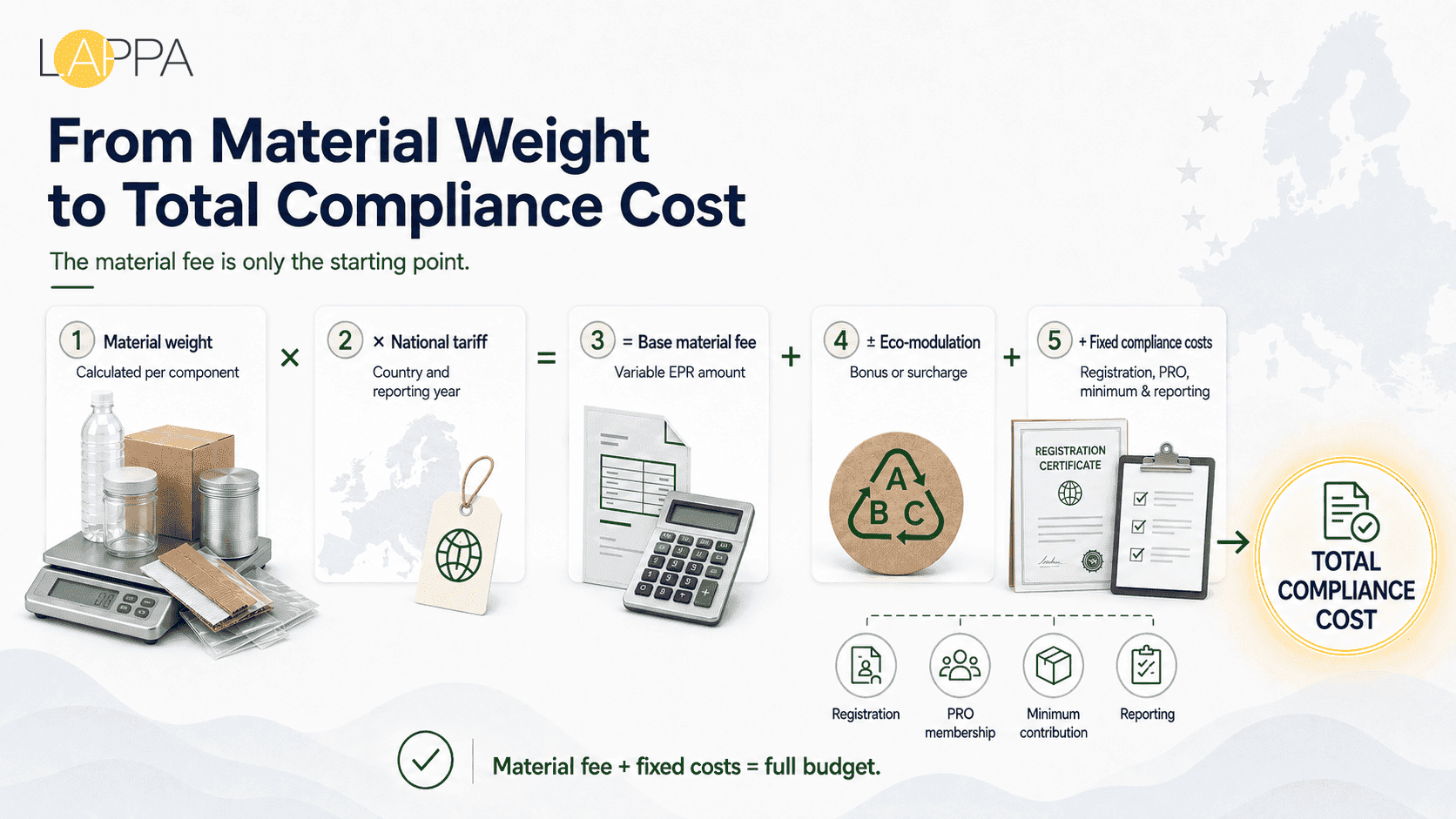
How do businesses calculate packaging eco-fees? Fees come from the weight and material of what you placed on each market, then eco-modulation adjusts them so harder-to-recycle formats cost more. That makes accurate per-component weights matter far more than sales figures. A calculator gives you a planning estimate; the binding amount arrives from the scheme once the declaration is filed.
What data is needed for packaging EPR reports? At minimum, country, material, weight, product category and the reporting period. Most schemes also want the channel split, B2C against B2B, and placed-on-market quantities rather than revenue. Supplier specifications and a reliable SKU database are usually where that detail has to come from.
Can Lappa handle EPR reporting for several EU countries at once? Yes. The platform is built around multi-market working, with country-level transaction records, per-market registration details and a reporting calendar showing deadlines by country, category and reporting period. Declarations, eco-fee amounts and payment status live in the same workspace. A team filing in six markets checks all six from one place, not six trackers. Confirm your specific markets and waste streams are in current scope when you book the demo.
How does EPR software help businesses operating in multiple EU countries? It pulls fragmented obligations into one dataset and one calendar. That is where multi-market teams lose most of their time. Rather than six workbooks and six sets of reminders, you keep one source of truth. It produces each national return in the format that market wants. The practical win is fewer missed deadlines and fewer manual errors — not an exemption from anybody's national rules.