


How to manage EPR compliance across multiple legal entities
Take a European electronics group with five subsidiaries and seven markets. One of them imports finished devices from Asia. Another sells to French retailers. A third runs a web shop for consumers, and a fourth repairs products and ships spare batteries. All of them touch packaging, WEEE or battery rules. Rarely the same ones, though.
This is where multi-entity EPR compliance begins: working out which business in the group holds each producer obligation, then running the lot as one programme. For the group above, that means juggling:
• producer registrations spread over several registers
• deadlines that don't line up between countries or streams
• more than one producer responsibility organisation (PRO)
• eco-fee invoices addressed to different subsidiaries
• product data sitting in three or four systems
• patchy sight from head office
Managing everything centrally doesn't merge the statutory duties of independent subsidiaries, and each one keeps its own status, numbers and filings. What follows is an operating model that gives head office full sight while accountability stays where the law put it. Already comparing tools? Here's how Lappa approaches multi-entity EPR software.
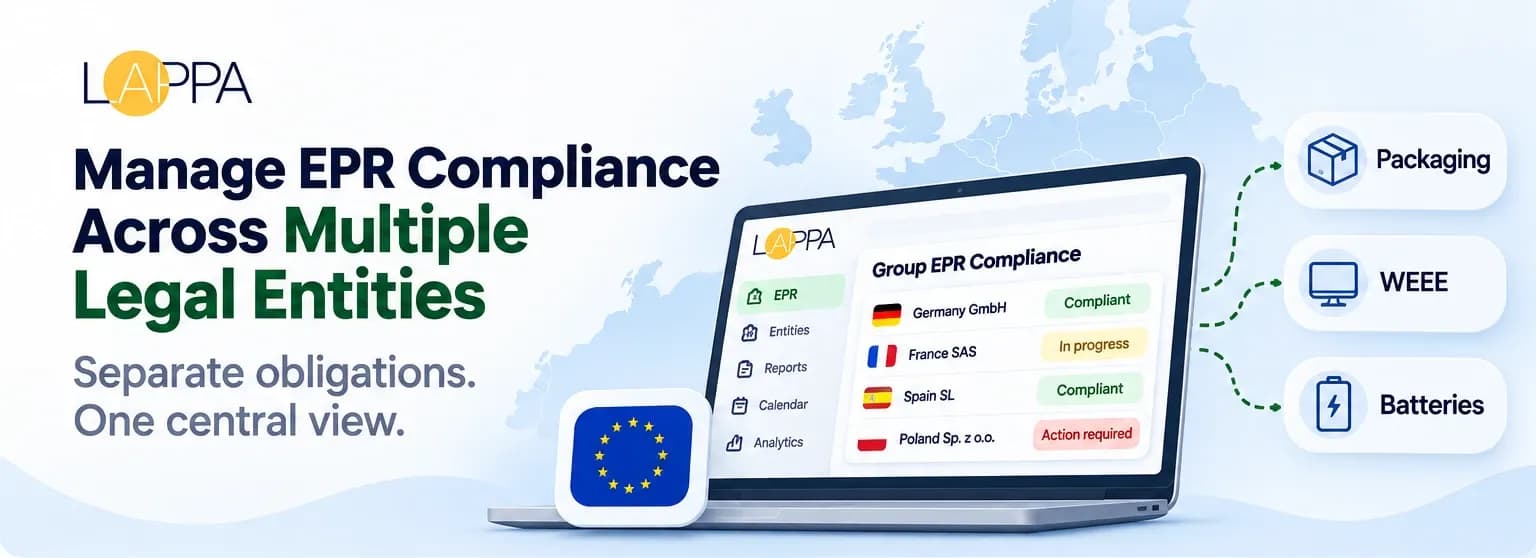
Why EPR compliance for subsidiaries is more complex
Multi-country compliance versus group compliance
Scenario A: one business sells into ten European countries. Hard work, but mostly a geography problem. You learn each market's rules, register where you have to, and handle multi-country EPR reporting and payments. Our guide to managing packaging obligations across multiple EU countries walks through that case.
Scenario B: five sister firms sell into the same ten markets. Now every country raises a second question. Which of the five is actually the producer there? It turns on who imports, who owns the brand, who sells and whose name is on the invoice.
Why central coordination matters
When nobody owns the whole picture, things drift:
• every subsidiary has its own way of doing things
• two teams build the same figures (and get different totals)
• nobody can find the registration certificate when an auditor asks
• it isn't clear who actually presses "submit"
• provider contracts get signed locally, on whatever terms were on offer
• nobody knows what compliance costs the group in total
|
Compliance area |
One legal entity |
Multiple legal entities |
Additional coordination requirement |
|
Producer status |
Assessed once per market |
Assessed per company, market and stream |
Matrix linking each company to its role |
|
Registrations |
One set of numbers |
Separate numbers where the law requires |
Central log of numbers and logins |
|
PRO contracts |
One contract per scheme |
Several contracts, possibly with different PROs |
Holder and notice period per company |
|
Declarations |
One calendar |
Overlapping calendars |
Consolidated calendar with named filers |
|
Eco-fees |
One cost line per scheme |
Invoices sent to several firms |
Reconciliation per firm plus a total view |
|
Product master |
One catalogue |
Shared catalogue, different sellers |
Allocation rules against double counting |
Managing EPR across multiple subsidiaries?

Groups that already run centralised compliance for international companies usually find their gaps in this corporate layer, not the country one.
Which legal entity is responsible for EPR obligations
A shared brand doesn't mean shared legal responsibility. Producer responsibility laws hang the duty on a "producer": a specific legal person, defined by what it does in a given market.
How producer status is determined
Run the same questions for every company, country and stream:
• Who first makes the goods, or their packaging, available on that market?
• Who imports them or sells them under its own name or trademark?
• Which company is the seller of record?
• How does the local law define "producer" for this stream?
• Do the packaging, WEEE and battery rules point at different businesses?
They often do, because the definitions aren't the same. Under the Packaging and Packaging Waste Regulation, Regulation (EU) 2025/40 (PPWR), status hinges on being first to make packaging or packaged goods available in a Member State. Distance sales to end users in another Member State count too. The Batteries Regulation (EU) 2023/1542 asks something else: who supplies batteries under its own name or trademark, or is first to supply them professionally in a Member State? WEEE sits in Directive 2012/19/EU plus each country's transposing law.
Can the parent company manage obligations for subsidiaries
Administratively, yes. A parent can coordinate the work, hire providers, pay for the programme and check the results. None of that turns it into the producer. It helps to keep five roles apart:
• Legal responsibility stays with whoever is the producer under the applicable law.
• Administrative coordination is about who organises and chases the work.
• Authorised representation only arises where a mandate is allowed or required.
• Reporting services means preparing and submitting the figures.
• Financial oversight covers monitoring, approving and paying.
In the example group, the German subsidiary imports boxed electronics and a French sister firm sells them on to French retailers. Head office may well run both files. Each company's status still has to be checked on its own.
If a subsidiary does need to register, specialist registration services can handle the filings. The duty itself stays with the producer.
How to map obligations across legal entities and countries
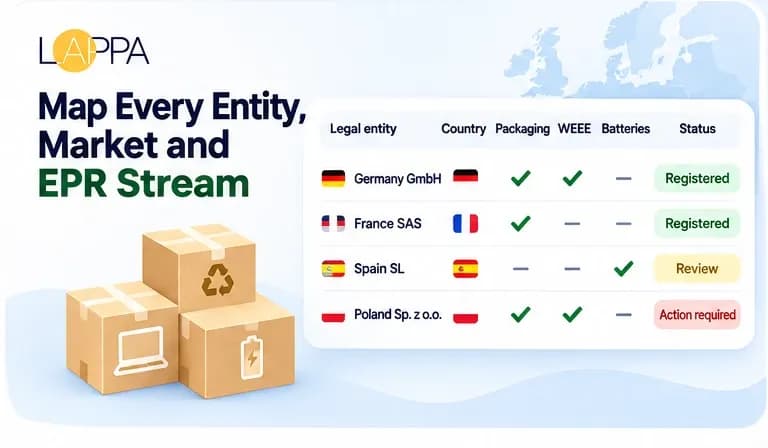
Build an entity by country by waste stream matrix
One row per company, country and stream. For each row, note the role (manufacturer, importer, brand owner, distributor or distance seller) and whether it has to register. Add the number or status, the PRO and any authorised representative. Then the deadline, a named employee and the next action.
Same hypothetical group as before. A is the Dutch parent and brand owner. B imports into Germany, C distributes in France, D sells online from Spain and E runs a service hub in Poland.
|
Legal entity (hypothetical) |
Country |
Waste stream |
Producer status |
Registration |
Action |
|
A, Dutch parent |
Netherlands |
Packaging |
To verify |
Existing |
Validate registration |
|
B, German importer |
Germany |
Packaging |
To verify |
Existing |
Validate registration |
|
B, German importer |
Germany |
WEEE |
To verify |
Existing |
Check filing ownership |
|
B, German importer |
Austria |
Packaging |
To verify |
Not assessed |
Confirm obligation |
|
C, French distributor |
France |
Packaging |
To verify |
Pending review |
Confirm obligation |
|
D, Spanish online seller |
Italy |
Batteries |
To verify |
Not assessed |
Regulatory review |
|
E, Polish service hub |
Poland |
Batteries |
To verify |
Not assessed |
Regulatory review |
All rows are illustrative. Read each line as a question to answer, not as proof of an obligation in that market.
Identify gaps and duplicate reporting risks
Once it's filled in, the grid tells you where to dig. Look for numbers held by a subsidiary that left that market years ago. Flag any row without an owner. Then compare volumes between sister firms, because double declarations happen more often than you'd think.
Intra-group sales deserve their own pass, since they blur who placed what on the market. Refresh the records after every restructuring. What you end up with is a working register of corporate EPR obligations.
Managing separate registrations and PRO memberships
Registration requirements for subsidiaries
National registers tie each record to one legal person, with its own number, login and master data. Owning a company doesn't let it file under your number. Article 44 of the PPWR requires producers to register in every Member State where they first make packaging available. If a producer has handed its duties to a PRO, the PRO meets the registration obligation, unless that Member State says otherwise.
Keep a log for each EPR registration for subsidiaries: register, number, update dates and who holds the login. Update master data the moment a name, address or legal form changes.
Producer responsibility organisations and authorised representatives
Memberships work the same way, by subsidiary and by stream. One subsidiary might belong to a French scheme while its sister holds a WEEE contract in Germany. Track who holds each contract, what it covers and how much notice it needs.
Authorised representatives work on a written mandate. Article 45(3) of the PPWR requires a producer selling into a Member State where it isn't established to appoint one there. The Commission has proposed amending that provision, so check where it stands before you rely on it. Lappa's authorised representative services cover markets where a mandate is needed.
Germany and France make a useful contrast:
|
Point |
Germany, packaging (LUCID) |
France, all schemes (ADEME) |
|
Who registers |
Each legally independent firm, including affiliates with their own commercial register entry |
Every producer covered by a scheme |
|
Identifier |
LUCID number: DE plus 13 digits |
Unique Identification Number (UIN) per scheme |
|
Issued by |
The ZSVR, after online self-registration |
The PRO the producer joins, or ADEME for individual schemes |
|
Scope |
German packaging law only; WEEE uses a different register |
One UIN for each scheme concerned |
|
Effect on a holding |
One registration per firm, each with its own login e-mail |
Several UINs per firm, shown in its terms of sale |
Neither is a template for the rest of Europe.
How to centralise product and packaging data across subsidiaries
Building a consistent packaging data structure
A declaration is only as good as the numbers behind it. Your shared master record needs the SKU identifier, materials, component weights, product category, supplier, sales by country and a named owner.
Hold each SKU once. Tag every sale with the company that made it, and allocation becomes a field you filter on instead of a spreadsheet you copy.
Preventing duplicate volume declarations
Say B imports 10,000 boxed headphones into Germany. It sells 4,000 of them to C, which resells them in France.
So who declares those boxes, and where? That depends on where each unit is first made available, and on national rules. Intercompany transfers aren't automatically excluded. They aren't always included either. Work out market placement first and assign quantities after.
Coordinating reporting deadlines across legal entities
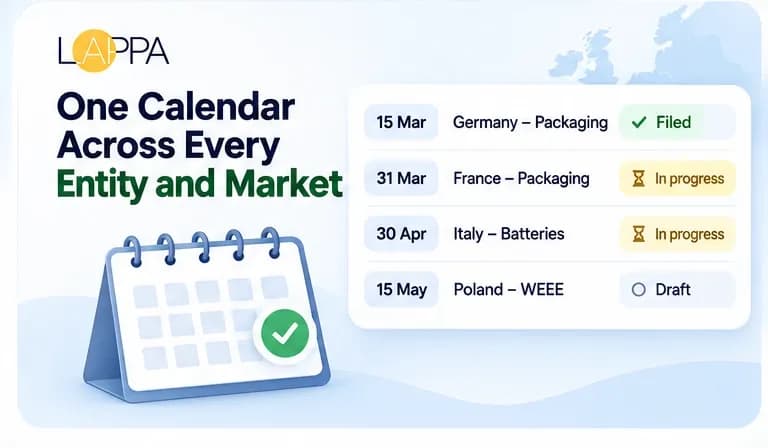
Establish a consolidated reporting calendar
A single calendar gives head office one timeline without muddying who files what. Each entry should carry:
• the country and the responsible subsidiary
• category and reporting period
• due date, plus the PRO or authority receiving it
• who files and who approves
• current submission status
Assign responsibility for reporting and validation
The central compliance team owns the calendar and the method. Local contacts confirm what happened in their market, and data owners sign off the figures. Finance ties values back to invoices. External providers file where they hold a mandate.
Three controls matter most in EPR reporting for corporate groups. Set a cut-off for missing data. Require sign-off before anything goes out. Keep a confirmation for every filing. Lappa's automated reporting software tracks deadlines across jurisdictions and takes most of the manual collation away.
Centralise your EPR reporting process

How to consolidate eco-fees without losing entity-level financial control
Track eco-fees by country, entity and waste stream
Eco-fees come in as scheme-specific charges and volume-based contributions, often in more than one currency. Log each invoice with its payment confirmation and cost allocation. Then reconcile every contribution against the volumes you declared for that period. Skip that step and overpayments slip through unnoticed.
Establish financial controls across subsidiaries
Finance usually wants five views: cost per company, total per country, cost per stream, what's still outstanding, and forecast against actual. Invented figures for the example group:
|
Legal entity |
Country |
Stream |
PRO / Scheme |
Amount due |
Payment status |
Responsible team |
|
B, German importer |
Germany |
Packaging |
Dual system (example) |
€18,400 |
Paid |
Finance DE |
|
B, German importer |
Germany |
WEEE |
Take-back scheme (example) |
€6,200 |
Invoice received |
Finance DE |
|
C, French distributor |
France |
Packaging |
Scheme FR (example) |
€11,900 |
Awaiting approval |
Central compliance |
|
D, Spanish online seller |
Spain |
Packaging |
Scheme ES (example) |
€4,300 |
Not yet invoiced |
Finance ES |
|
E, Polish service hub |
Poland |
Batteries |
Battery scheme (example) |
€1,150 |
Overdue |
Finance PL |
A combined invoice view helps with cash planning. It doesn't take away any producer's own duty to pay. Lappa explains how consolidated eco-fee payments are checked against declared volumes before approval.
Establishing governance and accountability across a corporate group
Define the role of headquarters and local teams
Strong group EPR compliance management puts roles in writing before anything goes wrong. One split that works:
• Headquarters sets policy, weighs regulatory risk, coordinates providers and tracks status.
• Subsidiaries confirm local activity, keep their own registrations current and supply the figures.
• External providers do the contracted work and watch their assigned deadlines.
Statutory responsibility still depends on the rules and any mandates in place.
Introduce approval processes and evidence management
Decide how long documents are kept and who signs off each declaration. Put a name against every task. Log changes, and limit who can edit records. Keep filing confirmations in one place, because internal audit will ask for them, usually at the worst possible moment.
|
Activity |
Central compliance |
Subsidiary management |
Finance |
External provider |
|
Producer-status assessment |
R |
A |
I |
C |
|
Registration |
C |
A |
I |
R |
|
Product data validation |
A |
R |
I |
C |
|
Declaration approval |
C |
A |
C |
I |
|
Filing |
C |
A |
I |
R |
|
Eco-fee reconciliation |
C |
A |
R |
I |
R = Responsible, A = Accountable, C = Consulted, I = Informed. Set the A from the real legal and organisational arrangement, not from the org chart. Vetting providers? Start due diligence with the Lappa security and trust page.
What happens when a corporate group acquires another company?
Integrating new entities into existing compliance processes
An acquisition brings new obligations with it, overnight. Before the next filing cycle, go through the target's registrations, PRO relationships and any declarations still outstanding. Gather its history, contracts and mandates, then decide who files from now on.
Buying a business doesn't automatically move its producer registrations or statutory duties to the buyer. Germany's LUCID register asks businesses to check whether a corporate change has led to a change of legal entity, and what updates follow from that. Worth asking in every market. After that, add the newcomer to the matrix, the calendar and the eco-fee tracker.
When should a group use enterprise EPR compliance software?
There's no magic number of entities. Spreadsheets cope for a while, then start to crack as complexity piles up across:
• legal entities, jurisdictions and streams
• filing frequency and data volume
• existing providers and contracts
• security and audit expectations
• financial visibility and system integration
The tipping point usually comes when the team spends more time assembling figures than checking them. When you look at platforms, ask how each one keeps company records separate. Ask how it handles intercompany flows, too, and what evidence it stores. Our enterprise software RFP checklist helps procurement and compliance teams compare providers properly.
Practical checklist for managing EPR across multiple legal entities
Regulatory mapping
• List every active legal entity.
• Verify producer status per company, country and stream.
• Map countries and the waste streams that apply.
• Record existing numbers and registers.
• Confirm PRO memberships and representative appointments.
Data and reporting
• Standardise packaging and product data.
• Allocate volumes to the right subsidiaries.
• Build one filing calendar.
• Decide who validates which figures.
• Keep evidence of every completed submission.
Financial and governance controls
• Record eco-fee obligations by entity.
• Give each payment an owner.
• Watch outstanding amounts.
• Agree internal approval steps.
• Revisit the matrix on a fixed cycle.
Repeat the review whenever you enter a country, add a company, launch a product category or change how you sell.
How Lappa supports EPR compliance for enterprise groups
With Lappa, registrations and obligations stay with each legal entity. Head office works from one consolidated compliance calendar, with analytics by country, stream and eco-fee. Procurement signs one master agreement, with centralised billing.
Every client gets a dedicated account manager. The L'EPR platform covers packaging, WEEE, batteries and textiles in a single programme, which gives you centralised EPR management without merging anyone's statutory duties.
The Geely case study shows it in practice. Lappa supported registrations for packaging and regulated automotive categories, aligned producer responsibilities with Geely's manufacturing, import and distribution set-up, and centralised declarations and eco-fee processes.
See how global companies manage EPR compliance
If your group adds businesses and markets every year, formalise this early. Running EPR compliance across multiple legal entities gets harder with each acquisition, and a clean matrix is far easier to extend than to rebuild.
Frequently asked questions about multi-entity EPR compliance
Not always. It depends on national rules, the stream, the company's producer status and whatever arrangements the register allows. In Germany, LUCID treats legally independent affiliates as separate producers, so each one needs its own registration. Packaging, WEEE and batteries can also give different answers for the same company. Map the duties first, and register only where the law says you must.


