

EPR Registration in Spain: Why You Need a Spanish NIF First
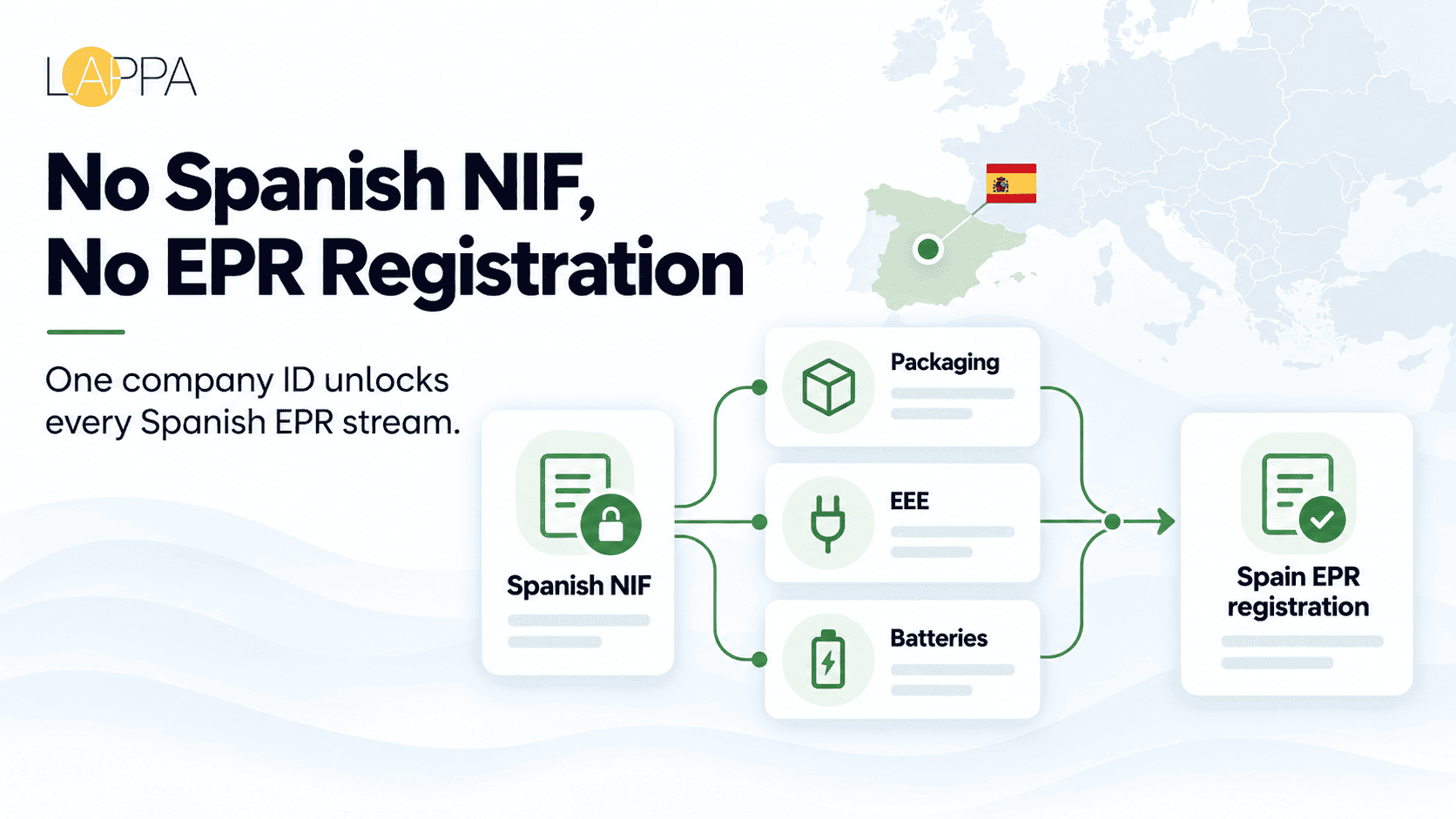
Every EPR registration in Spain starts with a Spanish tax identification number, the NIF. Without it, a foreign company cannot be entered in any register, whether for packaging, electrical equipment or batteries, and the NIF itself does not create VAT or tax obligations.
In Lappa's experience, the full path from NIF to an EPR number takes 3–4 months, and 95% of the companies that come to us for Spanish EPR work do not hold a NIF yet.
This guide explains how to get a Spanish NIF for EPR registration, which entity in your group needs it, which documents to prepare and how to plan the timeline. It is written for compliance, legal and operations teams at companies placing products on the Spanish market from abroad.
Spanish NIF for EPR registration at a glance
|
Question |
Answer |
|---|---|
|
Who issues the NIF |
Spanish Tax Agency (AEAT) |
|
Format for foreign companies |
Letter N + 7 digits + control character (NIF-N) |
|
Required before EPR registration |
Yes, for packaging, EEE and batteries |
|
Creates VAT or tax obligations |
No |
|
Documents |
Power of attorney and trade register extract, legalised, originals sent to Spain |
|
Time from start to EPR number |
3–4 months, based on Lappa's experience |
|
Companies starting without a NIF |
95% of Lappa's Spanish EPR clients |
What is a Spanish NIF
A Spanish NIF (Número de Identificación Fiscal) is the number the Spanish Tax Agency (Agencia Tributaria, AEAT) assigns to every person and company dealing with Spanish authorities. For a foreign company, it works as an official ID in Spain rather than as a tax registration.
Foreign legal entities whose registered office is outside Spain receive a number that starts with the letter N, often called a NIF-N (Spanish Ministry of Foreign Affairs). It has nine characters: a letter, seven digits and a control character, for example N1234567A.
For EPR planning, three points matter:
- Not a VAT registration. Holding a NIF does not make your company liable for Spanish VAT.
- One legal entity. The number is issued to a specific company, not to a group or a brand.
- Issued once. The same number is used for every later registration in Spain, including all EPR streams.
Why the Spanish producer register requires a NIF
The Spanish producer register identifies every producer by its NIF, so a company without one cannot be registered as a producer of packaged goods.
If your company already holds a Spanish VAT number, it already has a NIF, because that number is simply the NIF with the ES prefix.
Spanish producer registers are organised by stream, but all of them rely on the same NIF:
|
EPR stream |
Register |
Managed by |
NIF required |
|---|---|---|---|
|
Packaging (household, commercial and industrial) |
Registro de Productores de Producto (RPP), packaging section |
Ministry for the Ecological Transition (MITECO) |
Yes |
|
Electrical and electronic equipment (EEE) |
Registro Integrado Industrial, EEE section (RII-AEE) |
Ministry of Industry |
Yes |
|
Batteries |
Registro Integrado Industrial, batteries section (RII-PyA) |
Ministry of Industry |
Yes |
You do not need a separate NIF for each stream. One number covers all registrations of the same legal entity, so it makes sense to obtain it once and plan every Spanish EPR registration around it. For an overview of Spanish EPR rules, categories and fees, see our Spain EPR guide.
Why Spanish distributors ask for proof of registration
Royal Decree 1055/2022 requires producers established outside Spain to appoint an authorised representative in Spain. If a foreign producer has not done so, the first distributor or retailer established in Spain becomes responsible for the producer's obligations on a subsidiary basis (MITECO). In practice, Spanish distributors and retail partners therefore ask suppliers for proof of registration before taking on their products.
For a foreign brand, the NIF is the first document in that chain. Companies from outside the EU face the same logic in every member state they sell into, as we explain in our guide to EPR for non-EU manufacturers.
NIF, NIF IVA, Spanish VAT number and EPR number compared
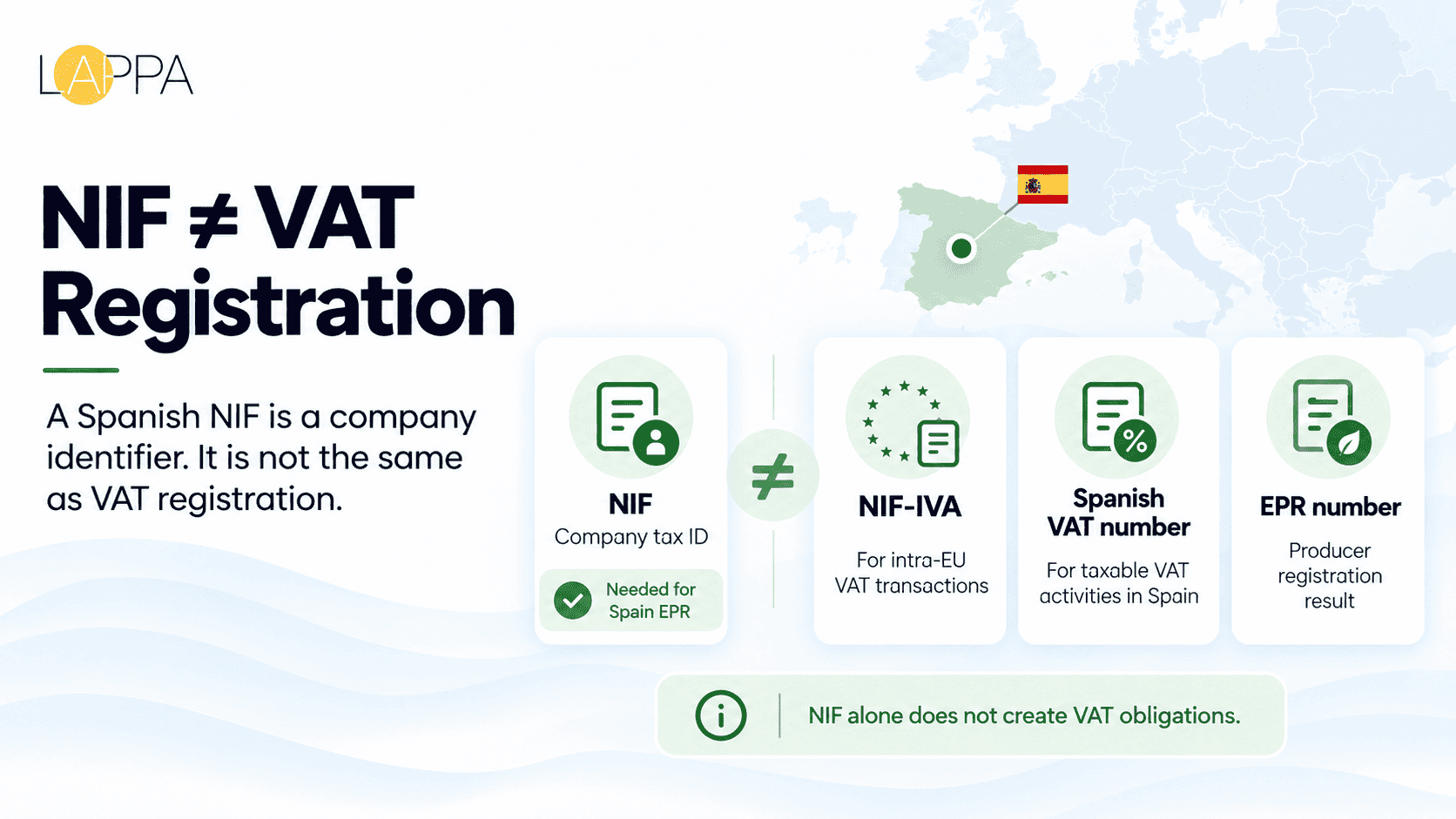
The NIF is the base number; the other three are built on it or issued after it. Companies often treat the Spanish VAT number and the NIF as the same thing, which leads to wrong expectations about tax obligations and timelines.
|
|
NIF |
NIF-IVA |
VAT number (ES) |
EPR number |
|---|---|---|---|---|
|
What it is |
Company identification number in Spain |
NIF registered for intra-EU transactions and visible in VIES |
ES prefix + NIF, after VAT registration in Spain |
Producer number in the relevant EPR register |
|
Issued by |
AEAT |
AEAT, after registration in the intra-EU operators register (ROI) |
AEAT |
MITECO or the Ministry of Industry, depending on the stream |
|
Needed for EPR registration |
Yes |
No |
Yes, it already contains the NIF |
It is the result of registration |
|
Creates tax obligations |
No |
Yes |
Yes |
No, but eco-fees apply |
In practice, you do not need to register for VAT to register for EPR: a NIF is enough. And if your VAT number is not yet active in VIES, your EPR registration is not affected, because the registers only look at the NIF.
Spain EPR registration requirements for groups with several entities
Under Spain EPR registration requirements, the NIF goes to the legal entity that counts as the producer, usually the company that first places the product on the Spanish market. It is not issued to a group, a holding company or a brand.
For groups with several companies, this question needs an answer before any documents are prepared:
- One selling entity. If one company sells into Spain, that company needs the NIF and the registration.
- Several selling entities. If different group companies sell different product lines into Spain, each one that acts as a producer needs its own NIF and its own registration.
- Different streams, same entity. If one company sells packaged goods and electronics, it uses one NIF for both the packaging and the EEE registrations.
A typical example: an EU manufacturer sells packaged consumer goods and electrical devices to a Spanish distributor. The manufacturing entity obtains one NIF, appoints one representative and registers in both the packaging and the EEE registers. Getting the entity right at the start avoids repeating the NIF process, which is the longest part of the work.
When your company already holds a NIF
If your company already holds a Spanish NIF, the longest step is behind you.
The same applies if you are registered for VAT, since a VAT number in Spain already contains the NIF. In both cases, the work starts with the appointment of a representative.
Before you start, check three things:
- the number belongs to the same legal entity that will register as the producer;
- the company name and address on the NIF match your current corporate documents;
- you have the document issued when the NIF was assigned, so that your representative can confirm it.
Only about 5% of the companies that come to Lappa for Spanish EPR work are in this position, so most teams should plan for the full process below.
Documents needed to get a NIF for foreign companies
The procedure for a NIF for foreign companies requires two legalised corporate documents, and the originals must be sent to Spain. This is the part of the process that sits with your team, so it is worth starting as soon as the decision to register is made.
What you will need:
- Power of attorney authorising your representative to act for the company. It must be notarised, apostilled and translated into Spanish by a sworn translator.
- Extract from the trade register of your country of incorporation. It must be apostilled and translated into Spanish by a sworn translator.
- Originals of both documents, sent by courier to Spain. Scans are not accepted.
|
Document |
Notarisation |
Apostille |
Sworn translation |
Original sent to Spain |
|---|---|---|---|---|
|
Power of attorney |
Yes |
Yes |
Yes |
Yes |
|
Extract from the trade register |
No |
Yes |
Yes |
Yes |
For large companies, a few practical questions usually come up:
- Who signs. The power of attorney must be signed by a person authorised to represent the company under its articles or the register. Check internally whether that signature alone is enough or a corporate approval is needed.
- Apostille. An apostille certifies the authenticity of a public document for use in another country. It is issued in the country where the document was produced, and processing times vary from country to country.
- Sworn translation. Spain accepts translations made by a traductor jurado, a translator authorised by the Spanish Ministry of Foreign Affairs. A certified translation from another country is not a substitute.
- Originals. Build courier time into your plan, especially if documents are signed in one country and apostilled in another.
From NIF to EPR number with an authorised representative in Spain
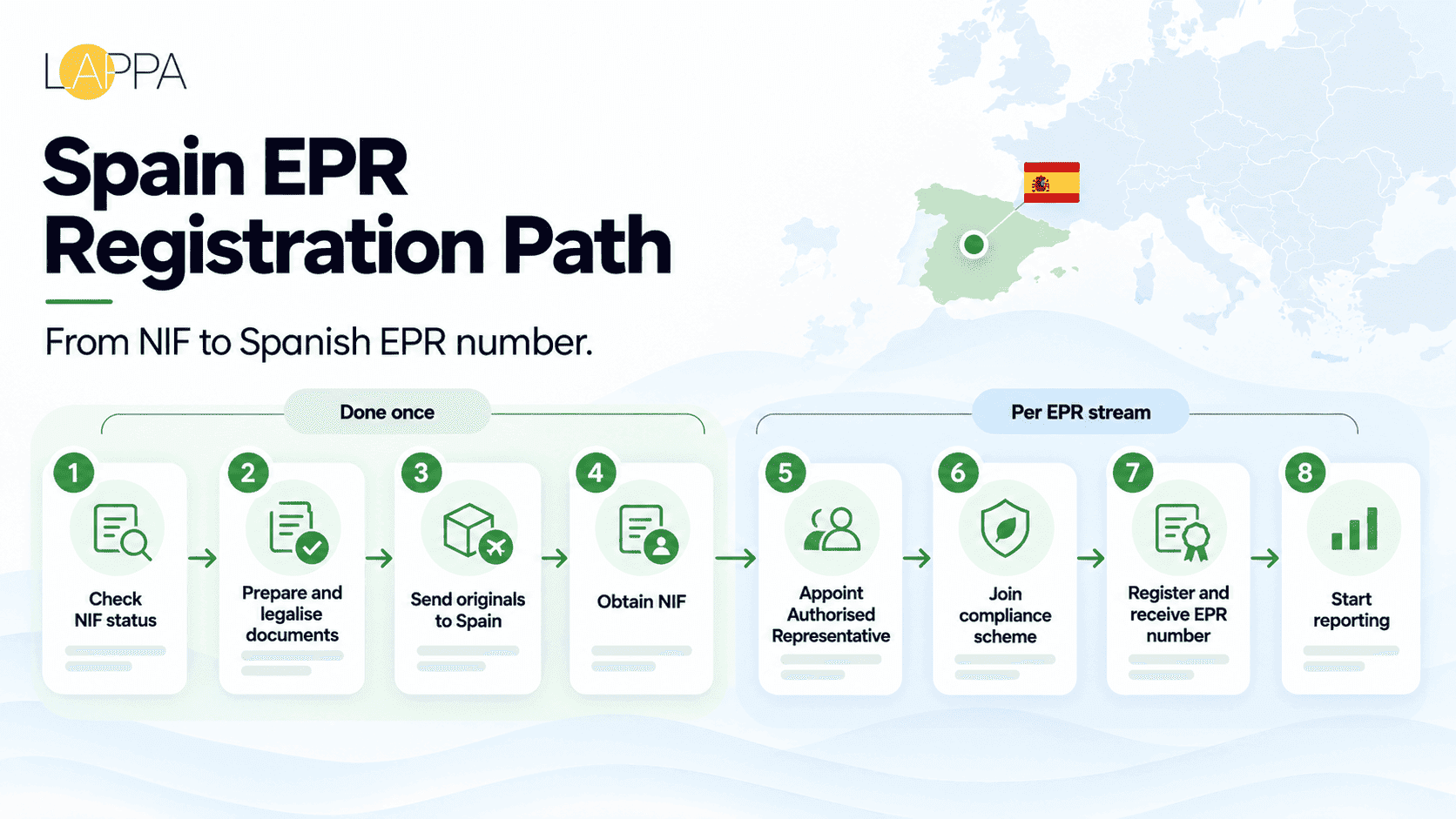
The process follows a fixed order: the NIF comes first, then the representative, the compliance scheme and the register. For a foreign producer, it looks like this:
- Check your identification status. Confirm whether the producing entity already has a NIF or a VAT number.
- Prepare and legalise documents. Notarise, apostille and translate the power of attorney; apostille and translate the trade register extract.
- Send the originals to Spain. Your representative needs the original documents to file the NIF application.
- Obtain the NIF. The application is filed with the Spanish Tax Agency (AEAT), which assigns the number.
- Appoint a representative. Producers established outside Spain must have a representative who acts for them before the authorities (EPR representative services).
- Join a compliance scheme. For packaging, this means a contract with a collective scheme (SCRAP), such as Ecoembes for light packaging and paper or Ecovidrio for glass.
- Register as a producer. Your representative registers the company in the Spanish producer register for packaging, or in the industrial register for EEE and batteries, and receives your EPR number. For packaging, it has the ENV/year/number format.
- Set up reporting. From this point, you report the packaging or products placed on the Spanish market and pay eco-fees through your scheme.
Steps 5 to 7 are repeated for each EPR stream, but steps 1 to 4 are done only once. If you manage packaging EPR across several EU countries, it helps to run Spain alongside your other registrations in one programme rather than as a separate project (EPR registration).
How long EPR registration in Spain takes
In Lappa's experience, EPR registration in Spain takes 3–4 months, including the NIF. That is longer than in most EU countries, and the difference comes almost entirely from the NIF and the work of the compliance schemes.
|
Stage |
What happens |
Who drives the timing |
|---|---|---|
|
Documents |
Notarisation, apostille, sworn translation |
Your company and local authorities |
|
Courier |
Originals travel to Spain |
Your company |
|
NIF |
Application filed and number assigned |
AEAT, via your representative |
|
Representative |
Representative appointed |
Your provider |
|
Compliance scheme |
Contract signed and producer onboarded |
The scheme (SCRAP) |
|
Register |
Registration and EPR number issued |
Your representative and the ministry |
What causes delays
- Document preparation. Notarisation, apostilles, sworn translations and couriering originals take time, and any error in a document means repeating the step.
- Compliance scheme processing. Schemes can take a long time to onboard new producers, and neither the company nor its provider controls that queue.
- Packaging data that is not ready. Schemes and registers need data on materials, packaging types (household, commercial, industrial) and volumes. In large companies, this data is often spread across procurement, logistics and production.
How to plan the Spanish timeline
Treat the Spanish NIF needed for EPR registration as part of your market entry plan, not as a task to start after the first shipment. Prepare corporate documents and packaging data in parallel, so neither waits for the other.
At Lappa, we complete the steps on our side as soon as we receive what we need and run everything that can run in parallel, so the timeline depends only on the stages outside anyone's control. This matters more now that the EU Packaging and Packaging Waste Regulation (PPWR) has applied since 12 August 2026: many companies are reviewing EPR across all EU markets at once, and Spain, with its NIF step, is the registration to start first.
Following every stage in the Lappa Registration Tracker
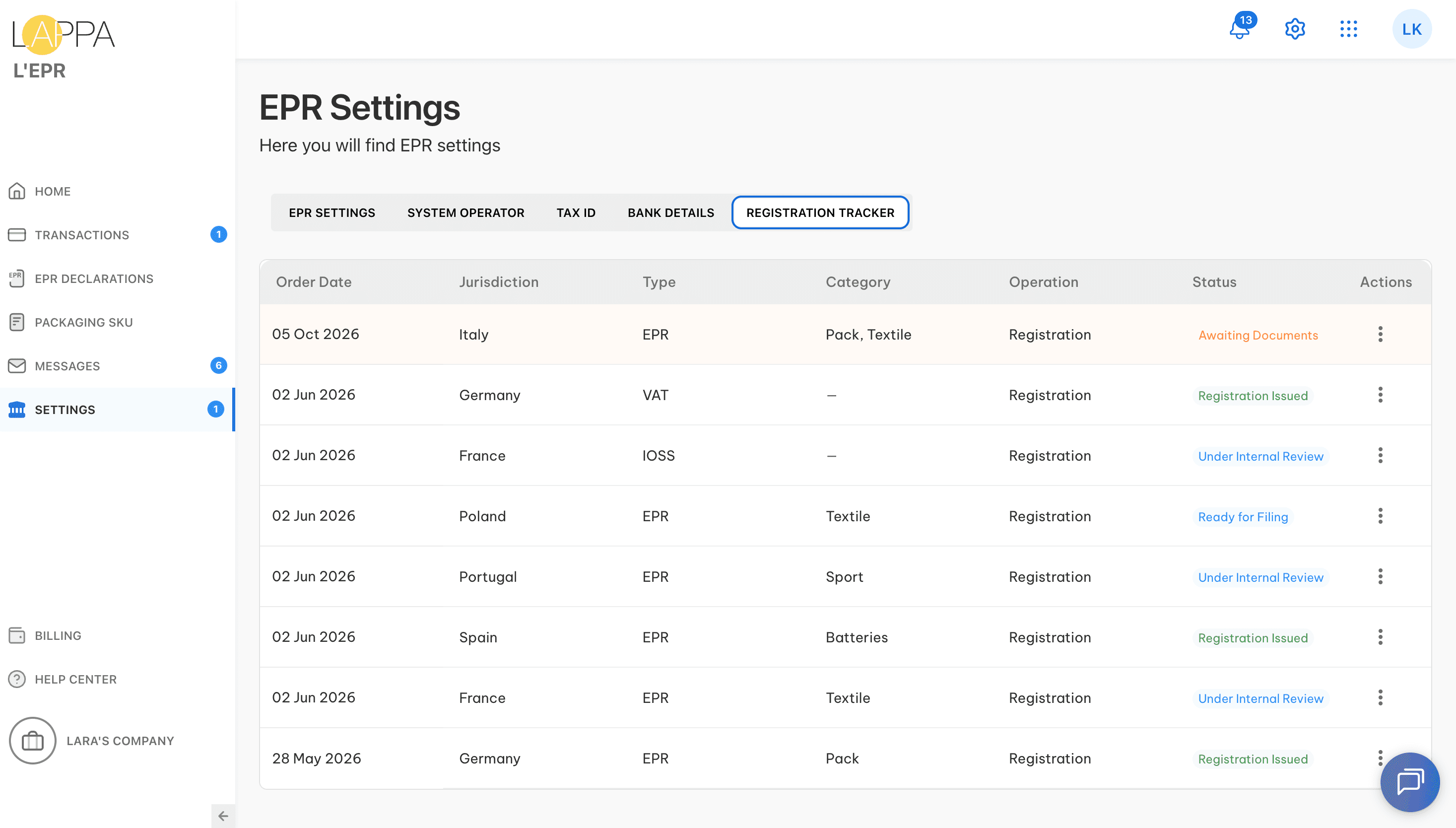
With a process that takes several months, knowing where things stand matters as much as the work itself. Every Lappa account has a Registration Tracker, available under Settings → Registration Tracker, where you can follow the live status of each registration from the moment it is submitted until the authority approves it.
The tracker table shows each registration with:
- Order date, when the registration was requested;
- Jurisdiction, the country;
- Type and category, for example EPR and packaging;
- Operation, such as a new registration or a renewal;
- Status, the current stage, for example In Government Review.
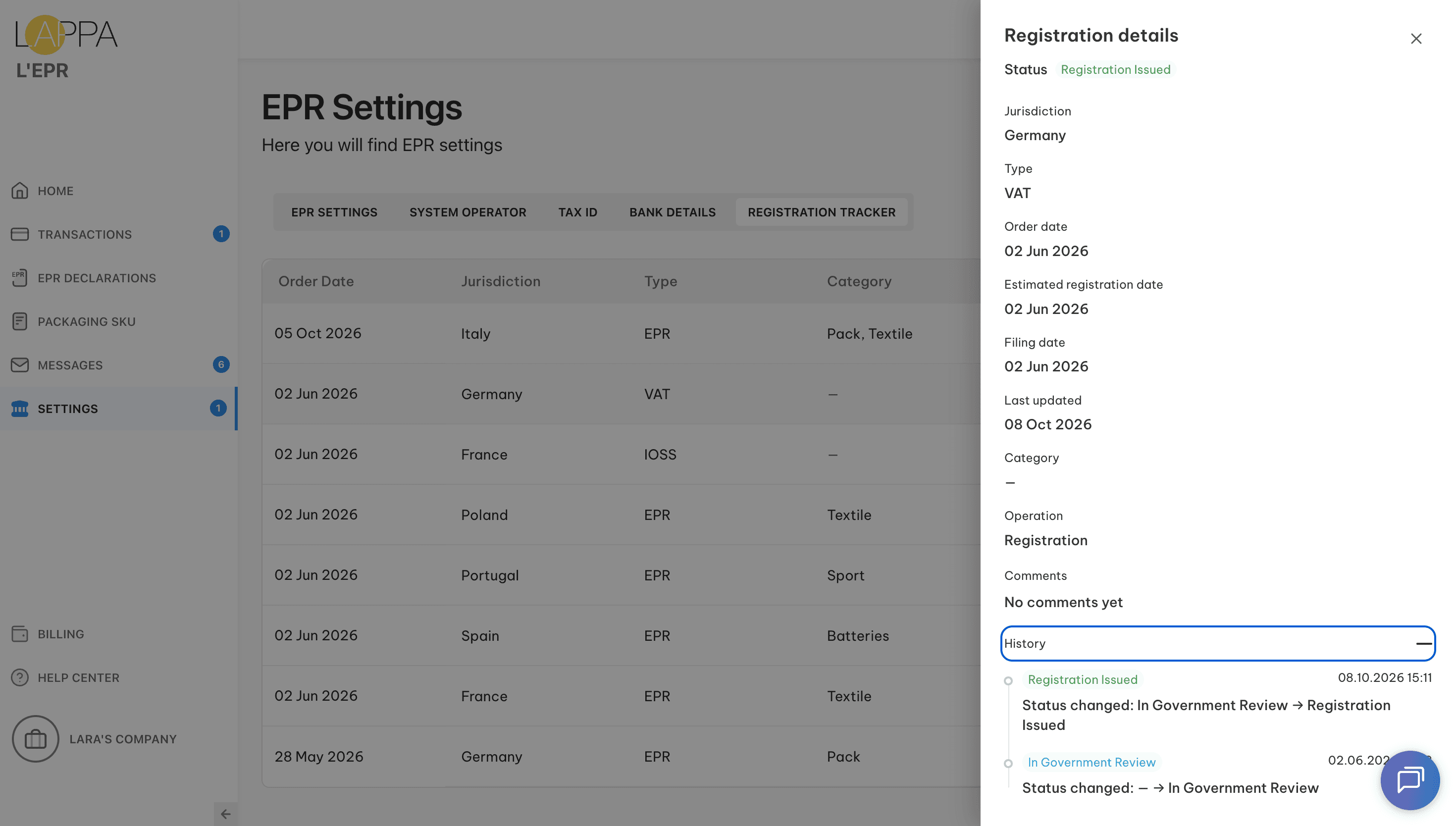
Opening a registration shows its full details: the estimated registration date, the filing date, the date of the last update, the Lappa specialist responsible for it, comments, documents and the complete history of status changes. If several entities of your group are registered, you can switch between companies at the top of the account and see each one separately.
The tracker is maintained by your Lappa manager, who creates the record and updates the status as the work moves forward. You can view everything but not edit it, and document requests and questions about your registration still go through email or your manager directly.
Common mistakes foreign producers make in Spain
Most delays come from misreading Spain EPR registration requirements in a few predictable ways:
- Treating the NIF as a VAT registration. Teams postpone applying for a NIF in Spain because they assume it brings tax obligations. It does not.
- Confusing the NIF with the NIF-IVA. Waiting for VIES activation is unnecessary for EPR purposes.
- Applying for the wrong entity. A NIF for a foreign company is issued to one legal entity, so a number held by the holding company does not cover the subsidiary that sells into Spain.
- Sending scans instead of originals. The NIF application needs the original legalised documents.
- Using a non-sworn translation. Only a translation by a Spanish sworn translator is accepted.
- Registering household packaging only. Commercial and industrial packaging are also in scope in Spain.
- Leaving too little time. Starting 3–4 weeks before a launch or a distributor deadline is not enough when the process takes 3–4 months.
How Lappa helps with EPR registration in Spain and where to request a fee quote
When a company has no NIF, no representative and a market launch already on the calendar, the work goes best as one joint project rather than a chain of separate providers. The key is to agree early on who prepares the corporate documents, who collects the packaging data and who handles the filings in Spain.
Lappa covers the Spanish part of that project end to end: the NIF application, an authorised Spanish representative, the compliance scheme contract, registration in each relevant register and ongoing reporting. Because the same team and platform manage EPR in other markets, Spain becomes part of your wider EPR compliance programme instead of a separate track.
Send us the list of entities selling into Spain, your product streams and your planned launch date, and we will prepare a fee quote for EPR registration in Spain that covers every step above.
Frequently asked questions about the Spanish NIF and EPR
A NIF is mandatory. Without a Spanish NIF for EPR registration, a foreign company cannot be entered in any of the registers, whatever its product stream.