

Battery Take-Back Scheme in Germany: A B2B Guide for Manufacturers
Battery Take-Back Scheme in Germany: A B2B Guide for Manufacturers
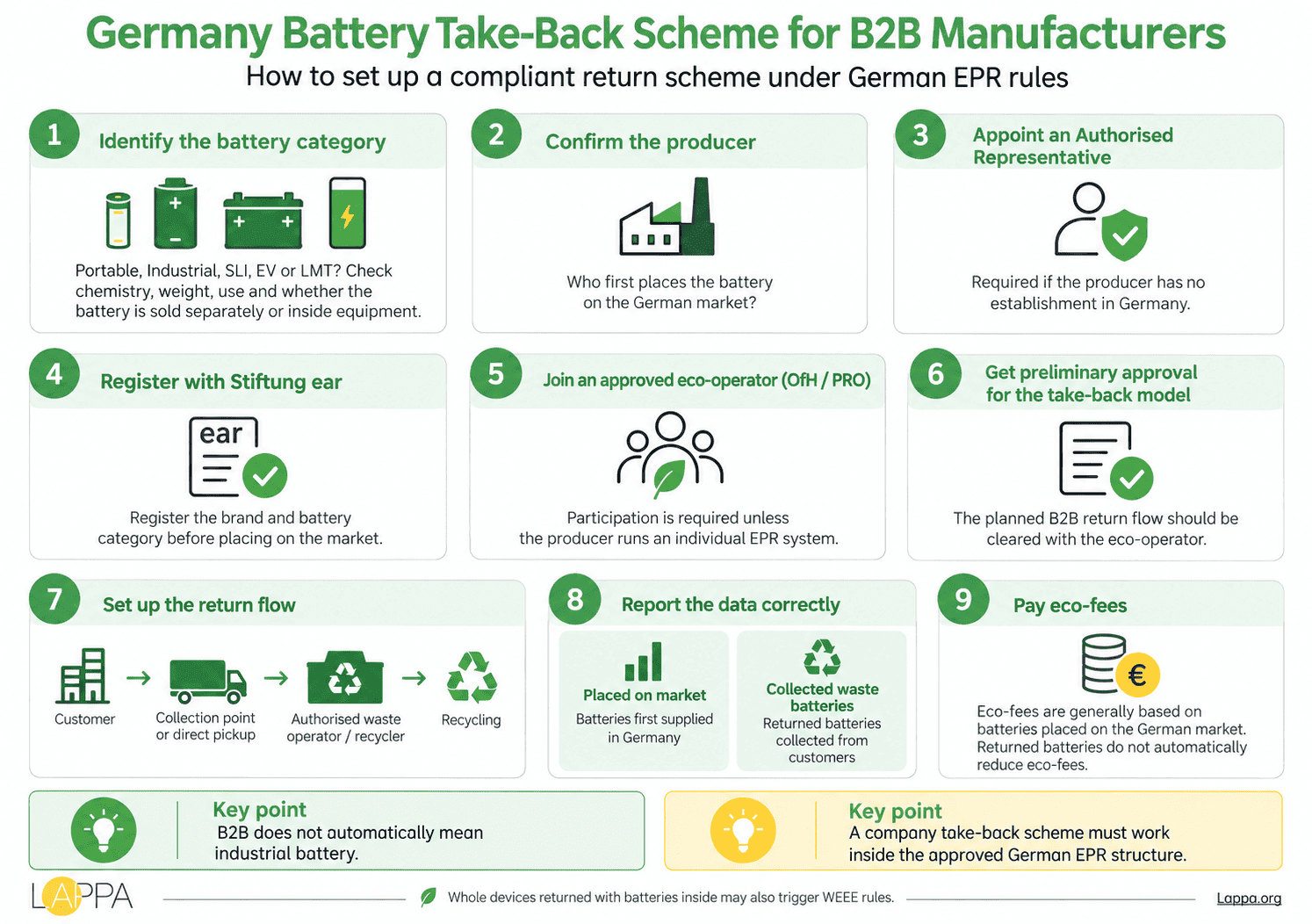
Companies selling batteries or battery-powered equipment in Germany may want to offer their business customers a simple solution: return used batteries to the supplier, and the supplier organises recycling.
This is possible — but a company take-back programme cannot usually operate separately from the German battery EPR system.
A compliant setup normally combines:
battery EPR registration → Producer Responsibility Organisation → customer return channel → authorised waste operator → recycling → EPR reporting.
This guide explains how manufacturers, importers and B2B suppliers can set up a battery return and recycling scheme in Germany.
Quick answer
A manufacturer can arrange to collect used batteries from its German B2B customers.
However, before starting the programme, the company should:
- identify the correct battery category;
- determine who is the EPR producer in Germany;
- register for battery EPR;
- appoint an Authorised Representative if required;
- participate in an approved Organisation for Producer Responsibility (OfH / PRO);
- agree how the take-back flow will work with the eco-operator;
- use an appropriate waste operator or recycler;
- keep placed-on-market and collected-waste quantities separate in reporting.
Under the German BattDG, producers must participate in an approved Organisation für Herstellerverantwortung for each relevant battery category unless they fulfil extended producer responsibility individually.
Which battery category applies
This should be the first question, not an afterthought.
A common mistake is to assume that a battery sold B2B is automatically an industrial battery.
It is not.
EU Regulation 2023/1542 distinguishes five main battery categories:
- portable batteries;
- light means of transport (LMT) batteries;
- starting, lighting and ignition (SLI) batteries;
- industrial batteries;
- electric vehicle batteries.
For example, a sealed battery weighing 5 kg or less may still be a portable battery if it was not specifically designed for industrial use. An industrial battery includes batteries specifically designed for industrial use and, generally, batteries above 5 kg that do not fall within another specific category.
For each battery model, businesses should therefore identify:
- battery chemistry;
- weight;
- intended use;
- whether it is rechargeable;
- whether it is sold separately or incorporated into equipment;
- the equipment or machinery it powers.
Correct classification affects registration, take-back obligations, reporting and eco-fees.
Who is the battery producer
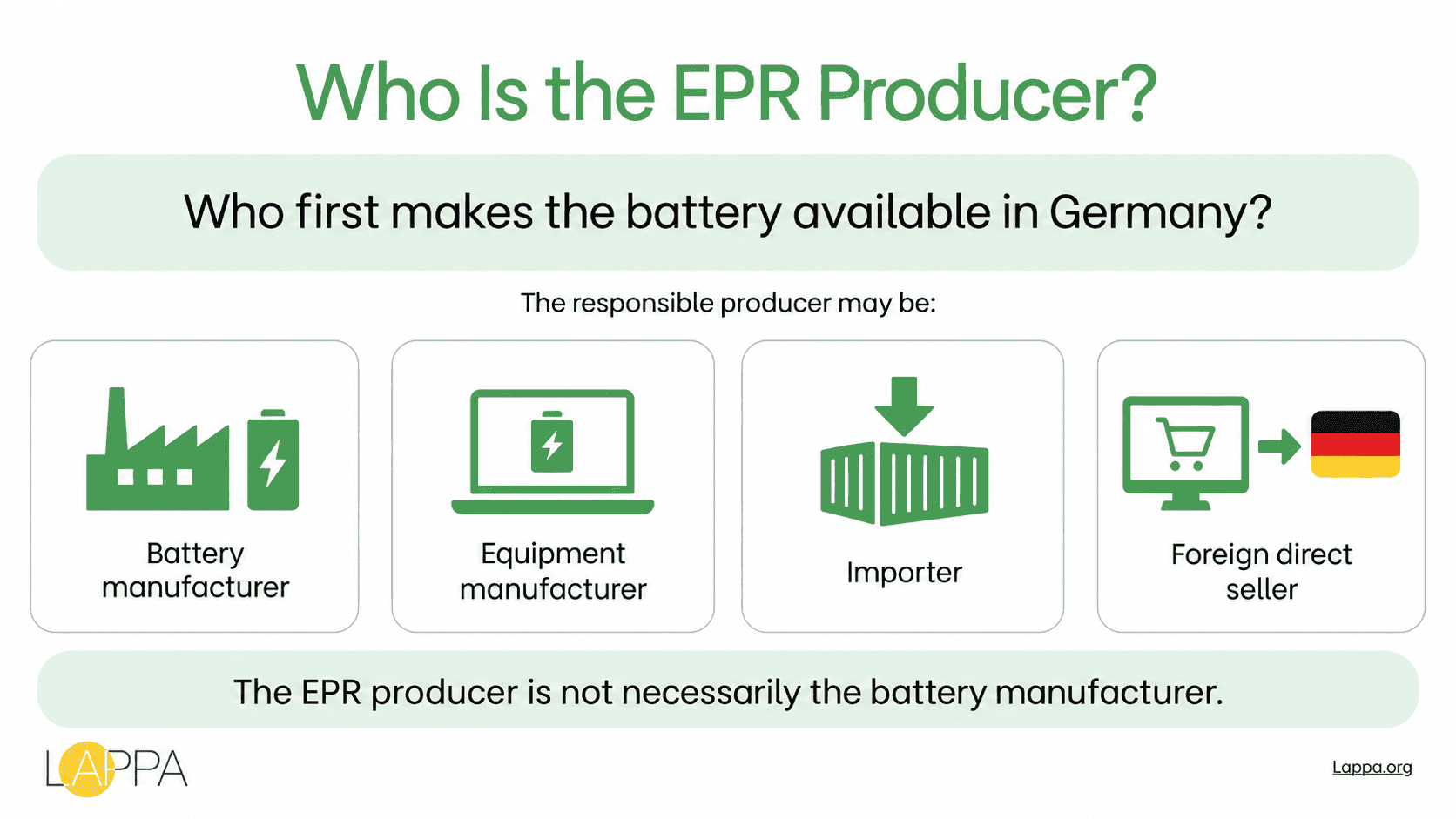
For EPR purposes, the producer is not necessarily the battery manufacturer.
The relevant question is usually:
Who first makes the battery available on the German market?
EU battery rules place extended producer responsibility on producers for batteries they make available on a Member State’s market for the first time. Producers must also register in each Member State where they first make batteries available.
This means the responsible producer may be:
- the battery manufacturer;
- an equipment manufacturer importing batteries inside its products;
- an importer;
- a foreign seller supplying German customers directly.
The supply chain should therefore be reviewed before setting up the return scheme.
Is battery EPR registration required
Yes, where the company qualifies as a producer.
In Germany, a producer — or its Authorised Representative where applicable — must register before first placing batteries on the German market.
Registration is linked to the brand and relevant battery category.
Battery registration in Germany is administered through Stiftung ear.
Registration and physical battery recycling are two different parts of the same compliance structure. Registering as a producer does not by itself create a compliant collection and recycling system.
Does a foreign company need an Authorised Representative
Often, yes.
A battery producer with no establishment in Germany must appoint an Authorised Representative for Extended Producer Responsibility.
Under §40 BattDG, the Authorised Representative performs the relevant EPR obligations in its own name. A producer may appoint only one such representative, and the appointment must be made in writing and in German.
This is particularly relevant for manufacturers based in the UK, US, Switzerland, China and other countries selling directly into Germany.
The Authorised Representative can coordinate the German EPR setup, but the physical battery collection flow still needs to be properly integrated with the applicable producer responsibility and waste-management structure.
What is an OfH or battery PRO
Germany uses approved Organisationen für Herstellerverantwortung, commonly referred to as OfH and broadly equivalent to Producer Responsibility Organisations or PROs.
A battery producer must participate in an OfH for each relevant battery category or fulfil EPR obligations individually.
The OfH is an important part of a corporate battery take-back project because it connects the producer’s EPR obligations with the collection and recycling system.
Before launching a private B2B return programme, we therefore recommend obtaining confirmation from the relevant OfH that the proposed collection model can be integrated into its compliance structure.
This preliminary confirmation is a practical risk-control step rather than a separate statutory licence.
How to set up a B2B battery take-back scheme
A typical project can be organised in seven steps.
1. Map the batteries
Create a list of all battery models supplied in Germany.
For each SKU, record:
- category;
- chemistry;
- weight;
- brand;
- intended use;
- annual units sold;
- annual weight placed on the German market.
This data will be needed for both EPR and take-back planning.
2. Check the German EPR setup
Confirm:
- who is the producer;
- whether registration is active;
- which battery categories are registered;
- which brands are covered;
- whether an Authorised Representative is required;
- which OfH covers each battery category.
Do this before organising the physical collection flow.
3. Estimate return volumes
Estimate how many waste batteries customers are likely to return each year.
The logistics model for 300 kg of batteries per year may be very different from the model required for 50 tonnes.
Return estimates should ideally include:
- number of batteries;
- total weight;
- chemistry;
- customer locations;
- frequency of collection;
- whether damaged batteries may be returned.
4. Agree the model with the OfH
Present the proposed B2B return flow to the eco-operator.
A useful description should explain:
Customer → collection point or direct pickup → authorised waste operator → recycler
Ask the OfH to confirm:
- whether the proposed flow can be used;
- whether a particular waste operator may be used;
- what documents are required;
- how collected quantities will be reported;
- whether collected volumes influence the commercial producer contribution.
5. Choose the return model
There are several practical options.
Direct pickup
A waste operator collects batteries directly from the B2B customer’s premises.
This can work well for large industrial customers or heavy batteries.
Supplier collection point
Customers return batteries to a supplier, dealer, service centre or warehouse.
The accumulated batteries are then collected by an authorised waste operator.
Service-network collection
For manufacturers with dealers or service partners across Germany, selected locations can form part of the return network.
The appropriate model depends on battery type, volume, geography and transport risks.
6. Use the right waste operator
Waste batteries should not simply be transported as ordinary goods.
The waste operator and recycler should be suitable for the relevant battery chemistry and waste stream.
This is especially important for lithium batteries, where storage, packaging and transport may involve additional dangerous-goods requirements.
For industrial, SLI and EV batteries, German law specifically provides that returned batteries are to be transferred to an approved OfH for the relevant category or to a waste operator selected within the applicable regulatory framework.
7. Keep collection evidence
The company should be able to reconcile what was:
placed on the German market
with what was:
collected as waste
and what was:
sent for recycling or other treatment.
Useful records include:
- collection date;
- customer or collection location;
- battery category;
- chemistry;
- collected weight;
- waste operator;
- treatment destination;
- recycling or treatment documentation.
What if the battery is inside equipment?
This is an important distinction.
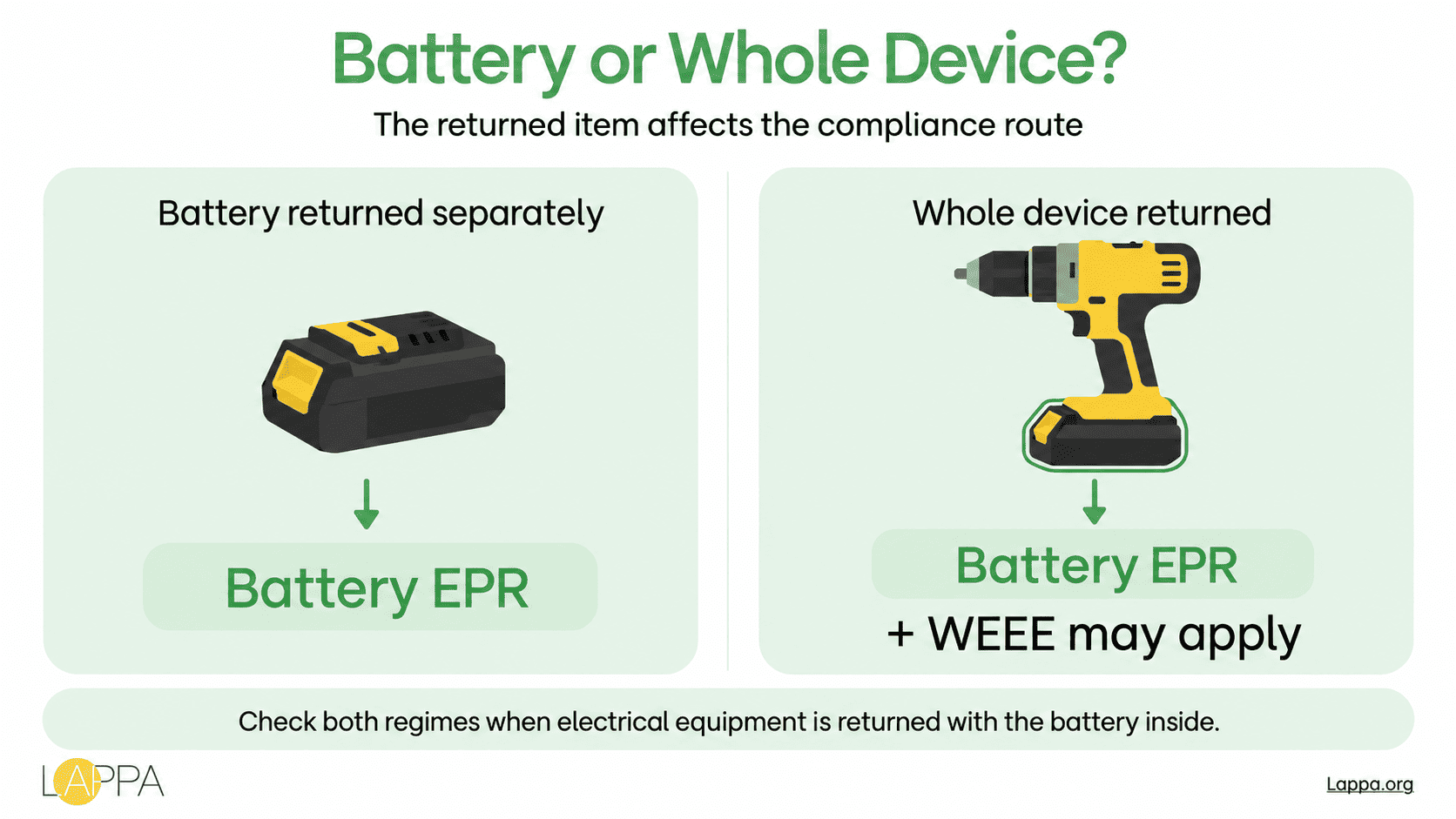
A company may sell equipment containing a battery but receive the whole device back from the customer rather than the battery separately.
In that case, battery EPR may not be the only regime involved.
German BattDG rules expressly distinguish the return of waste batteries from the return of products containing batteries, while the German Electrical and Electronic Equipment Act may continue to apply to the complete product.
For manufacturers of electronic or electrical equipment, the return project should therefore be checked for both:
Battery EPR + WEEE/ElectroG obligations.
Are B2B suppliers required to take batteries back?
Take-back obligations depend on the battery category and the company’s role in the supply chain.
For example, German law requires distributors of industrial, SLI and EV batteries to accept relevant waste batteries from end users free of charge where the batteries fall within the categories the distributor currently sells or previously sold. Distance sellers must provide suitable return possibilities within a reasonable distance from the end user.
Separate rules apply to portable and LMT batteries.
This means that for many B2B suppliers, a return solution is not simply an ESG initiative. It may also form part of the statutory battery compliance framework.
How does take-back affect EPR reporting?
The most important point is:
Batteries placed on the market and waste batteries collected are not the same reporting figure.
If a company places 10 tonnes of batteries on the German market and later collects 3 tonnes of used batteries from customers, this does not normally mean that its placed-on-market quantity becomes 7 tonnes.
The two flows are tracked separately.
German OfHs report, among other things:
- battery mass first placed on the German market by participating producers;
- waste batteries taken back;
- batteries sent for preparation for reuse;
- batteries sent for repurposing;
- batteries sent for recycling.
The information is broken down by battery category and chemistry.
This is why a B2B take-back programme needs its own collection data rather than simply adjusting sales data.
Do returned batteries reduce eco-fees?
Not automatically.
A company should not simply subtract collected waste batteries from its placed-on-market declaration.
Producer contributions are connected to EPR obligations for batteries placed on the market. At the same time, the rules allow contribution structures to take battery category, chemistry and environmental criteria into account.
German BattDG requires OfHs to consider factors including durability, reuse potential and recyclability when determining producer contributions.
EU rules also require PRO financial contributions to take certain environmental factors into account and to reflect relevant revenues from recovered secondary raw materials.
Therefore, a producer-operated return channel may affect the commercial economics of the EPR arrangement, depending on the OfH, battery type, recycler and contractual structure.
But there is no simple rule that:
1 kg returned = 1 kg deducted from the eco-fee.
Companies planning a significant B2B collection programme should discuss the pricing mechanism with their OfH before launching it.
What information is needed to start?
For an initial assessment, prepare the following information.
Battery data
- battery model;
- chemistry;
- weight;
- rechargeable or non-rechargeable;
- intended use;
- technical datasheet if available.
Sales data
- approximate annual units sold in Germany;
- annual weight;
- whether batteries are sold separately or inside equipment;
- relevant brands.
Return data
- estimated number of batteries returned annually;
- estimated return weight;
- customer locations;
- expected collection frequency;
- whether damaged batteries are expected.
With this information, the battery category can be confirmed and the proposed take-back model can be presented to the German eco-operator.
Common mistakes
Assuming B2B means industrial
Battery classification depends on the battery itself and its intended use, not simply whether the customer is a business.
Starting collection before checking the OfH
A physical recycling solution does not automatically satisfy EPR requirements.
The return flow should be aligned with the producer’s approved EPR structure.
Deducting returns from sales
Placed-on-market quantities and collected waste batteries are separate data streams.
Ignoring batteries inside equipment
Returning an entire electrical product can trigger WEEE obligations in addition to battery EPR.
Using an ordinary logistics provider
Waste batteries — especially lithium batteries — can require specialised handling, packaging and transport arrangements.
Forgetting the Authorised Representative
A foreign producer without an establishment in Germany may need an Authorised Representative before its German EPR structure is complete.
How Lappa can help
Lappa helps international manufacturers build and manage battery EPR compliance in Germany.
For a B2B battery take-back project, we can support the company with:
- battery category assessment;
- identification of the EPR producer;
- German battery registration;
- Authorised Representative services;
- OfH / eco-operator coordination;
- preliminary review of the proposed take-back scheme;
- EPR reporting;
- reconciliation of placed-on-market and collected quantities;
- coordination of the compliance structure for batteries supplied inside electrical equipment.
The objective is to build one connected compliance process rather than separate registration, recycling and reporting workflows.
If your company supplies batteries or battery-powered equipment to German customers and wants to organise a return programme, contact Lappa with your battery specifications and estimated German volumes. We can assess the battery category and determine how the proposed take-back model should fit into the German EPR system.
FAQ
Yes. A manufacturer can organise a customer return channel, including B2B collection. However, the collection and recycling model should operate within the applicable German EPR and waste-management framework.