

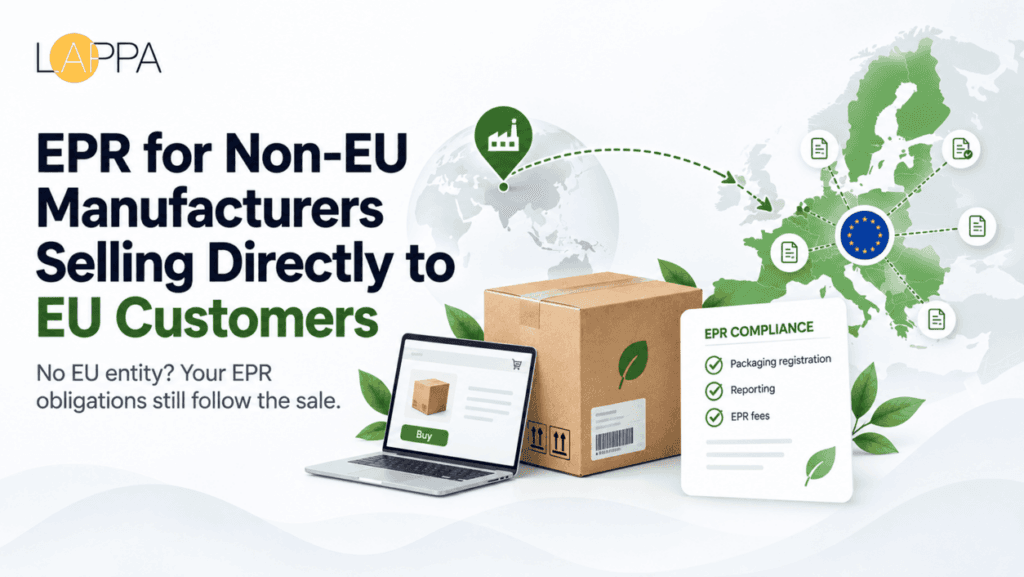
EPR for Non-EU Manufacturers Selling Directly to EU Customers
You ship from Shenzhen, Istanbul, or Ohio. Your parcels land on doorsteps in Munich and Lyon. No office in Europe, no warehouse, no local entity. For years that felt like a clean arrangement. Since 12 August 2026 it is not. The moment your box reaches an EU consumer, you become a producer in that country, with every duty the label carries.
Why EPR for Non EU Companies Changed in August 2026
epr for non eu companies stopped being a grey area the day Regulation (EU) 2025/40 became applicable. The Packaging and Packaging Waste Regulation now reaches sellers with no European footprint at all. Where you are incorporated is irrelevant. What matters is where your packaging first lands.
Brussels closed the loophole deliberately. Domestic manufacturers had been funding recycling for years while overseas rivals shipped in free. The playing field is level now, and enforcement arrived on a fixed date rather than a gentle ramp.
What Changes When Selling to EU Customers
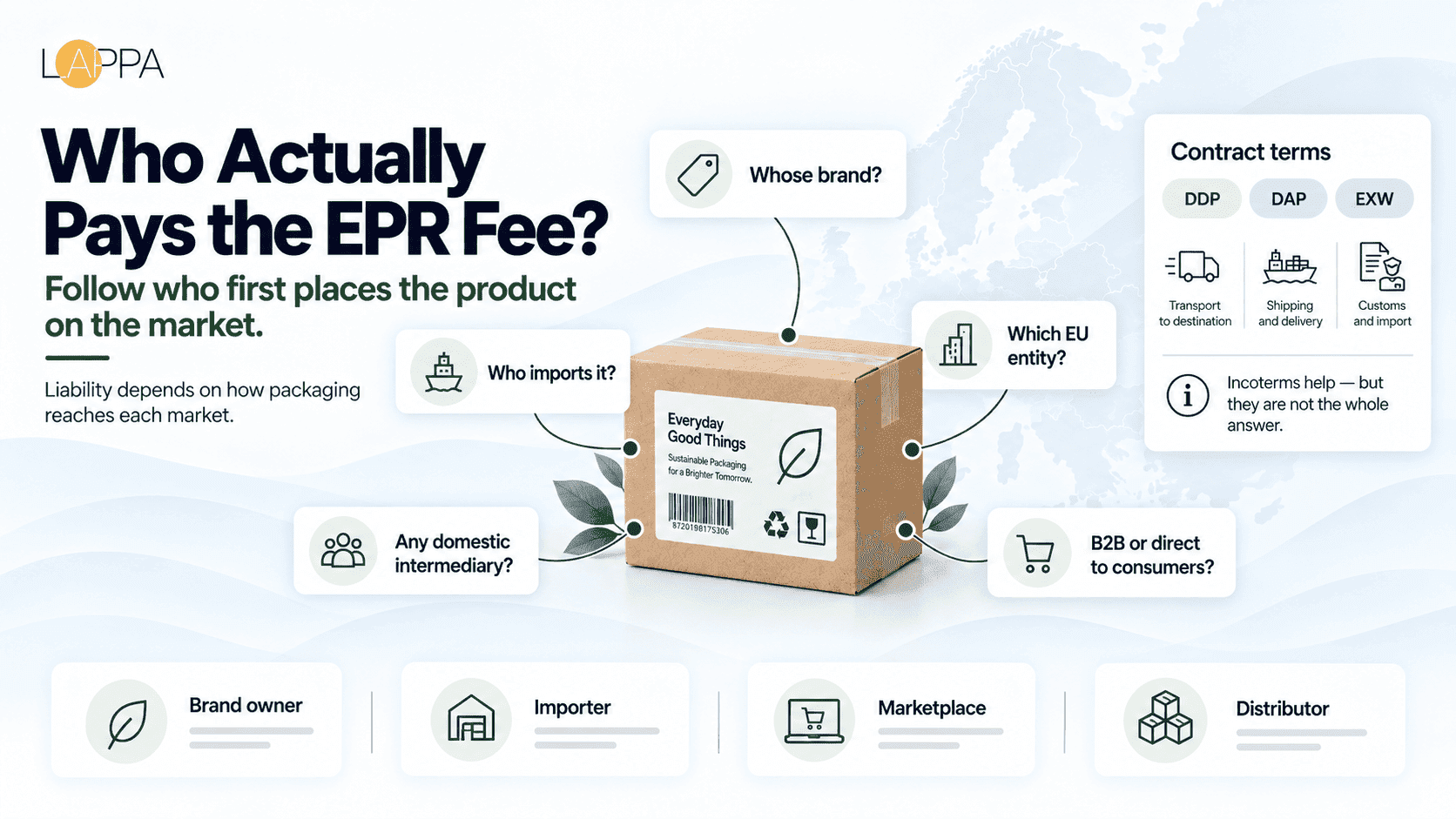
The shift is legal, not logistical. selling to eu customers directly makes you the producer of record in each destination country. Your freight forwarder does not absorb that. Neither does the customer, nor the carrier who hands over the parcel.
Three duties land at once. You register in a national producer register. You appoint someone local to represent you. You file volumes and pay fees that fund the recycling of what you sent. Skip any one and the other two stop protecting you.
Non EU Manufacturer EPR Duties in Plain Terms
A non eu manufacturer epr file looks much like a European one, with a single hard addition: representation. An EU company can usually register itself. You generally cannot, because most national registers demand a local legal presence to stand behind the entry.
Here’s where it gets tricky. Duties are per country, not per continent. Selling into six markets means six registrations, six sets of fees, and six calendars. There is no single European sign-up that clears them all.
EPR Obligations Non EU Sellers Cannot Skip
The epr obligations non eu businesses face break into a short, unforgiving list. Miss one and the rest unravel quickly.
- Appoint an authorised representative in each member state where you sell
- Register in that country’s producer register before any goods ship
- Declare the packaging you place on that market, by material and weight
- Pay the eco-fees your declared volumes generate
- Keep records and evidence available for later audit
Getting representation in place is the gate. Everything else waits behind it. That is why authorised representative services for non-EU producers are usually an overseas brand’s first call.
Distance Selling EPR Rules
The distance selling epr concept is simple once you see it from the regulator’s side. Somebody funded the bin that your mailer ends up in. If the goods crossed a border to reach a household, the seller who sent them carries that cost.
Your own webshop counts. So does a marketplace listing, a social-commerce checkout, and a dropshipped order routed through a third party. The delivery method changes nothing about the duty.
EPR Direct to Consumer Shipments
epr direct to consumer exposure is the sharpest version of this, because nobody sits between you and the household. A distributor would have absorbed the producer role. Shipping straight to the buyer means you keep it.
We see this happen often with fast-growing D2C brands. Revenue from Germany or France climbs quietly for two quarters. Nobody flags a threshold. The first warning is a dead listing. The fix always costs more after the fact than before.
The Authorised Representative Requirement
This is the provision most overseas sellers underestimate. A producer established outside the EU must appoint an authorised representative locally. That applies in every member state where it sells but holds no establishment. One appointment does not cover the bloc.
There was talk of pausing this duty until 2035. The catch: that relief was drafted for EU-established producers moving goods between member states. Non-EU companies were explicitly carved out, and in June 2026 the Council dropped the suspension anyway. Waiting it out was never a strategy.
Your representative registers in your name, files your declarations, and is the party an authority contacts. Choose one that actually covers every market you sell into, not just the easy ones.
EPR Registration for Foreign Companies
Handling EPR registration for foreign companies means working through one national system at a time. Each has its own register, identifier, and quirks. The table below covers the markets most overseas sellers hit first.
|
Country |
Register or scheme |
Representation for non-EU sellers |
Practical note |
|
Germany |
LUCID, plus a dual system contract |
Required |
Two steps — register, then contract an operator |
|
France |
Citeo, with a unique identifier |
Required |
The IDU code is requested constantly |
|
Italy |
CONAI |
Required |
Filing cadence scales with declared volume |
|
Spain |
Ecoembes plus the national register |
Required |
Producer and scheme duties sit apart |
|
Netherlands |
Verpact, formerly Afvalfonds |
Required |
Reporting starts above a weight threshold |
|
Poland |
BDO |
Required |
Annual return, typically due 15 March |
Treat that final column as a starting point, not gospel. National authorities adjust thresholds and dates, so confirm each one before you file.
EPR Cross Border Sales Across Several Markets
Scale is what turns this from admin into a project. epr cross border sales multiply the moving parts fast. Every market adds a number, a representative, a fee schedule, and a deadline. One SKU sold in six countries can carry six separate obligations.
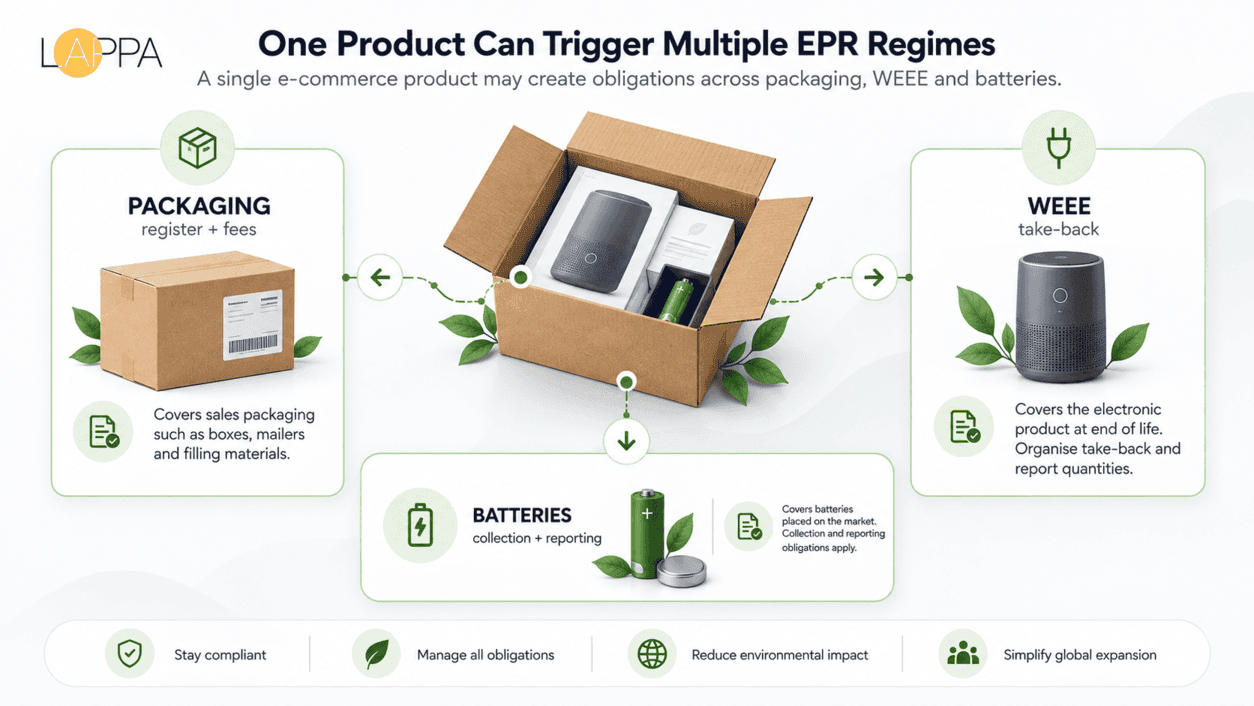
Packaging is rarely the only stream, either. Ship anything with a plug or a cell and two more regimes open up.
|
Waste stream |
What triggers it |
Typical duty |
|
Packaging |
Any box, mailer, label, or filler |
Register, declare weight by material, pay fees |
|
Electronics (WEEE) |
Devices with a plug or circuit |
Fund take-back of end-of-life units |
|
Batteries |
Loose cells or built-in power |
Meet collection targets and report volumes |
Once volumes are live, the work becomes rhythm rather than setup. Ongoing EPR reporting keeps each registration in good standing.
How Marketplaces Enforce the Rules
Platforms are now a second layer of enforcement, and a blunt one. Since 12 August 2026 Amazon verifies packaging registration in every EU country where you sell or store stock. A missing or invalid number deactivates the listing in that country, immediately. It is a hard switch, not a phased warning.
eBay, Zalando, Etsy, and Allegro run comparable checks. Storing inventory in a fulfilment centre counts as being active in that market, which surprises sellers using pan-European logistics. Our deeper breakdown of EPR compliance in Europe for marketplaces and online sellers walks through how each platform checks.
What Compliance Costs and How to Budget It
Costs split into three buckets: representation, scheme fees, and the admin around them. Scheme fees track the weight and material you declare, adjusted by how recyclable it is. Lighter, cleaner packaging genuinely bills less.
Rates swing hard between materials and markets, so a glass-heavy range behaves nothing like a paper one. Model the numbers per country before you commit to a market. An EPR fee calculator gets you a working figure in minutes. Published EPR pricing then shows what the service layer adds.
How to Get Compliant Without Stalling Sales
Sequence beats speed here. Chase the markets where you already ship volume, then work down the list. A country with two orders a month can wait a fortnight; Germany cannot.
- Map every EU country your parcels actually reach
- Rank them by volume, then by enforcement risk
- Appoint a representative in each priority market
- Register and secure the producer number before shipping resumes
- Gather packaging weights and materials per SKU
- File the first declaration and diarise the recurring dates
Want the numbers before you commit? Get a fee quote for your actual markets. Or book a demo and watch the flow run on your own catalogue.
Common Mistakes Overseas Sellers Make
The same errors repeat across continents and company sizes. None of them are exotic.
- Assuming an EU registration in one country covers the rest
- Treating a freight forwarder or 3PL as the responsible producer
- Ignoring small markets until a listing freezes there
- Forgetting that stored inventory triggers duties on its own
- Declaring sales figures rather than what was placed on the market
- Overlooking electronics or battery streams inside the same parcel
FAQ on EU Packaging EPR
Yes, and that is the whole point of the current rules. Since 12 August 2026 a producer established outside the EU carries the same duties as a domestic one. That holds in every market it ships to. Having no office, staff, or warehouse in Europe does not remove the obligation. It simply means you act through an appointed representative.sale, not the factory location.