


PRO vs Authorised Representative vs EPR Registration: What Is the Difference
Three terms get jumbled together in almost every EPR conversation. People say them as if they mean the same thing. They do not. A producer responsibility organization, an authorised representative, and the act of registering are three separate pieces of the same puzzle. Mix them up and you either overpay, underprepare, or get a listing frozen. Here is the clean version, minus the jargon fog.
What Is Extended Producer Responsibility
Start with the idea underneath all three. what is extended producer responsibility in practice? It is the rule that the business first putting a product on sale pays to deal with its spent packaging. That expense moves from town-hall budgets onto the seller.
The principle is old, but its reach keeps growing. Packaging led the way, then electronics and batteries joined. Textiles are next in several markets. Each stream has its own register, its own fees, and its own quirks.
The EPR Extended Producer Responsibility Framework
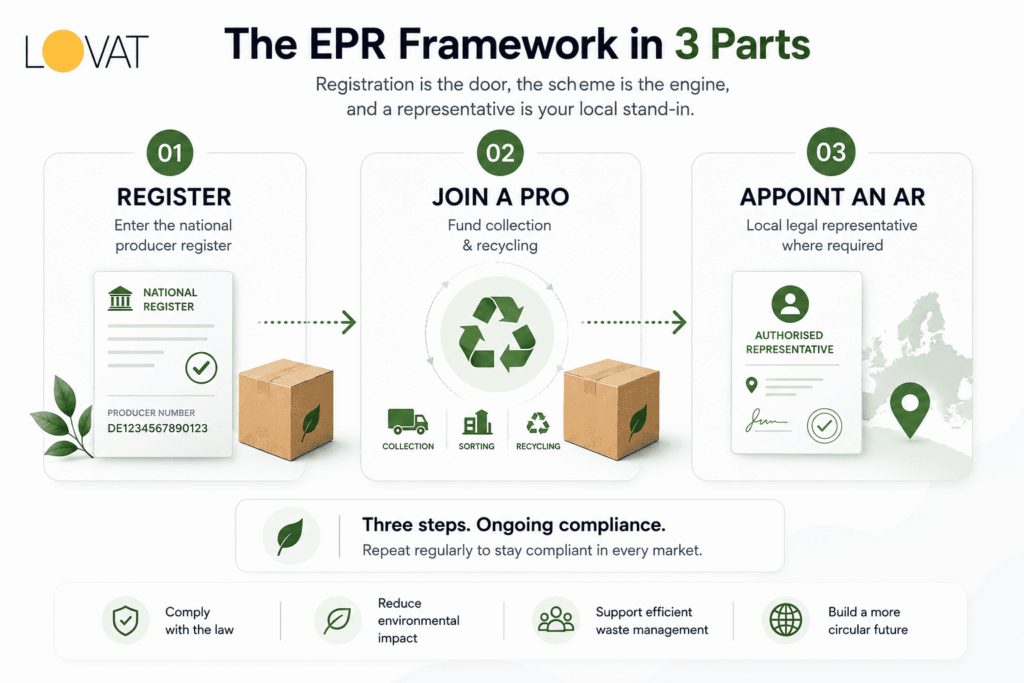
The EPR extended producer responsibility model rests on three moving parts. First comes EPR registration with the relevant national authority. You enrol with the national authority. You disclose what you release onto the market. Then you either settle a charge directly or bankroll a scheme that runs the recovery for you. Confusing these steps is exactly where businesses trip.
Picture a chain rather than one action. The register entry is the doorway, the scheme is the engine room, and a representative is your voice on the ground. Each link does a distinct job. Skip one and the whole thing rattles.
What a Producer Responsibility Organization Does
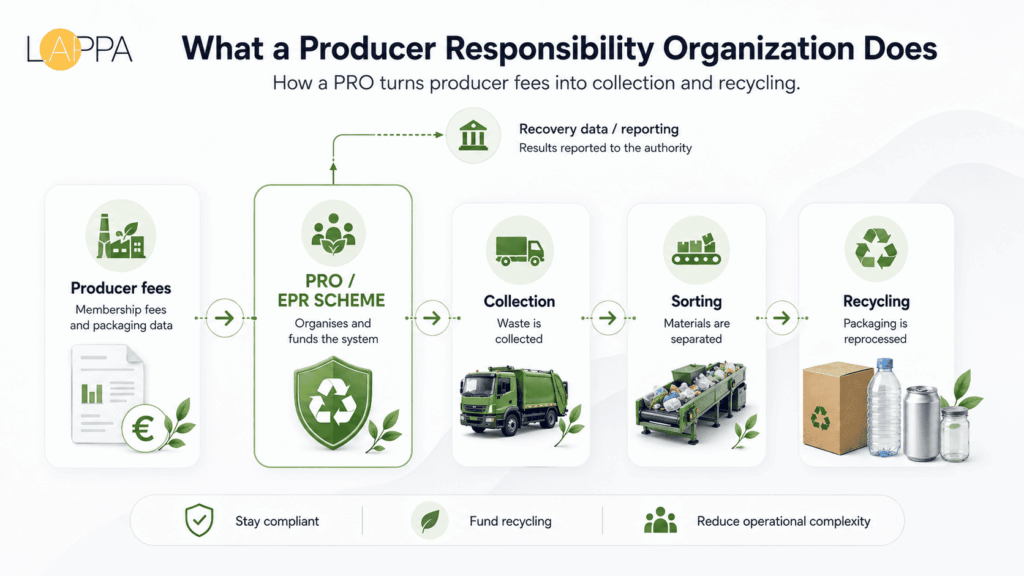
A producer responsibility organization is the collective that does the physical recycling work on your behalf. You pay it a membership fee based on your tonnage. It signs up the waste handlers, underwrites the household pickups, and sends recovery figures back to the regulator. Germany’s Grüne Punkt and France’s Citeo are two well-known examples.
Joining one is usually mandatory, not optional. A single brand cannot run a national collection network, so the law pushes you into a shared body. The organization spreads the operational burden across thousands of members. You get compliance without owning a fleet of trucks.
These bodies handle a surprising amount on your behalf:
- Arranging collection, sorting, and reprocessing of waste
- Meeting national recycling targets set by law
- Filing aggregate recovery data with the authorities
- Applying eco-modulated fees tied to recyclability
Lappa can handle EPR registration and compliance scheme enrolment across multiple markets.
What an Authorised Representative Is
An authorised representative service is a legal proxy for a producer with no local entity. Sell into Germany from Poland, or into France from outside the EU, and you often lack a registered office there. The rules still hold you responsible. A local representative steps in to carry those duties in your name.
The PPWR introduced harmonised rules around the PPWR authorised representative requirement for producers selling cross-border. Where a producer has no base in a given member state, it must name a local party to carry the duties on the spot. That proxy enrols, files, and settles charges under your name. Miss this step and customs or a marketplace can block your goods.
You typically need a representative when:
- You sell into a country where you have no legal entity
- National law bars foreign producers from registering directly
- A marketplace demands local representation before listing
- You run cross-border distance sales into several states
Selling across borders without an entity? Explore authorised representative services and keep every market open.
What EPR Registration Actually Means
EPR Registration is the narrowest of the three, and the most concrete. It is the act of entering your business into a national producer register before you sell. Germany’s version is the LUCID register; France hands out a unique identifier code. Skip that entry and you have no lawful route onto the market.
The catch: registering is not the same as complying. A register entry proves you exist in the system. It does not arrange a single act of recycling, nor pay a single fee. You still need a scheme for the operations and, if foreign, a representative for the liability.
How the Three Roles Differ
Laid side by side, the distinctions get obvious quickly. One is a step, one is an operator, one is a stand-in. The table below draws the lines cleanly.
| Element | What It Is | Who Needs It |
| EPR registration | Entry in a national producer register | Every producer, in each market |
| Producer responsibility organization | The scheme that runs the recycling | Producers meeting an operational duty |
| Authorised representative | A local proxy for a foreign producer | Producers with no local entity |
Read the table as a sequence, not a menu. You register, you join a scheme, and where needed you appoint a representative. Most cross-border sellers touch all three. A purely domestic producer often needs only the first two.
Extended Producer Responsibility Packaging Rules
The extended producer responsibility packaging stream is the busiest of the lot. Every box, pouch, label, and pallet wrap counts toward your reported tonnage. The PPWR, applicable since 12 August 2026, tightened the duties and the paperwork. A signed declaration and technical file now sit alongside the older registration and fee obligations.
Fees follow recyclability now, not just weight. Harder-to-sort formats and virgin-plastic-heavy designs cost more. Cleaner, single-material choices earn a discount. Use the EPR fee calculator before you finalise a new packaging format.
Choosing a Compliance Scheme
Picking a compliance scheme is less about price than coverage. Some organizations operate in one country; others span a dozen. A multichannel seller wants one partner that reaches every market it touches. Fragmented membership means fragmented reporting and duplicated effort.
Look past the headline fee to the service around it. Ask how a scheme handles reporting, audits, and cross-border filing. A cheap membership that leaves you chasing five portals is no bargain. Compare EPR pricing across your target markets before choosing a provider.
Which One Does Your Business Need
Most businesses need more than one of the three, and that surprises people. A domestic manufacturer registers and joins a scheme, and stops there. A foreign online seller registers, joins a scheme, and appoints a representative in each market. Your footprint decides the mix.
Work through a quick self-check:
- Do you place packaging on a market for the first time
- Do you sell into countries where you hold no legal entity
- Do you need someone to run the actual recycling duty
- Do you file reports and fees on a recurring schedule
Answer those honestly and your obligations fall into place. Reliable reporting ties the whole thing together, month after month. Manage your EPR reporting in one dashboard, or book a demo to see how the pieces connect.
FAQ
about organizing packaging information



Is a producer responsibility organization the same as an EPR scheme
The two labels usually describe the same thing, a shared body that carries out recycling for its members. You contribute in line with your volumes, and it organises pickup, sorting, and the paperwork. Some countries run several competing organizations, so you choose the one that best fits your markets and materials.
Do I always need an authorised representative
Not always, since a representative is only required when you sell into a country where you hold no legal entity. A domestic producer registering in its own home market rarely needs one. A foreign or cross-border seller, by contrast, usually must appoint one in each state where it lacks an office.
What packaging counts toward my EPR obligations
Practically all of it, from the primary pack around a product to the transport packaging around a pallet. Labels, caps, void fill, and secondary boxes all add to your reported tonnage. Under the PPWR you also hold a declaration and technical file proving each format meets the substance and minimisation rules.
How do the fees actually work
Charges rest on the weight and material mix you declare, then flex with eco-modulation. Formats that recycle cleanly attract lower charges, while mixed or virgin-heavy designs cost more. Modelling those numbers early, per market, keeps the annual bill predictable rather than shocking.
Can one provider handle registration, the scheme, and representation together
Yes, and that is often the simplest route for a business selling across several countries. A single partner can register you, connect you to the right organizations, and act as your representative where needed. Consolidating the work in one place cuts duplicated reporting and keeps every deadline in one view.
