


PPWR Compliance Checklist Before August 12, 2026
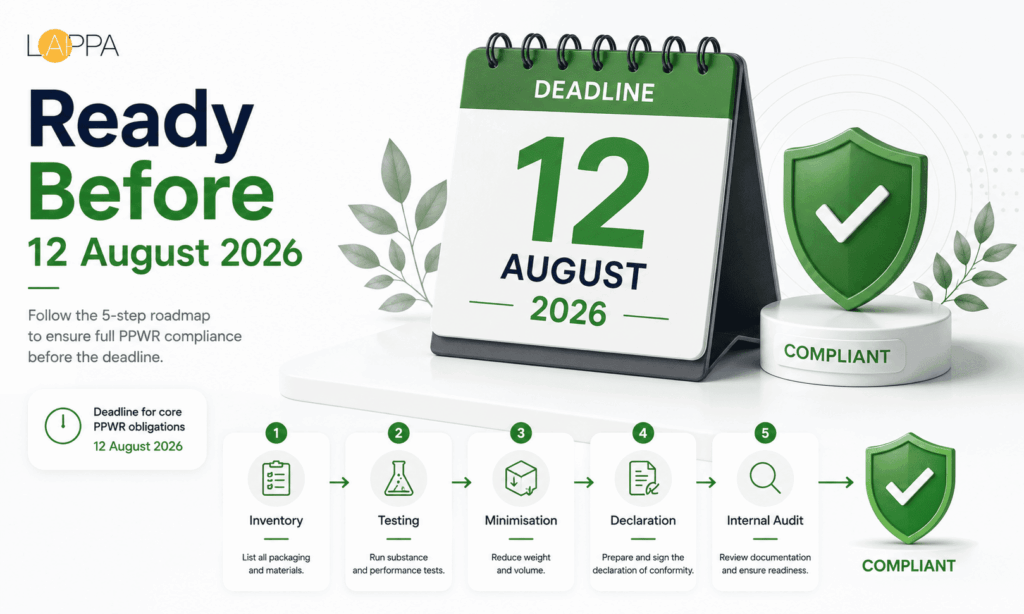
The clock is loud now. On 12 August 2026, the core of the Packaging and Packaging Waste Regulation, known as Regulation (EU) 2025/40, starts to bite. From that morning, no pack may enter the EU market without a signed declaration and a technical file behind it. Miss the date and your goods can be pulled from shelves. This guide gives you a practical, field-tested plan to arrive ready rather than exposed.
What Changes on August 12, 2026
The regulation entered into force on 12 February 2025. Most operative duties then wait until 12 August 2026. That gap was your runway, and it is nearly spent. Three obligations dominate the first wave.
Substance limits arrive first. Food-contact wraps must sit under strict PFAS thresholds from day one. Heavy metals face a combined ceiling across every format. The second duty is minimisation, meaning you justify the weight and volume of each unit. The third is proof itself, carried by a formal declaration and its supporting file.
Enforcement has real teeth. There is no grandfathering for old stock, so a pallet made in July 2026 still fails if it breaches the rules. National authorities can demand your paperwork on the spot. Retailers already ask suppliers for evidence months ahead.
Scope creep is the trap here. The rules reach primary, grouped, and transport formats alike. A single product can carry three layers, each in scope. Map all three from the start so none slips through.
Reuse enters the picture for certain formats too. Article 11 sets criteria for packs designed to be used again. Crates, kegs, and refill bottles must meet reusability tests. Where you claim reuse, the file has to prove the loop is real.
Building Your PPWR Compliance Checklist
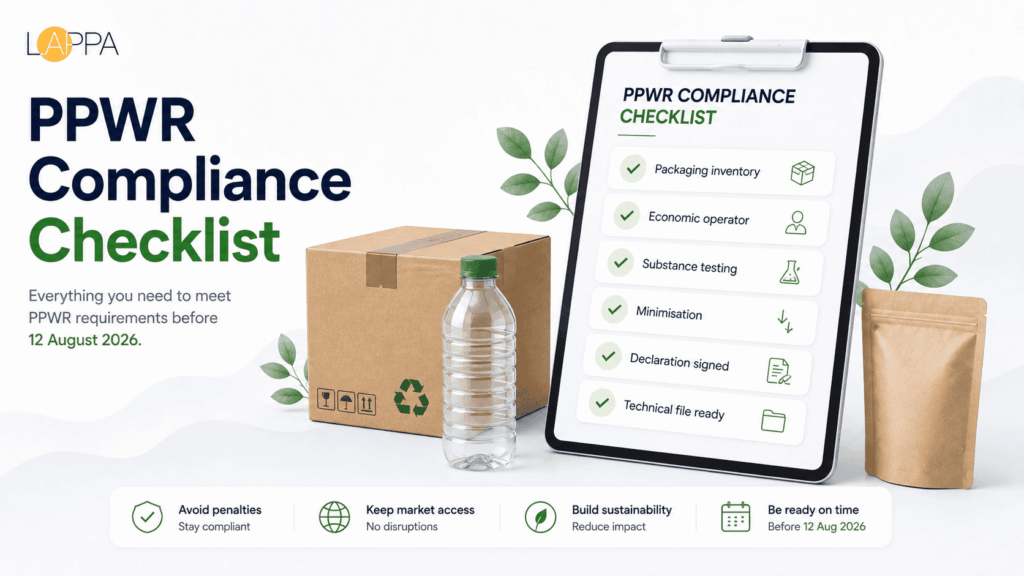
A strong PPWR compliance checklist turns a sprawling law into a set of tasks you can assign and track. Start by listing every format your business places on the market. Map each one to the duties that apply from August 2026. The exercise usually reveals gaps nobody owned.
Treat the list as a living record, not a one-off. Each SKU needs a named owner, a status, and a deadline. We see this happen often: teams that skip ownership let items slip between functions. A shared tracker keeps design, procurement, and legal honest.
Your first pass should capture these essentials:
- Every format and material you sell into the EU
- The economic operator role you hold for each line
- Substance test results for food-contact items
- A minimisation rationale for weight and volume
- The signed declaration and its technical file
Keep the checklist blunt about status. Green means done and evidenced, amber means in progress, red means exposed. That colour code alone sharpens a leadership meeting. It also shows an auditor you run a controlled process.
Review the tracker on a fixed rhythm, not by memory. A fortnightly check keeps red items from festering quietly. Tie each status to a real piece of evidence, never a claim. That habit turns your tracker into an audit rehearsal.
How to Prepare for PPWR Before the Deadline
Knowing how to prepare for PPWR is mostly about sequence. Chase the hard bans first, because they carry the sharpest penalties. Substance limits and the declaration cannot wait, while later duties like recycled content give you until 2030. Order the work by risk, not by comfort.
Preparation splits cleanly across functions. Procurement chases supplier evidence, design tackles minimisation, and legal owns the signed statement. A weekly stand-up keeps the threads together. Firms that ran this cadence in 2025 report far calmer summers.
The catch: data lives in silos, and August arrives whether you are ready or not. Pull material specifications, test reports, and weights into one place early. A central repository beats a frantic email hunt in July. Start that build now, not after the holidays.
Who Counts as an Economic Operator
The regulation spreads duties across the whole supply chain. Your obligations hinge on the role you play for each line. A business often wears several hats at once. Sorting this out early prevents a nasty shock at audit.
A producer makes the pack or sells goods under its own brand and controls the design. That party carries the heaviest load and signs the statement. An importer brings packed goods in from outside the bloc. It must confirm the producer did the work and keep a copy on hand.
Online sellers and fulfilment houses sit in a grey zone many overlook. A marketplace shipping into the EU can inherit producer duties for its own-brand lines. Distributors and retailers still check that markings and paperwork exist. We see this happen often: a brand assumes its supplier owns everything, then learns otherwise too late.
Points worth clarifying for your own business:
- Which lines you sell into the market under your own name
- Where you bring packed goods in from outside the EU
- Whether any marketplace role pulls you into producer duties
- Which partners hold the evidence you will need to cite
The Declaration of Conformity PPWR Requires
The declaration of conformity PPWR introduced sits at the heart of the new regime. It is a signed statement that a given format meets the applicable sustainability rules. The document follows the Annex VIII template and names the responsible operator. Whoever signs takes personal legal liability for the claim.
The statement is short, yet it rests on a mountain of evidence. It cites the requirements met, chiefly Article 5 on substances and Article 10 on minimisation. Where reuse applies, Article 11 joins the list. A bare signature without a backing file is worthless under audit.
Timing is unforgiving. No unit may reach the market from 12 August 2026 without this paperwork in hand. Greif, Mondi, and other large converters began issuing template statements to customers well ahead of the date. Their buyers, in turn, demanded matching proof down the chain.
PPWR Declaration of Conformity Packaging Records
Each PPWR declaration of conformity packaging file must trace a clear line from claim to evidence. The record links the signed statement to the tests, calculations, and specifications behind it. An inspector should move from the declaration to the raw proof in minutes. Weak links are where most audits stumble.
Keep these records tidy and versioned. A changed material or supplier means a fresh assessment and, often, a new signature. Store superseded versions rather than deleting them. That history shows you managed change rather than hid it.
Preparing Packaging Technical Documentation
Solid packaging technical documentation is the spine of the whole regime. It gathers every proof that supports your signed statement in one structured dossier. Authorities can request it for up to five years after a format leaves the market. A thin or scattered file is a red flag to any inspector.
The dossier should read like a story an outsider can follow. Describe the format, its materials, and its intended use. Show the assessments against each applicable article. Close with the test reports and supplier declarations that anchor every claim.
A complete technical file usually holds:
- A description of the format and its components
- Material composition and weight for each part
- The minimisation assessment and its criteria
- Substance test reports for restricted chemicals
- Supplier statements and upstream evidence
Here’s where it gets tricky. One format can span several suppliers, plants, and material grades. Each variant may need its own assessment and record. Treat a small design change as a trigger for a documentation review, not an afterthought.
Collecting Packaging Data
Reliable packaging data is the raw fuel for every assessment you will run. You need accurate weights, dimensions, and material breakdowns for each component. Guesswork here poisons the minimisation case and the substance checks alike. Measure, do not estimate, wherever you can.
Build one dataset that every team can trust. Weigh samples, record polymer types, and log recycled shares per part. A single source of truth stops two departments citing different figures. It also speeds the day an auditor calls.
Pull together the numbers that matter most:
- Net weight of each component in grams
- Primary material and any coatings or laminates
- Recycled content share where known
- Empty-space ratio for grouped and transport formats
- Supplier and plant of origin for traceability
Refresh these figures whenever a spec changes. A thinner film or a new laminate shifts both weight and recovery. Version the dataset so you can prove what was true and when. Auditors respect a clear trail far more than a tidy guess.
Gathering Supplier Documentation
Strong supplier documentation decides whether your file stands or collapses. Most of your evidence originates upstream, not on your own site. A converter must tell you the resin, the additives, and the test results. Without that flow, your declaration rests on hope.
Send suppliers a clear, standard request early. Ask for substance test reports, material specifications, and their own conformity statements. Chase the laggards in writing, since silence becomes your liability. A tiered supplier list helps you focus on the riskiest inputs first.
Standardise the request so every vendor answers the same questions. A short template beats a rambling email thread. Track responses in the same tracker that holds your formats. Gaps then surface in red, where leadership can see them.
Running a Packaging Compliance Audit
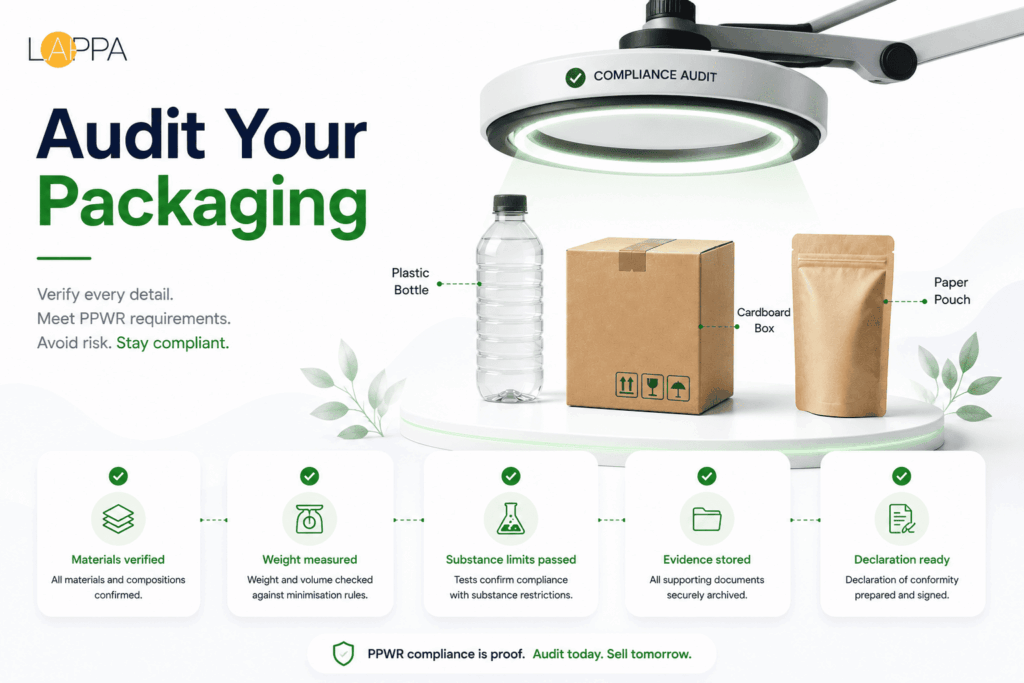
A disciplined packaging compliance audit stress-tests your file before an official ever does. Walk each format from claim to raw proof and note every gap. Treat the audit as a rehearsal for the real inspection. The findings become your fix list for the weeks that remain.
Run the check against the articles that apply in 2026. Confirm the substance limits, the minimisation rationale, and the signed statement for each line. Sample rather than boil the ocean, focusing on high-volume and food-contact formats. A short, sharp review beats a report nobody reads.
Structure the audit around clear steps:
- Select a representative sample of formats
- Verify the declaration and its Annex VIII fields
- Trace each claim to a test or calculation
- Flag missing supplier evidence and weak proofs
- Assign owners and dates for every gap found
Repeat the exercise on a cycle, not once. New products and new suppliers arrive constantly. A quarterly review keeps the portfolio honest as it changes. It also builds the paper trail that shows good faith.
Packaging Testing and Evidence
Laboratory packaging testing converts assumptions into defensible facts. Food-contact items need PFAS analysis by targeted and total methods. Heavy-metal screening covers the regulated combined limit. Use accredited labs, because an inspector trusts their reports over yours.
Plan testing around risk and volume. A high-turnover food wrap deserves priority over a rare industrial liner. Keep raw reports, not just summaries, in the technical file. Retesting follows any change in material or supplier.
Book lab slots early, since capacity tightens as the deadline nears. Queues at accredited labs already stretch for weeks in busy regions. A late booking can leave a format unproven when it matters most. Plan the testing calendar alongside the design calendar.
Packaging Minimisation Under Article 10
packaging minimisation is the duty most teams underestimate. Article 10 says each unit must use no more material than needed for function and safety. You must document why every gram and millimetre is justified. Over-packaging is no longer a style choice, it is a legal risk.
The assessment weighs several performance criteria. Protection, hygiene, and consumer information all count as valid reasons for material. Marketing bulk does not. A perfume box with a large false bottom is the classic failure everyone cites.
Work through a minimisation review for each format:
- Confirm the function each layer genuinely serves
- Remove void space that adds no protection
- Challenge secondary and tertiary layers hard
- Record the criteria that justify what remains
- Log the assessment date and the responsible signer
Real brands are already acting. Amazon cut millions of tonnes of material through right-sized boxes and paper mailers. Nestlé and Unilever trimmed secondary layers across several lines. Those moves both satisfy Article 10 and cut cost per unit.
Designing for Recyclability
Strong recyclability is a 2030 duty, yet it belongs on your 2026 plan already. Design decisions made now lock in grades you cannot easily change later. A mono-material pack sorts cleanly, while a fused laminate does not. Building for recovery early avoids a painful redesign down the line.
Favour single material families wherever function allows. Match labels, caps, and sleeves to the main body. Avoid carbon black and problematic adhesives that blind sorting lines. These choices lift future grades and often simplify the file today.
Bring your recycler into the conversation early. They know which formats their lines can actually sort. A quick review with them beats a lab surprise later. Their input often trims cost while raising the eventual grade.
Labelling and Marking Duties
Marking rules run alongside the conformity work and often get forgotten. Formats will need harmonised symbols that guide correct sorting and disposal. The detailed pictograms arrive through a delegated act expected around 2028. The direction of travel is already clear enough to plan for.
Consistency across a portfolio matters more than perfection today. Align your artwork process so labels can update quickly once symbols land. Reusable and deposit formats carry their own marking logic. Build that flexibility now and you dodge a costly artwork sweep later.
Penalties and Enforcement Realities
Member states set their own penalties, and they vary widely. Fines, forced withdrawal, and import refusals all sit on the table. A non-compliant line can be pulled from sale across a whole market. The reputational hit often stings more than the fine itself.
Market surveillance authorities lead enforcement on the ground. They can request your file, sample your stock, and inspect your claims. Customs officers screen imports at the border for missing paperwork. Retailers add private pressure, since they refuse to shelve exposed goods.
Enforcement will not switch on gently everywhere. Some states signal a soft landing, while others promise strict checks from day one. Betting on leniency is a risk few boards should accept. Treat the deadline as a hard line and you remove the guesswork.
Common Mistakes We See in Conformity Files
Plenty of teams reach the finish line with a file that cannot survive scrutiny. The errors repeat across industries and company sizes. Spotting them now is far cheaper than fixing them under pressure. The table below pairs each slip with its likely fallout.
| Common Mistake | Why It Hurts | The Fix |
| Signed statement with no backing proof | Fails on first inspection | Attach tests and calculations |
| Estimated weights instead of measured | Breaks the minimisation case | Weigh real samples |
| Ignoring imported own-brand lines | Leaves a legal gap | Assign producer duties clearly |
| One statement stretched across variants | Collapses under audit | Assess each variant on its own |
| Stale records after a supplier swap | Evidence no longer matches | Re-run the assessment promptly |
Master data is the quiet villain behind most of these slips. A wrong weight or a missing test poisons everything downstream. Clean the underlying numbers before you draft a single statement. That discipline spares you frantic rework in the final weeks.
The Business Case Beyond Mere Compliance
Meeting the rules is the floor, not the ceiling. A clean file unlocks commercial upside that pays for the effort. Several EU states charge extended producer responsibility fees that fall as formats improve. Lighter, cleaner units simply cost less to sell.
Savings show up across the operation. Right-sized formats use less material and ship more per pallet. Fewer disputes over evidence mean smoother retail relationships. Buyers increasingly screen partners on their paperwork before they commit.
The upside reaches your brand as well:
- Lower producer fees where eco-modulation applies
- Stronger retail listings with evidence-ready formats
- Cleaner ESG metrics your reporting team can publish
- Consumer trust from credible, checkable claims
Early movers turn a legal cost into a market edge. The laggards spend the same money later, under pressure, with less to show. Acting ahead of the rush buys you both calm and leverage.
Choosing a Compliance Partner or Tool
Spreadsheets crack under this weight once a portfolio grows. A dedicated system links formats, evidence, and signatures in one place. Look for supplier portals, version history, and audit-ready exports. Those features turn a scramble into a routine.
Ask any vendor how they handle change. A material swap should trigger a review, not a silent stale record. Multi-site and multi-language support matters for larger groups. Test the tool on your messiest line before you commit.
Your Compliance Roadmap to August 2026
A clear compliance roadmap converts panic into a sequence of dated milestones. Work backwards from 12 August 2026 and place each task on a calendar. Leave a buffer for supplier delays, which always run longer than promised. A dated plan also lets leadership see progress at a glance.
The table below sets the headline dates against the duties they carry.
| Obligation | Applies From | What It Means |
| Declaration and technical file | 12 August 2026 | No unit on the market without both |
| PFAS limits for food-contact wraps | 12 August 2026 | Binary proof per format type |
| Heavy-metal combined limit | 12 August 2026 | Four metals capped together |
| Minimisation assessment | 12 August 2026 | Justify weight and volume |
| Recyclability grades A to E | 1 January 2030 | Design-for-recycling thresholds |
| Recycled-content targets | 1 January 2030 | Minimum recycled plastic share |
Each economic operator carries a different load. The next table maps who does what across the chain.
| Role | Core Duty | Keeps on File |
| Producer or manufacturer | Draw up and sign the declaration | The full technical dossier |
| Importer | Verify and obtain a copy | Declaration plus supporting proof |
| Distributor or retailer | Check markings and paperwork | Evidence of due diligence |
Substance limits deserve their own quick reference. Keep the figures below pinned where your lab team can see them.
Milestones worth locking into your calendar now:
- March 2026 — finish the format inventory and ownership map
- April 2026 — collect supplier evidence and test the riskiest lines
- May 2026 — complete minimisation assessments across the portfolio
- June 2026 — draft and review every declaration and file
- July 2026 — run the internal audit and close remaining gaps
Lappa pulls your evidence, declarations, and assessments into one connected system. The platform links supplier data, test results, and the signed statement for every line. Get a Free Quote and see where your portfolio stands today.Preparation done well pays off long after August. A clean file wins retail listings and cuts extended producer fees. It also spares you the scramble when inspectors arrive unannounced. Lappa tracks each deadline so nothing slips through the cracks. Book a Demo to see the workflow on your own formats.Frequently Asked QuestionsWhat exactly must be ready by 12 August 2026Every format you place on the EU market needs a signed declaration and a technical file behind it. That file must prove compliance with substance limits, minimisation, and reuse rules where they apply. Without both documents in hand, the unit cannot legally enter the market, even if it was made earlier. Build the file before the pallet ships, since retrofitting proof after the fact rarely holds up.Who is responsible for signing the declarationThe producer, meaning whoever makes the pack or sells goods under their own brand and controls the design, must draw up and sign it. Importers must obtain a copy and keep the technical documentation available for authorities. Distributors and retailers carry a lighter duty to check that the paperwork and markings are present. If you are unsure which hat you wear, map each line to a role well ahead of the deadline.Does the PFAS ban apply to all packagingThe strict PFAS limits target food-contact formats specifically, where migration into food poses the clearest risk. From 12 August 2026, those wraps must sit below tight thresholds measured by targeted and total analysis. There is no clearance period for old stock, so material made before the date still fails if it breaches the limits.How detailed does the technical documentation need to beIt must fully substantiate every claim in the signed declaration, not merely assert compliance. Expect to include material composition, weights, minimisation reasoning, and accredited test reports. Authorities can request the dossier for years after a format leaves the market, so completeness protects you long term. Treat the dossier as the product’s passport, kept current through every change.What happens if a supplier will not provide evidenceSilence upstream quickly becomes your own liability, since your declaration rests on that missing proof. Send a clear, written request early and escalate laggards in writing to build a record. If a supplier cannot deliver, treat that input as high risk and consider an alternative source before the deadline. A documented chase also shows authorities that you acted in good faith.Can I reuse one declaration across similar formats You can group genuinely identical formats, but small differences in material, weight, or supplier often break that shortcut. Each meaningful variant usually needs its own assessment and record to stand up under audit. When in doubt, document the variant separately rather than stretch a single statement too far.
| Substance | Limit | Scope |
| Lead, cadmium, mercury, chromium VI combined | 100 mg/kg | All formats |
| Any single non-polymeric PFAS | 25 µg/kg | Food-contact wraps |
| Sum of non-polymeric PFAS | 250 µg/kg | Food-contact wraps |
| Total PFAS including polymeric | 50 mg/kg | Food-contact wraps |
Milestones worth locking into your calendar now:
- March 2026 — finish the format inventory and ownership map
- April 2026 — collect supplier evidence and test the riskiest lines
- May 2026 — complete minimisation assessments across the portfolio
- June 2026 — draft and review every declaration and file
- July 2026 — run the internal audit and close remaining gaps
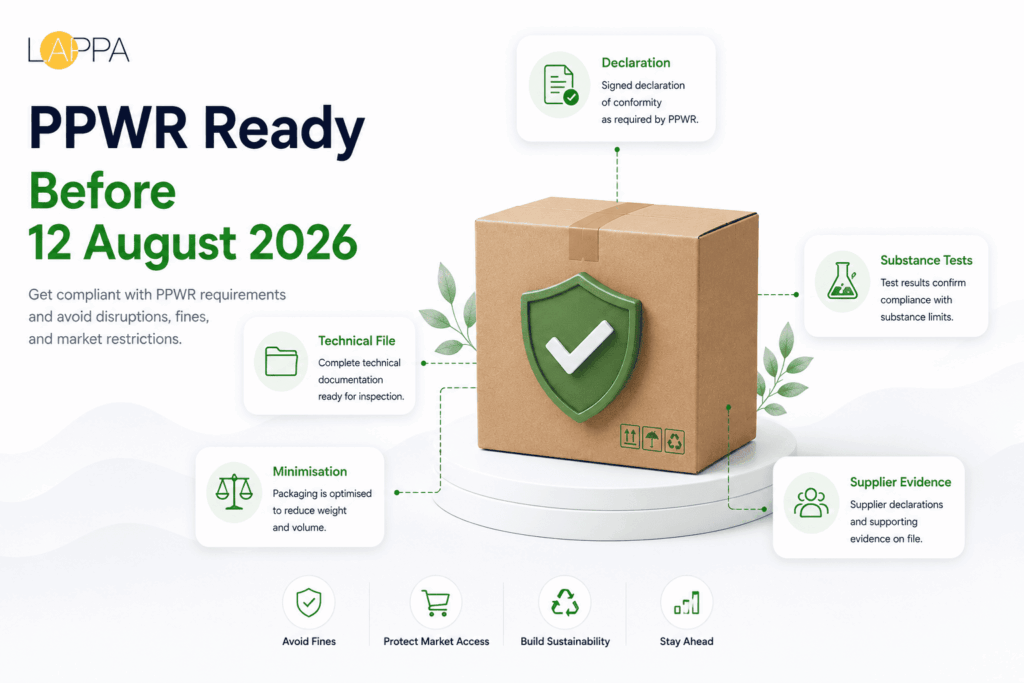
Lappa pulls your evidence, declarations, and assessments into one connected system. The platform links supplier data, test results, and the signed statement for every line. Get a Free Quote and see where your portfolio stands today.
Preparation done well pays off long after August. A clean file wins retail listings and cuts extended producer fees. It also spares you the scramble when inspectors arrive unannounced. Lappa tracks each deadline so nothing slips through the cracks. Book a Demo to see the workflow on your own formats.
Frequently Asked Questions




What exactly must be ready by 12 August 2026
Every format you place on the EU market needs a signed declaration and a technical file behind it. That file must prove compliance with substance limits, minimisation, and reuse rules where they apply. Without both documents in hand, the unit cannot legally enter the market, even if it was made earlier. Build the file before the pallet ships, since retrofitting proof after the fact rarely holds up.
Who is responsible for signing the declaration
The producer, meaning whoever makes the pack or sells goods under their own brand and controls the design, must draw up and sign it. Importers must obtain a copy and keep the technical documentation available for authorities. Distributors and retailers carry a lighter duty to check that the paperwork and markings are present. If you are unsure which hat you wear, map each line to a role well ahead of the deadline.
Does the PFAS ban apply to all packaging
The strict PFAS limits target food-contact formats specifically, where migration into food poses the clearest risk. From 12 August 2026, those wraps must sit below tight thresholds measured by targeted and total analysis. There is no clearance period for old stock, so material made before the date still fails if it breaches the limits.
How detailed does the technical documentation need to be
It must fully substantiate every claim in the signed declaration, not merely assert compliance. Expect to include material composition, weights, minimisation reasoning, and accredited test reports. Authorities can request the dossier for years after a format leaves the market, so completeness protects you long term. Treat the dossier as the product’s passport, kept current through every change.
What happens if a supplier will not provide evidence
Silence upstream quickly becomes your own liability, since your declaration rests on that missing proof. Send a clear, written request early and escalate laggards in writing to build a record. If a supplier cannot deliver, treat that input as high risk and consider an alternative source before the deadline. A documented chase also shows authorities that you acted in good faith.
Can I reuse one declaration across similar formats
You can group genuinely identical formats, but small differences in material, weight, or supplier often break that shortcut. Each meaningful variant usually needs its own assessment and record to stand up under audit. When in doubt, document the variant separately rather than stretch a single statement too far.
