


Packaging Data Sheet Requirements for PPWR
Four separate items sit inside one ordinary shampoo bottle before it ever reaches a shelf in the EU — the bottle itself, its cap, its label, and the case it travels in. Each needs its own weight, its own material name, its own line on file. That combined record is what the industry now calls a packaging data sheet, and three separate things lean on it: the signed Declaration of Conformity, the tonnage figure sent to a national scheme, and whatever a market surveillance officer decides to pull up first. When a compliance file falls apart, the cause is rarely the regulation text itself — it’s this one working document.
Curious whether your packaging data sheet would hold up if a regulator asked for it tomorrow? Get a free quote or book a demo and we’ll walk through your current documentation together.
What a packaging data sheet covers under PPWR legislation
Brussels adopted Regulation (EU) 2025/40 in early 2025 — it took legal effect that February — and the transition window closes on 12 August 2026, the date every Member State starts enforcing it identically, with no country writing its own version into national law first. Whatever record a business keeps for a bottle, a carton, or a stretch-wrapped pallet has to point back to a supplier source at every layer, because Articles 5 through 12 lay out the design and substance rules while Articles 38 and 39 spell out the proof a company must hold behind them under PPWR legislation.
This isn’t something bolted on once sourcing decisions are already locked in. Picture two suppliers quoting for the same cap — a buyer comparing them should already be pulling the same figures a technical file will ask for later: resin grade, gram weight, recycled share. Companies running dozens of these records at once usually discover that a single gap somewhere in the middle of the list holds up an entire submission, not just the one line it belongs to.
Why documentation quality decides audit outcomes
Three obligations draw on the same underlying record without most teams realising it: the Annex VII technical file, the Annex VIII Declaration of Conformity, and the tonnage report a national scheme collects for an entirely separate reason — funding waste collection, not proving design. Holding a signed DoC offers no protection if an EPR review turns up a mismatch, and the same runs in reverse whenever source numbers got typed in once and never checked again against what actually arrived from a supplier.
Working documentation means exactly one dataset that both filings draw from, updated the moment something changes rather than patched at the next deadline. Say a cap moves from virgin polypropylene to thirty percent recycled content partway through the year — that change belongs on file within the same week, not folded into a year-end tidy-up. Waiting is how a record quietly stops reflecting what’s actually shipping.
What a filled record actually looks like
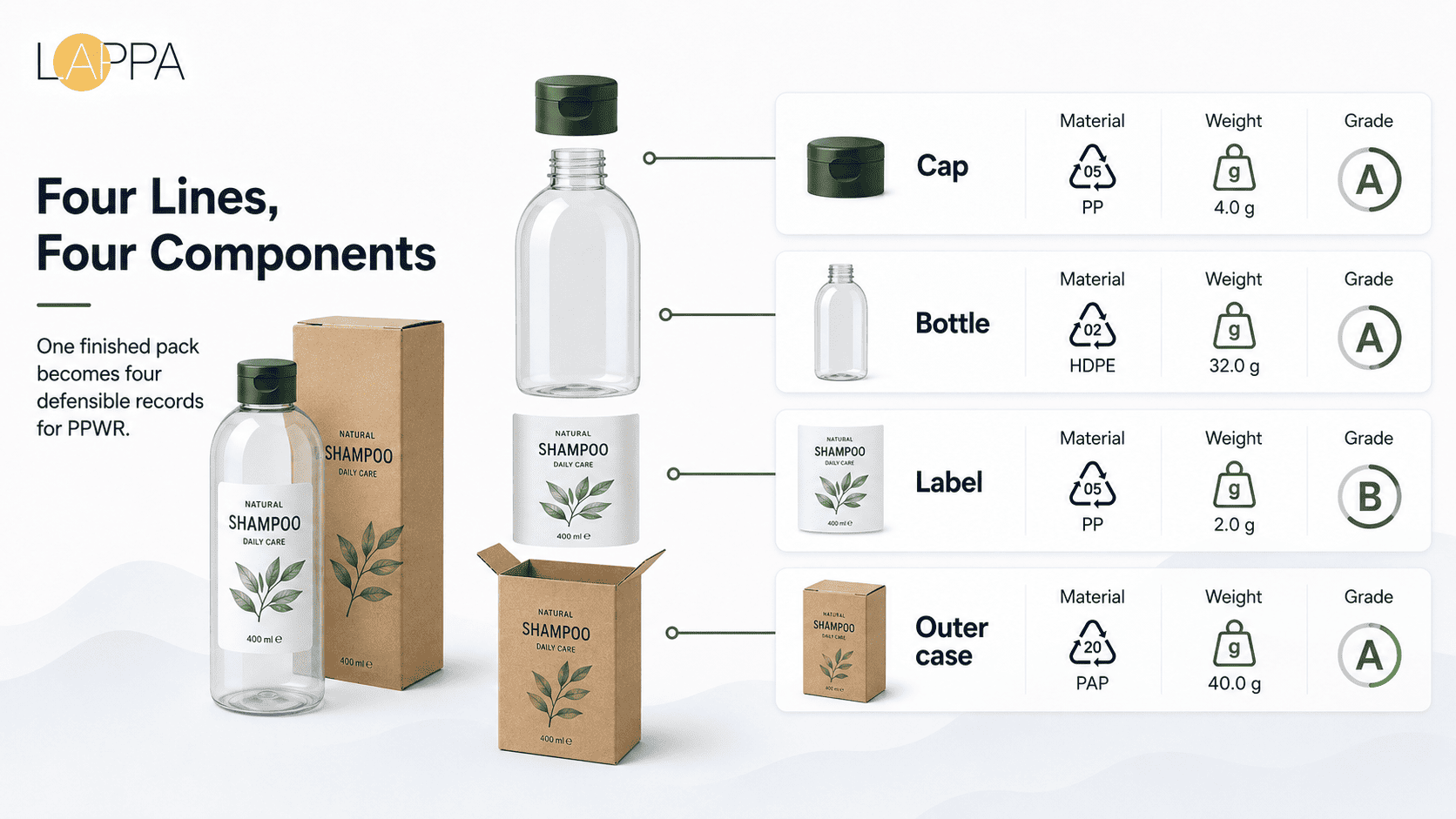
Here is a worked example — the figures below are for illustration only and carry no regulatory weight — showing how a single item splits into its component parts.
| Component | Material used | Weight, grams | Recycled share | Recyclability grade |
| Bottle, 500 ml | HDPE | 28.0 | 30% | A |
| Cap | PP | 3.1 | 10% | B |
| Label | PET film | 0.9 | 0% | C |
| Outer case (12 units) | Corrugated board | 140.0 | 75% | A |
Four lines, four weights, four grades, one finished pack. Summing that up as “plastic bottle, recyclable” on a single row leaves no component individually defensible, and a reviewer will ask for exactly this breakdown regardless of how tidy the summary looks on paper.
Who owns this file inside a company
No single team holds every number a complete record calls for. Procurement typically has weight and material specs pulled from purchase orders; sustainability or R&D holds recycled content figures and lab results; legal or compliance turns all of that into a signed declaration and a tonnage filing. Naming one person to pull those three threads together, rather than letting the file default to whoever last opened it, is usually what keeps a fifty-SKU catalogue from sliding into inconsistency over twelve months. Whoever owns it needs the authority to chase down missing information from any department, not just the patience to wait for it.
A realistic starting checklist
- SKU code, plus the exact market or markets it is sold into
- Every component broken out on its own line, by material and by gram weight
- Packaging category — sales unit, grouped pack, transport format, or service item
- Recycled content share for each plastic part, backed by a supplier certificate rather than a spoken assurance
- Recyclability grade plus the method behind it, checked where possible against RecyClass’s Design for Recycling rules
- Test results for substances of concern, such as PFAS or heavy metals, wherever the format touches food or sensitive goods
- Live EPR registration numbers for each Member State the item reaches
Companies without dedicated software can run this from a shared spreadsheet just as well, as long as every row covers one component rather than a finished product, and as long as version history is kept so that a March update can’t quietly erase what January said.
Building packaging compliance data that scales past a handful of SKUs
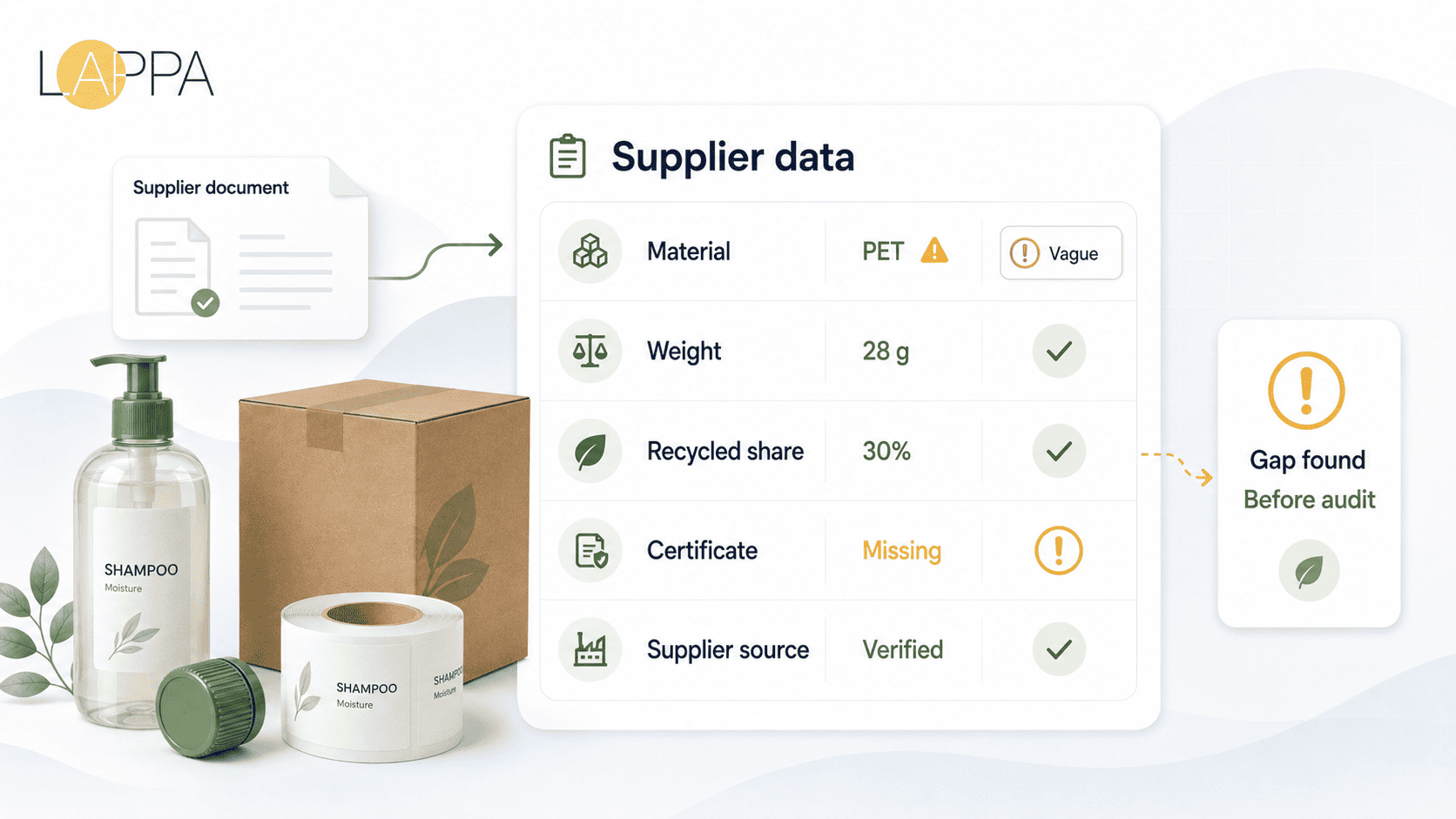
Packaging compliance data falls apart the moment a catalogue grows past a few dozen items, unless it is structured by component from day one. A bottle, a cap, a sleeve, and an outer case inside one SKU each sit under different weight thresholds and different recyclability rules, so folding them into one combined “packaging” line answers neither question correctly. Splitting things out early costs a handful of extra spreadsheet rows; sorting it out after an audit request costs actual weeks.
Suppliers rarely hand over a full material breakdown unless asked directly. A short standard intake form — material, weight, recycled share, test certificate where relevant — turns a messy back-and-forth over email into one structured set of figures that both the technical file and the tonnage report can pull from, instead of asking the same supplier the same question twice.
A packaging data sheet template that survives multiple markets
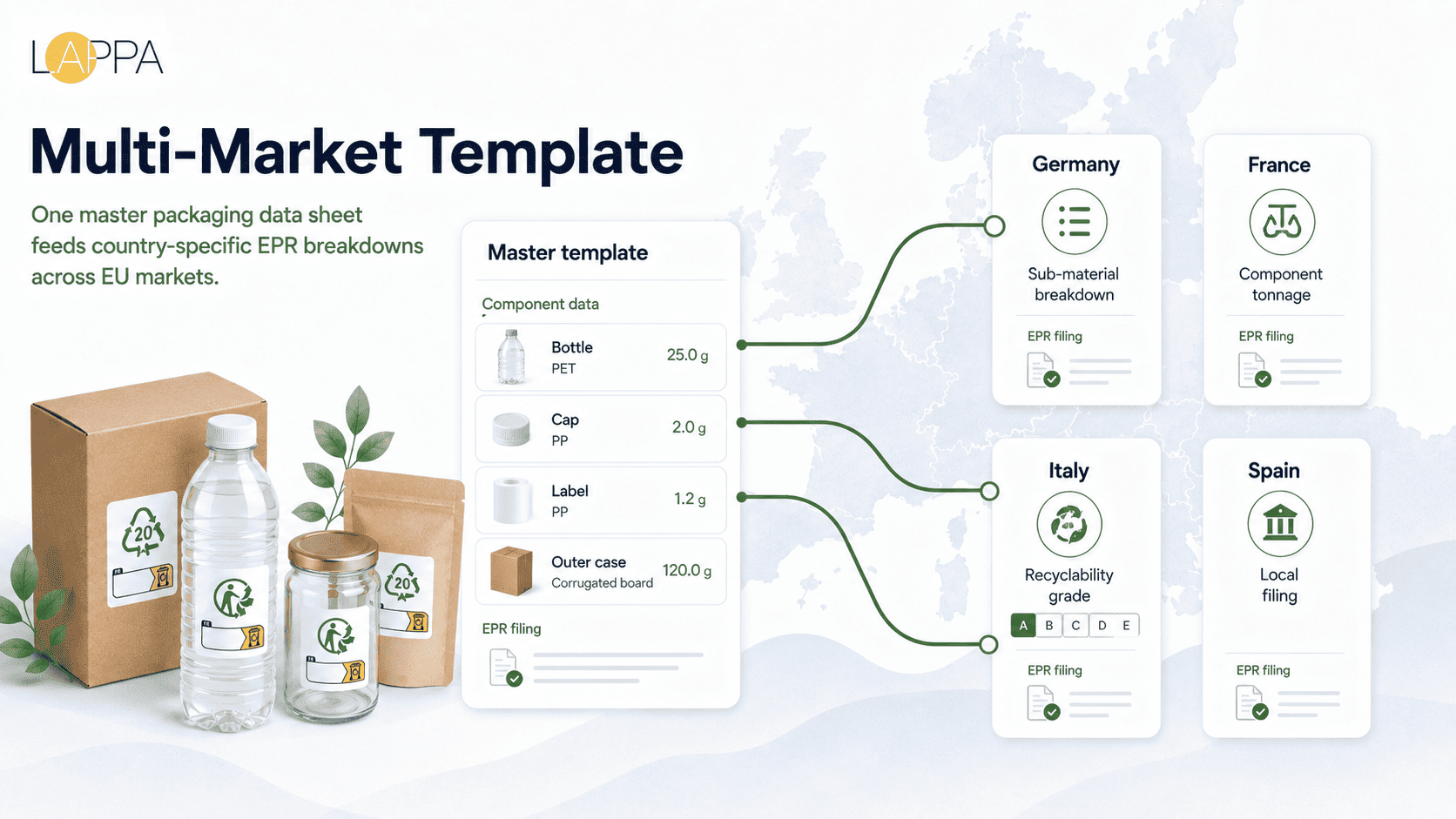
One packaging data sheet template starts paying off the moment a business sells into more than two or three Member States, since every producer responsibility organisation asks for its own particular breakdown. Germany wants sub-material detail; France wants tonnage reported by component rather than by finished item. Building one master structure that covers every field any target market might ask for, then narrowing it down per country at filing time, beats running a separate spreadsheet per market that inevitably falls out of step within a few months.
Firms that set up packaging data sheet templates ahead of their first filing under the new rules typically spend far less time later reconciling figures between teams. What matters more than the software itself is version control — a template tied to dated supplier certificates, rather than paraphrased summaries of them, holds up through staff changes and supplier audits alike, provided the compliance datasets behind each entry stay accurate at component level.
Already juggling packaging records across several EU countries? Lappa brings EPR registration and reporting together in one place. See how EPR Consolidation works.
PPWR labelling requirements and why the file matters before the labels do
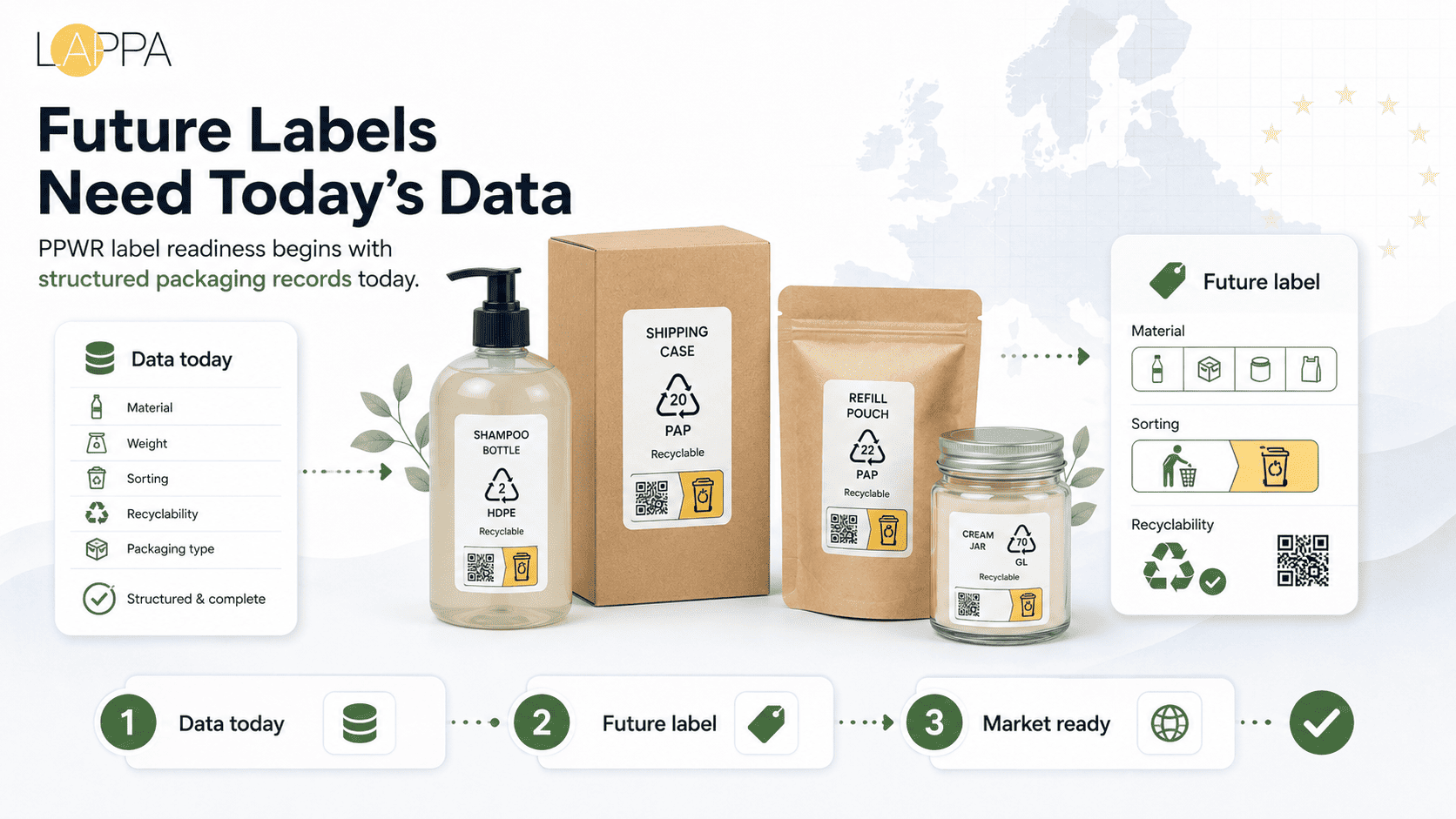
PPWR labelling requirements have not been locked in yet. The Commission is on track to adopt the implementing acts covering the harmonised pictogram system in the closing quarter of 2026, with mandatory on-pack use starting in 2028. What a business can control right now is whether its underlying record already holds the resin code, board grade, and layer structure that any future label will need to draw on.
Writing down “recyclable plastic bottle” today means a second round of supplier questions once the labelling requirement becomes binding. Capturing the resin code and layer structure now means the label gets generated from data that is already sitting there. Teams already handling artwork across several markets can keep that identification and the artwork itself together using Lappa’s Packaging Label Manager.
Turning the record into EPR reporting
EPR reporting is where a properly built record pays for itself. National schemes work out fees from tonnage placed on the market, split by material category, and a few — Germany and France included — now link the fee rate directly to a recyclability grade. An incomplete record does not earn a lower charge; it triggers the default, worst-case assumption instead, and industry figures put the resulting overpayment in the tens of thousands of euros a year for a mid-sized brand carrying gaps in its supplier data.
EPR reporting and PPWR conformity paperwork draw on the same source figures but answer to different legal purposes — one funds end-of-life collection, the other proves the design itself meets the rules. A producer filing EPR reports across several countries usually only spots a missing field once a national scheme kicks the submission back. That gap almost always traces to packaging compliance data that got logged as one combined number per SKU rather than broken down component by component.
| What it covers | Rule behind it | Who signs off | Usual timing |
| Technical file + Declaration of Conformity | PPWR Articles 38–39, Annexes VII–VIII | Manufacturer | Ahead of market placement, from 12 August 2026 |
| Annual EPR / tonnage filing | National scheme rules under PPWR Chapter VIII | Producer or importer | Set by each Member State, typically once a year |
Deadlines to plan against under PPWR 2026
PPWR 2026 marks the point where this record stops being background work and starts carrying an actual legal date. The Commission repeated the same message in its March 2026 Guidance and FAQ — 12 August 2026 is not moving, and there is no grace window for stock already on its way. The same legislative framework sets retention at five years for single-use packaging and ten for reusable formats, counted from the date an item first reaches the market.
- 12 August 2026 — Declaration of Conformity and the technical file both become compulsory; PFAS and heavy metal ceilings kick in immediately, with no phase-in period
- Fourth quarter of 2026 — implementing acts arrive covering PPWR labelling requirements and the method for calculating recycled content
- 2027 — reuse and refill rules start applying to takeaway formats
- 2028 — harmonised pictograms become compulsory on every pack
- 1 January 2030 — recyclability grade C as the floor, recycled content targets between 10 and 35 percent depending on material, and empty-space caps for transport and e-commerce formats
- Retention — five years for single-use records, ten for reusable ones, from first placement on the market
None of those dates are likely to shift. What does shift is how much last-minute scrambling happens before each one lands, and that outcome depends almost entirely on whether the record behind it was already built.
Where a PPWR doc usually falls apart
A PPWR doc thrown together under deadline pressure tends to fail in the same three ways, over and over. First: material descriptions copied straight off a supplier’s marketing sheet — “eco packaging,” “recyclable plastic” — carry zero evidentiary weight. What a reviewer actually needs is the resin type, the specific grade, the layer weight, not the tagline sitting above it.
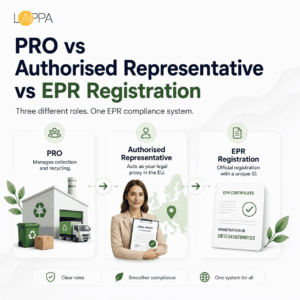
Second: teams treat the EPR filing and the conformity PPWR doc as if they were the same paper. They are not. A producer responsibility organisation checking tonnage will not accept a Declaration of Conformity instead of an annual report, and a market surveillance body will not take a tonnage filing instead of a technical file. Companies juggling several PPWR documents at once tend to learn this the hard way, usually right after one submission gets bounced back.
Third: the record drifts away from what is actually shipping. Suppliers switching resin grade mid-contract rarely send a heads-up, and a file updated once at onboarding and never touched again can be wrong for months — usually surfacing right when a regulator comes asking.
Keeping the record ready for an unannounced check
A file only earns its keep if it can be produced, complete, within a day or two of being asked for, rather than pieced back together from memory after the request lands. Keeping entries in one place, tying each one to a dated supplier source, and reviewing the whole catalogue on a fixed schedule rather than only when a new market opens is what makes that realistic, especially as further PPWR 2026 deadlines stack on top of the current one.
Businesses still running this out of scattered spreadsheets tend to find their gaps only once an inspector finds them first. Structured tooling surfaces those same gaps earlier and keeps figures aligned across every market a catalogue touches.
Need records built for both PPWR conformity and EPR reporting at once? See how Lappa’s EPR Reporting Software works, or book a free demo.
For the audit work that produces this record in the first place, see our guide on How to Conduct a Packaging Audit for EU Packaging Requirements, and for the wider rollout, our PPWR Compliance Guide for Businesses.
FAQ




What is a packaging data sheet and who needs to keep one
A packaging data sheet logs material, weight, recycled content, and recyclability for every component of an item sold into the EU. Any manufacturer, importer, or brand owner sits under this obligation no matter their size, since PPWR legislation carries no general exemption for smaller catalogues. This file feeds both the Annex VII technical record and the annual submission sent to a national producer responsibility organisation, and neither one can be finished without it.
How does a packaging data sheet template differ between EU markets
A packaging data sheet template built around one country’s rules rarely fits the next one cleanly, since each national scheme sets its own categories, its own breakdown, and its own submission format. Germany wants sub-material detail; France wants tonnage reported by component rather than by finished item. The workable fix is one master structure holding every field any target market could ask for, filtered down per country when filing time comes — that beats keeping parallel spreadsheets that drift apart within a few months.
What information must the record contain to support a Declaration of Conformity
The information needed covers material by component, weight per component, substance test results, and the method behind a recyclability grade. Every one of those figures has to trace to an actual supplier certificate or lab report rather than a generic tagline, since Article 39 calls for evidence, not assurance. Recycled content share belongs at component level too, wherever a plastic part is involved. Vague entries here are the single biggest reason a technical file gets sent back.
How does EPR reporting rely on the same underlying record
EPR reporting pulls its tonnage and material breakdown straight from the same file that supports conformity, since national schemes calculate fees off those identical figures. Several Member States now scale that fee by recyclability grade, so a record with gaps risks landing on the default, worst-case rate instead of the one actually earned. One dataset serving both filings means suppliers only get asked once. It also keeps the two submissions from contradicting each other if a reviewer compares them.
What happens if labelling rules change after the record is already finalised
PPWR labelling requirements still depend on implementing acts due in the second half of 2026, ahead of mandatory on-pack use from 2028. A record that already holds resin codes and layer structure can generate compliant labels the moment those rules land, with no fresh supplier round needed. A record built on generic descriptions alone will most likely need exactly that — a second data-collection pass for something that could have been captured the first time. Building to what the regulation actually needs, rather than to today’s label design alone, is what avoids that repeat work.
