


How to Conduct a Packaging Audit for EU Packaging Requirements
The PPWR — Regulation (EU) 2025/40 — entered into force in 2025 and reset compliance expectations for any company moving goods into EU markets. Running a thorough packaging audit went from best practice to operational necessity almost overnight. What follows is a practical walkthrough: which data to gather, how to check packaging materials against current rules, what a proper recyclability assessment involves, and where regulators look first.
Not sure where your packaging stands under the PPWR? Get a free quote or book a demo to talk through your compliance gaps with an expert.
What EU packaging requirements actually demand right now
Regulation (EU) 2025/40 repeals Directive 94/62/EC and takes direct effect across all member states — no national transposition, no grace periods. It brings in mandatory recyclability grades, heavy metal concentration limits, minimum recycled content thresholds by material type, and a harmonised labelling scheme rolling out through 2030. The packaging requirements EU producers now navigate are considerably more specific than before, and enforcement sits with national market surveillance authorities.
On top of the pan-European framework, each member state runs its own Extended Producer Responsibility (EPR) system under Article 48 of the PPWR. Germany, France, Italy, Spain, and the rest of the bloc all require annual registration, fee payment, and tonnage reporting. The regulatory standards national producer responsibility organisations apply vary on material categories, reporting granularity, and deadlines. A solid packaging audit cannot stop at the PPWR layer — it has to cover each individual market where the company places goods. 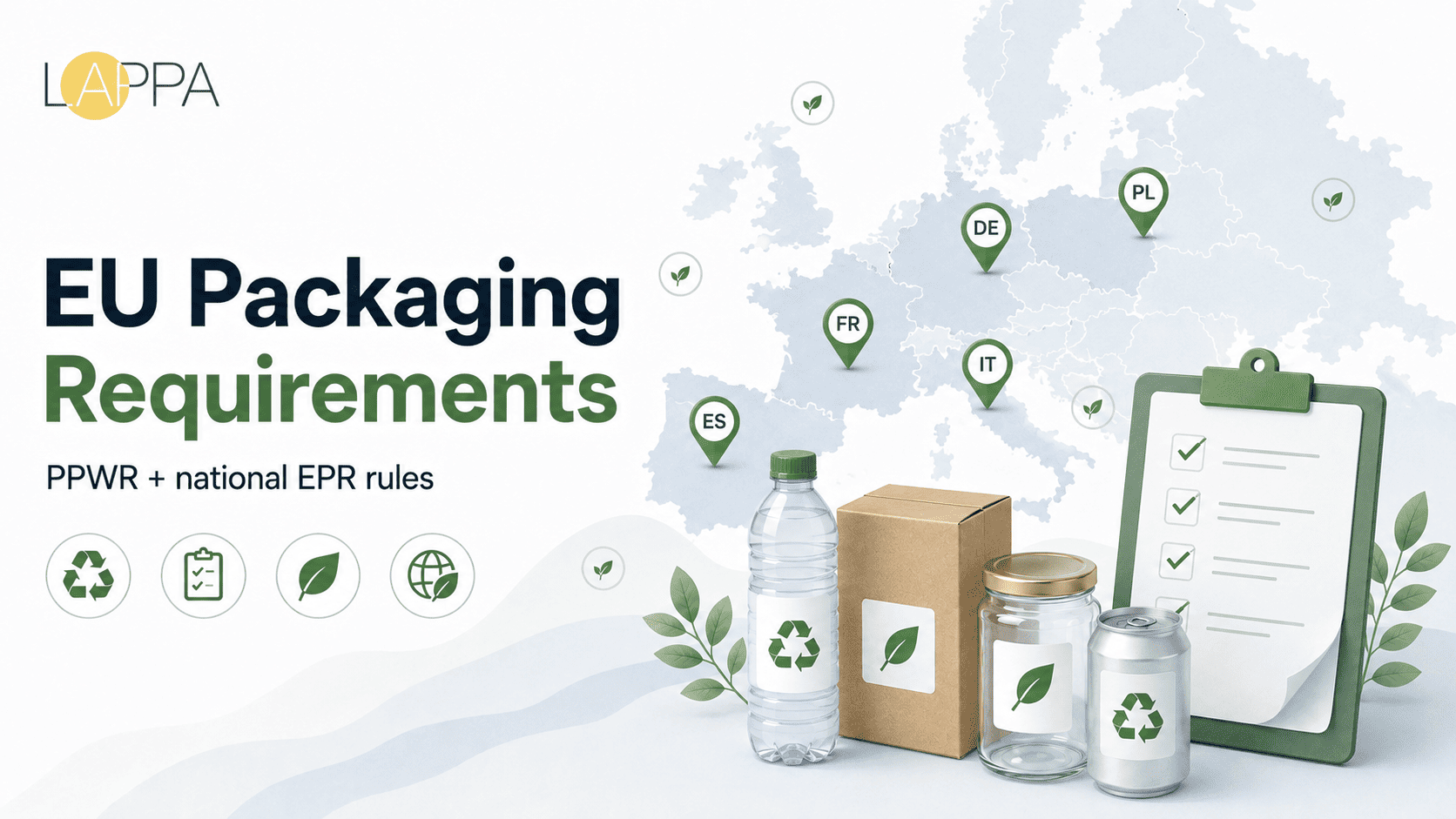
How to structure your packaging audits step by step
Good packaging audits move in sequence: define scope, gather data, classify materials, assess recyclability, review labelling, check EPR status, document everything. Teams that skip stages revisit the whole process at far greater cost later.
Stage 1 — Scope definition and data collection
Before touching any data, pin down which markets are in scope, which SKUs are covered, and which tier is being reviewed — sales, grouped, or transport. The PPWR distinguishes all three explicitly, and the EU packaging requirements that apply to each are genuinely different.
The primary data inputs for a packaging audit are:
- A complete SKU list with all associated components per unit sold
- Material data sheets or supplier declarations identifying type and grade for each component
- Weight data (grams per component) pulled from production or procurement records
- Annual volume placed on each target market, broken down by SKU or product family
- Existing EPR registration certificates and prior-year reporting submissions
- Current label artwork files and any conformity documentation already held
Supplier data gaps cause more audit delays than anything else. Some packaging materials — multi-layer films especially, and composite closures — need lab testing to nail down composition. Getting certificates of conformity from suppliers at intake, rather than chasing them later, cuts weeks off the timeline.
Stage 2 — Materials classification and regulatory mapping
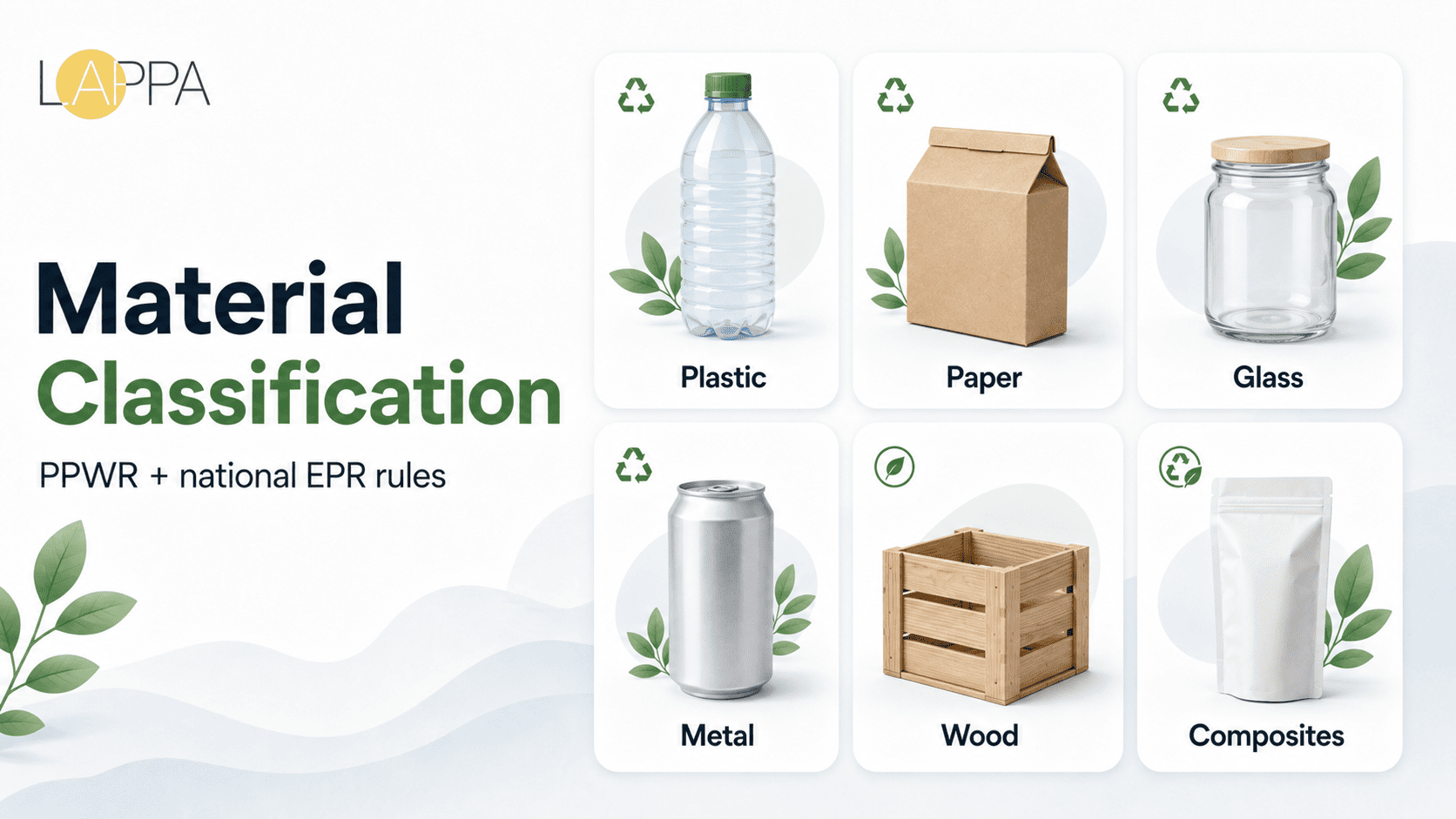
Every packaging material in scope gets classified against the PPWR’s tiered category system: plastic, paper and board, glass, metals, wood, composites. The category determines which recycled content targets apply, what recyclability criteria the format is judged against, and what labelling is needed.
Plastics carry the toughest targets. PET contact-sensitive consumer formats have to hit 30% recycled content by 2030. Composite structures — laminated pouches, foil-lined cartons, barrier-coated rigid containers — are the hardest to place correctly. If a secondary material exceeds 5% of total weight, recyclability criteria apply to both components. That’s where most companies find exposure they weren’t expecting.
Recyclability assessment under PPWR methodology
The PPWR ties a mandatory recyclability assessment to an A-to-E grading scale set out in European Commission delegated acts. The methodology for recyclability assessment packaging is built on Design for Recycling guidelines from Recyclass — now converted from voluntary guidance into binding law. Any format scoring D or E is banned from EU shelves from 2030 onwards. Findings go into a technical file kept as part of the conformity dossier under PPWR Article 11.
Steps for completing a recyclability assessment:
- Identify the format and primary material using the Recyclass classification system
- Run through the relevant Design for Recycling guideline; flag prohibited features — PVC labels on PET, carbon black pigments, adhesive types that interfere with sorting
- Check compatibility with the actual collection and sorting infrastructure used in each target market
- Establish whether the format is recycled at scale: PPWR sets the bar at 70% population coverage across a minimum of three member states
- Assign a working grade and list any design changes that would push the score higher
- Bring in third-party verification where the applicable delegated act makes it a requirement
Rigid plastics — bottles, trays, pots — can reach A or B without major redesign. Flexible multi-layer films are a harder case. Sorting infrastructure for that format is still patchy across the EU, and few formats currently clear the at-scale threshold. Companies with heavy reliance on flexible packaging materials should plan for a multi-year design and procurement project, not a label fix.
Evaluating sustainable packaging materials
Sustainability under the PPWR goes beyond recyclability. Article 6 sets out requirements for sustainable packaging materials covering recycled content use, the absence of substances of concern, weight and volume kept to functional minimums, and — for certain formats — reusability targets.
Working through sustainable packaging materials in an audit means cross-referencing supplier declarations against REACH restrictions and PPWR Annex substance lists, then checking whether current weight and dimensions are the functional minimum for product protection. From 2030, take-away containers, e-commerce outer wraps, and grouped retail formats also face reuse percentage requirements at system level.
| Packaging Category | Key PPWR Obligation | Deadline | Audit Focus |
| Plastic bottles (PET) | 30% recycled content; recyclability grade A/B | 2030 | Recycled content certification, recyclability grade |
| Flexible film packaging | Design for recyclability; substances of concern check | 2030 (D/E ban) | Material composition, Recyclass grading |
| Transport packaging | Reuse targets B2B; over-packaging minimisation | 2030 | Volume/weight ratio, reuse feasibility |
| All formats | PPWR harmonised labelling | 2030 | Artwork review, country-specific icons |
| Contact-sensitive plastic | Substances of concern restrictions | Progressive from 2026 | Supplier declarations, test reports |
EPR registration, reporting, and regulatory standards
Every EU market now runs a mandatory EPR scheme for packaging, with most already tying annual fees to recyclability scores. Any serious packaging audit has to verify registration status in every market where the business sells above the national de minimis threshold — for most active commercial relationships, that threshold is low enough that registration is simply required.
The regulatory standards national producer responsibility organisations enforce vary sharply on how much detail reporting demands. Germany goes down to sub-material level; France’s CITEO scheme wants tonnage by individual component rather than finished product. Back-payments triggered by ZSVR corrections in Germany can be substantial, which is why reviewing prior-year submissions — not just confirming registration — is part of a complete audit.
The regulatory standards picture is also changing for businesses that import into the EU. PPWR Article 4(4) puts the EU-based importer in the same position as a domestic manufacturer — trading companies and marketplace sellers sourcing outside the EU often discover they hold producer obligations nobody registered for.
Non-EU manufacturers placing goods on the EU market need an EU Authorised Representative under the PPWR. See how Lappa’s AR service works.
Most common findings in packaging audits
Across compliance reviews covering multiple EU markets, the same issues come up repeatedly:
- Incomplete material data: Supplier declarations are absent, out of date, or too vague to support a correct PPWR classification. Getting procurement involved early and updating qualification criteria is the fix.
- Missed EPR registration markets: Businesses selling across six or more EU countries routinely find two or three where they have no registration — usually because a local distributor handled market entry and EPR was never written into the agreement.
- Recyclability gap for flexible formats: Multi-layer films with aluminium barriers land at D or E under Recyclass grading. A design or material substitution programme needs to be running well before the 2030 ban kicks in.
- Over-packaging non-conformity: PPWR Article 9 says volume and weight cannot go beyond what the product actually needs. Older designs with generous void space are an obvious target for market surveillance.
- Missing technical documentation: Plenty of companies have no conformity dossier for existing formats at all — yet PPWR Article 11 makes it a formal obligation.
Managing EPR registrations across multiple EU markets? Lappa consolidates reporting and registration in one place. Explore EPR Consolidation.
Practical steps toward packaging requirements EU compliance
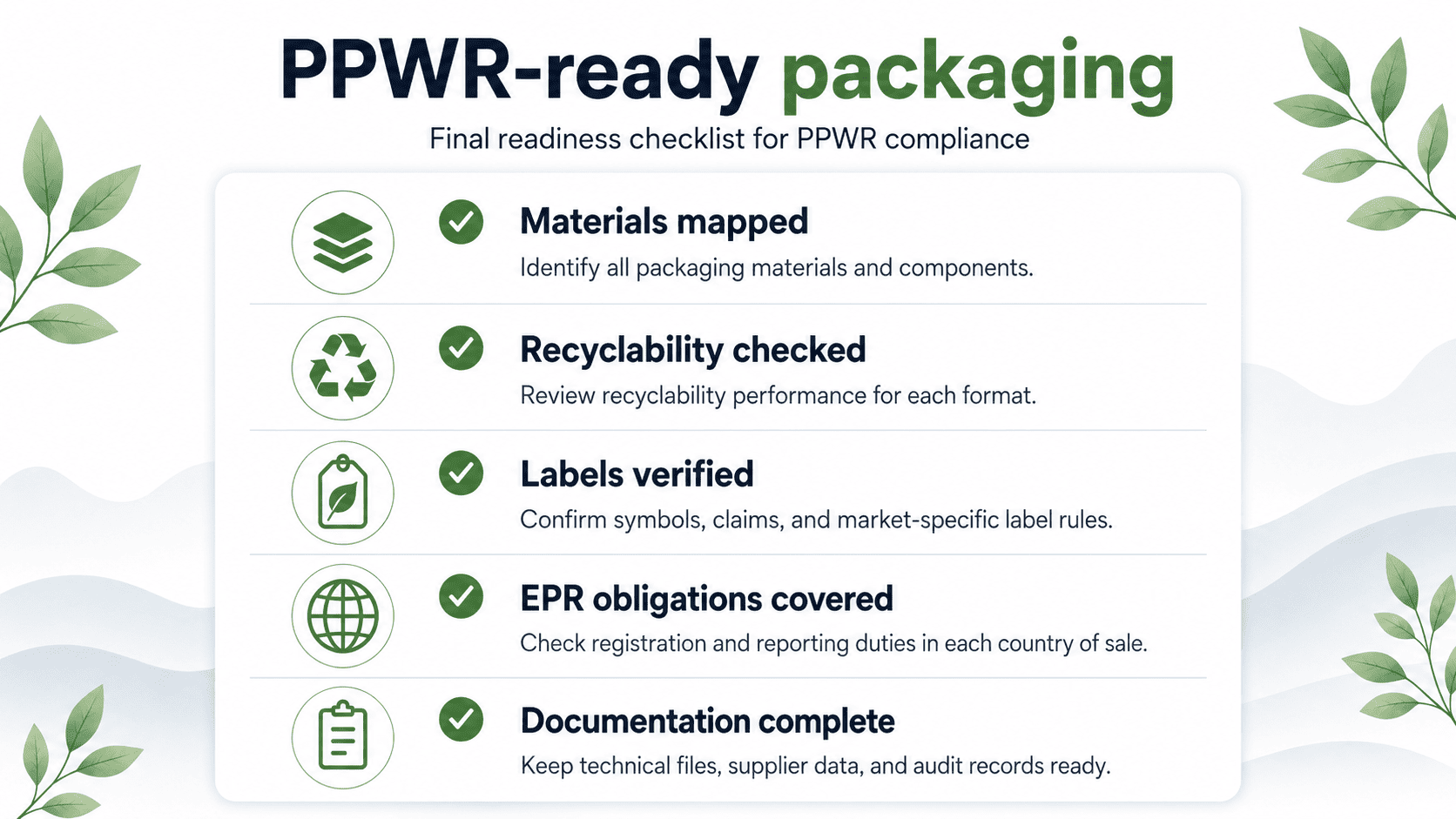
- Build a central data register for all packaging materials. Weights, SKU-market combinations, EPR registration status, recyclability scores — keep it in one version-controlled place. Without that, every new audit starts from zero and old errors stay invisible until they become penalties.
- Put packaging audits on a fixed annual schedule. Compliance problems found by regulators cost far more than those found internally. A Q4 review timed ahead of EPR reporting deadlines gives enough room to correct submissions before they go in.
- Get recyclability assessment done for all plastic formats before 2027. The Commission’s delegated acts locking in the grading methodology are due by late 2026. Companies that have already worked through their portfolio against Recyclass guidance won’t be scrambling when binding criteria land.
- Treat sustainable packaging materials transition as a sourcing project, not a labelling one. Moving to recyclable formats and hitting recycled content targets requires 12 to 24 months of supplier lead time. That clock starts now.
- Assign someone to track regulatory standards changes in each market. EPR fee structures, reporting formats, and national PPWR implementation details shift regularly and often without much warning to industry.
FAQ about
PPWWR


What is a packaging audit and who needs to conduct one under EU law
A packaging audit is a structured review of a company’s full range of formats against its legal, environmental, and reporting obligations. Under the PPWR, that obligation falls on any producer placing goods in EU markets — domestic manufacturers, importers, and authorised representatives of non-EU brands alike. Running a packaging audit is the most direct way to find where current practice diverges from the regulation before national authorities do. For businesses across several EU countries, the review covers both PPWR conformity at European level and EPR compliance in each jurisdiction.
How does recyclability assessment work under the new EU regulation
Recyclability assessment under the PPWR runs on an A-to-E scale, with grading criteria defined by European Commission delegated acts and anchored in Recyclass Design for Recycling guidelines. The core question is whether a given format is actually collected, sorted, and recycled at scale — which the PPWR defines as covering at least 70% of the population across a minimum of three member states. Formats landing at D or E are off EU shelves from 2030. Starting a recyclability assessment packaging review now, using current Recyclass guidance, lets companies get ahead of the binding delegated acts.
What are the most significant EU packaging requirements introduced by the PPWR
The PPWR brings in a set of EU packaging requirements that go well past the old directive: mandatory recyclability grading, minimum recycled content in plastic formats (30% for PET contact packaging by 2030, 35% aggregate for all plastic by 2035), substance of concern restrictions for anything touching sensitive products, proportionality rules limiting void space, reuse targets for specific categories, and a harmonised labelling system. The packaging requirements EU companies face are enforced by market surveillance authorities, and EPR fees in several countries are indexed to recyclability scores.
How should a business evaluate its sustainable packaging materials against PPWR criteria
Evaluating sustainable packaging materials under the PPWR comes down to three checks: confirming no substances of concern are present (against REACH and the PPWR Annex lists), verifying that recycled content targets for plastic components are being met or planned for, and confirming that current weight and dimensions represent a genuine functional minimum rather than legacy design. On the documentation side, sustainable packaging materials assessments rely on supplier declarations that are current and specific enough to be useful. Every time a material changes, the review of sustainable packaging materials has to be run again.
What regulatory standards govern EPR reporting for packaging across the EU
EPR reporting regulatory standards are national in scope, set within the PPWR’s broader producer responsibility framework. Each country decides its own reporting format, material category breakdown, weight thresholds, and submission deadlines — and the regulatory standards that come out differ quite a bit. Germany reports by sub-material type and cross-checks against ZSVR licensing; France wants component-level tonnage through CITEO; Spain moved to a new SCRAP-based system in 2023. Changes to regulatory standards in any given market need tracking on an ongoing basis, because updates arrive with less notice than most compliance teams expect.

