


ViDA Explained — Everything Businesses Need to Know About VAT in the Digital Age
Europe’s VAT system has a €128 billion problem. Every year, roughly that sum leaks out through fraud, error, and a patchwork of national reporting systems that tax authorities cannot meaningfully cross-reference. ViDA — VAT in the Digital Age — is the EU’s answer to that gap, and it is now law. The Council of the EU adopted the package in March 2025; it entered into force on 14 April 2025.
ViDA is not a minor technical update. It replaces periodic summary returns with transaction-level digital reporting, makes e-invoicing mandatory for cross-border B2B trade, rewrites the VAT rules for platforms like Airbnb and Uber, and expands the One Stop Shop so that most cross-border sellers need only one registration for the entire EU. Businesses have until 2030 to be fully compliant with the digital reporting rules — but member states are already moving ahead of that deadline.
This article breaks down what ViDA actually requires, when each obligation takes effect, and what your business needs to do before the deadlines arrive.
What Is ViDA and Why It Matters for EU Businesses
ViDA stands for VAT in the Digital Age. It is a legislative package covering three interconnected reforms: digital reporting and mandatory e-invoicing, new platform economy VAT rules, and a single VAT registration that extends the One Stop Shop across more transaction types. The European Commission first proposed the package in December 2022. After two years of negotiation, ECOFIN reached political agreement in November 2024, the European Parliament approved the text in February 2025, and the Council formally adopted it in March 2025.
The core problem ViDA addresses is the EU VAT gap. In 2021, the most recent year with complete data, member states collectively lost an estimated €61 billion in VAT receipts — down from €128 billion pre-pandemic, but still enormous. A significant share of that gap comes from intra-EU fraud, particularly carousel schemes where VAT is charged and then disappears before it reaches the tax authority. Real-time digital reporting makes this category of fraud structurally much harder to execute.
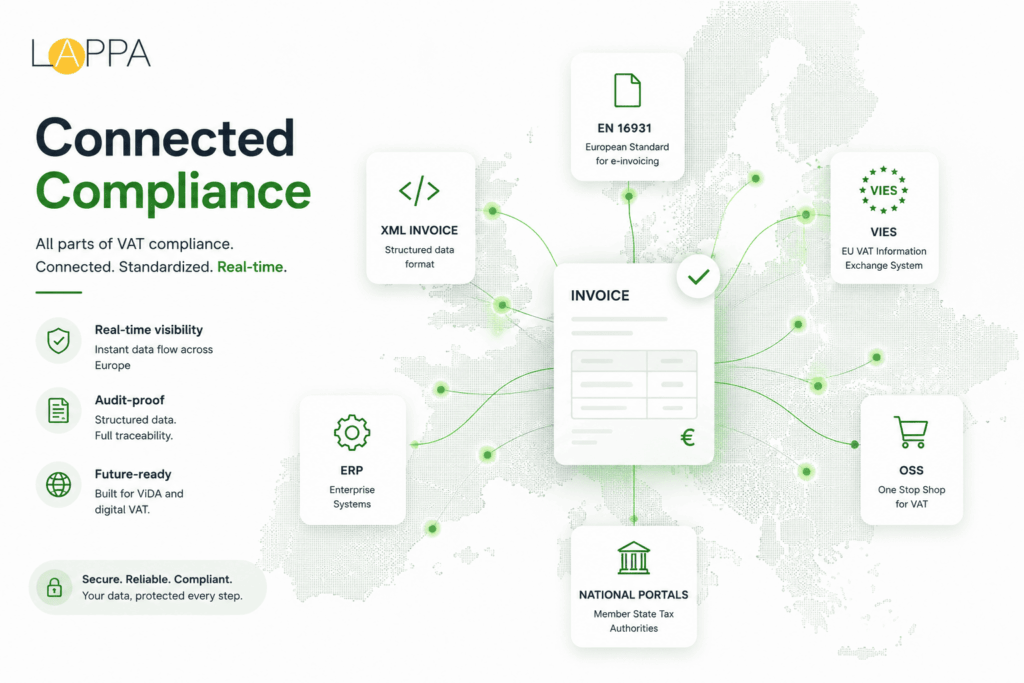
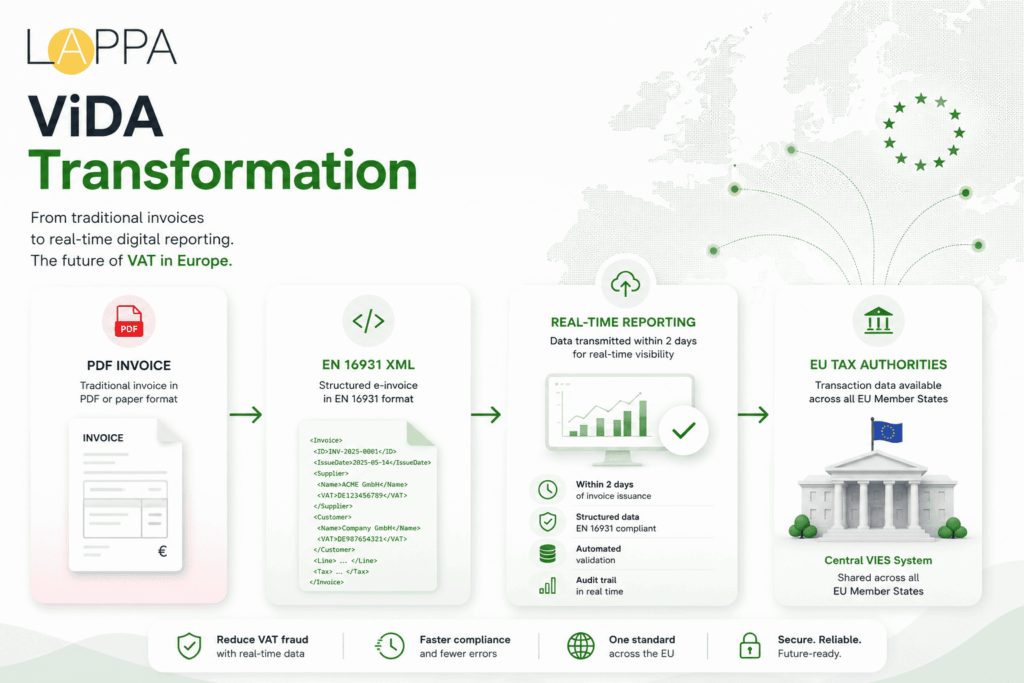
For most businesses, the practical impact of VAT in the Digital Age is a shift in how invoices are generated and transmitted. Today, a German manufacturer selling components to a Polish distributor issues an invoice in PDF or paper form, records the transaction in its ERP, and reports the sale in a periodic VAT return filed weeks or months later. Under ViDA, that same transaction will generate a structured electronic invoice transmitted to tax authorities near-simultaneously with the supply. The audit trail becomes automatic rather than retrospective.
Why the EU Acted Now
Several member states — Italy, France, Poland, Romania, and others — have already introduced or mandated national e-invoicing and real-time reporting systems independently. This fragmentation created a problem for cross-border businesses: a company selling into five EU countries potentially needed to connect to five different national reporting portals with five different technical standards. ViDA harmonises the cross-border layer while allowing member states to keep their domestic systems, provided those systems align with the EU-wide standard by 1 January 2035.
The Three Pillars of VAT in the Digital Age
The VAT in the Digital Age reform is structured around three pillars, each targeting a different weakness in the current system. Understanding which pillar affects your business — and when — is the starting point for any compliance plan.
| Pillar | What It Covers | Who Is Affected | Key Deadline |
| Digital Reporting Requirements (DRR) | Mandatory e-invoicing and near-real-time transaction reporting for cross-border B2B supplies | All businesses engaged in intra-EU B2B trade | 1 July 2030 |
| Platform Economy | Deemed supplier rules for accommodation and transport platforms; platforms collect and remit VAT on behalf of providers | Digital platforms (Airbnb, Uber, Booking.com) and their service providers | 1 July 2028 |
| Single VAT Registration (SVR) | Expanded OSS/IOSS; mandatory reverse charge for non-established suppliers; one registration covers all EU obligations | Cross-border sellers, marketplace vendors, multi-country VAT registrations | 1 July 2028 |
Pillar 1 — Digital Reporting Requirements
The first pillar covers mandatory e-invoicing and near-real-time reporting for intra-EU B2B transactions. From 1 July 2030, structured electronic invoices following the EN 16931 standard replace PDFs and paper for cross-border supplies. Data is transmitted to a central EU platform — the Central VIES system — within two days of the invoice being issued. Tax authorities across all 27 member states can then see the transaction data in near-real time. This pillar affects every business that sells goods or services to VAT-registered customers in another member state.
Pillar 2 — Platform Economy Rules
The second pillar makes platforms the deemed supplier for VAT collection purposes in short-term accommodation and passenger transport sectors. If you rent a property through Airbnb or take a ride via Uber, the platform — not the underlying host or driver — becomes responsible for collecting and remitting the tax on that transaction. This closes a significant loophole: previously, individual hosts and drivers below the local VAT registration threshold could operate VAT-free, creating an unlevel playing field against hotels and traditional taxi services. From 1 July 2028, platforms in these sectors must charge the tax on every qualifying transaction, regardless of whether the underlying provider is VAT-registered.
Pillar 3 — Single VAT Registration
The third pillar extends and strengthens the One Stop Shop. Currently, OSS covers B2C distance sales and certain service categories. ViDA’s SVR expansion brings in B2C local supplies by non-established sellers, certain transfers of own goods, and mandatory reverse charge for B2B supplies by non-established businesses without a local registration. For an Amazon seller dispatching goods from a Polish fulfilment centre to customers across ten EU countries, SVR means potentially consolidating multiple local VAT registrations into a single OSS filing. That is a material compliance cost reduction for marketplace businesses with complex multi-country footprints.
VAT Digital Reporting and Mandatory E-Invoicing Under ViDA
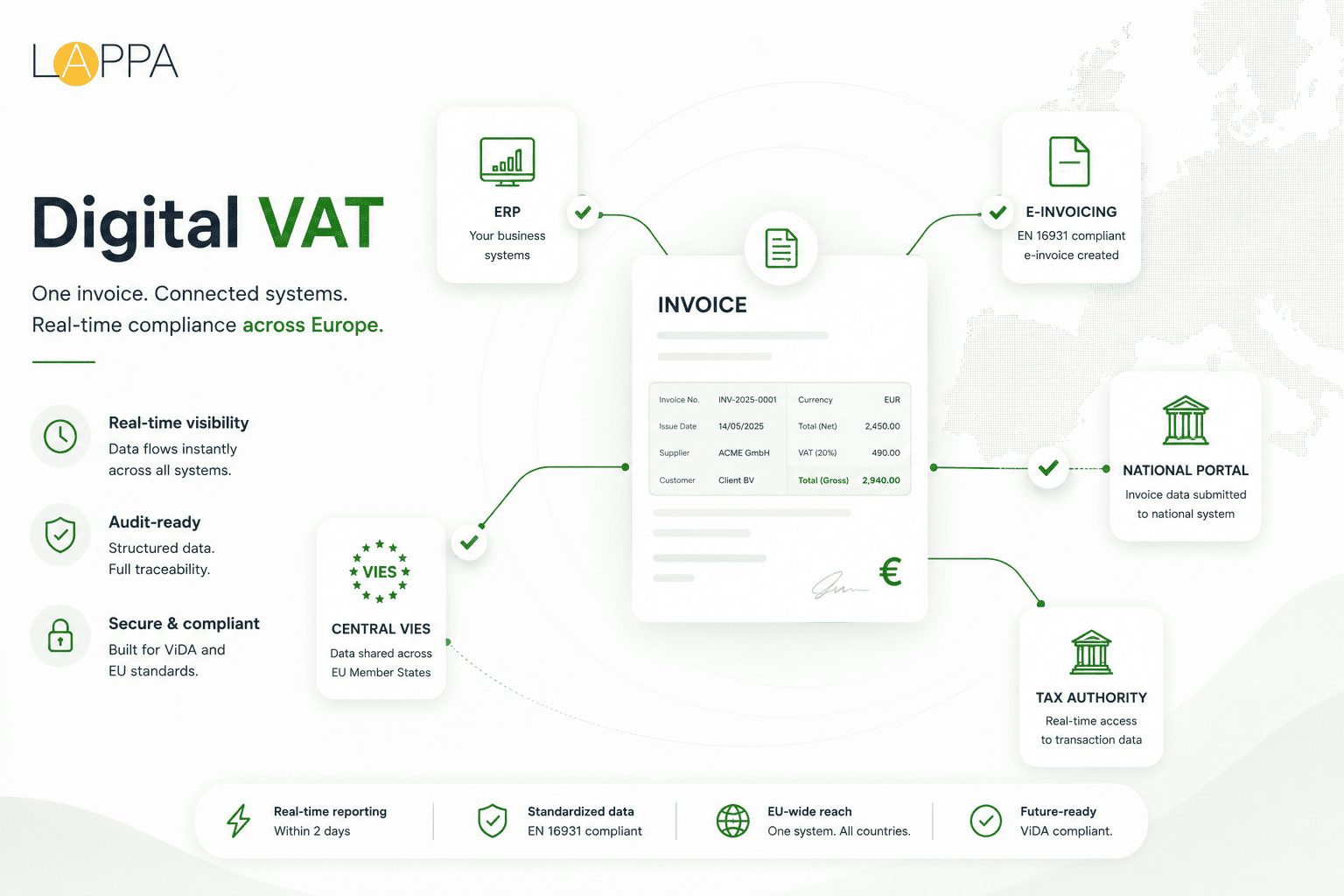
VAT digital reporting is the mechanism that makes ViDA’s fraud-prevention ambitions concrete. Rather than businesses filing periodic summary returns — monthly or quarterly snapshots of what happened in the past — digital reporting transmits structured invoice data to tax authorities on a transaction-by-transaction basis within 48 hours of each invoice being issued.
The technical standard underpinning this is EN 16931, the European norm for electronic invoicing. ViDA references an updated version — EN 16931-1:2026 — which adds data fields needed for the real-time reporting system. An EN 16931-compliant invoice is machine-readable XML, not a PDF. Your ERP or invoicing software must be able to generate structured XML in one of the approved formats (UBL 2.1 or UN/CEFACT CII) and transmit it to the receiving system and to the national reporting portal simultaneously.
Here’s where it gets tricky: the requirement for vat digital reporting applies to cross-border B2B transactions from 2030, but several member states are imposing domestic e-invoicing mandates before that date. France requires e-invoicing for all B2B transactions from 2026. Romania introduced mandatory structured invoicing for domestic B2B supplies in 2024. If your business sells into those markets today, you are already operating under the advance version of what ViDA will require EU-wide.
Changes your invoicing infrastructure must support before 1 July 2030:
- Generation of structured XML e-invoices in EN 16931-compliant format (UBL 2.1 or UN/CEFACT CII)
- Automatic transmission to the national reporting portal of the customer’s country within 48 hours of invoice issuance
- Receipt and processing of incoming structured e-invoices from EU suppliers
- Integration between your ERP or accounting system and national APIs, or use of a certified e-invoicing service provider
- Archive of e-invoices in machine-readable format for the required retention period (minimum 10 years in most member states)
- Updated VAT codes and mapping to EN 16931 data fields in your chart of accounts
ViDA EU Timeline — Key Deadlines from 2027 to 2035
The vida eu timeline is phased deliberately. The Commission designed it to give businesses time to adapt and member states time to build or update their reporting infrastructure. That said, “phased” does not mean “distant” — the 2028 platform economy and SVR changes are less than three years away, and 2030 arrives faster than most compliance projects get started.
| Date | Milestone | What Changes | Who Must Act |
| 14 April 2025 | ViDA enters into force | Legislative framework active; transposition period begins | EU member states |
| 1 January 2027 | OSS extension for EV charging | B2C supplies in e-charging sector can use OSS | EV charging providers |
| 1 July 2028 | Platform economy + SVR reforms | Deemed supplier rules for accommodation and transport; mandatory reverse charge for non-established suppliers | Platforms, cross-border sellers, marketplace vendors |
| 1 July 2030 | Mandatory DRR and e-invoicing | Cross-border B2B transactions require structured e-invoices and near-real-time reporting | All businesses with intra-EU B2B trade |
| 1 January 2035 | Domestic alignment deadline | Member states with domestic real-time reporting must align with the cross-border system | EU member states with existing domestic DRR |
The ViDA EU timeline has one important nuance that the table above cannot fully capture: national implementation often runs ahead of EU-wide mandates. Italy’s FatturaPA system has required domestic e-invoicing since 2019. Poland’s KSeF platform mandates structured invoicing for B2B transactions from February 2026. If you sell cross-border into these countries, you already need to comply with their systems — and those national systems will be the ones the EU-wide reporting connects to in 2030.
The 2035 domestic alignment deadline is also significant. Member states that have built their own domestic real-time reporting systems — Italy, Spain, Hungary, Romania among others — must align those systems with the cross-border standard by January 2035. This means the technical specifications your business builds for EU cross-border reporting in 2030 should also work for domestic reporting by 2035 in the markets where you operate.
ViDA Requirements for Ecommerce and Marketplace Sellers
For ecommerce businesses and marketplace sellers, ViDA requirements land in two distinct phases. The 2028 changes are immediately relevant for anyone using fulfilment-by-marketplace services or selling through Amazon, eBay, or similar platforms. The 2030 changes reshape the core invoicing workflow for any seller with B2B customers in other member states.
Under the current OSS, a UK-based seller dispatching goods from a French warehouse to B2C customers in Germany, Spain, and Italy can register in France and file one quarterly OSS return covering all three markets. ViDA’s SVR expansion extends this logic to cover local supplies by non-established sellers — meaning the same seller might no longer need separate French, German, Spanish, and Italian VAT registrations for different transaction types. The estimated saving for a mid-sized ecommerce business with five EU country registrations runs to €15,000–30,000 per year in local filing and accountancy fees.
The deemed supplier rules under Pillar 2 hit platforms directly. Airbnb, Booking.com, and Uber will become the VAT collector for accommodation and passenger transport transactions from 1 July 2028. If you host properties through these platforms or operate as a driver through a rideshare app, the platform will charge VAT on your revenue and remit it — you will receive net income rather than gross. Hosts and drivers who have been operating below national VAT thresholds will see their platform income reduced, because VAT will now apply regardless of their individual registration status.
Practical steps ecommerce and marketplace sellers should take now:
- Audit your current VAT registrations across EU member states — identify which could consolidate under expanded OSS from 2028
- Check whether your marketplace (Amazon FBA, Zalando Fulfillment, eBay) has announced its approach to deemed supplier rules under ViDA
- If you sell B2B cross-border, assess whether your invoicing software can generate EN 16931-compliant structured invoices
- Review your contracts with EU customers — e-invoicing mandates affect payment terms and invoice acceptance workflows on both sides
- Map which member states where you sell have already introduced domestic e-invoicing requirements ahead of 2030
- Calculate the potential impact of SVR consolidation on your current local registration costs
How to Prepare Your Business for Digital VAT Compliance
The businesses that struggle with ViDA in 2030 will be the ones that treat it as an IT project starting in 2029. Digital VAT compliance is a cross-functional initiative — tax, finance, IT, and operations all have roles to play, and coordinating them takes time that most finance teams systematically underestimate.
Start with a process audit. Map every invoice your business issues in a cross-border B2B context: which systems generate them, in what format, and how they are currently transmitted. Then map the gap between your current process and what ViDA requires — structured XML, 48-hour transmission, connection to national portals. For most businesses using general-purpose accounting software, that gap is larger than expected.
Evaluate your ERP or accounting software’s readiness. Major platforms — SAP, Oracle, Microsoft Dynamics, Sage — are all developing or have released ViDA-ready modules. Smaller or custom systems will need either an upgrade or a middleware layer that translates your existing invoice data into EN 16931 format. Budget for this now; enterprise ERP customisation projects rarely complete on time when tax deadlines are the driver.
The vida requirements for e-invoicing also affect your customers. If you issue a structured XML invoice to a German distributor, that distributor’s system must be able to receive and process it. Build bilateral testing into your preparation timeline — your readiness depends partly on your counterparties’ readiness.
Five practical preparation steps to run in parallel:
- Run a cross-border B2B transaction audit — volume, countries, invoice formats, current tools
- Assess ERP/accounting software against EN 16931-1:2026 requirements and get vendor roadmaps
- Identify which of your EU markets already have national structured-invoice mandates predating 2030
- Review the 2028 SVR changes and model the cost impact of consolidating local registrations
- Engage a VAT compliance partner to conduct a gap analysis before your internal budget cycle closes
Assess your ViDA readiness before the deadlines arrive
Businesses that want to assess their readiness for ViDA’s digital reporting and e-invoicing rules can use Lappa to review their current VAT setup and identify compliance gaps before the deadlines arrive.
How Lappa Helps Businesses Navigate ViDA Compliance
Lappa is built for exactly the compliance environment ViDA creates. The platform handles multi-country VAT filings, supports e-invoicing standards across member states, and covers EPR obligations in the same dashboard — which matters because ViDA compliance and extended producer responsibility requirements often affect the same cross-border transactions.
For businesses with existing multi-country VAT registrations, Lappa’s automation layer reduces the manual work of maintaining local filings while the SVR reforms phase in. Rather than managing separate accountancy relationships in Germany, France, Italy, and Poland, your team works through one interface that generates compliant returns, tracks deadlines, and flags regulatory changes as they happen.
On the e-invoicing side, Lappa maps your current invoice data to EN 16931 fields, connects to national reporting portals in markets where domestic mandates are already live, and prepares the connection architecture for the 2030 cross-border mandate. The goal is that when the digital vat mandate hits, your business is already operating in compliant mode rather than scrambling to retrofit.
The vida eu legislative framework also interacts with other EU product compliance obligations — particularly for ecommerce sellers dealing with packaging EPR, WEEE, and battery take-back schemes across multiple markets. Lappa combines VAT and EPR compliance in one platform, which removes the coordination overhead of managing separate providers for each regulatory stream.
Prepare for ViDA with Lappa
If your business operates across EU borders and needs to prepare for the shift to digital VAT, Lappa can help you automate filings, adopt e-invoicing, and stay compliant as ViDA rolls out across member states.
FAQ





What is ViDA and how does it change VAT rules in the EU
ViDA — VAT in the Digital Age — is a legislative package adopted by the EU Council in March 2025 that modernises how businesses report and pay VAT across Europe. It introduces mandatory e-invoicing for cross-border B2B transactions, near-real-time digital reporting to authorities, and new rules that make platforms responsible for collecting VAT in the accommodation and passenger transport sectors. The reform targets the EU’s estimated €128 billion annual tax gap by replacing manual, retrospective processes with automated digital ones that give tax authorities transaction-level visibility in near-real time.
How does a packaging data sheet template differ between EU marketsфWhat are the ViDA requirements for e-invoicing
Starting 1 July 2030, all businesses engaged in intra-EU B2B transactions must issue structured electronic invoices following the EN 16931 standard and transmit transaction data to tax authorities within 48 hours of invoice issuance. Traditional PDF or paper invoices will no longer satisfy the vida requirements for cross-border B2B supplies — only machine-readable structured XML formats will qualify. Businesses need to adopt invoice software compatible with the EN standard, connect to national reporting portals, and ensure their ERP or accounting systems can generate and receive compliant invoices well before the 2030 deadline.
How does the ViDA EU timeline affect businesses that sell cross-border
The ViDA EU timeline introduces changes in phases: platform economy and single VAT registration reforms on 1 July 2028, followed by mandatory digital reporting and e-invoicing on 1 July 2030. Cross-border sellers should treat the 2028 milestone as their first major compliance event, because expanded OSS and mandatory reverse charge for non-established suppliers will change how multi-country VAT obligations are handled across the EU. Waiting until 2030 to start preparation is a significant risk — several member states are already implementing national e-invoicing mandates ahead of the EU-wide deadline, so businesses selling into France, Poland, Romania, or Italy need to adapt sooner than the headline 2030 date suggests.
What is VAT digital reporting under ViDA
Vat digital reporting under ViDA refers to the requirement for businesses to transmit structured invoice data to tax authorities electronically, on a transaction-by-transaction basis, rather than submitting periodic summary VAT returns filed weeks after the fact. This moves tax compliance from a retrospective model to a near-real-time one where authorities see each invoice almost as it happens, enabling automated cross-border matching and fraud detection that the current periodic return system cannot support. The system is designed to reduce fraud, speed up VAT refunds, and give tax authorities across all 27 member states consistent, machine-readable visibility into cross-border trade flows.
How can businesses prepare for digital VAT compliance under ViDA
Preparation should begin with an audit of your current invoicing and VAT reporting processes to identify the gap between what you do today and what digital vat rules will require from 2030 onward. Coordinate your tax, finance, and IT teams to evaluate whether your ERP or accounting software can generate EN 16931-compliant invoice files and transmit data to national reporting portals — most standard systems need either a certified module upgrade or a middleware integration layer. Working with a compliance automation partner like Lappa can simplify this transition significantly: Lappa’s platform handles multi-country VAT filings, supports invoice standards across EU markets, and helps businesses stay ahead of each ViDA milestone as it takes effect.
