

Why Non-EU Brands often get PPWR conformity declarations wrong
Any product entering the European Union will be required to have a valid proof of certification (DoC) begin in August 2026..This formal document confirms it meets the sustainability rules of the Packaging and Packaging Waste Regulation. For brands outside Europe, this creates real challenges. Most non-EU companies bring assumptions from product-level CE marking. Others rely on habits from older directives. Those habits lead to costly mistakes at customs.
This article explains where non-EU businesses go wrong. It covers what the DoC must contain. And it shows how supporting evidence ties everything together.
What a PPWR Declaration of Conformity Means for Non-EU Brands
A PPWR declaration of conformity is not a third-party certificate. It is not a stamp of approval. The responsible party in the supply chain signs this self-declaration. It confirms that a given format meets the duties laid down in Regulation EU 2025/40.
The scope covers Articles 5 through 12. These include substance restrictions on heavy metals and PFAS. Recyclability targets apply. So do minimum thresholds for post-consumer recycled input, minimisation rules, labelling, and reuse standards.
Non-EU brands often treat this as a one-time paperwork task. They compare it to an ISO certificate or a supplier test report. The critical difference is legal liability. The company signing accepts direct responsibility for each claim. Surveillance authorities in any EU member state can request the statement. They can also ask for all supporting proof. If the data does not match, penalties can exceed half a million euros. Goods may be blocked at the border.
We see this regularly with consumer goods companies. Brands shipping from Asia or North America assume a signed PDF is enough. Declarations of conformity under the PPWR carry binding weight. They tie the signatory to specific, testable duties. A general quality statement will not protect you.
Why Non-EU Brands Misunderstand the PPWR Declaration of Conformity
The first mistake is copying. Companies download a generic form. They fill in details and file it with shipping documents. That approach worked under older European directives. But the PPWR introduces duties without equivalent in most non-EU markets. A form that skips Article 5 substance restrictions, Article 6 recyclability assessments, or Article 7 recycled-input thresholds is incomplete from the start.
The second common error is confusing product conformity with container conformity. Brands holding CE product-level marks assume the wrapping is covered too. It is not. PPWR duties attach to the wrapping itself. The box, the sleeve, the blister, the shrink wrap. A product can hold a valid CE mark while its wrapping fails PPWR substance limits.
The third misconception is assuming the EU importer handles everything. Importers carry their own duties. These include verification and document retention. But the manufacturer stays responsible for accuracy. If your brand name appears on the wrapping, you are likely the manufacturer. Where you are physically based does not matter. Delegating the task to a logistics partner does not remove your liability.
PPWR Conformity Declaration — What It Should Prove
A PPWR conformity declaration connects several regulatory requirements into one traceable statement. It should prove the design meets minimisation criteria. It must show that substances comply with restrictions. And it must confirm the format achieves its required recyclability grade.
Where applicable, the DoC must also confirm recycled-input thresholds are met. Labelling must follow the harmonised format. All supporting proof must be compiled before signing. The catch is that each element depends on real data.
Recyclability cannot be declared without a formal assessment. That assessment must be tied to the composition and available collection infrastructure. Substance checks require analytical test results. A verbal assurance from a supplier is not sufficient. A PPWR-related conformity statement that lacks this depth of evidence becomes a liability during an audit.
Brands selling through multiple EU channels need separate assessments for each variant. A single DoC cannot cover formats made from different components. Even items carrying the same brand need individual assessments if their structures differ. The assessment must reflect what is actually placed on the market. A representative sample chosen for convenience will not hold up.
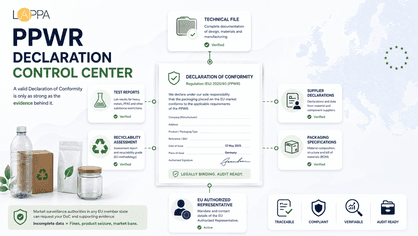
PPWR Declaration of Conformity Template — Why a Generic Form Is Not Enough
A PPWR declaration of conformity template can be a useful starting point. But relying on a generic form creates serious gaps. The regulation assigns different duties based on format type, the substance family, the product category, and the role of the company.A strict template that disregards these factors may either leave out necessary statements or include ones that aren’t relevant.
A template designed for rigid plastic containers references recyclability grades. Those grades do not apply to paper-based transport wrapping. A template built for a distributor omits manufacturer-specific duties. Using such forms unmodified creates a false sense of readiness. It collapses when an authority requests proof.
Treat any template as a framework. Tailor it to your actual portfolio, your suppliers, and your specific role in the EU supply chain. Templates for PPWR declarations should be revised when you change a format, switch a supplier, or enter a new EU member state. This kind of ongoing attention keeps the document reliable.
PPWR Documentation — What Businesses Need Before Signing
Before any responsible party signs, the supporting PPWR documentation must already exist. Signing first and collecting evidence later is one of the most common shortcuts. It is also one of the most dangerous.
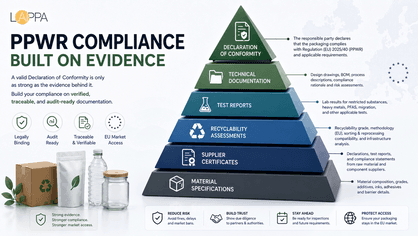
At a minimum, businesses need the following evidence before the DoC can be considered credible.
- Detailed specifications covering dimensions, weight, and layer structure
- Supplier statements confirming composition, including inks, coatings, adhesives, and barriers
- Analytical test reports for substance restrictions, particularly heavy metals and PFAS limits
- Evidence for post-consumer recycled-input claims, with chain-of-custody certificates and mass-balance calculations
- A recyclability assessment conducted against applicable design-for-recycling criteria
- Labelling artwork and placement details aligned with PPWR harmonised requirements
- A reference to the structured file where all evidence is stored
Each element must be traceable to a specific item. Grouping unlike types under a single DoC regularly triggers enforcement action. Proof required under the PPWR differs from what many non-EU companies provide. National rules in the United States, Japan, or Australia rarely demand this level of proof at market entry. That gap is where failures begin. Proper documentation under the PPWR closes that gap.
Declaration of Conformity Packaging — Frequent Errors in Real Projects
When companies prepare their first declaration of conformity packaging statements, certain errors appear again and again. The most frequent is scope confusion. Companies declare a product line rather than a specific type. The PPWR requires statements at the item level. Two products sharing identical wrapping can reference the same DoC. But every component, coating, and structural element must truly be the same.
Another common error involves dates. The DoC must be signed before goods are placed on the EU market. It cannot come after the first shipment clears customs. Backdating a document to cover goods already in circulation creates an exposure that is difficult to correct.
Warning signs that a DoC is unreliable include the following.
- Claiming compliance without holding test results for PFAS or heavy metals
- Listing a non-EU headquarters address instead of the EU-based authorised representative
- Citing the old Directive 94/62/EC instead of Regulation EU 2025/40
- Failing to update after a component or supplier change
- Using supplier certificates that do not specify the exact item they cover
Packaging-specific declarations of conformity need to be living documents. Every supplier switch and every reformulation of an ink or adhesive affects the validity of the original statement. Treat each change as a trigger for review.
Conformity Packaging — How Responsibility Is Shared Across the Supply Chain
Conformity packaging duties do not sit with a single company. The PPWR distributes responsibilities across every party involved. Understanding who carries which duty is essential. Non-EU brands may hold multiple roles without realising it.
The manufacturer is defined as the company whose name or trademark appears on the wrapping. This party carries the heaviest burden. It must conduct the conformity assessment. It must compile the evidence, sign the statement, and retain all files. If a non-EU brand prints its logo on wrapping produced by a contract factory in China, that brand is the manufacturer under the PPWR.
The EU importer places the goods on the market. The importer must verify that the manufacturer has completed the assessment and prepared the supporting files. Importers do not create their own DoC. But they carry verification duties that create liability if they fail to check.
Distributors and fulfilment service providers have narrower duties. Visual clues, such as labeling, are primarily what they look for. They should not provide products that are plainly not compliant. These days, Article 45 applies to online marketplaces as well.
. It requires them to verify that sellers hold valid EPR registration.
Packaging conformity across the supply chain means every participant must map its own role. The PPWR does not let any single party assume someone else has filled the gap.
Common PPWR Declaration Mistakes
|
Mistake |
Why it happens |
Compliance risk |
How to fix it |
|
Using a generic form |
Company copies an old template |
Missing PPWR-specific duties |
Adapt the document to real data |
|
No supporting evidence file |
DoC treated as standalone |
Cannot prove compliance during checks |
Build evidence before signing |
|
Wrong operator listed |
Brand misunderstands EU roles |
Liability sits with wrong party |
Map all supply chain roles |
|
Unsupported recycled-input claim |
Supplier data is incomplete |
Greenwashing and enforcement risk |
Keep calculation proof and evidence |
Packaging Regulatory Compliance — What Non-EU Companies Often Miss
Many non-EU brands focus only on the DoC. They miss the broader set of packaging regulatory compliance duties that apply once goods enter the EU. The DoC is only one piece of a larger architecture.
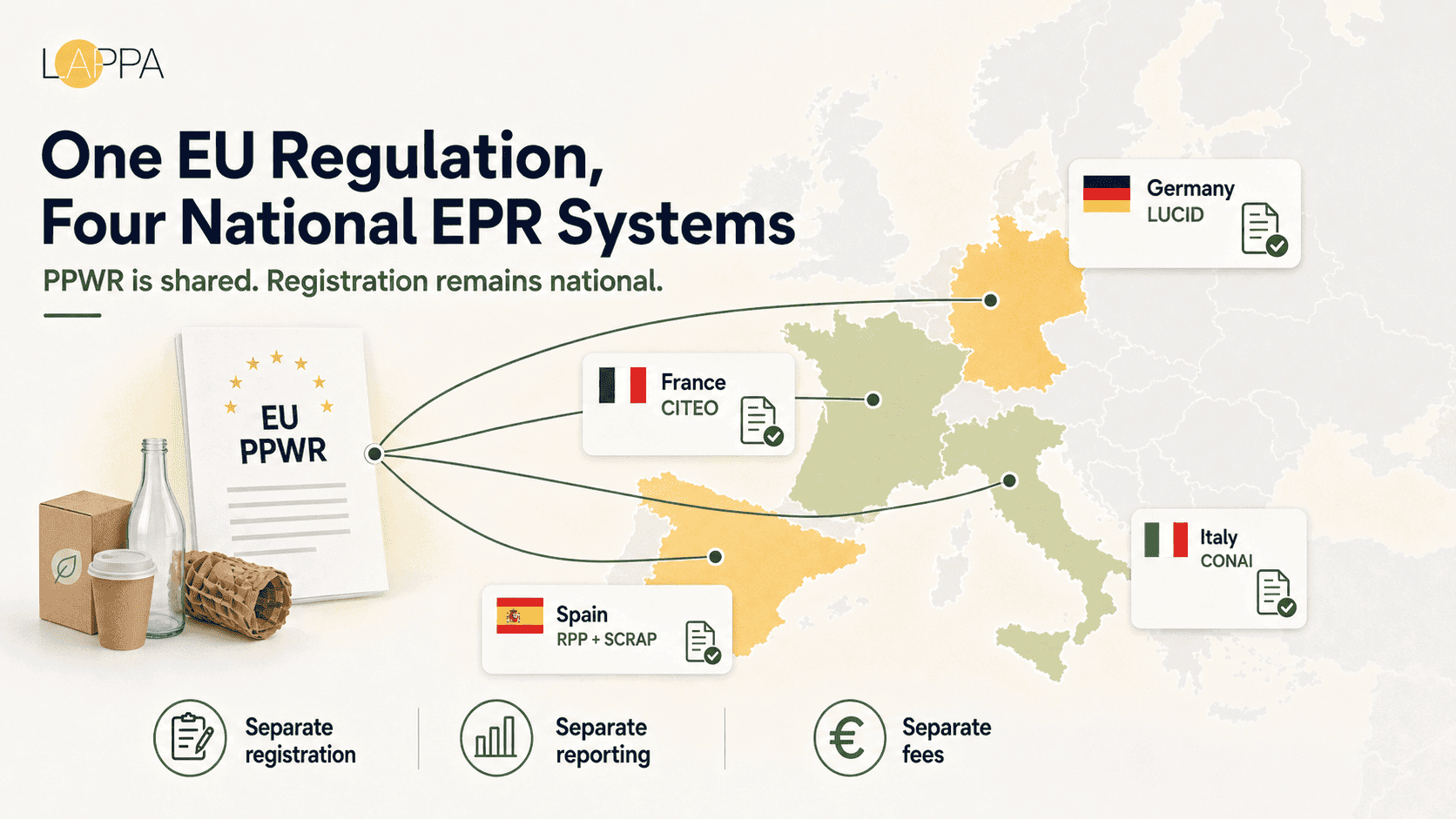
EPR registration is a common blind spot. Every company that first makes wrapping available in an EU member state must register with the national producer registry. There is no single EU-wide registration. A US brand selling into Germany, France, and the Netherlands needs three separate registrations. Each has its own reporting cycle and fee structure.
Annual reporting requires disclosing the weight and composition placed on each national market. These figures feed into recycling targets. They also set the eco-contribution fees. Conformity data should be connected to these reporting workflows. That keeps data consistent.
Labelling requirements will introduce harmonised symbols across the EU starting in 2028. But some member states already enforce national labelling rules. Italy has its own environmental labelling decree. It requires identification codes on items sold in the Italian market. Regulatory compliance for packaging demands attention to both EU-wide and national rules.
A practical checklist for non-EU brands should include the following actions.
- Register with EPR schemes in every EU member state of sale
- File annual data reports disclosing weight, type, and format
- Monitor national labelling rules alongside upcoming PPWR harmonised labels
- Appoint an EU-based authorised representative to hold files and respond to authorities
- Verify that each type has a valid DoC with evidence before the first shipment
Compliance with EU rules is not a single milestone. It demands active monitoring. It requires regular data submissions. And it needs timely updates whenever formats or substances change.
PPWR Technical Documentation — The Evidence Behind the Declaration
A DoC without evidence is an empty statement. PPWR technical documentation provides the proof that every claim can be verified. Annex VII of Regulation EU 2025/40 sets out what it must contain.
The evidence must connect real data to the specific item covered by the DoC. Here you may find test results, certifications from suppliers, breakdowns of composition, and assessments of recyclability. It is not enough for generic supplier data sheets to simply mention a chemical family without identifying the specific component. The claimed object must be clearly associated with the evidentiary file and the item itself, according to the authorities.
Technical documentation under the PPWR must be retained for five years for single-use formats. Reusable ones require ten years. The clock starts from the date the item was last placed on the EU market. With each new shipment, the retention period starts over for brands that have continuous shipments.
It is common practice for authorities to initiate monitoring by requesting the DoC. Then, within the allotted time frame, they want proof to back up their claims. The product could be taken back if the necessary documentation isn’t there or doesn’t match. The responsible operator faces financial penalties. The burden of proof rests entirely with the company.
Declaration vs Technical Documentation
|
Item |
Purpose |
Who prepares it |
When it is needed |
|
Declaration of conformity |
Formal compliance statement |
Responsible operator |
Before placing items on the EU market |
|
Technical file |
Evidence supporting the DoC |
Brand, manufacturer, importer, or advisor |
Before signing the DoC |
|
Supplier data |
Proof of composition and structure |
Supplier |
During evidence preparation |
|
Test reports |
Evidence for specific requirements |
Lab or supplier |
When claims or standards require testing |
Technical File — How to Build One for Packaging Compliance
A well-structured technical file follows a logical sequence. It mirrors the duties listed in the DoC. Organise the file so any auditor can trace a claim to its supporting proof within minutes.
Building one for the first time can feel overwhelming. Start with the highest-risk categories. Focus on primary food-contact items, plastic formats, and anything with environmental claims. Once the process works for these, it scales to the rest of the portfolio. PPWR-related documentation should feed directly into this structure.
A practical structure for this supporting dossier should include the following sections.
- Identification section covering the item description, dimensions, weight, layers, and intended use
- Bill of components listing closures, labels, inks, adhesives, and barrier coatings
- Substance section containing analytical test reports for heavy metals and PFAS, with references to the tested sample and applicable Article 5 thresholds
- Recyclability assessment documenting the design-for-recycling grade and any deviations from standard collection infrastructure
- Post-consumer recycled-input evidence, including supplier certificates, chain-of-custody proof, and calculation methodology
- Labelling files showing artwork, placement, and compliance with harmonised or national requirements
- The signed DoC, cross-referenced to the evidence above
- Version control log recording every update, the reason for the change, and the date it took effect
Technical files should not be static. Every supplier change, reformulation, or design update requires a review. Companies that build their dossiers as living documents avoid the scramble when an authority request arrives.
Economic Operator — Why the Role Matters Under PPWR
The concept of the economic operator determines who carries which duties under the PPWR. Getting the role wrong creates more than administrative confusion. It opens a gap in legal responsibility that surveillance authorities will flag.
Under the PPWR, the manufacturer is defined by branding. Not by geography. If your company name or trademark appears on the wrapping, you are the manufacturer. Even if production happens on another continent. This catches many non-EU brands off guard. They assume the contract factory holds the duties. But the regulation follows the brand, not the production line.
Article 21 adds another layer. Any importer or distributor that places wrapping on the EU market under its own name gets reclassified as the manufacturer. That means inheriting the full set of duties. Private-label retailers and marketplace sellers with own-brand items fall squarely into this category.
Economic operators at every level should map their specific role before preparing any evidence. The duties differ at each step. The penalties for getting the classification wrong apply regardless of intent.
Responsibilities by Economic Operator
|
Economic operator |
Typical role |
PPWR declaration responsibility |
Documentation responsibility |
|
Non-EU brand |
Sells goods into the EU |
Must understand what is being declared |
Must provide reliable data |
|
EU importer |
Places products on the EU market |
May carry formal compliance duties |
Must verify available evidence |
|
Distributor |
Makes products available in the EU |
Must check visible compliance signals |
Must avoid selling non-compliant items |
|
Fulfilment partner |
Stores or ships goods |
May be involved in supply chain checks |
May need data from the seller |
Recycled Content — Why Claims Must Be Documented Carefully
Recycled content claims are among the most scrutinised elements of PPWR compliance. From 2030, plastic formats will need to meet specific minimum thresholds for post-consumer recycled input. The calculation methodology must follow implementing acts that the European Commission is currently finalising.
Even before the 2030 targets apply, voluntary claims about recycled-input levels must be substantiated. Enforcement of greenwashing is associated with the PPWR’s unproven environmental claims. Under both the PPWR and the EU Green Claims Directive, brands that do not provide chain-of-custody documentation yet claim to be “made with 30% recycled plastic” may face regulatory action.
Proper evidence for post-consumer recycled input requires the following steps.
- Obtain certificates of origin from the recycler confirming the post-consumer source
- Record the mass-balance calculation showing how the input translates to the claimed percentage
- Retain processing files identifying the waste input stream, sorting steps, and reprocessing methods
- Confirm whether supplier certificates specify post-consumer or post-industrial status
- Update all files when switching suppliers or changing input ratios
The distinction between post-consumer and post-industrial trips up many companies. Manufacturing scrap that never reached a consumer does not qualify. Only substance collected from consumers after use counts toward the mandated thresholds. Companies that mix these categories risk enforcement penalties and reputational damage. Claims about recycled inputs must always trace back to verifiable source data.
Non-EU brands unsure whether their evidence is complete can use Lappa to check the files before a DoC is signed. Lappa — Get a Fee Quote
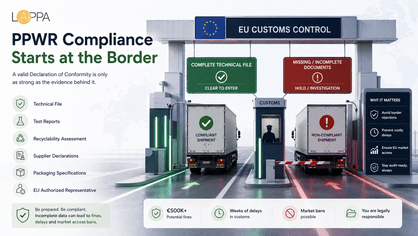
How Lappa Helps Non-EU Brands Avoid PPWR Declaration Mistakes
Preparing declarations, technical dossiers, and supply chain files for the EU market is a task many non-EU brands underestimate. Lappa works with manufacturers, importers, and online sellers. It helps structure their compliance with EU requirements before the first shipment crosses the border.
Lappa reviews portfolios. It maps the applicable PPWR duties to each item type. And it identifies gaps in existing files. For brands lacking substance test data, recyclability assessments, or post-consumer recycled-input proof, Lappa coordinates the collection of missing proof with suppliers and testing laboratories.
The result is a ready-to-use package. It includes properly structured declarations, supporting data, and clear role mapping for every party in the supply chain.Partnering with Lappa ensures that brands’ goods will not be vulnerable to border seizures prior to the August 2026 deadline.
Lappa provides initial setup in addition to continuous monitoring. At any given time, harmonised standards, delegated legislation, and national implementation guides may modify specific demands. Relying on a one-time check means falling behind as the framework evolves.
If your company sells goods in the EU and needs a clearer PPWR process, Lappa can help you structure the DoC, evidence, and operator responsibilities. Lappa — Book a Demo
FAQ
It is a legally binding self-declaration under Regulation EU 2025/40. The responsible party confirms that specific wrapping complies with the sustainability requirements of the PPWR. The signatory accepts liability for each claim. The statement must be backed by test reports, composition data, and recyclability assessments. Authorities can request it at any time during the retention period.