

Packaging labeling requirements in Spain
Every company placing packaged goods on the Spanish market faces a clear legal obligation that came into full effect on January 1, 2025 and remains in force throughout 2026. All household packaging must carry a visible, physically printed sorting symbol telling consumers exactly which recycling bin to use. This requirement is not optional, does not apply only to large producers, and extends to foreign businesses selling into Spain via e-commerce just as much as it does to domestic manufacturers.
Royal Decree 1055/2022 on packaging and packaging waste established the framework. Article 13 of that decree sets out the specific labeling obligations, while the broader EPR system in Spain determines what producers must register, report, and pay. Labeling is one piece of that puzzle — but for many businesses it is the most visible and immediately actionable piece.
This guide explains which symbols are required, which bin each symbol corresponds to, how to handle packaging made of multiple materials, what the design rules are, and what additional obligations apply to reusable and compostable packaging. It also covers what changed for 2025 and 2026 and what producers still in the process of updating their packaging need to know.
Not sure whether your packaging meets Spain’s current labeling requirements? Get a free compliance check from our team. Contact us today.
The legal foundation of Spain packaging labeling
Spain’s packaging labeling framework sits within a broader European regulatory push toward the circular economy and extended producer responsibility. The key legal milestones that led to the current requirements are straightforward.
|
Legislation |
What it introduced |
|
EU Directive 94/62/EC |
EU-level baseline for packaging and packaging waste |
|
EU Directive 2018/851 |
Updated waste framework; required harmonization of SCRAP financial contributions |
|
Law 7/2022 Spain |
National waste and contaminated soil law; introduced EPR framework and ecodesign |
|
Royal Decree 1055/2022 Spain |
Specific packaging obligations including mandatory sorting labels from January 1, 2025 |
Royal Decree 1055/2022 was published on December 27, 2022, replacing the previous Law 11/1997. Among its many changes, Article 13 introduced a requirement that all household packaging placed on the Spanish market must display sorting instruction markings. These markings must appear directly on the packaging itself or on its label, must be physically printed rather than communicated only through digital means, and must remain legible even after the packaging has been opened.
What changed in 2025 and what remains in force for 2026
Before January 1, 2025, the use of sorting symbols was voluntary. Producers could choose to label their packaging with a recycling symbol but were not legally required to do so.
From January 1, 2025, the obligation became mandatory for all new household packaging entering the Spanish market. A transitional provision allowed packaging that had already been placed on the market before December 31, 2024 to continue being sold. Similarly, packaging that had been labeled before January 1, 2025 could continue in commerce for up to six months after the deadline.
In 2026, all transitional provisions have expired. All household packaging on the Spanish market must now carry the correct sorting symbols. There is no grace period remaining, and both Spanish and foreign companies are held to the same standard.
Who must comply with the labeling requirement
The obligation applies to any producer that places household packaging on the Spanish market. Under Royal Decree 1055/2022, a producer is defined broadly. Any company that manufactures, imports, or sells products under its own brand in Spain is considered a producer. If a product is not produced in Spain but is sold there for the first time — including through e-commerce platforms — the company making that first sale bears the EPR obligations, including labeling.
Foreign companies that do not have a physical presence in Spain are typically required to appoint an authorized representative to manage compliance on their behalf. You can read more about this in our guide to EPR registration in Spain.
Why sorting symbols were introduced
The Spanish labeling requirement was introduced in direct response to a well-documented problem. Consumers across Spain were systematically sorting household packaging into the wrong bins. This contamination reduced the quality and volume of recyclable materials recovered from the waste stream, increasing processing costs and decreasing the effectiveness of recycling infrastructure.
Research and experience from sorting plants across Spain consistently showed that the main cause was not consumer unwillingness to recycle but genuine uncertainty about where specific packaging types belonged. A bottle might end up in a glass bin. A cardboard carton might be put with paper. Flexible plastic bags created particular confusion.
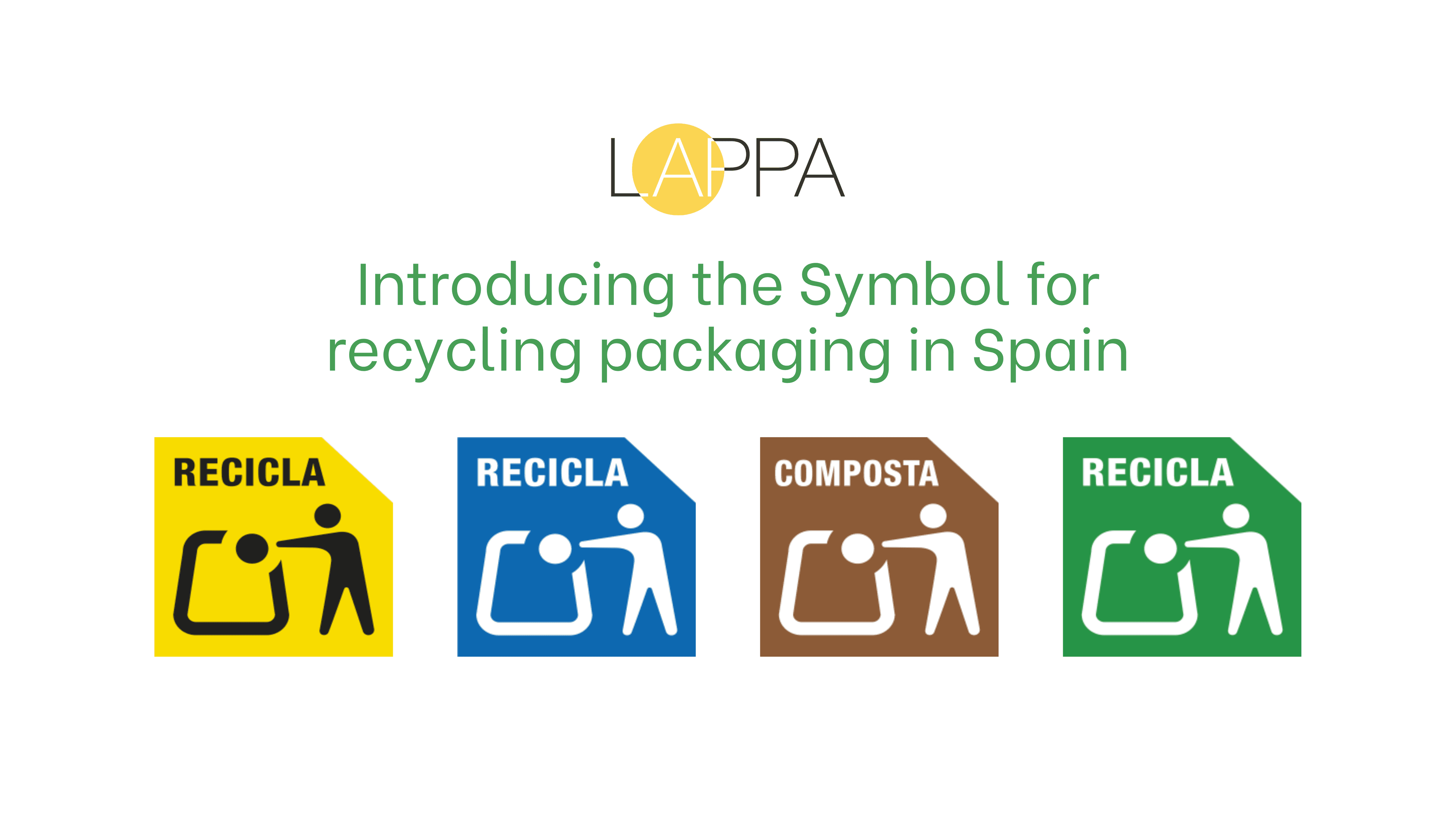
The solution written into Royal Decree 1055/2022 was a standardized, colour-coded symbol system. Each symbol shows the colour of the specific household bin into which that packaging component should be placed. Rather than requiring consumers to remember rules, the label provides the answer directly on the packaging itself.
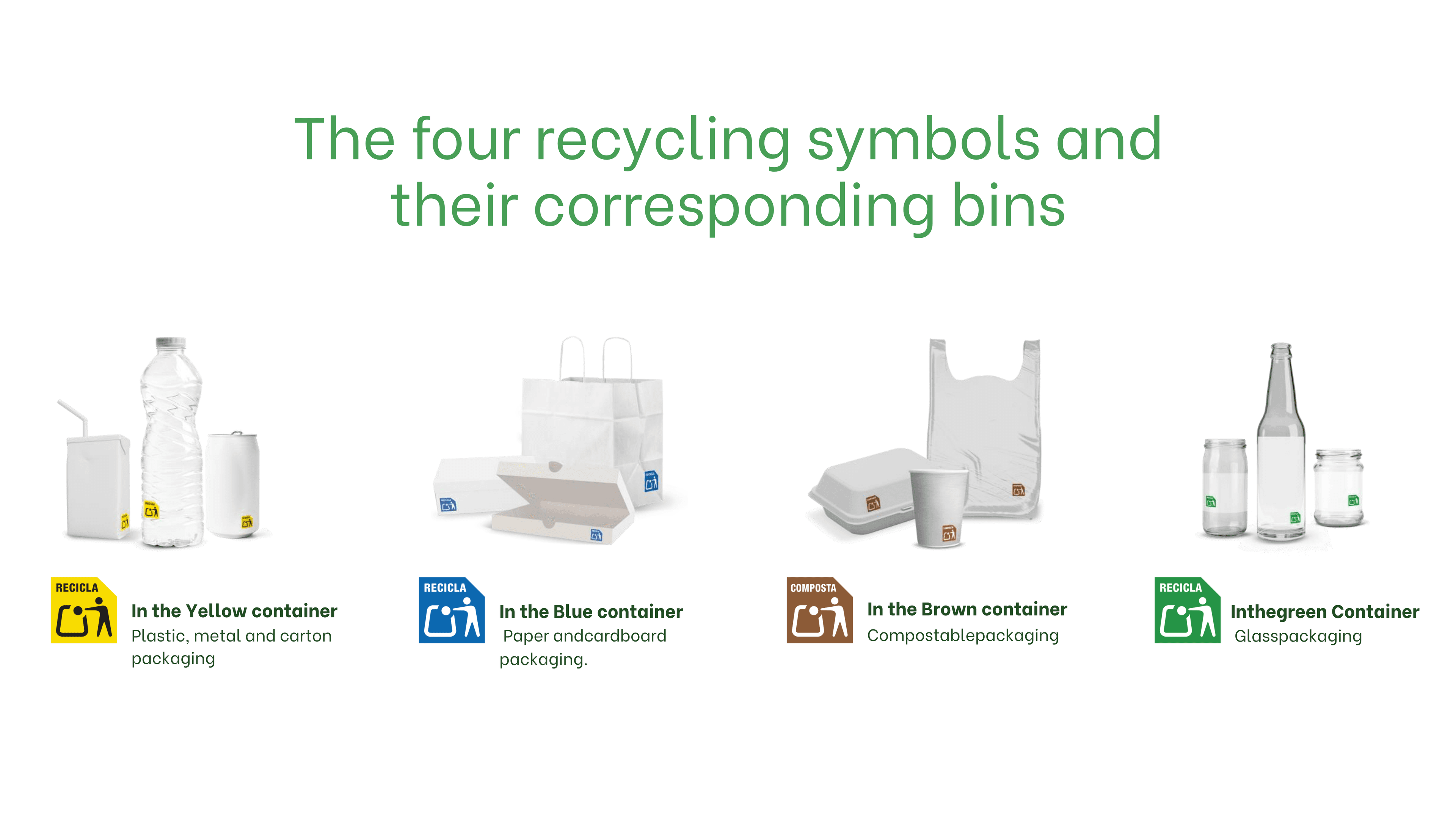
The four recycling symbols and their corresponding bins
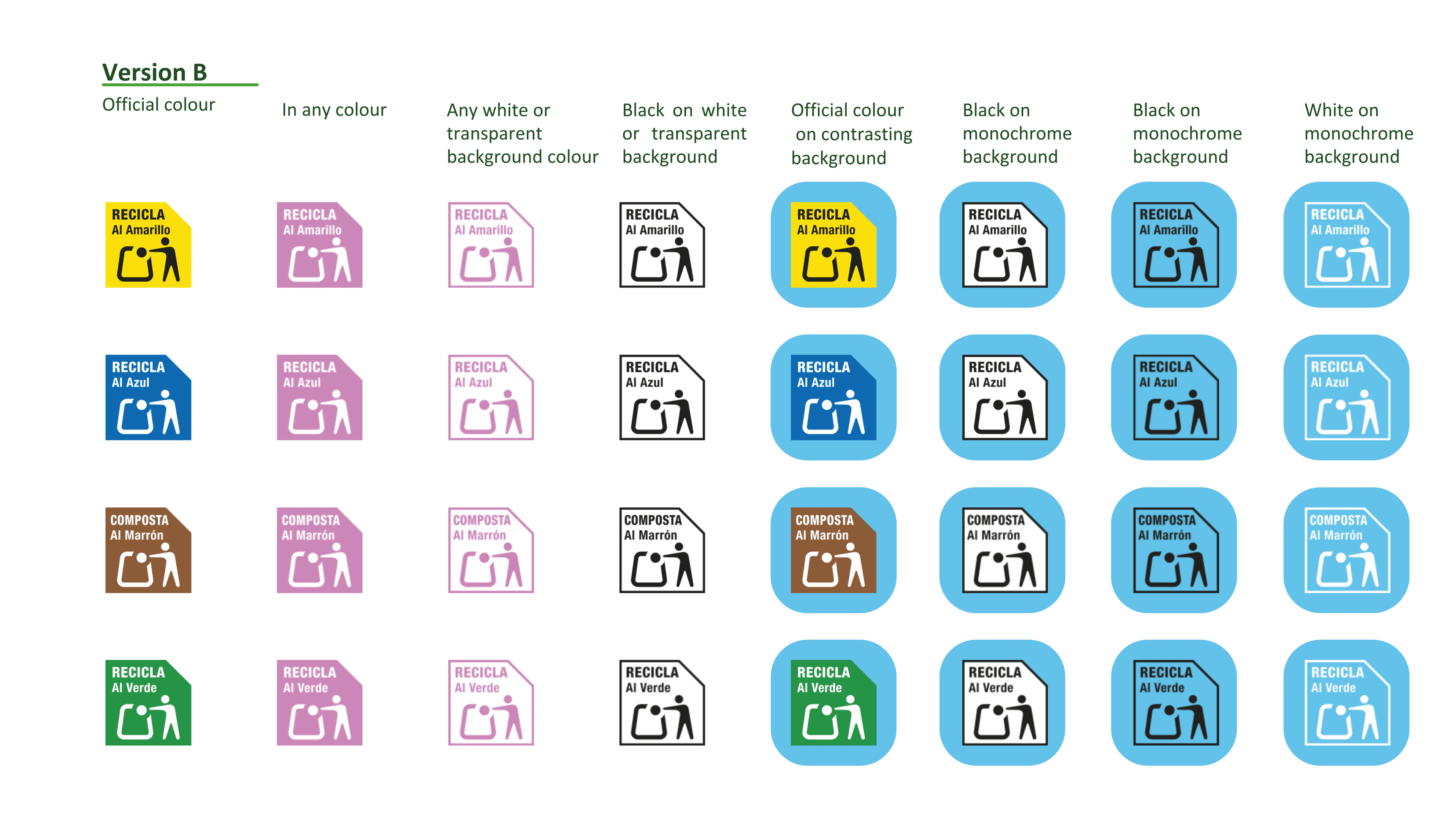
Spain’s sorting symbol system uses four colours, each corresponding to a specific household collection bin and a specific category of packaging material. Producers must select the correct symbol based on the material and type of their packaging.
|
Bin colour |
Packaging category |
Key examples |
|
Yellow |
Plastic, metal, brick cartons |
Plastic bottles, cans, yogurt pots, detergent bottles, juice cartons, bags |
|
Blue |
Paper and cardboard |
Cardboard boxes, cereal packaging, newspapers, brochures |
|
Brown |
Compostable packaging |
Packaging certified to UNE EN 13432:2001 |
|
Green |
Glass |
Wine bottles, spirit bottles, jam jars, cosmetic glass |
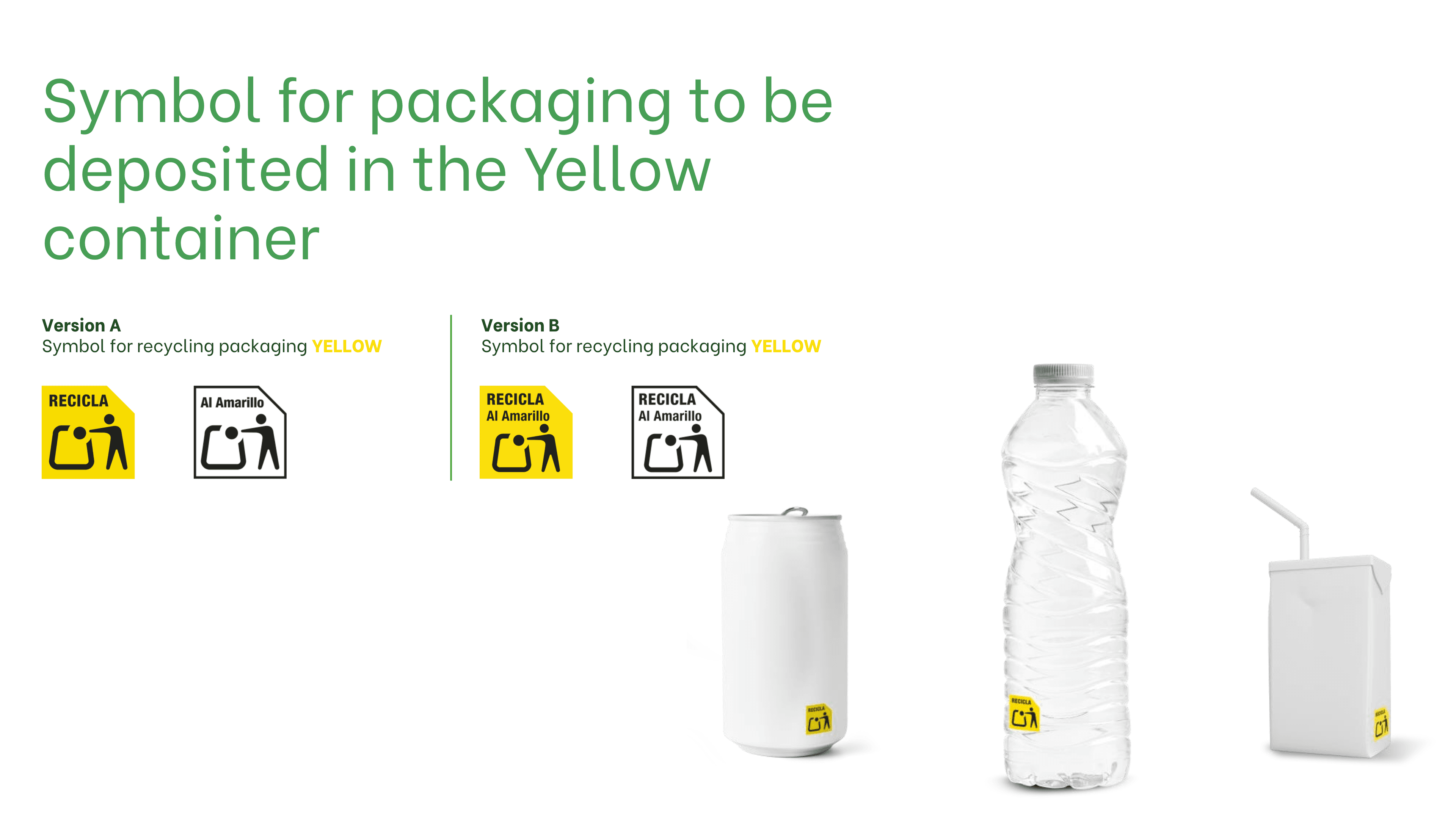
The yellow bin symbol for plastic metal and carton packaging
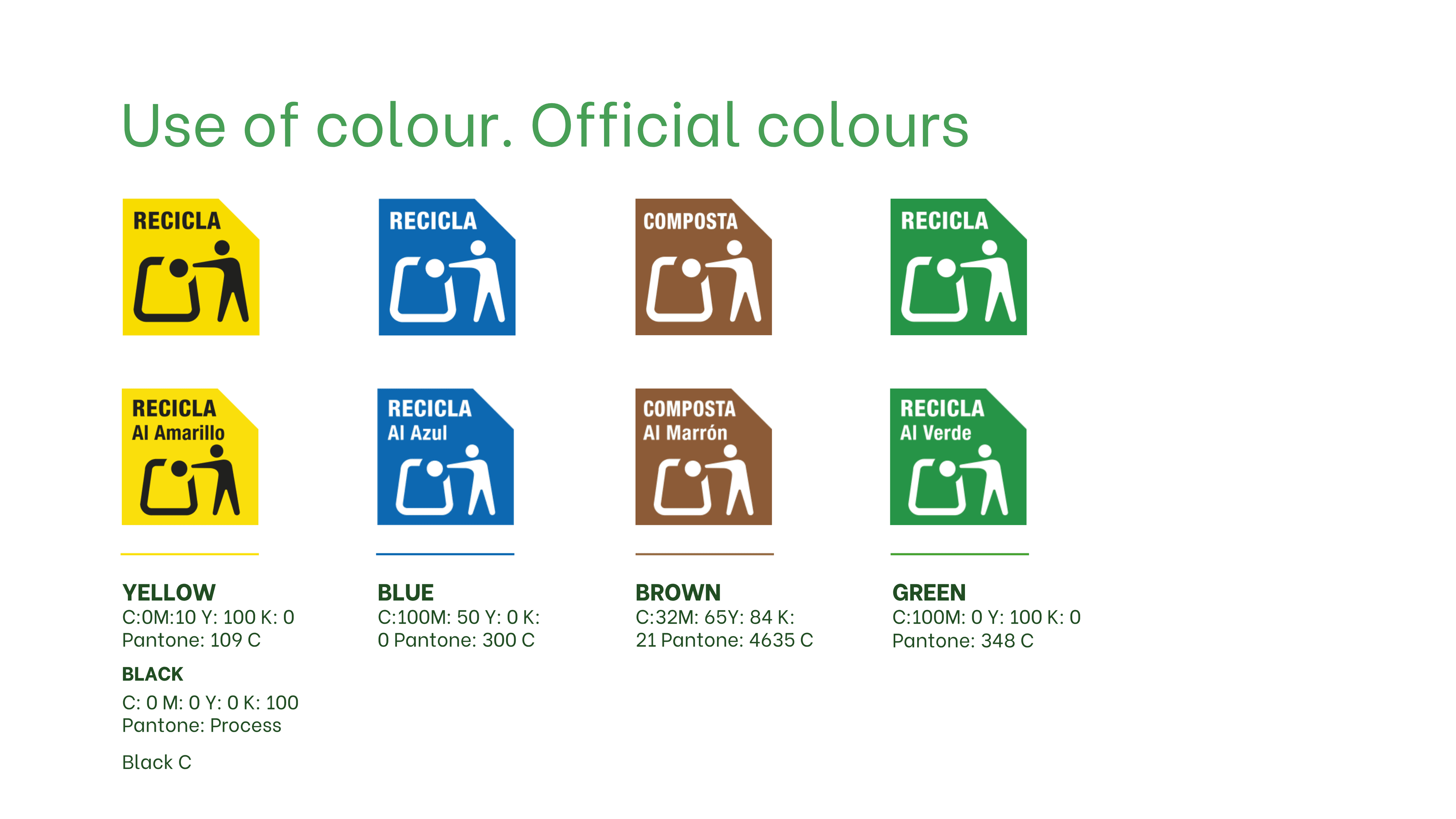
The yellow bin is for light packaging including plastic, metal, and brick carton packaging that should be deposited in the separate yellow household collection container.
In practice, the yellow bin covers a wide variety of everyday packaging. Plastic containers of all kinds — soft drink bottles, mineral water bottles, detergent and fabric softener bottles, shopping bags, foam trays, yogurt pots — all belong here. Metal containers including aluminium and steel cans for drinks, beer, and canned food, as well as aluminium trays, also go in the yellow bin. Brick containers for milk, juices, soups, and food products like sugar and beans belong here as well. Mixed packaging such as bread bags that are partly paper and partly plastic should also carry the yellow bin symbol.
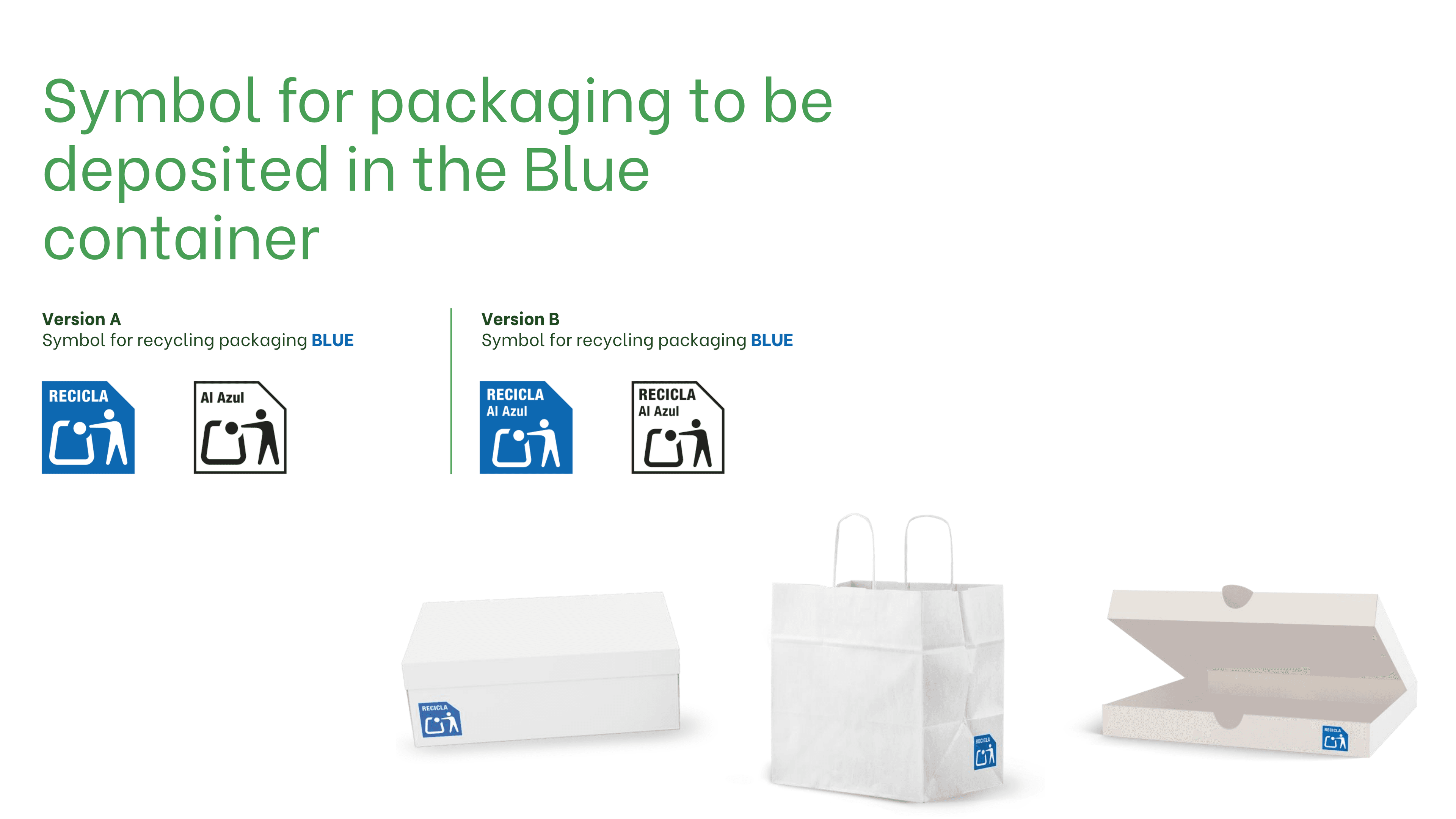
The blue bin symbol for paper and cardboard packaging
The blue bin is for household paper and cardboard packaging. This includes cardboard boxes and packaging of all kinds, cereal boxes, office paper, magazines, newspapers, brochures, comic books, and advertising leaflets.
An important distinction to remember is that milk and juice cartons, despite being made partly of cardboard, belong in the yellow bin because of their multi-material composite structure. The blue bin does not accept dirty paper such as toilet paper, kitchen paper, or napkins. Copy paper and plastic-coated paper are also excluded from the blue bin stream.
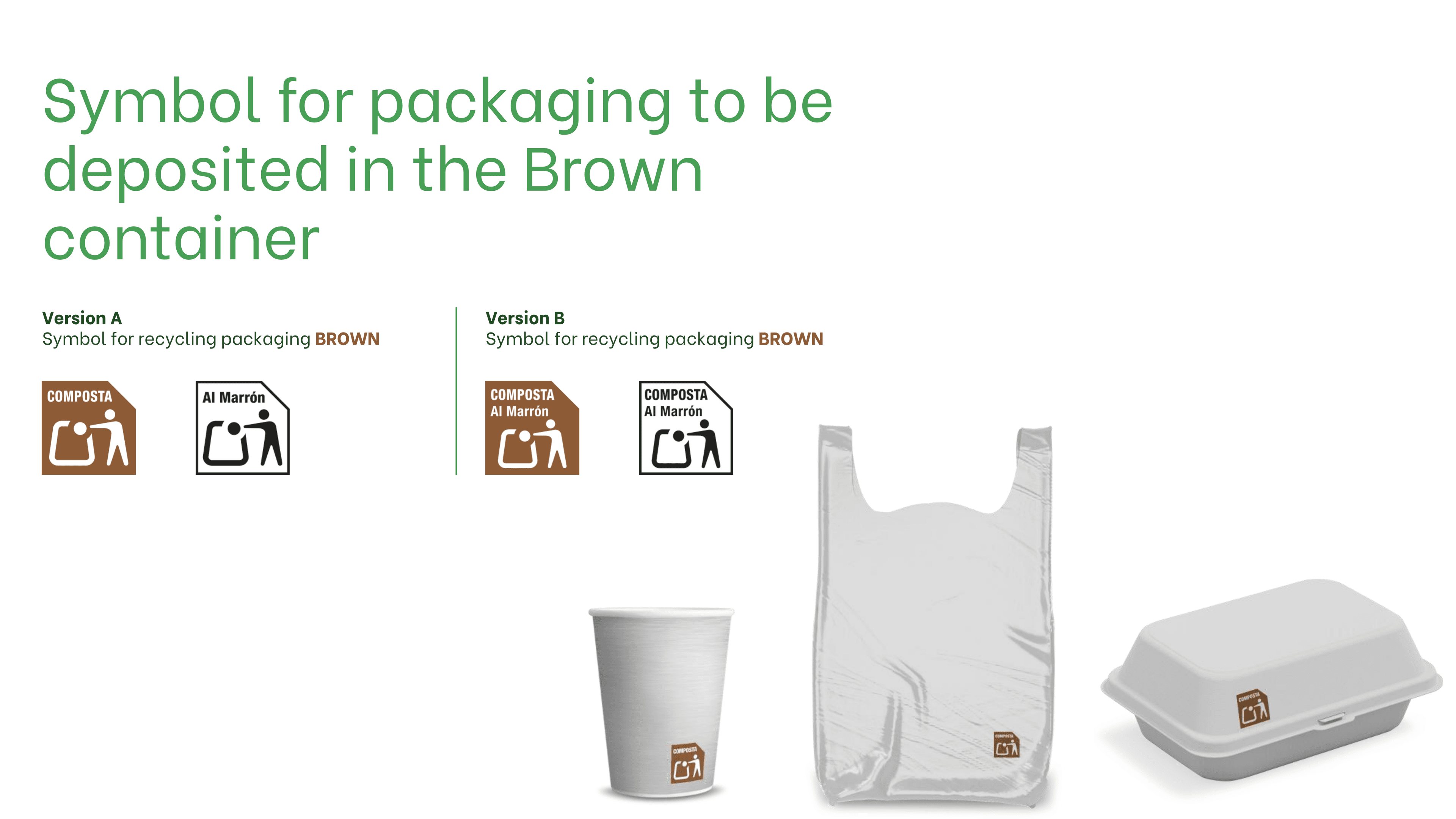
The brown bin symbol for compostable packaging
The brown bin is for compostable packaging. A piece of packaging is considered compostable for the purposes of Spanish labeling requirements if it complies with the UNE EN 13432:2001 standard for compostability or an equivalent European or national standard. This standard requires that the material can be almost wholly decomposed together with organic matter under composting conditions.
Compostable packaging carries a specific additional obligation beyond the brown bin symbol. The packaging must also display the statement that it should not be discarded in the environment. This warning is mandatory and is not satisfied by the symbol alone.
The green bin symbol for glass packaging
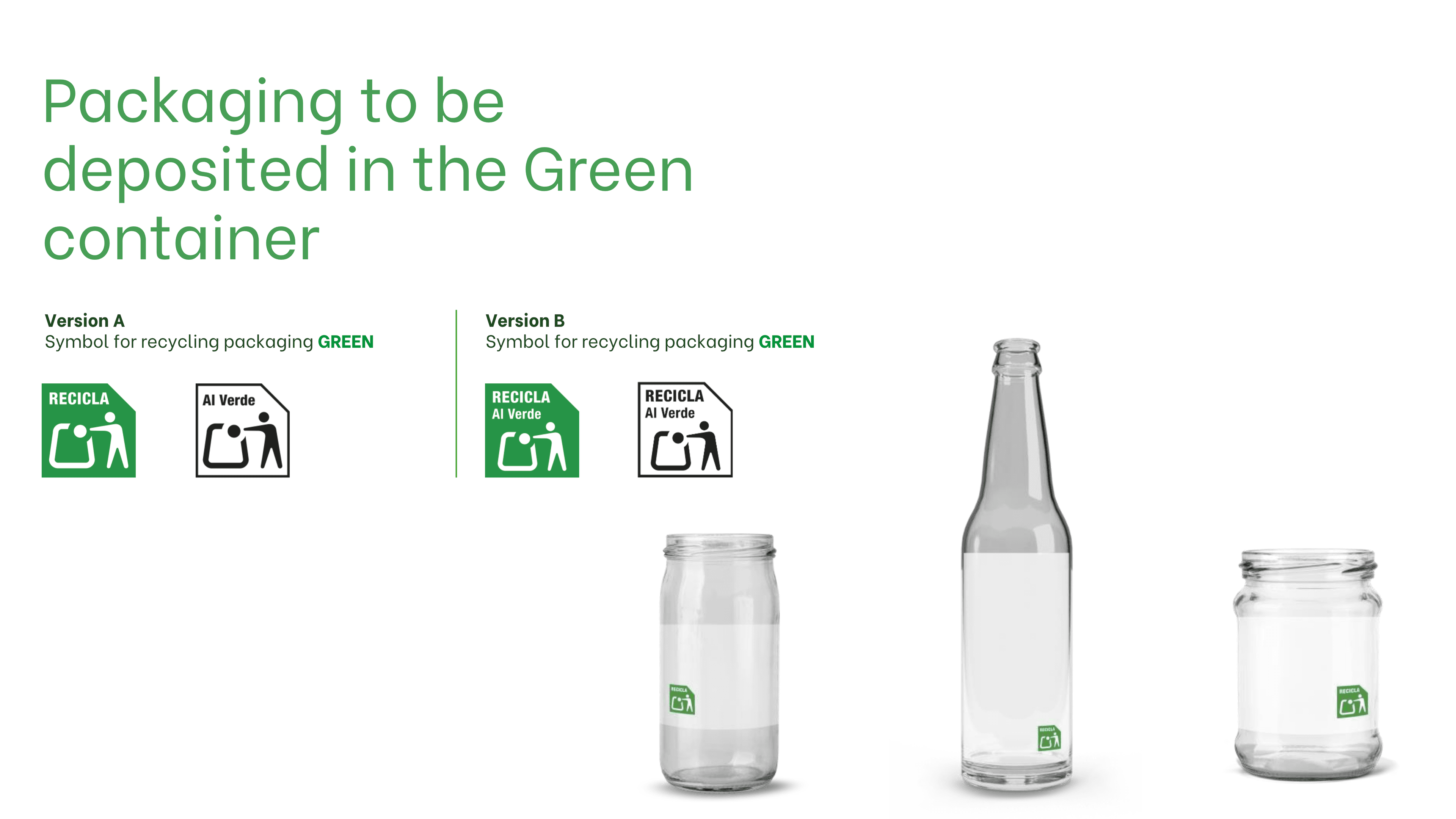
The green bin is for glass containers. Wine bottles, spirit bottles, bottles for other beverages, cosmetic glass jars, cologne bottles, jam jars, and similar glass containers all belong in the green separate collection bin. The green bin symbol should appear on all glass packaging intended for household use.
Multi-material packaging and how to label it correctly
Most household packaging in the real world is not a single uniform material. A plastic bottle has a label. A cardboard box may have a plastic window. A jar has a metal lid. Spanish regulations address this directly, and the rule is based on a practical test.
When components can be separated by hand
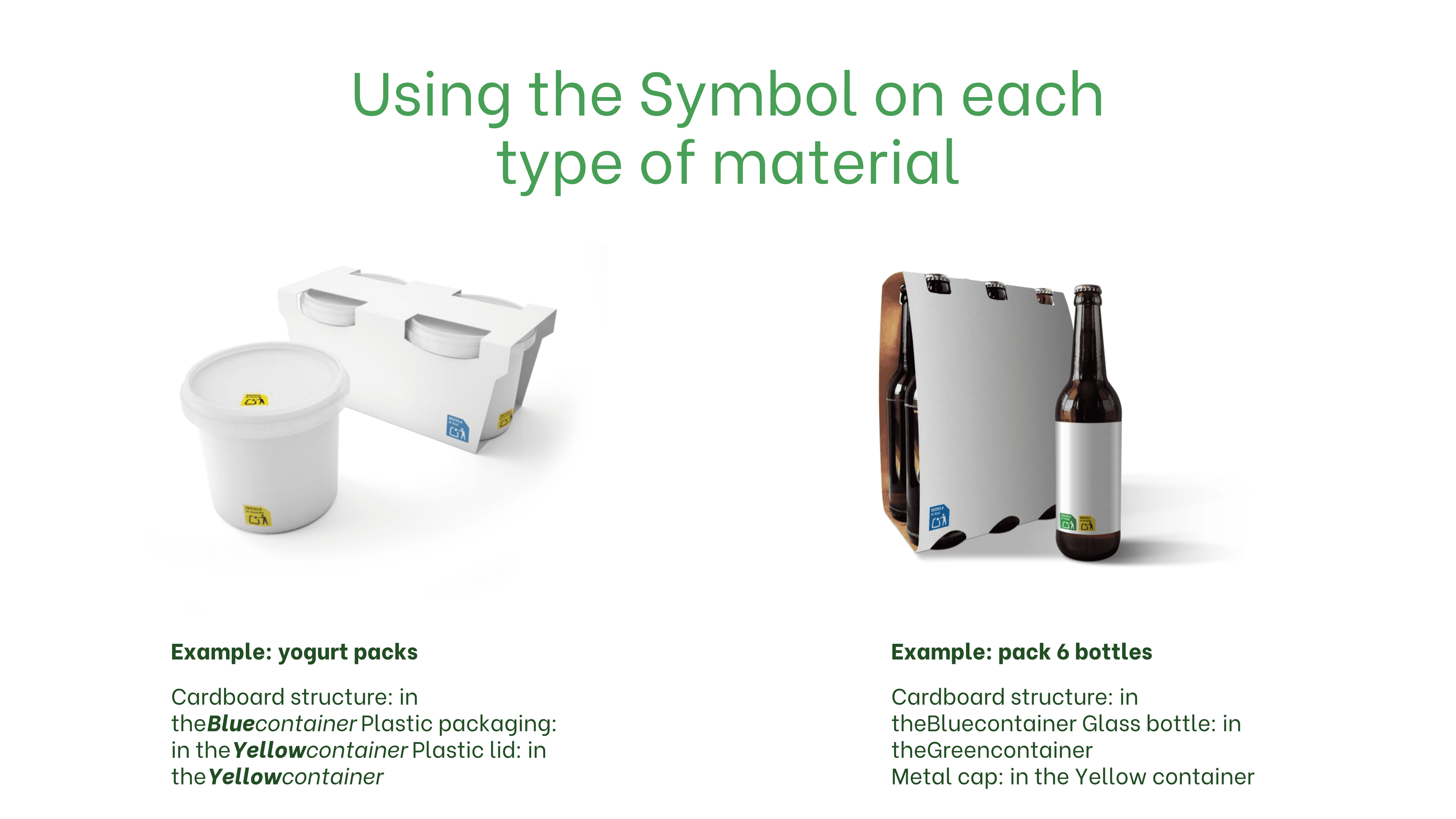
If the different materials that make up a packaging solution can be separated by the consumer without tools — by simply pulling, tearing, or unscrewing — then the labeling should indicate a different bin symbol for each separable component. This means that a packaging solution might carry two or even three different symbols, one for each element and its corresponding bin.
For example, a glass jar with a metal lid and a paper label could legitimately carry a green bin symbol on the jar body, a yellow bin symbol on the lid, and a blue bin symbol on the label. The consumer separates each component and places it in the correct bin.
Spanish regulations recommend that whenever possible and space allows, each packaging element carries its own symbol.
When separation is not practical for the consumer
If the materials cannot be separated by the consumer without tools or significant effort, the regulation requires using the bin symbol that corresponds to the primary material, defined as the material that makes up the highest proportion of the packaging by weight.
This situation most commonly arises with composite packaging where materials are bonded, laminated, or otherwise integrated in a way that makes separation impossible in ordinary household use.
The separation instruction on packaging
When an element of the packaging is designed to be removed before the product is used or consumed — such as a sleeve label, a protective cap, or a closure — the packaging may include an instruction to separate that element. Text such as “separate me” or an equivalent phrase in Spanish that clearly communicates the instruction to remove the component is recommended. This helps consumers understand which parts of the packaging should be dealt with separately and also has implications for fee calculations under Spain’s eco-modulation system.
Make sure your packaging fully complies with Spain’s 2026 labeling requirements. Contact us today for a free review of your product range.
Design and placement rules for sorting symbols
Choosing the correct symbol is necessary but not sufficient. Spanish regulations also specify how the symbol must be presented in terms of size, placement, contrast, and durability. These requirements exist to ensure that the symbol is genuinely useful to consumers rather than technically present but practically invisible.
|
Design requirement |
Specification |
|
Minimum recommended size |
10 mm |
|
Placement |
On packaging or label; physically printed |
|
Format |
Physically printed; digital-only is not compliant |
|
Durability |
Must remain legible after packaging is opened |
|
Contrast |
Maximum contrast against photographic backgrounds |
|
Visibility |
Clearly visible and easily recognizable |
|
Language |
Spanish required; bilingual versions permitted |
Minimum size and visibility standards
A minimum size of 10 mm is recommended for the sorting symbol. The underlying principle is that the symbol must be large enough to maintain the clarity of its message. On very small packaging where a 10 mm symbol would take up a disproportionate amount of label space, producers may adapt, but the symbol must remain recognizable and functional.
Two official symbol formats
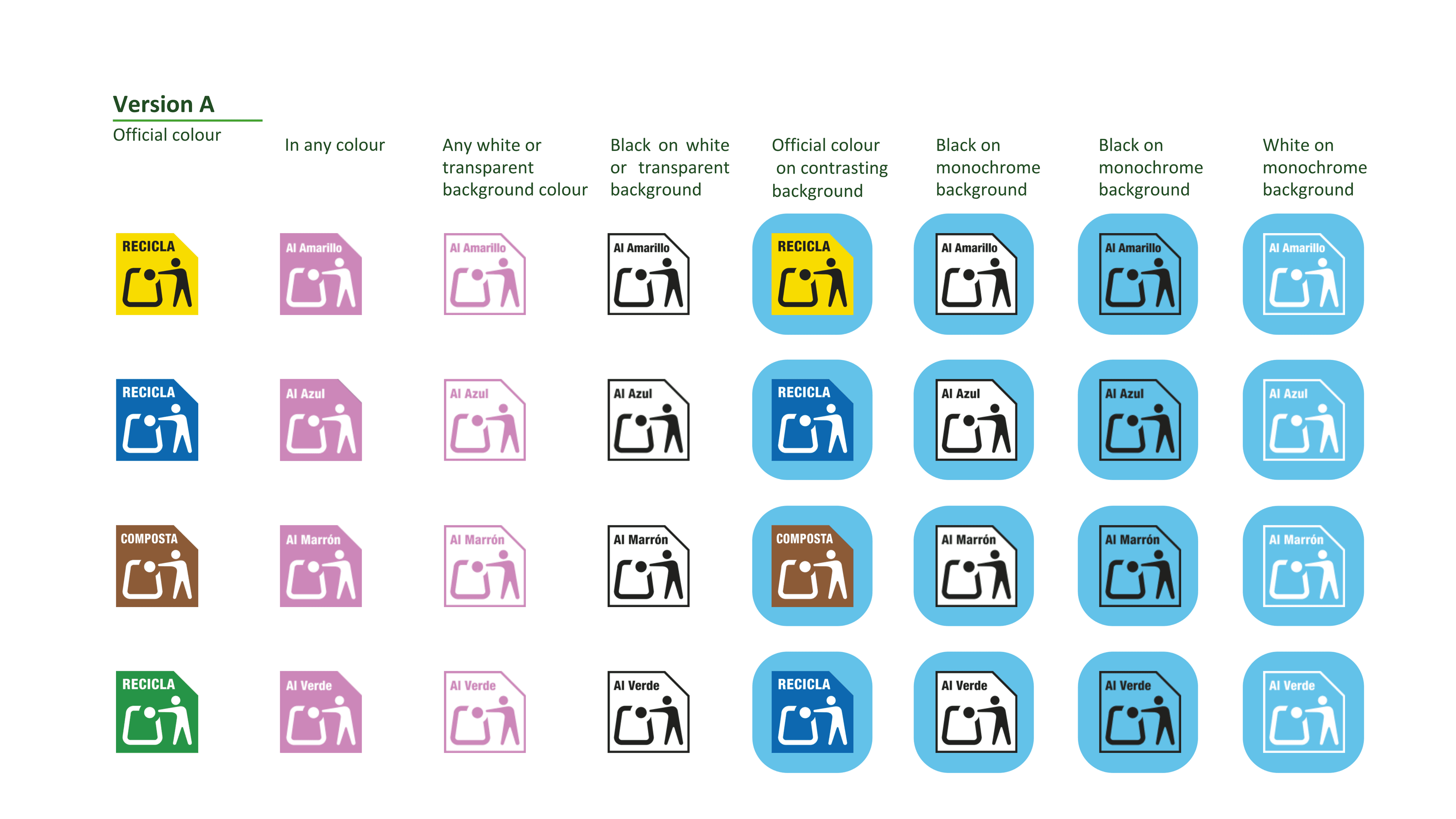
Spanish regulations permit two versions of the sorting symbol, intended to accommodate different packaging sizes and label layouts. The first is a compact version suited to packaging with limited available space. The second is an extended version that provides more detailed information and is preferred where space allows. Both versions carry equal legal standing. Producers should select the version that best fits the available space on their specific packaging.
Contrast requirements on complex backgrounds
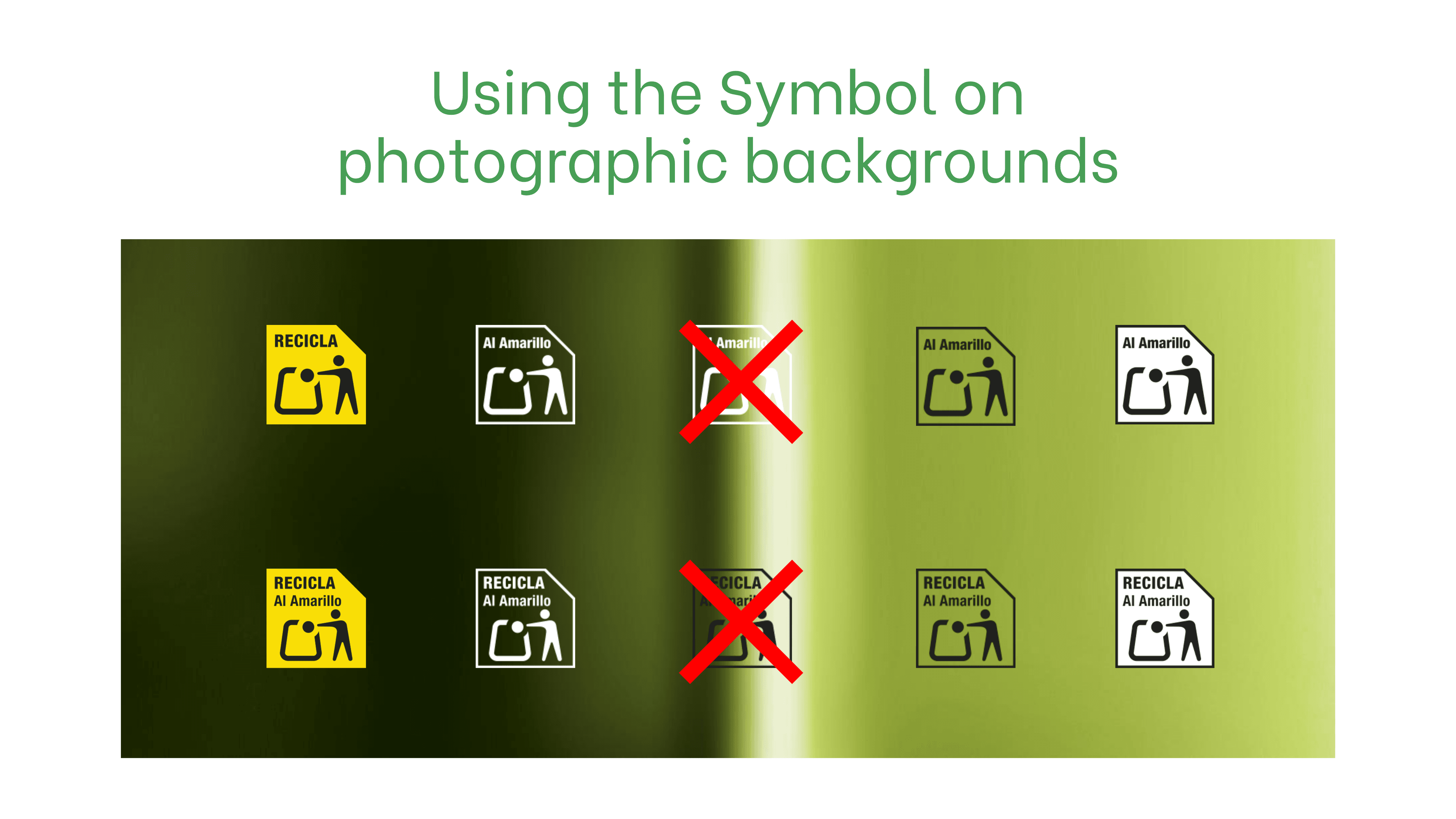
When a sorting symbol is placed against a photographic or complex visual background, the contrast between the symbol and the background must be as high as possible. If achieving adequate contrast on the primary label surface is not feasible, the symbol should be moved to another location on the packaging where it can be displayed clearly. In some cases, placing the symbol on a plain white or neutral panel within the overall label design is the appropriate solution.
Bilingual symbol options for international brands
Spain permits bilingual versions of the sorting symbols. Approved language combinations include Spanish with English, Spanish with French, Spanish with Italian, and Spanish with Portuguese. This provision is particularly useful for international brands that produce unified packaging for multiple European markets, as it allows a single label to serve both the Spanish market requirement and the language needs of other markets without requiring separate packaging runs.
Special packaging categories and their additional labeling obligations
Beyond the standard sorting symbol, certain categories of packaging carry additional labeling obligations under Royal Decree 1055/2022.
Reusable packaging and the SDDR symbol
Packaging designed and intended for reuse must clearly indicate its reusable status. The label must carry the symbol associated with Spain’s deposit, return, and refund system — the SDDR or Sistema de Depósito, Devolución y Retorno. This symbol helps consumers identify that the packaging is not single-use and should be returned rather than placed in a recycling bin.
The SDDR labeling requirement is separate from, and in addition to, the general sorting symbol requirement. Both must appear on reusable packaging where applicable.
Compostable packaging and the mandatory environmental warning
Compostable packaging must meet the UNE EN 13432:2001 standard or equivalent. Beyond carrying the brown bin symbol, compostable packaging must display a clear statement that it should not be discarded in the environment. This is a mandatory text requirement and is not satisfied by the symbol alone.
The rationale is straightforward. Compostable packaging that ends up in a landfill, waterway, or natural environment does not decompose in the way a composting standard describes, because those standards require specific conditions of temperature, humidity, and microbial activity. Consumers need to understand that compostable does not mean it can be left anywhere.
Packaging containing hazardous materials
Packaging for products classified as hazardous must carry appropriate hazard warning markings in addition to sorting symbols. Hazard labeling is governed by separate legislation from the packaging waste framework, but both sets of requirements apply simultaneously. The presence of a hazard symbol does not remove the obligation to display a sorting symbol.
Packaging labeling as part of full EPR compliance in Spain
Labeling is one of several obligations that producers face under Spain’s extended producer responsibility system. Understanding how labeling fits within the broader EPR picture is important for building a complete compliance strategy.
|
EPR obligation |
Description |
|
EPR registration |
Register with MITECO and join a Producer Responsibility Organisation; obtain an EPR registration number |
|
Annual reporting |
Submit declaration of packaging volumes placed on the Spanish market each year |
|
Eco-fees |
Pay fees to the PRO based on material type and weight of packaging placed on the market |
|
Labeling |
Apply correct sorting symbols to all household packaging; mandatory from January 1, 2025 |
|
Eco-modulation |
Fee adjustments applied from 2024 based on packaging recyclability and recycled content |
Non-compliance with labeling requirements exposes producers to the same enforcement mechanisms that apply to other EPR obligations. Spain’s authorities have the power to impose fines and, in serious cases, to restrict the sale of non-compliant products.
Foreign companies selling into Spain without a physical presence are required to appoint an authorized representative. This representative handles registration, reporting, and compliance obligations on their behalf, including ensuring that packaging meets labeling requirements before it enters the Spanish market. Learn more in our complete EPR guide for Spain and our dedicated page on authorized representative services.
Quick reference summary of Spain packaging labeling rules for 2026
|
Requirement |
Rule |
|
Mandatory from |
January 1, 2025; all transitional periods expired |
|
Who must comply |
All producers placing household packaging on the Spanish market including foreign companies |
|
Symbol type |
Colour-coded bin symbol indicating the correct household recycling container |
|
Placement |
On packaging or label; physically printed |
|
Minimum size |
10 mm recommended |
|
Multi-material packaging |
Separate symbol per separable component; symbol for primary material if inseparable |
|
Reusable packaging |
Additional SDDR deposit return symbol required |
|
Compostable packaging |
Brown bin symbol plus mandatory environmental warning text; UNE EN 13432:2001 certification |
|
Language |
Spanish required; bilingual versions permitted |
|
Digital-only label |
Not compliant |
Need to register for EPR in Spain or verify that your packaging labels are compliant with the 2026 requirements? Our compliance specialists can help. Book a free demo or get fee quote
Frequently Asked Question
All household packaging placed on the Spanish market must carry a physically printed sorting symbol indicating the correct household recycling bin. The requirement has been mandatory since January 1, 2025 under Article 13 of Royal Decree 1055/2022 and all transitional provisions have now expired. There are four symbols corresponding to four bin colours. Yellow is for plastic, metal, and cartons. Blue is for paper and cardboard. Brown is for compostable packaging. Green is for glass.