

Which Products Will Need a Digital Product Passport in the EU
The EU has been building toward this for years, and 2025 marks the point where theory becomes compliance obligation. Manufacturers, importers, and retailers selling into European markets need to understand which product categories fall under the digital product passport framework — and when their deadlines hit. Miss the window and you are looking at market access blockages, not just paperwork fines.
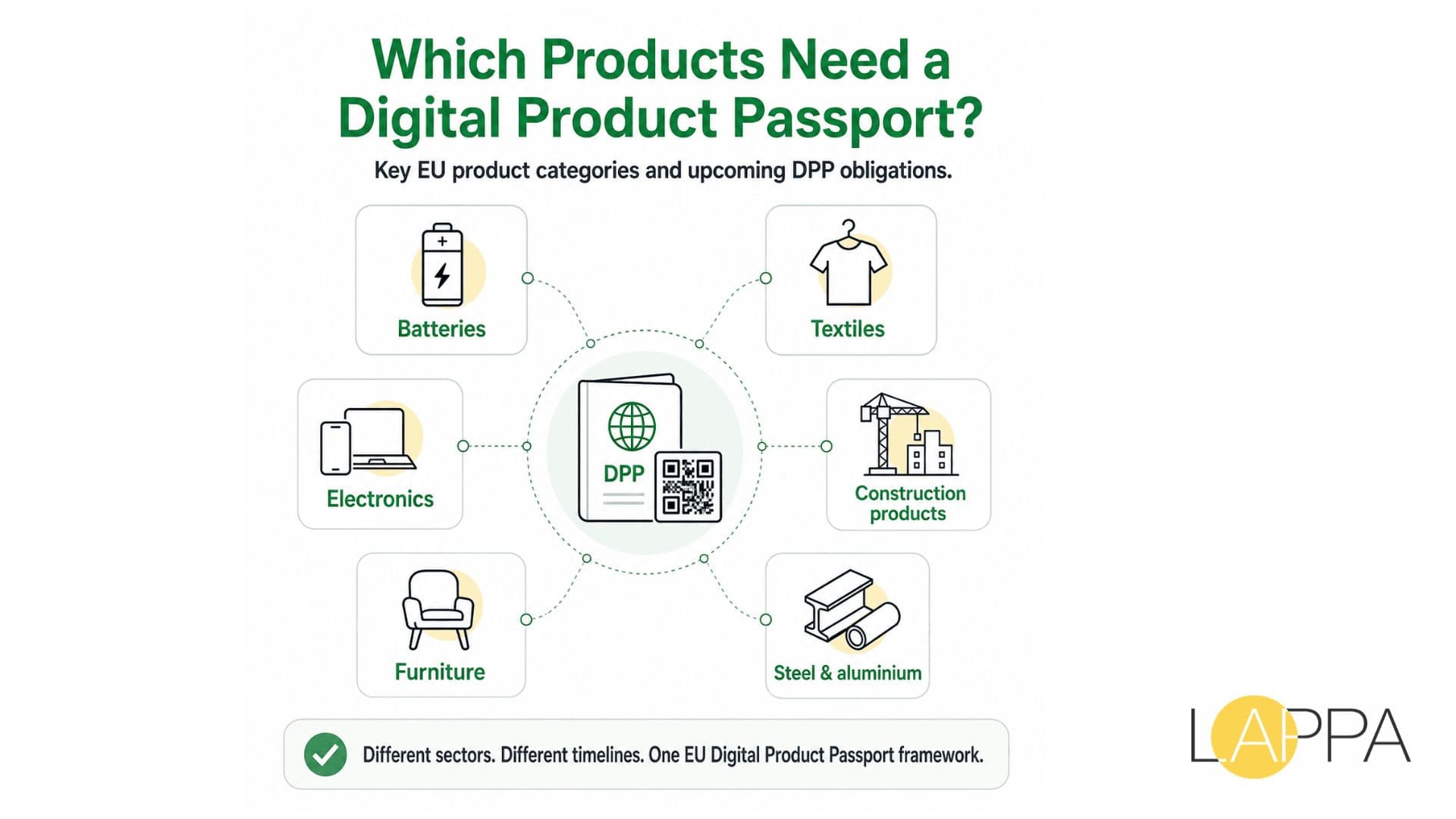
A digital product passport (DPP) is a structured data record that travels with a product throughout its entire lifecycle. It links via a QR code, RFID tag, or similar carrier to a dataset covering origin, material composition, repairability, carbon footprint, and end-of-life guidance. The European Commission’s target is standardised traceability across most product categories by the early 2030s, with batteries already locked in.
This article maps the product groups already named in legislation, explains the data requirements per sector, and sets out the timelines your compliance team should be working to right now.
Need country-specific EPR guidance?
DPP requirements interact with extended producer responsibility rules that vary by market. Our country guides cover both. → Browse our EPR guides by country
The Legal Backbone of Digital Product Passport EU Obligations
Three pieces of legislation carry most of the weight when mapping digital product passport EU obligations across sectors. The Ecodesign for Sustainable Products Regulation (ESPR), which entered force in July 2024, is the horizontal framework. It repealed the 2009 Ecodesign Directive and gives the Commission authority to mandate DPPs for virtually any product category sold in the EU.
The EU Battery Regulation (2023/1542) is the first sector-specific law to impose a fully operational passport. It defines exact data fields, QR code specifications, and phased rollout dates for batteries from portable cells to large stationary systems. Every other sector’s passport structure will mirror this blueprint.
The Construction Products Regulation revision is moving in parallel, while sector delegated acts under the ESPR will define the rules for textiles, electronics, furniture, and steel. Each delegated act goes through preparatory studies and stakeholder consultations before it becomes binding law — a process that typically runs 18 to 24 months.
How ESPR Delegated Acts Turn Into Binding DPP Rules
The Commission publishes a working plan listing the product groups next in line for ecodesign measures. Each group enters a preparatory study, then a draft delegated regulation, then a final act with a transition period. Textiles are the furthest along after batteries, with a delegated regulation expected around 2026–2027 and mandatory DPPs estimated for 2030. The transition windows tend to be short — the Battery Regulation gave manufacturers just 18 months between final publication and the first compliance date. Companies that begin data architecture work only after a delegated act publishes routinely run out of time.
Digital Product Passport Batteries — The Only Confirmed Hard Deadline
Digital product passport batteries rules are the most advanced in the entire EU framework. Three categories fall under full passport obligations: electric vehicle (EV) batteries, industrial batteries above 2 kWh, and light means of transport (LMT) batteries such as e-bike packs. Portable batteries — laptop or power tool cells — face a lighter labelling regime rather than a full passport.
The hard date for digital product passport batteries compliance is 18 February 2027. From that point, every battery placed on the EU market must carry a QR code linked to a machine-readable record containing:
- Carbon footprint per kWh of capacity, declared by lifecycle stage
- Share of recycled cobalt, lithium, nickel, and lead in manufacture
- State of health and expected lifetime data, updated throughout use
- Supply chain due diligence documentation for six regulated raw materials
- Dismantling and safety instructions for waste processing facilities
LMT batteries join the same scheme from February 2027 onward. The data infrastructure must be hosted in manufacturer-operated systems accessible via a standardised API — there is no central EU registry. Battery producers working with Asian contract manufacturers are discovering that mine-level material traceability is the hard part. The QR code itself takes a week to implement. Upstream data can take 18 months.
Digital Product Passport Textiles — What Apparel Brands Face
The digital product passport textiles framework will cover clothing, footwear, and home textiles sold to EU consumers. The ESPR textile delegated act is still in its preparatory study phase as of mid-2025, but the data fields under discussion are already well-signalled through the Commission’s consultation documents.
Mandatory data for digital product passport textiles will almost certainly include fibre composition by percentage, country of origin for each manufacturing stage, washing and care instructions, microplastic-shedding data for synthetic fabrics, and end-of-life sorting guidance in a machine-readable format. Voluntary fields in the current draft cover repairability scores and links to spare component sourcing.
Here’s where it gets tricky for fast fashion operators: the textile passport rules sit alongside the EU’s Substantiation of Green Claims Directive, which bans vague claims like ‘sustainable cotton’ without documentary evidence. A brand filling its passport with aspirational language rather than verified data faces dual exposure — DPP non-compliance and misleading marketing enforcement at the same time.
Physical Label Requirements for Garments
A QR code must survive the garment’s expected washing lifecycle. Technical discussions point toward a minimum module size of 0.4 mm and a requirement that the code remain scannable after 50 wash cycles at 40°C. Brands using heat-transfer labels rather than woven tags are already running durability tests with their packaging suppliers.
Selling textiles or apparel into EU markets
Textile DPP rules vary in implementation timeline by member state. Check what your target markets require before the delegated act publishes.→ Read our country-by-country EPR guides
Digital Product Passport Electronics — Scope, Data, and Timing
Digital product passport electronics obligations build on top of existing ecodesign rules rather than replacing them. Smartphones, tablets, and laptops already fall under specific regulations from 2021–2023 mandating repairability information and spare-part availability. The DPP layer adds a machine-readable carrier and expands the data scope.
The ESPR working plan places smartphones and tablets in the first wave of full digital product passport electronics implementation, with a target timeline around 2030–2031. Expected mandatory data fields include energy efficiency class, repairability score (the EU scoring system runs 0–10), list of available spare parts with pricing caps, hazardous substance information under RoHS, and software update support duration.
Manufacturers of professional electronics — industrial servers, medical devices, telecoms equipment — should watch the B2B carve-out discussions closely. Current drafts suggest products sold exclusively B2B may get modified requirements, with some data fields restricted to professional operators rather than public consumers.
The French Repairability Score as a DPP Pilot
France introduced a repairability scoring system for consumer electronics in 2021. That national pilot is now being harmonised into a pan-EU index that will feed directly into the DPP data structure. Brands already selling into France have the scoring infrastructure in place — they will need to pipe that data into their passport records when the EU regulation lands.
DPP EU Timelines and Requirements — Sector Comparison
The tables below set out confirmed and estimated deadlines across major product groups, and compare the three most active sectors in detail. The DPP EU framework is not a single law — it is a network of sector-specific delegated acts under the ESPR umbrella, each with its own data model and rollout date.
|
Product Category |
Regulation |
Deadline |
Key DPP Data Points |
|
EV & industrial batteries ≥2 kWh |
EU Battery Reg. 2023/1542 |
Feb 2027 |
Carbon footprint, recycled content, state of health, supply chain due diligence |
|
Textiles & apparel |
ESPR |
2030 (est.) |
Fibre composition, origin, care instructions, recycling guidance |
|
Consumer electronics |
ESPR |
2030–2031 (est.) |
Energy class, repairability score, spare-part availability, hazardous substances |
|
Construction products |
CPR revision + ESPR |
2027–2028 (est.) |
Environmental product declaration, recycled content, end-of-life instructions |
|
Furniture |
ESPR |
2030–2032 (est.) |
Material sourcing, durability rating, disassembly guide, chemical substances |
|
Steel & aluminium |
ESPR + CBAM |
2030 (est.) |
Embedded carbon, recycled content share, production process route |
Reading across sectors, the data challenge scales with supply chain complexity. Batteries require mine-level traceability. Textiles require per-stage origin declarations across a global manufacturing chain. Electronics require live repairability data that must be updated as spare parts are discontinued. A single platform built to the DPP EU specifications can cover all three — but the data collection process for each is fundamentally different.
|
Dimension |
Batteries |
Textiles |
Electronics |
|
Legal basis |
EU Battery Regulation 2023/1542 |
ESPR delegated act |
ESPR delegated act |
|
Hard deadline |
18 Feb 2027 |
~2030 (estimated) |
~2030–2031 (estimated) |
|
Carrier format |
QR code on battery |
QR code on label/tag |
QR code on device/box |
|
Hardest data challenge |
Mine-level material traceability |
Per-stage country of origin |
Repairability score + spare-part pricing caps |
|
SME transition period |
Extended for manufacturers only |
TBD in delegated act |
TBD in delegated act |
Digital Product Passport Requirements — The Common Data Architecture
Across all sectors, the digital product passport requirements share a core technical structure. The passport record must be stored in a manufacturer-operated system — the EU runs no central registry. A unique product identifier based on the GS1 Digital Link standard ties the physical QR code to the data record. That record must be accessible via a standardised API to regulators, customs authorities, recyclers, and consumers, with tiered visibility for each audience.
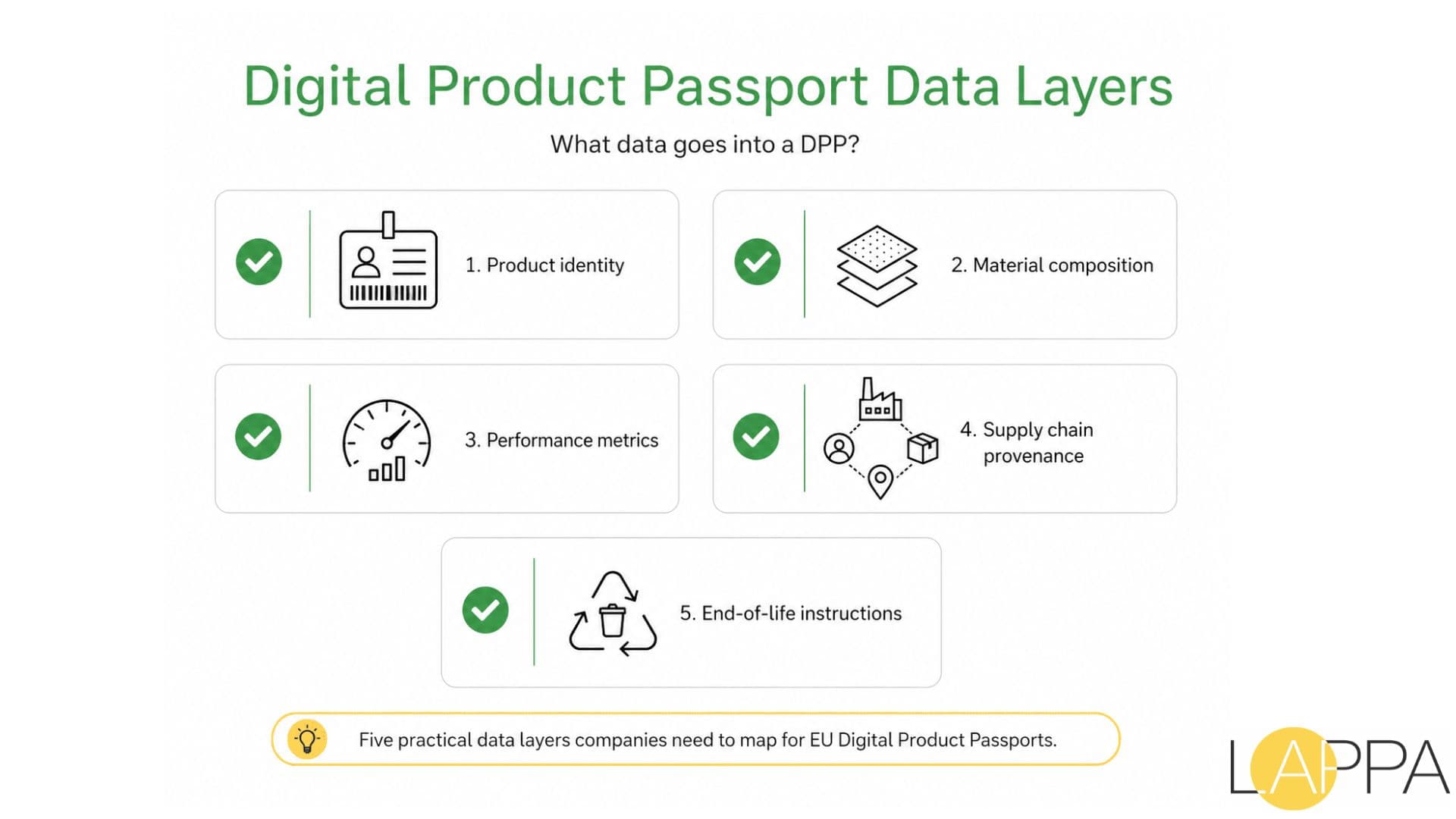
The five data layers every product passport must support under current digital product passport requirements:
- Product identity — GTIN or equivalent, batch or serial number, manufacturer identifiers
- Material composition — substance-level data down to 0.1 % by weight for restricted substances
- Performance metrics — energy class, carbon footprint, repairability score
- Supply chain provenance — country-of-origin declarations, supplier identifiers, certifications
- End-of-life instructions — sorting codes, disassembly guides, hazard warnings for recyclers
Interoperability is non-negotiable. The Commission has mandated alignment with the EPCIS 2.0 standard for event-level tracking. The CIRPASS-2 project is actively developing the API specifications that all sector systems must conform to. Proprietary databases that cannot expose a CIRPASS-2 compliant API will not satisfy the regulation.
One German automotive parts distributor spent 14 months and €2.1 million retrofitting supply chain data for their battery portfolio — roughly four times what a proactive build would have cost. The businesses that avoid that trap are the ones treating DPP data collection as a procurement requirement from day one.
Not sure what DPP compliance costs for your product category
We work with manufacturers and importers across batteries, textiles, and electronics to map their DPP data obligations and build a compliance roadmap.→ Get a fee quote →
EU Sustainability Regulations That Overlap With the DPP Framework
The DPP does not operate in isolation. Several eu sustainability regulations run in parallel and share data fields with the passport. Understanding the overlaps reduces compliance cost — data collected for one regulation can often satisfy another.
The four most significant overlapping eu sustainability regulations for DPP-covered sectors:
- ESPR Ecodesign Regulation — sets minimum product performance standards; the DPP communicates compliance with those standards to the market
- EU Deforestation Regulation (EUDR) — requires supply chain traceability for timber, leather, and natural rubber; that provenance data feeds directly into DPP material composition records for relevant products
- Carbon Border Adjustment Mechanism (CBAM) — already requires embedded carbon reporting for steel, aluminium, and cement imports; this data maps onto the DPP carbon footprint field for those categories
- EU Green Claims Directive — bans unsubstantiated environmental marketing; the DPP data record becomes the documentary backbone for any green claim a brand makes in the EU market
Businesses that build their data infrastructure to satisfy all four frameworks simultaneously will spend significantly less than those who treat each regulation as a separate compliance project. The data model overlaps by roughly 60 % across the four sets of requirements.
Construction Products, Furniture, and Steel — The Next Wave
Construction is the EU’s largest material consumption sector. The revised Construction Products Regulation is pushing for standardised environmental data across steel, concrete, insulation panels, windows, and structural timber — all expected to require a machine-readable lifecycle record by the late 2020s. The link to CBAM makes steel urgent: importers already reporting embedded carbon for CBAM have a significant head start on their DPP data.
Furniture sits in the ESPR’s second-priority wave. Upholstered seating, mattresses, and kitchen cabinetry are in scope. The data requirements focus heavily on chemical substances — flame retardants, surface treatments, adhesives — alongside material sourcing and disassembly guidance. Italian manufacturers, who dominate EU export volumes, are already running DPP pilots through the Federlegno trade association.
SMEs and the DPP — Lighter Obligations With Real Teeth
The ESPR explicitly requires the Commission to consider SME burden when drafting delegated acts. The Battery Regulation gives SME battery manufacturers extended transition periods — though these apply only to manufacturers, not importers. An SME importing EV batteries from South Korea still faces the full February 2027 deadline regardless of company size.
The practical SME pathway runs through hosted DPP software. Several providers — Circularise, Evonik’s TRACE platform, and GS1-certified DPP-as-a-service vendors — offer per-product subscription rates rather than enterprise licensing. For a clothing brand with 200 SKUs, the data collection challenge is harder than the technical hosting challenge.
SMEs sitting in the supply chain — component manufacturers, fabric mills, chemical suppliers — face indirect pressure even without direct EU sales. Brand customers are already including DPP-compatible data clauses in 2025 supplier contracts across the German automotive and apparel sectors.
Stay current on EU product compliance
We publish regular updates on ESPR delegated acts, DPP timelines, and EPR rule changes across European markets.→ Read the Lappa blog
Enforcement — How Market Surveillance Will Work
Each EU member state designates a market surveillance authority (MSA) for each product category. For batteries, this typically sits with the national environment or chemicals regulator. The MSA can request DPP data from any economic operator in the supply chain, not only the brand that placed the product on the market.
The customs angle is binary. The EU’s Customs Reform package will require customs declarations to reference the DPP unique identifier for in-scope products from the relevant deadline date. No valid DPP, no import clearance — the product stops at the border. There is no grace period in the current draft.
Non-compliant products already on the market face withdrawal orders, not just monetary fines. The ESPR gives MSAs the power to order both withdrawal from sale and consumer recall for serious non-compliance. The financial exposure is the lost inventory value plus logistics costs, on top of any regulatory penalty.
FAQ
EV and industrial batteries above 2 kWh must carry a compliant passport from 18 February 2027. This is the only product category with a confirmed binding date as of mid-2025. All other sectors are operating under estimated timelines derived from the ESPR working plan.


.jpg&w=3840&q=75)