

The Hidden 5% Rule — Why Some Paper Packaging Escapes PPWR's Single-Use Plastic Ban
Most compliance teams assume paper is automatically safe under the PPWR. That assumption fails for many formats sold today. Paper packaging recycling rules under Regulation (EU) 2025/40 hinge on one number: 5% plastic content by weight. Miss it, and a carton you always called “paper” falls into the same 2030 ban as a plastic pouch. This guide walks through the rule, the exemption, and the steps your team needs before the next audit.
Not sure whether your cartons and pouches cross the 5% line? Get a free quote or book a demo to review your portfolio with a Lappa specialist.
Why paper packaging recycling suddenly matters under PPWR
Regulation (EU) 2025/40 entered into force on 11 February 2025 and starts to apply from 12 August 2026. The European Commission published its final guidance and an FAQ on 30 March 2026; both were formally adopted in the Official Journal in June 2026. One line inside that guidance changed how fiber-based formats get treated. No legal definition for “single-use plastic packaging” exists in the regulation text itself, so the Commission filled the gap through interpretation instead. Composite structures, including paper-based ones, with 5% or more plastic fall within Article 25 and Annex V. That clarification reshaped how these lightly treated formats are judged across the EU.
The impact lands hardest on categories nobody flagged as plastic before. Coffee cups, sandwich wraps, takeaway boxes, and single-serve sachets often carry a thin polymer film. Few procurement teams weigh that layer during ordinary supplier checks. Under the older Single-Use Plastics Directive, no threshold exemption existed at all — any fiber carrying a moisture or grease barrier counted as plastic outright. The PPWR draws a bright line at 5% instead, good news for lightly treated formats and a trap for anyone who never measured content by weight.
The hidden 5 percent rule explained
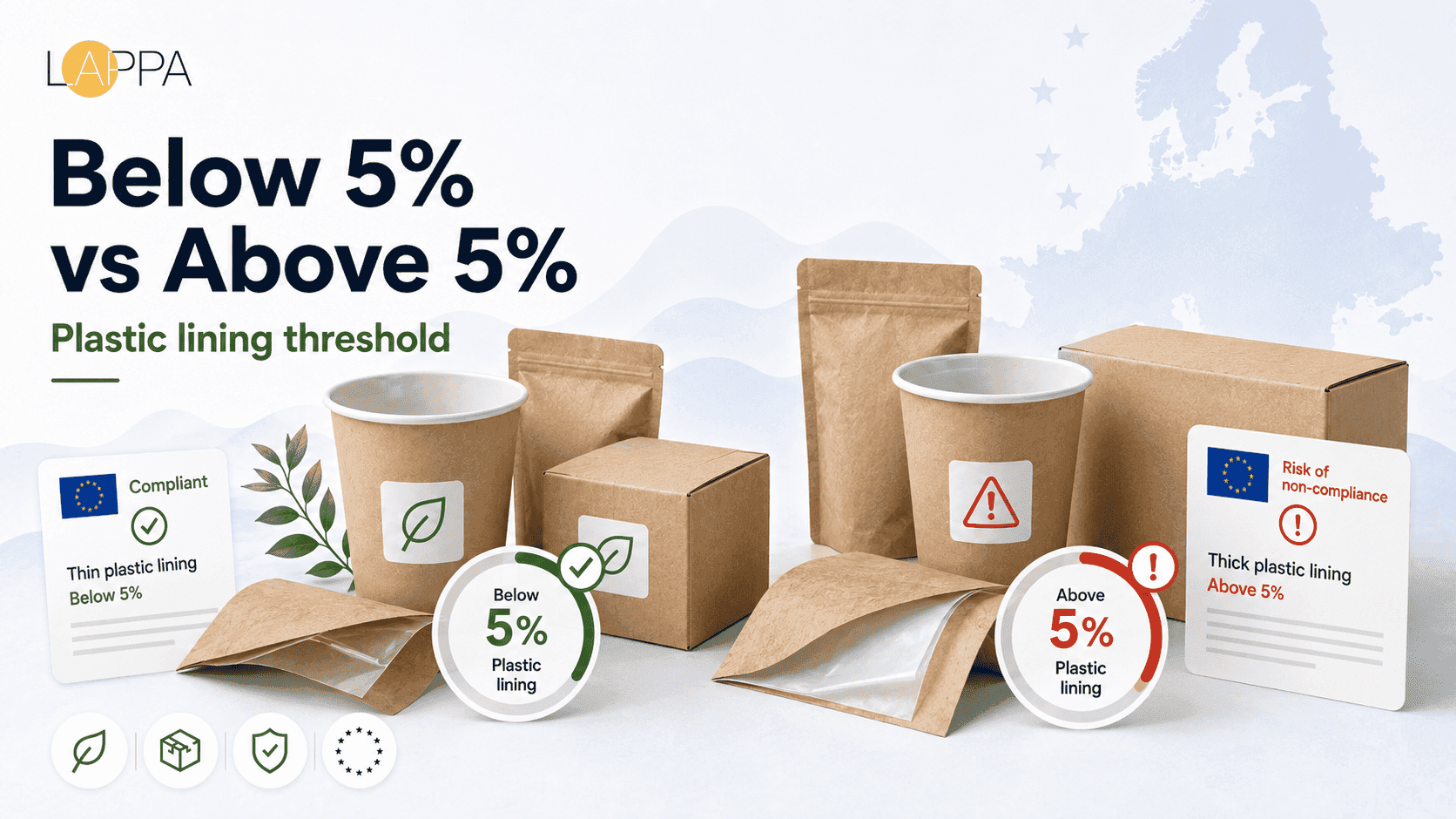
The rule itself is short: a composite item under 5% plastic, by total weight, is not single-use plastic packaging. That exclusion covers labels, varnishes, paints, inks, adhesives, and lacquers. Above 5%, the same carton becomes legally single-use plastic, regardless of how much fiber it contains. Paper packaging recycling claims printed on a box mean nothing to an inspector holding a lab report showing 6% polymer by mass.
Two details make this threshold tricky. First, the 5% figure applies to total component weight, not to the coating layer alone — a light cup with a thick polyethylene lining can breach the limit even though the film looks negligible to the eye. Second, the exclusions list stays narrow: adhesive and lacquer mass never counts toward the 5%, while a structural film laminated between two fiber layers counts in full. Recycling paper packaging without confirming which side of that line a format sits on is guessing rather than compliance.
|
Framework |
Threshold for plastic-coated fiber |
Legal basis |
|
Single-Use Plastics Directive (EU) 2019/904 |
No minimum exemption for barrier-coated board |
Directive 2019/904, Annex |
|
PPWR Regulation (EU) 2025/40 |
Below 5% plastic by weight is exempt from Article 25 bans |
Commission Guidance and FAQ, 30 March 2026 |
|
National plastic taxes (various Member States) |
Vary by country, often no weight threshold |
National implementing legislation |
How packaging classification determines your compliance path
Packaging classification is the first task in any PPWR review, and it decides everything downstream. Category choice sets which recycled content targets apply, which labelling rules kick in, and whether a format faces the 2030 single-use bans at all. The Commission’s guidance stresses one point above all: classification starts from the Article 3(1) definition, not from how a product line has always been described internally. A cup sleeve that looks like plain board can still be legally composite once its coating gets tested.
Getting this wrong surfaces in three places: EPR fee calculations, recyclability grading, and Annex V exposure itself. A misclassified format usually ends up under-reported for producer responsibility purposes, since fee schedules in Germany, France, and Italy already weight contributions by material category. The table below maps categories to obligations in simplified form.
|
Material category |
Recycled content obligation |
Recyclability grading |
Annex V ban exposure |
|
Plastic (pure) |
Yes, staged targets from 2030 |
A to E scale, mandatory |
Full exposure |
|
Composite, plastic content 5% or more |
Depends on delegated acts |
A to E scale, mandatory |
Full exposure |
|
Composite, plastic content under 5% |
Not currently mandated |
A to E scale, mandatory |
Exempt from Article 25 bans |
|
Fiber and board, no plastic layer |
Not applicable |
A to E scale, mandatory |
Exempt |
Steps a team should run when classifying an item:
- Pull the bill of materials for every component, layer by layer.
- Request supplier declarations stating polymer content by mass, not volume.
- Exclude adhesive, ink, varnish, and lacquer weight from the calculation.
- Compare the result against 5% and record supporting evidence.
- Re-run the check whenever a vendor changes a coating formulation.
Composite packaging under the single use plastic ban
Composite packaging is the category behind most confusion around cups, pouches, and cartons. The PPWR does not limit single-use plastic to items made entirely from resin — a hybrid unit can still be banned even when fiber makes up most of its mass. It sits at the center of the Article 25 exemption for this exact reason: it blends materials in ways the old directive never addressed cleanly.
From 1 January 2030, Annex V bans several single-use formats outright, and hybrid structures above the 5% line get caught by every one of them. This list covers items named directly in Annex V that most often involve fiber-polymer blends:
- Single servings of condiments, sauces, coffee creamer, sugar, and spices
- Retail bundling wrap that encourages multi-portion purchases
- Pre-packed fresh produce under 1.5 kilograms
- Accommodation-sector items for individual toiletries and amenities
- Very lightweight carrier bags under 15 microns
Any composite unit on that list needs its polymer share measured now. Waiting for enforcement to start is the costliest mistake a procurement team can make.
Plastic coated paper packaging and the barrier problem
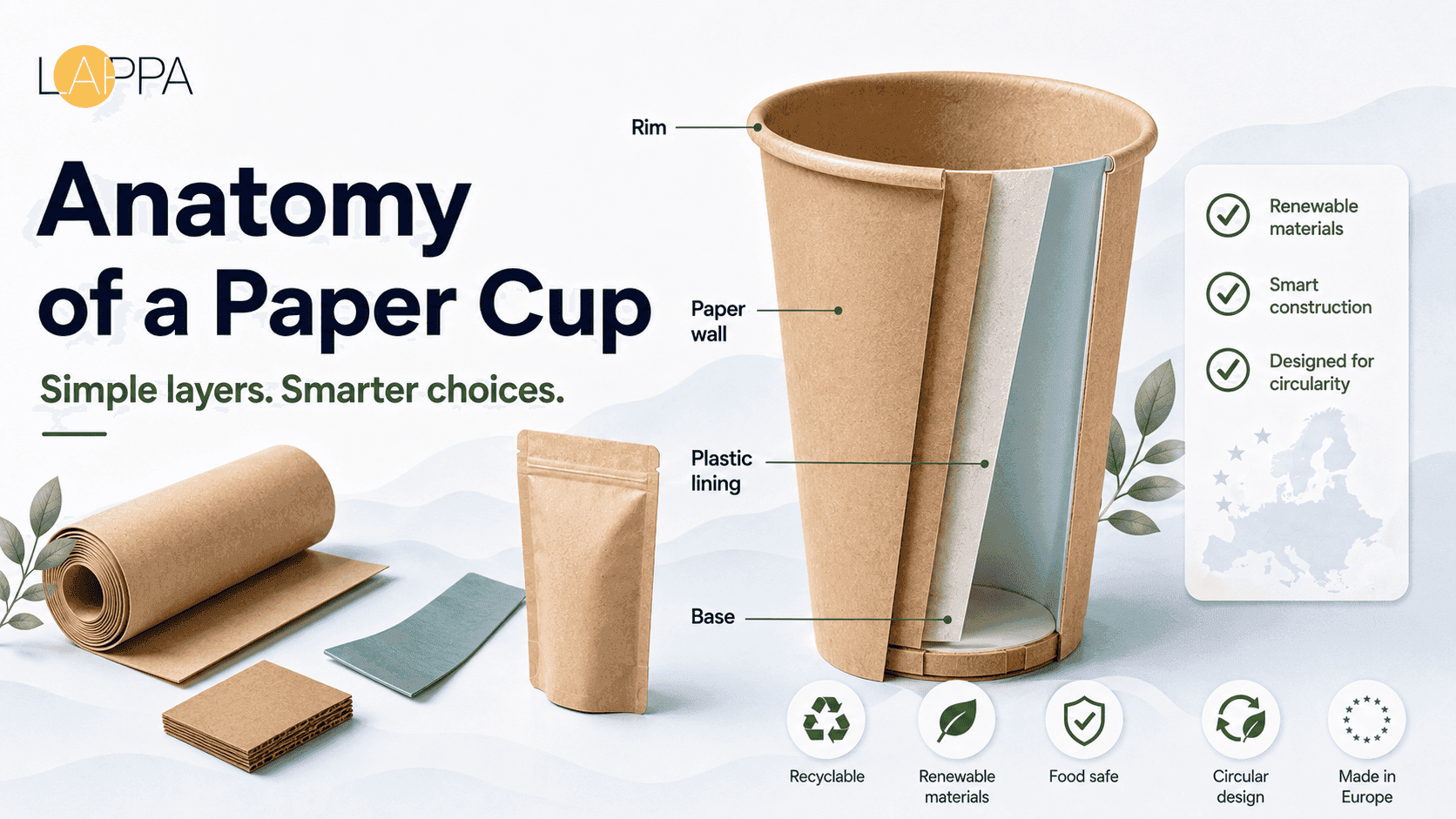
Plastic coated paper packaging exists for a simple reason: fiber alone rarely blocks grease, moisture, or oxygen well enough on its own. A thin polyethylene or polypropylene film solves that barrier problem, but it also raises the classification question this guide addresses. Coating mass, not visual thickness, is what regulators and recyclers actually measure.
Plastic-coated paper packaging splits into two groups worth separating early. Light dispersion coatings, often under 5 grams per square meter, frequently land under the 5% threshold; extrusion-laminated films bonded across the full surface routinely exceed it instead. Testing a real sample from each vendor closes the gap between assumption and fact — a technical data sheet written years ago rarely reflects a current formulation.
Multilayer packaging structures that fall outside the exemption
Multilayer packaging raises the stakes further because it stacks several material types rather than a single coating. Aseptic cartons for liquids, retort pouches, and some coffee bags combine board, foil, and film in one structure, and each layer adds to the total polymer weight calculation. Such a stack almost never clears the 5% line without genuine material substitution.
Recyclass grading treats these structures harshly today. A multilayer film with an aluminium barrier typically lands at grade D or E, putting the unit on a collision course with the 2030 ban on poorly recyclable structures, quite apart from the single-use question. Companies relying on multilayer packaging for shelf-life reasons should treat redesign as a multi-year project, since mono-material alternatives still need qualification and shelf-life testing first.
Managing recyclability data and EPR reporting across several EU markets gets complicated fast. Explore EPR Consolidation to keep every market’s obligations in one place.
Sustainable paper packaging design choices that work
Sustainable paper packaging is not achieved simply by swapping resin for fiber — the Commission’s own guidance warns that board with a plastic film complicates recycling regardless of how the box gets marketed. Genuine design work here starts by trimming barrier layers to only what a product truly needs, then verifying the remaining polymer share sits comfortably under 5%, with margin for supplier variation.
A few design changes consistently move formats in the right direction:
- Switching from full-surface lamination to spot coating on exposed areas only
- Replacing polyethylene films with water-based dispersion coatings where food rules allow
- Reducing coating mass through vendor reformulation instead of adding a second layer
- Specifying uncoated fiber based packaging wherever no moisture barrier is needed at all
None of these swaps come free, and none happen overnight — suppliers typically need lead time to reformulate and requalify coatings. Sustainable paper packaging projects started now will be ready well ahead of 2030, rather than scrambling once the deadline lands.
Fiber based packaging and the Recyclass grading scale
Fiber based packaging still has to pass the PPWR’s recyclability assessment, even once a format clears the 5% single-use exemption. The Commission’s guidance confirms grading applies across every material category, board included. A unit can sit outside the Annex V ban and still fail recyclability grading if its coating interferes with pulping or contaminates the fiber stream.
Fiber based packaging generally performs well on this scale under certain conditions: coatings need to stay thin, water-dispersible, and free of adhesives that resist repulping. Formats combining board with wax, heavy lamination, or non-removable plastic windows tend to score lower, sometimes regardless of exact mass share. Testing against the applicable Recyclass protocol remains the only reliable way to know where a format stands.
Recyclable paper packaging versus recycling in practice
Recyclable paper packaging and packaging actually recycled at scale are two different things, and confusing them trips up more compliance teams than the 5% rule itself. The PPWR defines recyclability at scale as coverage of at least 70% of the population across a minimum of three Member States. A unit can be technically recyclable in a laboratory sense while falling well short of that population bar in practice.
This claim with a barrier coating depends heavily on local mill infrastructure. Some national systems pulp lightly coated cups without any issue; others reject the same cup because sorting lines cannot separate it economically. Before labelling anything as recyclable paper packaging, confirm actual collection capability in every market where a product ships, not just the country of manufacture.
|
Claim |
What it actually requires |
Common gap |
|
Recyclable in principle |
Material can technically be reprocessed |
Ignores real-world collection infrastructure |
|
Recyclable at scale (PPWR standard) |
70% population coverage across 3+ Member States |
Requires market-by-market verification |
|
Widely recycled |
No single legal definition under PPWR |
Often used loosely in marketing, risk of misleading claims |
Coated paper packaging test methods companies should run
Coated paper packaging cannot be classified just by looking at it. Testing protocols matter more here than in almost any other category. Total fluorine screening, solvent extraction, and gravimetric analysis after de-lamination are common lab methods, each isolating the polymer fraction from the fiber base. The same stepwise logic the Commission applies to PFAS testing works here too: start broad, then narrow down only if a threshold is genuinely at risk.
A practical testing sequence for coated paper packaging looks like this:
- Weigh the full component and record the baseline mass.
- Separate or dissolve the coating using an accredited method for that resin type.
- Weigh the remaining fiber fraction and calculate the polymer share by difference.
- Exclude ink, adhesive, or lacquer mass, consistent with PPWR guidance.
- Compare the outcome against the vendor’s original declaration and flag gaps.
Run this sequence once per vendor, per format, and repeat it whenever a coating formulation changes. Nothing else offers a defensible way to prove exemption status if a surveillance authority ever asks.
Barrier paper packaging alternatives worth evaluating
Barrier paper packaging does not have to mean plastic film. Several commercial alternatives now offer comparable grease, moisture, or oxygen resistance without pushing polymer share anywhere near the 5% line. For teams already relying on plastic coated paper packaging today, these alternatives offer a realistic migration path rather than a full redesign from scratch. Mineral-based coatings, certain bio-based dispersion barriers, and fluorine-free grease treatments have matured over recent years, with many now available at food-grade specification.
The trade-offs are real and worth weighing category by category:
|
Barrier type |
Typical plastic content |
Recyclability outlook |
|
Standard polyethylene extrusion coating |
Often above 5% |
Frequently graded D or E under Recyclass |
|
Water-based dispersion coating |
Usually well under 5% |
Generally scores B or higher |
|
Mineral or fluorine-free grease barrier |
Typically 0% plastic |
Scores well, performance varies by application |
Barrier paper packaging redesign is rarely a simple swap — it needs shelf-life and food-safety validation before any commercial rollout. Starting that qualification work now, rather than in 2029, gives a business room to test and adjust safely.
Key deadlines for paper packaging recycling compliance
Several dates matter here, and they do not all fall together. The general PPWR application date of 12 August 2026 brings PFAS limits and conformity assessment obligations into force. But the single-use bans under Annex V, including the 5% threshold for composite packaging, apply from 1 January 2030. Recyclability grading criteria arrive through delegated acts by January 2028, and units scoring D or E lose market access from 2030 as well.
- 12 August 2026 — general PPWR application date; PFAS limits and conformity assessment begin
- 1 January 2028 — delegated acts on recyclability grading due; methodology becomes binding
- 1 January 2030 — Annex V single-use bans apply, including the 5% composite threshold
- 1 January 2030 — units graded D or E under the recyclability scale lose EU market access
- 1 January 2035 — additional design-for-recycling-at-scale requirements take effect
Treating 2030 as a single cliff edge is a mistake. Classification and lab work need to finish well before that date, since supplier requalification and structural redesign both take longer than most procurement calendars assume.
Common mistakes companies make with packaging classification
Getting packaging classification wrong at the start tends to cascade through every later stage of a compliance review. The same errors show up repeatedly across such reviews, regardless of sector:
- Assuming any fiber-based format is automatically exempt without testing polymer content
- Measuring coating thickness visually instead of by mass, missing thin but extensive lamination
- Including adhesive or ink weight in the 5% calculation, which overstates the polymer share
- Relying on outdated vendor declarations that predate a coating reformulation
- Treating recyclability grading and the single-use exemption as one single question
Need help documenting classification and recyclability evidence for a conformity file? Lappa’s EPR Reporting Software keeps supplier data, test results, and deadlines in one dashboard.
FAQ
No, it does not automatically count as single-use plastic. The Commission's guidance confirms a composite unit only qualifies once its share reaches 5% or more by weight. Labels, varnishes, paints, inks, adhesives, and lacquers stay excluded from that calculation. A lightly coated format that stays below the threshold falls outside the Article 25 and Annex V bans entirely.


.jpg&w=3840&q=75)