

PPWR Design for Recycling Guide — Understanding Packaging Recyclability Grades
Europe just rewrote the rulebook for how goods are wrapped, boxed, and shipped. Regulation (EU) 2025/40, the Packaging and Packaging Waste Regulation, entered into force on 12 February 2025. Most of its provisions apply from 12 August 2026. The headline change affects every brand selling into the EU. Each pack must earn a recyclability score, and weak formats will lose market access. This guide explains the grades, the design rules behind them, and the moves your business should make now.
What Design for Recycling Means Under PPWR
Design for Recycling, or DfR, is a simple idea with sharp teeth. A product’s wrapper must be built so recyclers can actually recover its materials. The regulation ties market access to that outcome. If a format cannot be sorted and reprocessed at scale, it eventually cannot be sold.
DfR sits at the core of the new rules. It replaces vague sustainability promises with measurable criteria. Brussels wants materials to loop back into new products rather than end up burned or buried. That shift rewards clean, single-stream materials and punishes hard-to-sort combinations.
The regulation also pushes designers upstream. Recyclability can no longer be an afterthought bolted on at the end. It has to be engineered into the first sketch. Good design starts at the drawing board, where material choices decide the fate of every unit.
Design for Recycling and the Circular Economy
The circular economy is the destination, and DfR is one road to it. Materials kept in use lose less value and cause less waste. A recovered aluminium can returns as a new can within weeks. A well-built loop turns yesterday’s waste into tomorrow’s feedstock.
This model breaks the old take, make, dispose habit. Keeping resources circulating cuts raw-material costs and carbon at once. Packs designed for recovery feed that loop instead of leaking out of it. The regulation simply makes the loop a legal duty rather than a nice goal.
How PPWR Recyclability Grades Work
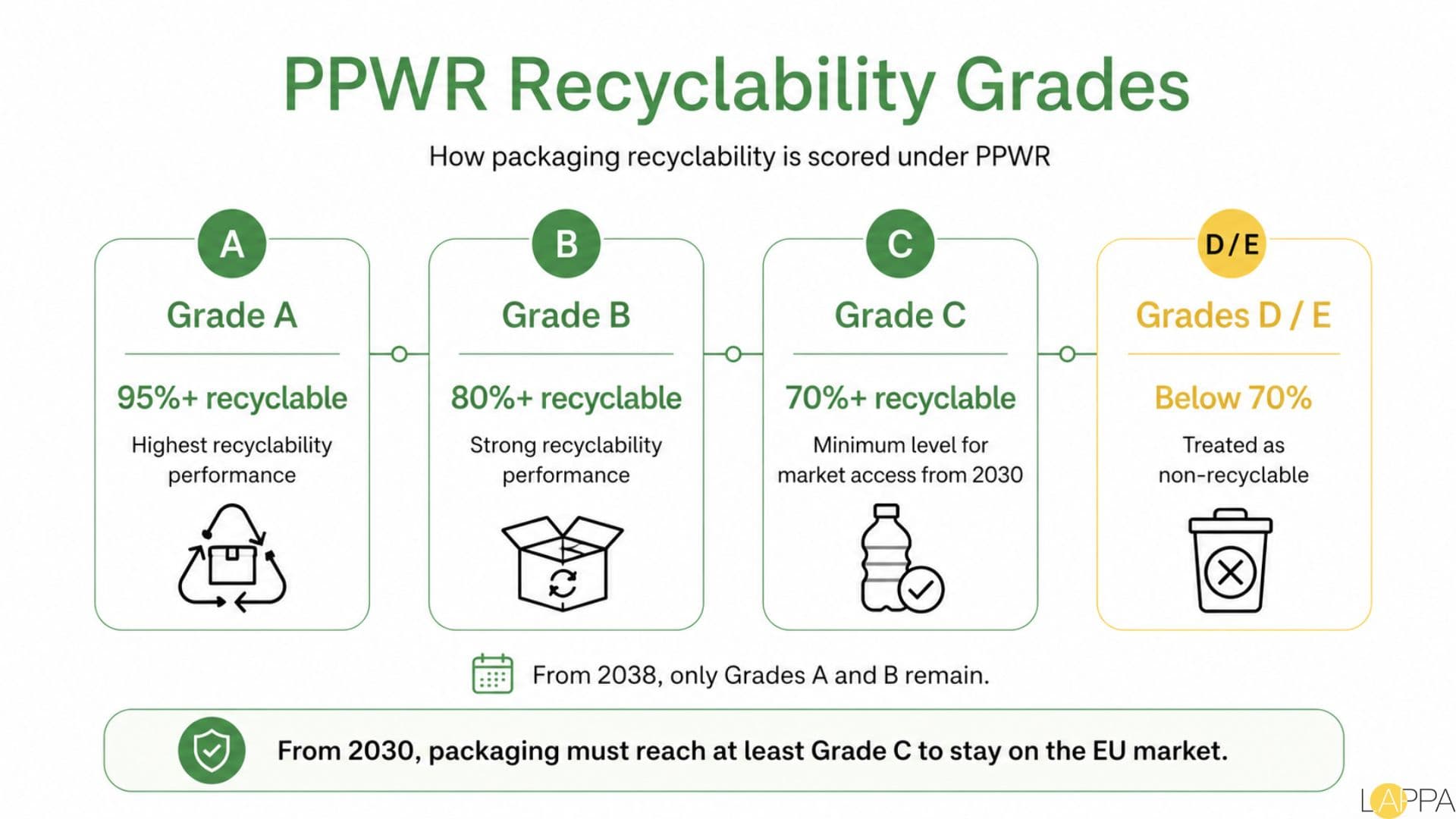
Every pack will carry a performance score based on how much of it can be recycled by weight. The ppwr recyclability grades run from A down to E, set out in Annex II of the regulation. Grade A means at least 95 percent recyclable by weight. Grade B means at least 80 percent. Grade C means at least 70 percent, and anything below that falls into D or E.
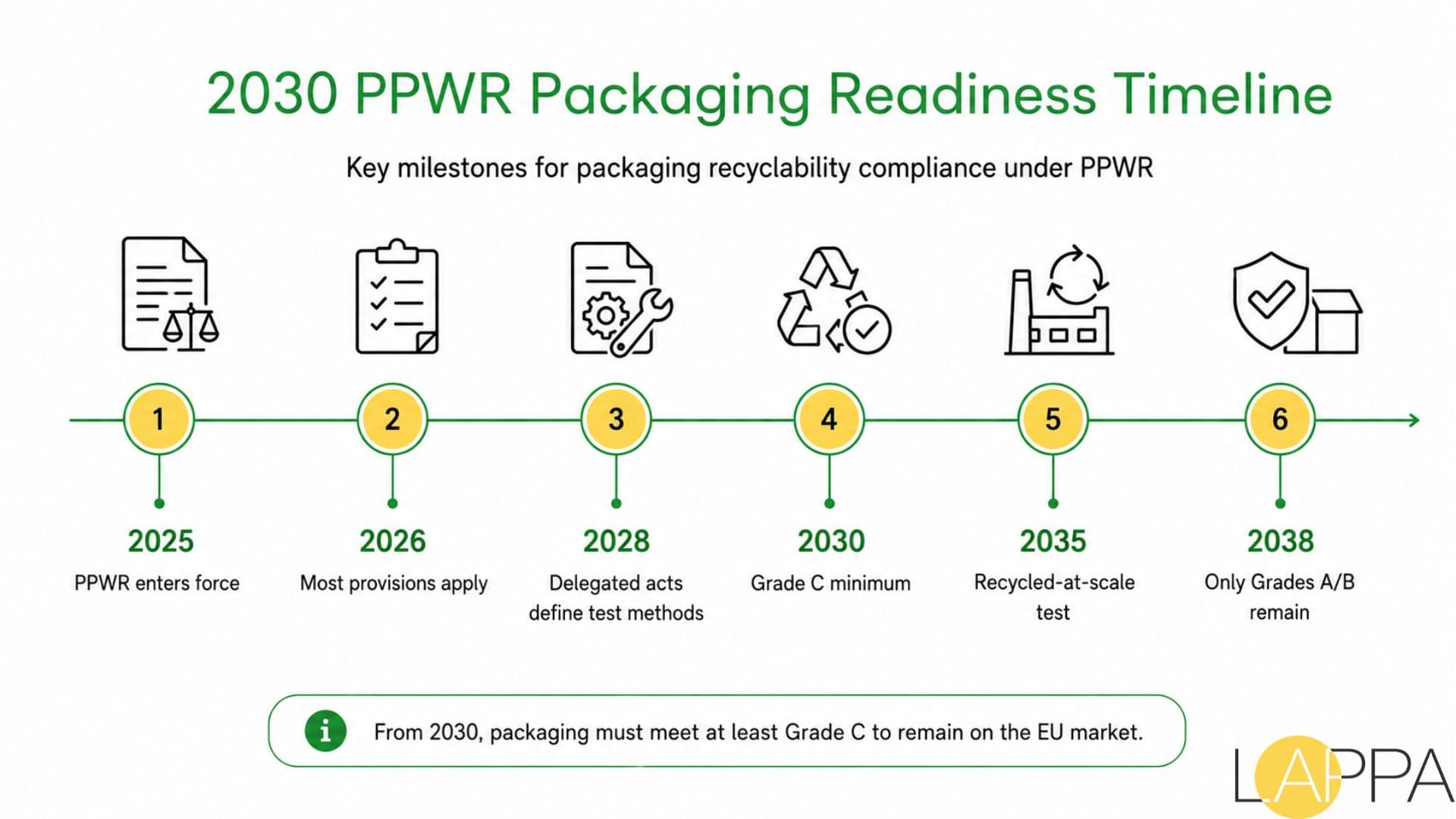
The dates matter as much as the letters. From 1 January 2030, a format must reach at least a C rating to stay on the market. From 1 January 2038, only Grades A and B survive, and Grade C drops out. A second test arrives in 2035, when packs must also be recycled at scale through real EU infrastructure, not just in theory.
Grade thresholds under the recyclability performance system:
- Grade A — at least 95 percent recyclable by weight
- Grade B — at least 80 percent recyclable by weight
- Grade C — at least 70 percent recyclable by weight
- Grades D and E — below 70 percent, treated as non-recyclable
Grading Packaging Recyclability
Scoring packaging recyclability is not a guess. The Commission will publish delegated acts by 1 January 2028 that fix the test methods and material categories. Each format is judged against sorting and reprocessing reality in the EU, not a lab ideal.
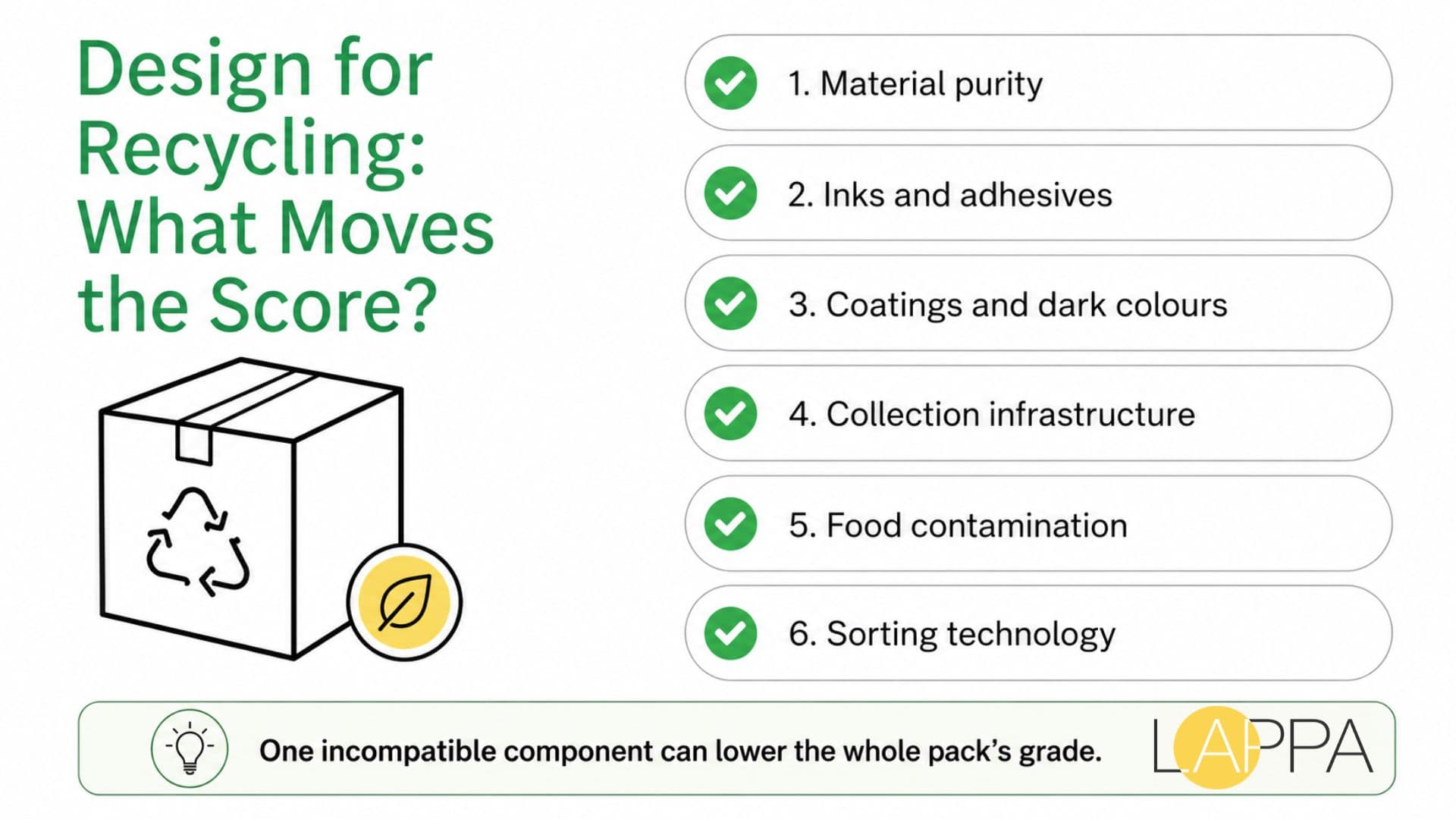
Assessment looks at the whole unit. A bottle, its cap, its label, and its adhesive all count toward the score. One incompatible part can drag an otherwise strong pack down a tier. That is why recyclability now gets measured component by component.
Factors That Shape a Recyclability Score
Several forces decide whether a format scores well. Material purity comes first, since mixed inputs confuse sorting lines. Collection matters too, because a material with no kerbside route rarely gets recovered. Even a technically clean pack fails if local infrastructure cannot process it. That gap between lab and reality is exactly what the 2035 recycled-at-scale test targets.
These variables explain why the same wrapper scores differently across regions. A film recovered in Germany may be landfilled in a smaller market. The delegated acts will set a single EU baseline to narrow that divide. Until then, you should test against the toughest market you sell into.
Factors that move a recyclability score up or down:
- Material purity and the number of substances combined
- Presence of inks, adhesives, coatings, and dark colours
- Whether kerbside or deposit collection exists for the stream
- Sorting technology available at regional facilities
- Contamination from food residue or mixed disposal
PPWR Design for Recycling Requirements
The regulation sets binding design principles rather than loose advice. PPWR design for recycling rules demand that materials can be separated, sorted, and reprocessed with existing technology. Colours, coatings, and additives that blind sorting machines are discouraged. Carbon black plastic, long invisible to optical sorters, is a textbook problem.
Material selection carries the heaviest weight. A mono-material pouch built from one polymer sorts cleanly. A laminate that fuses plastic, aluminium, and paper does not. Designers must now weigh recovery at the same table as cost and shelf appeal.
Delegated acts will sharpen these duties over the next few years. The 2028 criteria translate the broad law into concrete thresholds per material. Smart teams are already testing against draft standards from bodies like RecyClass and CEFLEX.
The rules also raise the bar on recycled input. Article 7 sets minimum recycled content for plastic formats, near 30 percent on average by 2030. Those thresholds climb toward 50 to 65 percent by 2040, depending on the application. Contact-sensitive items, such as food wrappers, face their own tailored figures. Sourcing that recycled feedstock early protects you from a supply crunch later.
Design for Recycling PPWR in Practice
On the factory floor, design for recycling PPWR compliance looks like hard trade-offs. A brand may drop a glossy metallised film for a clear recyclable one. Teams sometimes shorten the whole effort to recycling PPWR readiness in their internal decks. The label matters less than the result.
Take a coffee brand switching from a foil-lined pouch to a mono-polypropylene version. The new pack sorts in existing streams and climbs several grades. It costs more per unit today, yet it dodges the 2030 market ban. We see this happen often once buyers model the deadline risk.
Common Packaging Types and Their Recyclability
Not all formats face the same odds. Some materials enjoy mature recycling streams across Europe. Others have almost none. The table below sketches how common types perform against the grading logic.
|
Packaging Type |
Recyclability |
Common Issues |
PPWR Performance |
|
PET bottle |
High |
Sleeves, labels, coloured resin |
Excellent, often Grade A |
|
Aluminium can |
High |
Minimal, mature streams |
Excellent, often Grade A |
|
Glass jar |
High |
Weight, mixed colours |
Strong, Grade A or B |
|
Corrugated cardboard |
High |
Plastic laminates, grease |
Strong, Grade A or B |
|
Flexible mono-plastic |
Medium |
Thin films, patchy collection |
Moderate, Grade C likely |
|
Multilayer pouch |
Low |
Fused layers, hard separation |
Weak, below Grade C |
|
Beverage carton |
Low to medium |
Paper, polymer, foil blend |
Improving but fragile |
Paper and board lead the pack in most member states. Glass, aluminium, and steel follow close behind with well-funded streams. Rigid PET, especially clear bottles under deposit return schemes, scores highly too. Trouble starts when materials mix, which is where the next section digs in.
Glass and metals deserve credit for their maturity. Glass can be remelted endlessly with no loss of quality. Steel cans rely on magnetic separation that makes recovery cheap and reliable. Aluminium recovery saves up to 95 percent of the energy needed for virgin metal. These streams routinely hit the top rating band.
Paper and board look easy yet hide traps. A plastic window on a carton or a wax coating on a cup blocks the fibre stream. Grease from food, as on a used pizza box, also downgrades the load. Clean, uncoated fibre stays one of the safest bets under the new rules.
E-commerce formats deserve special attention. Online orders travel in mailers, void fill, and oversized boxes that often mix materials. The regulation also caps empty space, targeting a 50 percent void limit for grouped and transport formats by 2030. Retailers like Zalando and Amazon already trim air and switch to paper-based mailers. Right-sizing cuts both material use and shipping cost in one move.
Why Multilayer Packaging Creates Challenges
Multilayer Packaging exists for good reasons. A crisp bag needs a barrier against oxygen, light, and moisture. Engineers stack thin layers of polyester, polyethylene, and aluminium to hit that spec cheaply. The result protects food brilliantly and recycles terribly.
Here’s where it gets tricky. Recyclers cannot easily split fused layers back into pure streams. A metallised chip wrapper looks like plastic but behaves like a composite. Most sorting plants send it straight to incineration or landfill.
Design alternatives are maturing fast. Mono-material films from a single polymer family now match many barrier needs. Nestlé, Unilever, and PepsiCo have all trialled recyclable mono-structures on flagship lines. The catch: they often cost more and demand new sealing equipment.
The table below compares four broad approaches on recovery and fit.
|
Approach |
Recyclability |
Typical Use |
Trade-off |
|
Mono-material |
High |
Bottles, mono films, trays |
Barrier limits on some foods |
|
Multilayer |
Low |
Snacks, pouches, sachets |
Strong barrier, poor recovery |
|
Reusable |
Very high in use |
Crates, refill bottles, kegs |
Logistics and cleaning cost |
|
Composite |
Low to medium |
Cartons, blister packs |
Mixed streams, partial recovery |
Packaging Assessment Under PPWR
Compliance rests on evidence, not claims. Formal packaging assessment measures each unit against the delegated-act criteria and assigns a grade. Producers must hold technical documentation that proves the score. That file travels with the product through the supply chain.
Testing follows published protocols once the 2028 acts land. Labs check sortability, material purity, and reprocessing yield. Third-party schemes such as RecyClass already offer pre-assessments that mirror the coming rules.
Documentation is the part most teams underestimate. Regulators can ask for proof at any point after August 2026. Weak records can sink an otherwise recyclable design.
Evidence you should keep on file:
- Material composition and weight for every component
- Grade calculation with the method and version used
- Test reports from accredited or recognised labs
- Supplier declarations for inks, adhesives, and coatings
- A change log tracking design revisions over time
Eco-design Strategies for Better Packaging
Fixing a weak format rarely means one big change. Strong eco-design stacks several small wins that lift a grade. The first lever is simple: cut the number of materials in a single unit. Fewer materials mean cleaner sorting and higher recovery.
Mono-material solutions do the heavy lifting. A pack built from one polymer family sorts without special handling. Recycled content is the second lever, and the regulation already sets plastic targets near 30 percent by 2030. Reuse is the third, turning a single-trip box into a return-and-refill asset.
Core Design for Recycling principles worth pinning above every designer’s desk:
- Favour one material family per unit wherever possible
- Make labels, caps, and sleeves compatible with the main body
- Avoid carbon black and full-sleeve dark colours that blind sorters
- Skip PVC and problematic adhesives that contaminate streams
- Design closures and layers to separate easily during sorting
Common mistakes that quietly wreck recyclability:
- Gluing dissimilar materials with permanent adhesives
- Adding metallised layers when a clear barrier would serve
- Oversizing the pack and wasting material on empty space
- Printing directly with inks that bleed into the recyclate
Where Packaging Innovation Pays Off
Packaging innovation is no longer a marketing luxury. It is the cheapest route to a compliant, high score. Companies that redesign early avoid the scramble when bans bite in 2030. They also win shelf trust from shoppers who read labels closely.
Real progress shows up in material science. Compostable coatings, paper-based barriers, and refill systems are moving from pilot to pallet. Loop, the reuse platform backed by Tesco and Carrefour, shows how return models can scale. Early movers turn a legal cost into a brand asset.
Business Benefits of Sustainable Packaging Design
Compliance is the obvious payoff, yet it is far from the only one. A strong sustainable packaging design program cuts fees, waste, and risk together. Many EU states charge extended producer responsibility fees that fall as recyclability rises. A top-rated pack simply costs less to put on the market.
Cost savings run deeper than fees. Lighter, simpler formats use less material and ship more per pallet. Amazon trimmed millions of tonnes of material through right-sized boxes and mailers. Those cuts hit the bottom line every quarter.
Customers and investors are watching too. Shoppers increasingly reward brands that visibly reduce waste. ESG reports now lean on packaging metrics that recyclability grades feed directly. A clean result becomes a data point you can publish with confidence.
Customer expectation is now a commercial force, not a slogan. Studies from McKinsey and NielsenIQ show shoppers increasingly favour products with credible environmental claims. Younger buyers in particular check recyclability before they commit. A verified score gives your marketing a fact to stand on rather than a vague promise.
The Case for Packaging Sustainability
Strong packaging sustainability turns a defensive chore into an offensive edge. Retailers such as Lidl and IKEA already screen suppliers on recyclability. A weak score can cost you a listing before a regulator ever calls.
Lappa helps you assess formats, map grades, and build the evidence file the regulation demands. The platform connects material data, test results, and compliance records in one place. Get a Free Quote and see where your portfolio stands today.
Preparing for Future PPWR Requirements
The smart play is to act before 2030 forces your hand. Manufacturers should audit every format against the A to E logic now. Importers must confirm that overseas suppliers meet EU criteria before goods land. Retailers need supplier data to defend their own shelves.
Packaging suppliers sit at the centre of this shift. They must offer recyclable materials and the proof to back them. The 2028 delegated acts will firm up the exact thresholds, so early testing pays off.
E-commerce businesses carry a double load, since they act as both seller and shipper. You must vet the formats your suppliers use and the boxes you add for transit. Map every mailer, insert, and filler against the void and recyclability rules. Early cleanup here avoids a costly retrofit when enforcement tightens.
A practical compliance checklist to start this quarter:
- Inventory every format and record its material makeup
- Run a pre-assessment against draft A to E criteria
- Flag any unit likely to miss the C threshold by 2030
- Redesign multilayer and composite formats first
- Lock in recycled-content sources ahead of the 2030 targets
- Build the technical file regulators can request from 2026
When your preparation runs smoothly, compliance becomes a routine check rather than a crisis. Lappa runs assessments and tracks each rating against the deadlines that matter. Book a Demo to see the workflow on your own formats.
FAQ
Design for Recycling is a set of binding rules that require every format to be built so its materials can be recovered. It shifts recyclability from a voluntary goal to a legal condition for market access. Under Regulation (EU) 2025/40, packs that cannot be sorted and reprocessed at scale will lose the right to be sold in the EU.


.jpg&w=3840&q=75)