

EPR Packaging Thresholds in Europe 2026: Country-by-Country Compliance Guide
Businesses selling packaged goods into the EU, EEA, or UK face a genuine compliance puzzle: every jurisdiction sets its own EPR threshold, and crossing it triggers registration, reporting, and cost obligations. This guide lays out where those lines sit for 2026, starting with the numbers themselves.
EPR Thresholds by Country — Quick Reference Table
Businesses often assume EPR thresholds are identical across the EU, but the reality is far messier, since each country legislates independently within the shared PPWR framework.
EPR Packaging Thresholds by Country
|
Country |
Packaging Threshold (kg/year) |
Turnover Threshold |
Key Notes |
|
0 |
0 |
Registration required for all packaging; obligations can be split across schemes. |
|
|
0 |
0 |
|
|
|
0 |
0 |
Marking on packaging is mandatory. |
|
|
Croatia |
0 |
0 |
Centralized government program; marking required. |
|
0 |
0 |
Confirm current limit directly with Green Dot Cyprus. |
|
|
0 |
0 |
|
|
|
TBD (likely 0 or low) |
0 |
Newer DPA (Dansk Producentansvar) system. |
|
|
0 |
0 |
|
|
|
0 |
0 |
|
|
|
0 |
0 |
|
|
|
0 |
0 |
Free, mandatory enrollment via LUCID. Multiple competing compliance bodies. Costs start around €25/year. Audited declarations required above certain material volumes. |
|
|
0 |
0 |
All packaging must be registered. |
|
|
0 |
0 |
Centralized program; a product-fee alternative is available. |
|
|
0 |
0 |
|
|
|
0 |
0 |
|
|
|
0 |
0 |
|
|
|
0 |
0 |
|
|
|
0 |
0 |
Industrial packaging is fully in scope. |
|
|
Malta |
0 |
0 |
|
|
0 |
0 |
|
|
|
0 |
0 |
Multi-body system (e.g. Rekopol); all packaging in scope. |
|
|
0 |
0 |
Marking mandatory; multiple compliance options available. |
|
|
0 |
0 |
All packaging requires registration. |
|
|
0 |
0 |
Six approved programs; individual compliance allowed for non-household packaging. |
|
|
0 |
0 |
Individual compliance requires ministry certification. |
|
|
0 |
0 |
Ecoembes is the main body. Marking rules apply. |
|
|
0 |
0 |
Managed via Materialretur/FTI; compliance costs are relatively high. |
|
|
25,000 kg (small) / 50,000+ kg (large) |
£1,000,000 – £2,000,000 |
Run through PackUK. Small: £1–2M revenue OR 25–50 tonnes. Large: £2M+ revenue AND 50+ tonnes. |
EPR thresholds for every EU member state, plus the UK, are listed above, covering both packaging-weight and revenue-based triggers.
Threshold levels set under EPR shift periodically as domestic regulators fold in guidance from Brussels, so treat the table above as a snapshot rather than a permanent reference.
Understanding EPR Regulations Across the EU
EPR regulations differ sharply depending on where a business sells, because each jurisdiction transposes the shared EU framework into its own domestic program. The umbrella law, the Packaging and Packaging Waste Regulation (EU 2025/40), entered into force in February 2025 and becomes generally applicable in August 2026.
EPR regulations are built around two core levers: how much packaging a business places on the market, and how much revenue it earns doing so. Some countries apply only one lever, others apply both, and a handful apply neither, meaning obligations start with the very first unit sold.
|
Threshold type |
How it works |
|
Weight-based |
Enrollment triggers once annual packaging placed on the market crosses a set kg figure (e.g. Ireland at 10,000 kg). |
|
Revenue-based |
Enrollment triggers once domestic sales revenue crosses a set figure (e.g. France at €10,000,000). |
Where the regulations governing EPR set both a weight and a revenue trigger, businesses typically have to clear both before an obligation kicks in, though a few programs trigger on either measure alone.
EPR Registration Requirements for Producers
EPR registration requirements start with a simple question: does your packaging volume or your revenue exceed the domestic limit? If it does, enrolling with a Producer Responsibility Organisation becomes mandatory before packaging can legally reach that market.
EPR registration requirements typically involve signing up with a domestic compliance body, then reporting material types and quantities on a recurring basis. In general, big companies have audited statements, while smaller companies sometimes have a simplified filing.
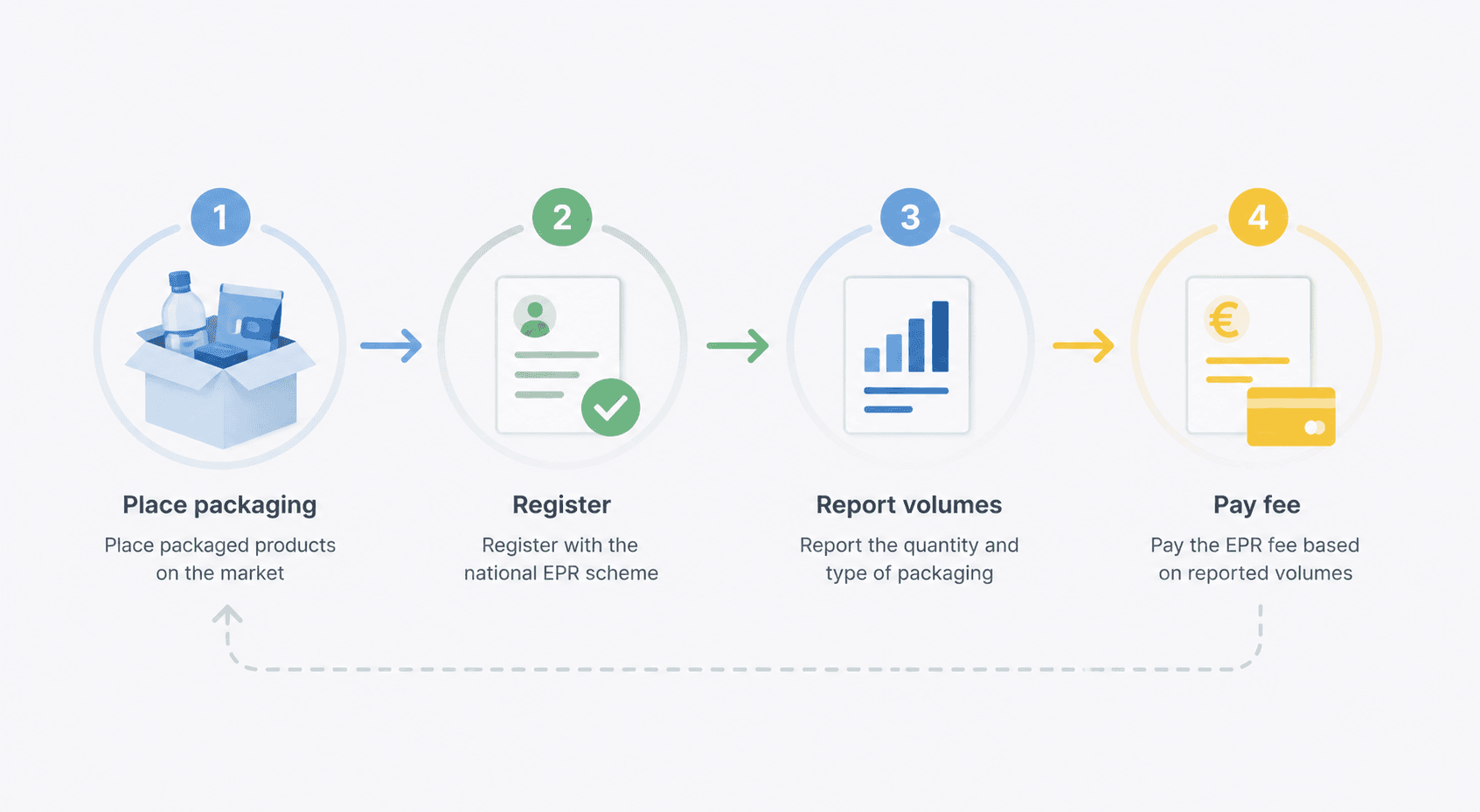
A typical enrollment sequence looks like this:
- Identify every jurisdiction where your packaging reaches end consumers.
- Check both the weight and revenue limits that apply there.
- Enrol with the relevant domestic compliance body (e.g. LUCID for Germany, CITEO for France).
- Appoint an Authorized Representative if you have no local presence.
- Set up recurring data reporting broken down by material type and quantity.
The requirements for registering under EPR also often include naming a local contact or Authorized Representative if the business has no physical presence in that jurisdiction.
Meeting EPR Packaging Requirements in Practice
EPR packaging requirements go well beyond enrollment; they include recyclability grading, marking standards, and, in several countries, audited annual declarations tied to material volume.
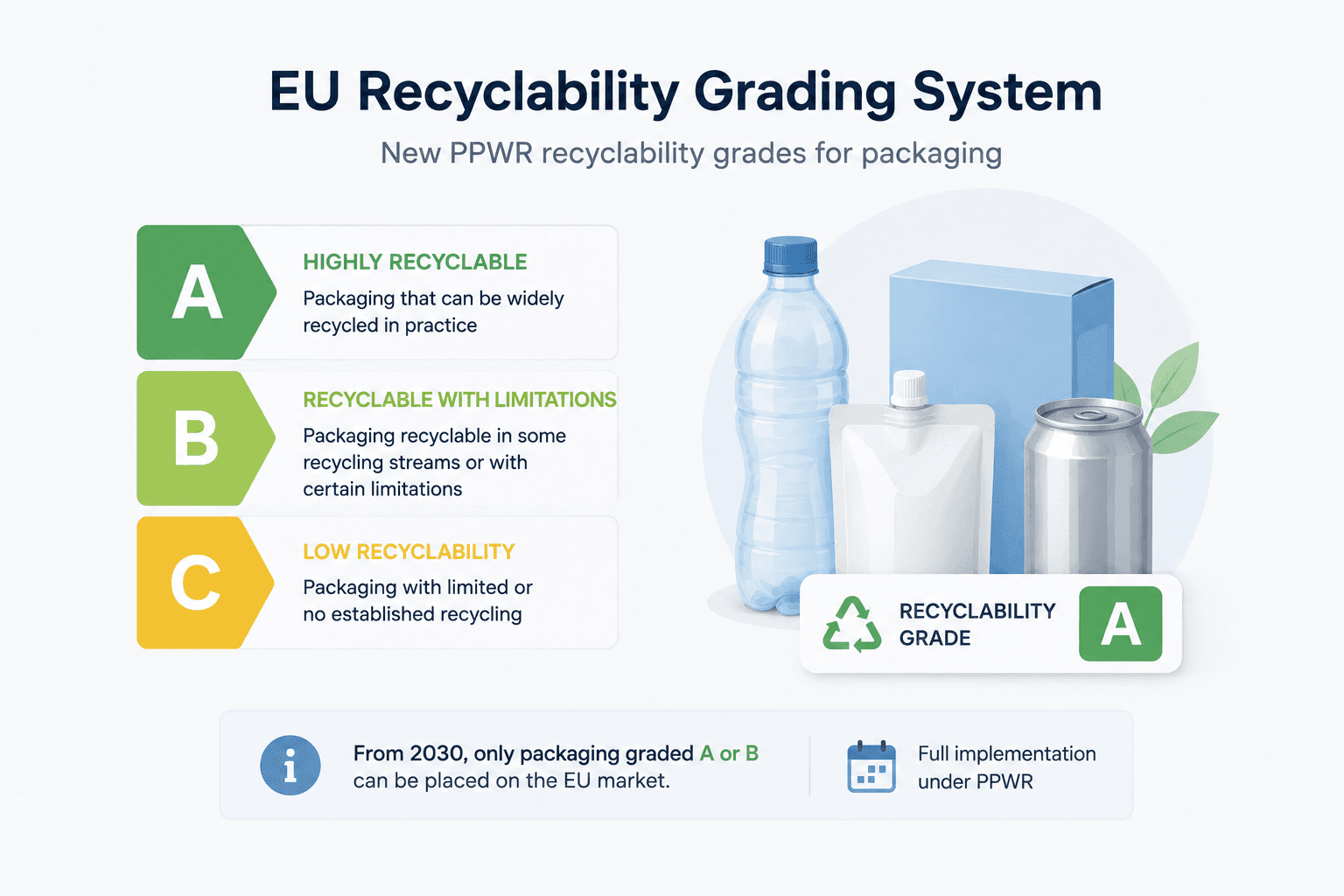
EPR packaging requirements are increasingly standardised under the EU’s A-to-C recyclability grading system, which every member state will eventually apply to consumer packaging.
|
|
Germany |
France |
UK |
|
Main body |
LUCID (register) + multiple compliance bodies |
CITEO |
PackUK |
|
Minimum limit |
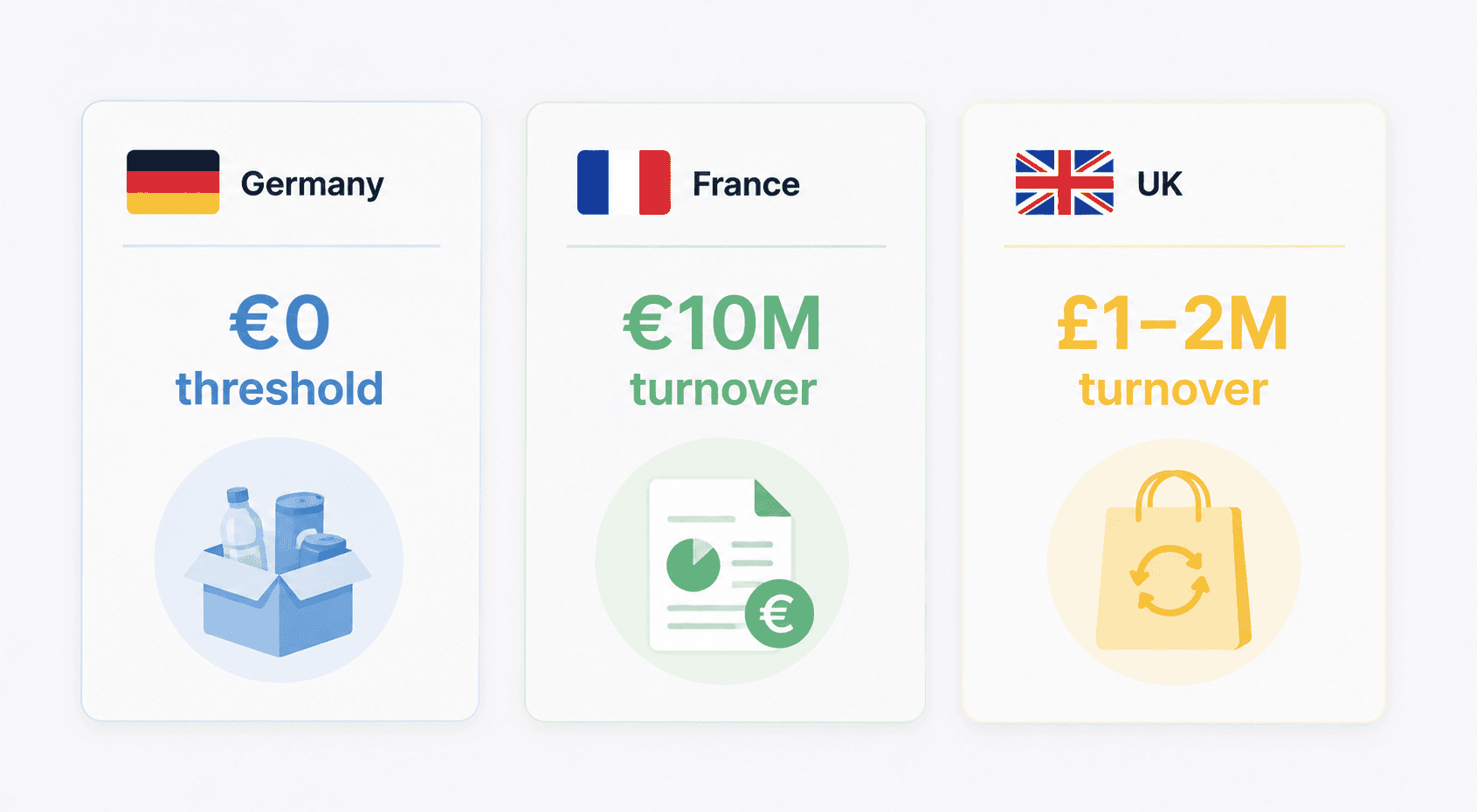
None — first package counts |
None — single unit can trigger |
25,000 kg or £1M revenue |
|
Marking |
Not centrally mandated |
Triman logo required |
Not centrally mandated |
Packaging-related requirements under EPR also extend to marking, since several countries mandate specific disposal symbols on consumer packaging, and non-compliant labels can themselves trigger enforcement action.
How EPR in Europe Is Enforced
EPR in Europe is enforced primarily at the domestic level, even though the underlying legal framework originates in Brussels. Each country designates its own regulator and its own approved compliance bodies to collect payments and monitor adherence.
EPR in Europe relies on a network of Producer Responsibility Organisations, each authorized to collect payments and track material flows within its own borders. Denmark’s DPA system and the UK’s PackUK platform are both recent examples of this domestic build-out.
Europe’s EPR framework leaves real gaps between jurisdictions, which is exactly why businesses selling across borders struggle to keep every rule straight without dedicated tracking.
EPR Packaging Tax and Penalty Exposure
An EPR packaging tax applies once a business exceeds the relevant weight or revenue line, and the charge generally scales with material volume and recyclability grade.
The EPR packaging tax rate varies enormously; Sweden and Germany, for instance, charge noticeably more than the Netherlands for comparable packaging volumes.
Missing enrollment entirely carries its own penalties, separate from any ongoing charge:
- Germany: fines up to €200,000, sales bans, and platform-level insolvency exposure.
- France: fines up to €30,000 per offence, plus restrictions on online sales.
- UK: civil sanctions and possible trading prohibitions.
- EU-wide: customs holds and loss of market access.
Tax obligations tied to packaging under EPR aren’t the only cost of non-compliance; missed-registration fines can end up far higher than the tax itself.
Preparing for EPR 2026 Deadlines
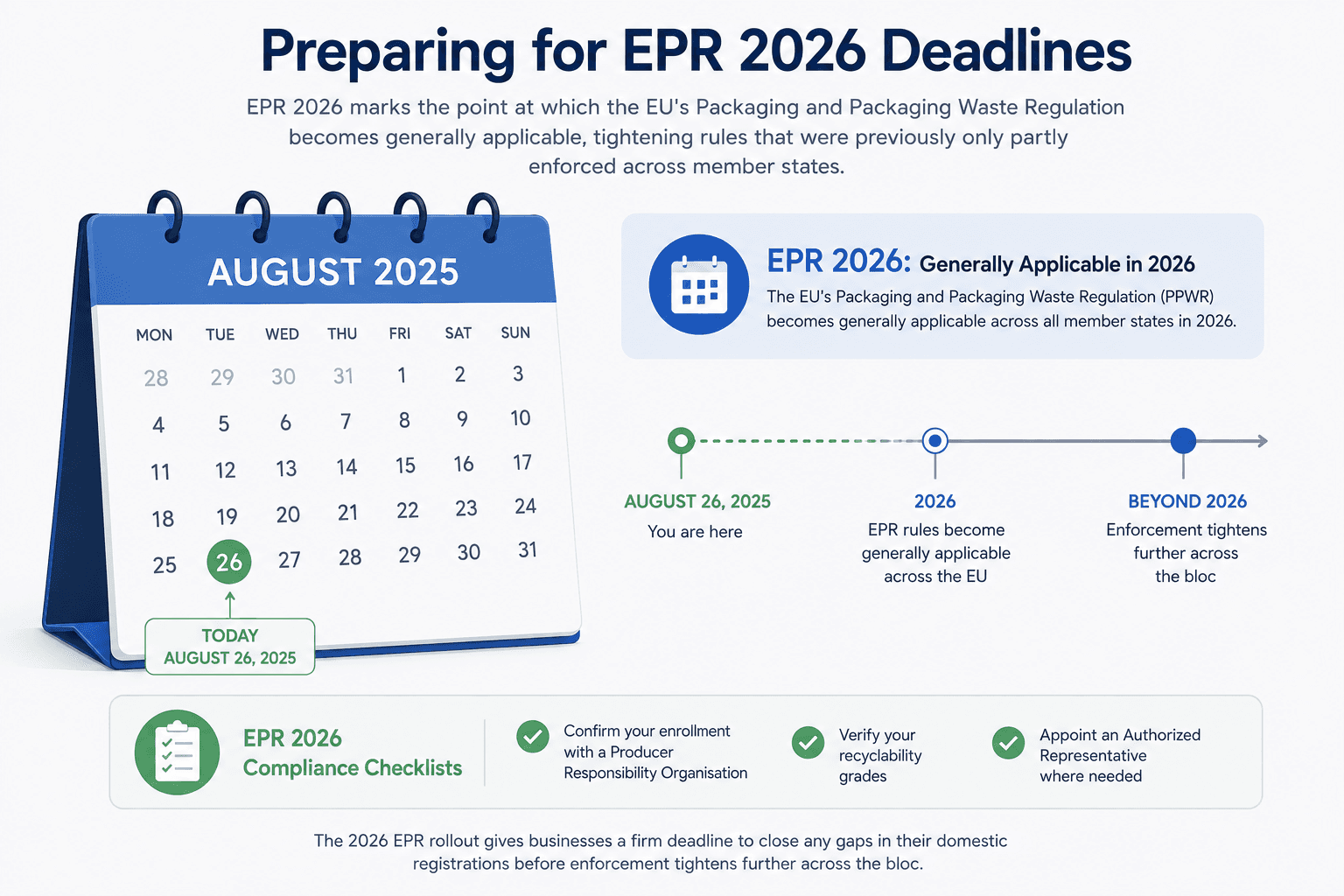
EPR 2026 marks the point at which the EU’s Packaging and Packaging Waste Regulation becomes generally applicable, tightening rules that were previously only partly enforced across member states.
EPR 2026 compliance checklists should include confirming your enrollment with a Producer Responsibility Organisation, verifying your recyclability grades, and appointing an Authorized Representative where needed.
The 2026 EPR rollout gives businesses a firm deadline to close any gaps in their domestic registrations before enforcement tightens further across the bloc.
Coordinating Compliance Across Multiple Markets
Selling into more than a handful of European countries at once turns packaging compliance into a genuine operational project. Reporting calendars rarely line up: Germany expects data on one cycle, France on another, and the UK on a third, so a single missed date can cascade into several separate penalties at once.
Many mid-sized sellers now rely on specialist software or a compliance partner to consolidate filings, convert material data into each country’s required format, and flag upcoming deadlines automatically. That kind of coordination matters most for fast-growing businesses, since a new market can quietly introduce a fresh obligation long before anyone on the finance team notices the shift in sales volume.
Currency conversion, language requirements, and differing definitions of packaging (some jurisdictions count e-commerce shipping materials, others don’t) add further friction. A simple internal checklist per country, reviewed at least twice a year, catches most of these issues before they turn into compliance gaps.
Frequently Asked Questions about EPR Threshold Rules
Generally, only packaging placed on that specific domestic market counts, not total production or global sales. A retailer selling into Germany and France, for example, tracks each country's volume separately, because the two systems don't share data with each other. Some jurisdictions also distinguish between household and commercial packaging when calculating whether a limit has been crossed, so the same product line can count differently in two neighboring markets.


.jpg&w=3840&q=75)