


EN 16931 Explained A Complete Guide to the European Standard for Electronic Invoicing
Disclaimer: This article is for informational purposes only. Lappa does not currently use or claim compliance with EN 16931. Any references to the standard are intended solely to explain the European e-invoicing framework.
Paper invoices are quietly disappearing across Europe. Governments now demand structured, machine-readable billing that software can read without a human touching it. At the centre of that shift sits one technical rulebook. It defines exactly what a compliant electronic invoice must carry, field by field. This guide walks you through the rules, the formats, the deadlines, and the moves your finance team should make before the mandates bite.
What EN 16931 Actually Defines
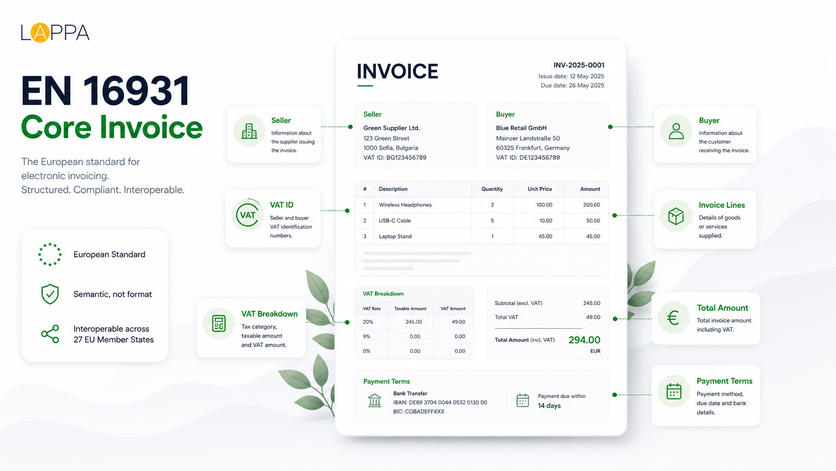
EN 16931 is a European norm that fixes the semantic data model for the core elements of an electronic invoice. Published by CEN, the European Committee for Standardization, it lists every value a compliant bill must contain. That means seller and buyer identifiers, VAT breakdowns, line items, and payment terms. The norm describes meaning, not one fixed file layout.
Semantics come first for a good reason. Two systems can only trade a bill if they agree on what each value means. The norm locks that shared vocabulary across 27 member states. A net amount reads the same way in Lisbon and in Helsinki, which removes costly guesswork.
The Core Semantic Data Model
The core model covers roughly 160 business terms grouped into logical blocks. Each term carries a clear definition, a cardinality, and an attached rule. The layer stays syntax-neutral by design. That choice lets one meaning travel through several technical formats without distortion.
The semantic model pins down the parts that matter most:
- Buyer and seller legal identities and tax registrations
- Invoice totals, VAT categories, and rounding logic
- Line-level detail for goods and services supplied
- Payment instructions, due dates, and bank references
- Links to orders, contracts, and delivery notes
That structure sounds dry, yet it solves a real headache. A machine can post a compliant bill straight into a ledger. No retyping, no scanning, no lost paperwork in a drawer.
Take a simple example from the model. The term for a buyer VAT identifier has a fixed code and a format rule. If it goes missing on a taxable sale, the validator throws a specific error. That precision is what lets software trust an incoming figure.
Why the EN 16931 Standard Exists
The EN 16931 standard grew out of a public-sector mess. Directive 2014/55/EU told every contracting authority to accept structured bills. Suppliers to government could not realistically build a different file for thousands of buyers. CEN received mandate M/528 from the Commission and delivered the norm in 2017.
Public procurement drove the first wave, known as business-to-government, or B2G. Central authorities had to receive compliant documents by 18 April 2019. Sub-central bodies followed roughly a year later. The rulebook turned a messy patchwork of formats into a single shared reference.
The logic then spread beyond government. Tax authorities saw a chance to close the VAT gap, estimated near 61 billion euro across the bloc in 2021. Structured data lets them spot fraud in near real time. That fiscal motive now powers the business-to-business rollout.
A Short Timeline of European E-invoicing
The story runs back further than most people assume. Directive 2010/45/EU first put electronic and paper bills on an equal legal footing. The 2014 procurement directive then forced the public sector to act. CEN answered with the core norm in 2017, and Italy switched on mandatory exchange in 2019.
Momentum has only built since then. The pandemic pushed finance teams toward touchless processing almost overnight. France, Germany, and Poland lined up national rules for the mid-2020s. The 2025 VAT reform then set one shared cross-border deadline.
Milestones worth remembering:
- 2010 — electronic and paper bills gain equal legal status
- 2014 — the procurement directive mandates public-sector acceptance
- 2017 — CEN publishes the core semantic norm
- 2019 — Italy launches full mandatory exchange
- 2025 — the VAT reform sets the 2030 cross-border date
Inside the EN 16931 E-invoicing Standard
The EN 16931 e-invoicing standard splits into several parts. Part 1 holds the semantic model itself. Parts 2 and 3 map that model onto two approved XML syntaxes. Those syntaxes are OASIS UBL 2.1 and UN/CEFACT Cross Industry Invoice, usually shortened to CII. Both carry identical meaning in different tags.
Business rules keep the data honest. Each rule, tagged with codes such as BR-16, checks that mandatory values exist and reconcile. A validator rejects any file that breaks a rule. CEN published an updated EN 16931-1:2026 in March 2026 to support B2B trade and digital reporting.
The norm also draws a line it will not cross. It never dictates your software, your archive, or your transport network. That neutrality is deliberate and hard-won. Vendors compete on tools while the meaning stays common to all.
Extensions handle the edge cases the core cannot. A sector with unusual needs, such as construction retention or utility metering, can extend the model. The extension still validates against the parent rules. That balance keeps the whole framework both stable and flexible.
Where the Norm Sits Beside Peppol and ViDA
The rulebook rarely works alone in practice. Peppol supplies the network and the delivery envelope around each file. ViDA supplies the legal push that makes structured trade mandatory. Directive 2014/55/EU started the chain for public buyers. Together they form a stack, with the semantic model as its foundation. Miss one layer and a project stalls, so plan for all four from the outset.
Choosing an Electronic Invoice Format
Picking an electronic invoice format is where theory meets your ERP. UBL suits many procurement platforms and the Peppol network. CII underpins the Franco-German hybrid Factur-X, which pairs a readable PDF with embedded XML. Here’s where it gets tricky: a supplier and a buyer must settle on one shared route.
National profiles add a further layer. A Core Invoice Usage Specification, or CIUS, narrows the core model for local needs. Germany’s XRechnung, Italy’s FatturaPA, and Peppol BIS Billing 3.0 all follow this pattern. Each stays compatible with the parent norm while adding a few national fields.
The table below sets the main options side by side.
| Encoding | Type | Typical Use | Notes |
| UBL 2.1 | XML syntax | Peppol, public procurement | Widely supported across Europe |
| UN/CEFACT CII | XML syntax | France, Germany, hybrids | Basis for many hybrid documents |
| Factur-X and ZUGFeRD | Hybrid PDF plus XML | Franco-German B2B | Human-readable and machine-readable at once |
| XRechnung | National profile | German public sector | Pure XML with strict rules |
Format choice is rarely yours alone to make. The receiving mandate or trading partner usually dictates it. A German public buyer expects XRechnung, while a French partner may send Factur-X. Building your system to emit more than one encoding saves costly rework later.
EN 16931 and Cross Border Invoicing
cross border invoicing is about to change dramatically. The VAT in the Digital Age package, adopted on 11 March 2025, sets a hard date. From 1 July 2030, intra-EU business trade must use structured documents built on the European norm. Real-time digital reporting will then replace the old recapitulative statements.
The catch: today each country runs its own model. A firm selling from Rotterdam to Milan may juggle several schemas and two networks. Harmonising all of this by 2035 is the stated aim. Traders who align early feel far less pain when the wider mandate lands.
Trade across borders raises stakes that domestic billing never does. A rejected file can stall a shipment or a payment for weeks. Currency, language, and tax codes all vary between partners. A common norm strips out much of that friction at the data level.
Countries pick different control models, and that choice shapes your workflow. The table below compares the three approaches you will meet.
| Model | How It Works | Example | Trade-off |
| Clearance | Tax body approves each bill before delivery | Italy, Poland | Tight control, less flexibility |
| Interoperability | Partners exchange through a shared network | Peppol countries | Flexible, needs onboarding |
| Post-audit | Bills flow freely and get checked later | Older EU regimes | Simple now, fading fast |
Achieving EN 16931 Compliance
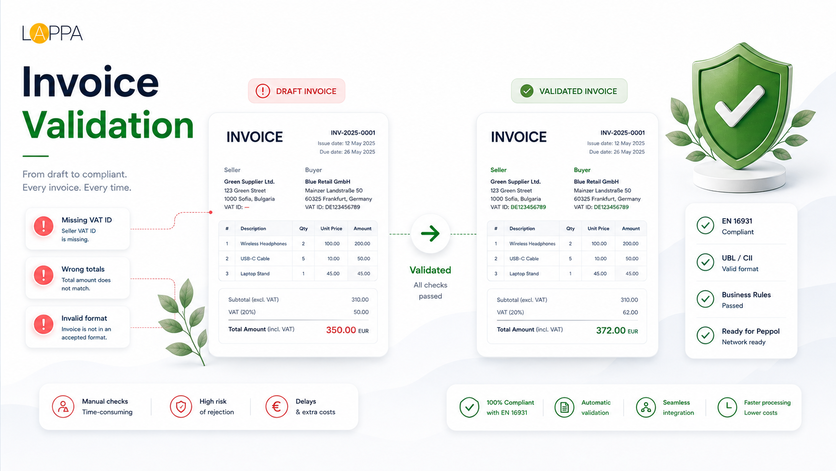
Reaching en 16931 compliance means three things line up at once. Your bill must fit the semantic model, pass every business rule, and travel in an approved syntax. A document that looks perfect as a PDF can still fail validation. Structured data, not appearance, decides the result.
Transmission matters just as much as content. Many mandates route files through Peppol access points or national platforms. Italy uses its SdI clearance system, while Poland relies on KSeF. We see this happen often: teams nail the format yet stumble badly on delivery.
Validation and Business Rules
Validation is your safety net before a tax authority ever looks. Open-source and commercial validators test a file against the official rule set. They flag missing VAT categories, broken totals, and malformed identifiers. Running that check early spares you painful rejections down the line.
A practical checklist to work through:
- Map your ERP fields to the core semantic terms
- Pick a syntax that your trading partners can accept
- Validate against the current business rules and version
- Confirm your route, whether Peppol or a national portal
- Archive structured files for the legally required period
Lappa helps you map, validate, and route bills without rebuilding your finance stack. The platform links your ERP data to the right syntax and network in one place. Get a Free Quote and see where your invoicing stands today.
National Mandates Built on the European Norm
Member states are moving at very different speeds. The common norm gives them a shared foundation, yet each layers on local rules. Italy led the way, and the rest are catching up fast. Your exposure depends entirely on where you sell and buy.
The comparison below tracks four key markets.
| Country | Key Date | National Format | Model |
| Italy | Since January 2019 | FatturaPA | SdI clearance |
| France | Receiving from September 2026 | Factur-X and peers | PDP platforms |
| Germany | Issuing from January 2027 | XRechnung, ZUGFeRD | Decentralised exchange |
| Poland | Phased from February 2026 | FA(3) XML | KSeF clearance |
A few market details worth tracking closely:
- France finishes its rollout for small firms on 1 September 2027
- Germany has required all firms to receive structured bills since January 2025
- Poland treats a document as delivered only after KSeF approval
- Belgium brings in domestic B2B rules during 2026
France deserves a closer look, since its design is unusual. It leans on accredited platforms called PDPs to move each document. Germany, by contrast, keeps exchange decentralised and defines a strict electronic bill in law. Poland offers an offline mode for outages, yet still demands submission to KSeF afterwards. These quirks mean a single template rarely covers every market cleanly.
Business Benefits of Structured Invoicing
Compliance is the obvious driver, yet the upside runs deeper. A structured bill posts itself into your ledger with no manual keying. Error rates drop, and disputes over figures shrink. Suppliers get paid faster because approval no longer waits on a clerk.
Cash flow feels the difference within a quarter. Automated matching cuts the days a bill sits in a queue. Auditors gain a clean, machine-checkable trail. Tax teams can answer a query in minutes rather than days.
Real numbers back this up. Billentis has long estimated that a structured document costs a fraction of a paper one to process. Italy reported billions in recovered VAT after its SdI system went live. Those gains explain why finance leaders now push adoption rather than resist it.
Sustainability is a quieter benefit that boards increasingly notice. Cutting paper, print, and postage trims both cost and carbon. A mid-sized firm sending 100,000 bills a year saves reams of paper and hours of labour. Those figures read well in an annual ESG report.
Fraud control rewards the honest majority too. Real-time data lets authorities spot missing-trader schemes quickly. Compliant firms then face fewer blanket audits as a result. A clean digital trail becomes a quiet mark of trust with regulators and banks alike.
Common Implementation Challenges and Roles and Responsibilities in the Invoicing Chain
Compliance is a team sport, not a single button. The supplier must issue a valid, well-formed document on time. The buyer must be able to receive, read, and store it. Service providers and access points sit in the middle, moving files and checking them.
Tax authorities form the fourth corner of this chain. In clearance countries they approve or reject each bill in near real time. In interoperability models they collect reporting data instead. Knowing which corner you occupy shapes every technical choice you make.
Typical responsibilities by role:
- Supplier — issue valid structured documents and handle rejections
- Buyer — receive, validate, and store incoming files
- Provider — route, convert, and secure the exchange
- Authority — approve, audit, or gather reporting data
Common Implementation Challenges
The theory reads cleanly, yet real projects hit friction fast. A buyer receiving bills from four countries may face four schemas. Two transmission networks, Peppol and KSeF, rarely speak to each other. Legacy ERP systems often lack any native structured output.
Frequent pain points that teams report:
- Mismatched fields between old templates and the core model
- Hybrid documents that need both a valid PDF and valid XML
- Master data gaps, such as missing or wrong VAT numbers
- Provider lock-in that blocks future format changes
Master data is the quiet villain in most rollouts. A single wrong tax identifier can void an entire batch. Cleaning that data before go-live repays the effort quickly. We often advise a data audit as step one, not step ten.
Change management is the factor budgets always underestimate. Accounts staff who trusted a PDF for decades must learn a new flow. Clear training and a named support contact cut resistance fast. Skip that step and a technical win turns into a daily complaint.
How to Prepare Your Business
Start with a map of who you trade with and where. That map tells you which mandates and formats you must support first. Next, check whether your ERP or accounting tool can emit valid XML. Many older systems need a middleware layer or an external service provider.
Budget for the hidden costs, not just the licence fee. Integration, testing, and data cleanup often dwarf the software price itself. A phased pilot spreads that spend across two or three quarters. It also surfaces nasty surprises while the stakes stay low.
Timing beats last-minute panic every time. The 2030 cross-border deadline feels distant, yet ERP projects run long. Firms that pilot now avoid the crush that hit Italian suppliers back in 2019. Early movers also gain leverage when negotiating provider fees.
Working With Peppol and Access Points
Peppol is the backbone for much of European exchange. You connect once to a certified access point, then reach every other user on the network. That removes the need for a bespoke link to each partner. Providers handle the technical handshakes on your behalf.
Access points are certified and interchangeable by design. If one provider disappoints, you can switch without losing your network address. That portability guards you against lock-in over the long run. Ask any prospective vendor about their exit terms before you sign.
Preparation steps that pay off:
- Appoint one owner for the project across finance and IT
- Choose an access point or platform with multi-country coverage
- Test with real trading partners before any mandate date
- Train staff on rejections, error codes, and re-submission
Lappa runs your validation, routing, and archiving from a single dashboard. It tracks each mandate date so nothing slips through unnoticed. Book a Demo to see the workflow on your own documents.
Frequently Asked Questions




What is EN 16931 in plain terms
It is the European norm that defines the data every compliant electronic invoice must contain. Rather than forcing one file type, it fixes the meaning of each field so different systems can agree. Published by CEN, it now underpins nearly every e-invoicing mandate across the European Union. Almost every new national rulebook cites it as the baseline to build on.
Is the norm the same as a file format
No, and that gap trips up many finance teams. The norm describes a semantic model, while UBL and CII are the technical syntaxes that carry it. A single invoice meaning can therefore be expressed in several approved encodings without losing validity.
When does cross-border e-invoicing become mandatory
Under the VAT in the Digital Age package adopted in March 2025, intra-EU business trade must use structured documents from 1 July 2030. Digital reporting will replace the current recapitulative statements at the same moment. Domestic rules differ, so several countries already enforce their own mandates well before that date.
Which countries already require structured invoices
Italy has run mandatory B2B exchange through its SdI platform since 2019. France, Germany, Poland, and Belgium are phasing in their own rules across 2026 and 2027. Each mandate builds on the European norm yet adds national formats and delivery routes.
How do I check whether my documents are compliant
Run each file through a validator that tests it against the official business rules. The tool flags missing fields, broken totals, and invalid identifiers before you submit. Pairing that validation with a reliable route, such as a Peppol access point, gives you a dependable path to compliance.
What happens if my packaging is not labelled correctly by the deadline
Customs can stop non-compliant goods right at the EU border, or a national surveillance authority can pull them from the market after the fact. Fines get set at national level rather than centrally, so the financial hit differs from one member state to the next. Repeated slip-ups also tend to damage a brand’s standing with retailers and marketplaces, many of which now run their own packaging checks before a product goes live.
How can Lappa help with PPWR labelling and packaging compliance
Lappa’s platform brings material classification, recyclability data, Declaration of Conformity drafting and label generation together in one workspace built specifically around EU packaging rules. It cuts down the manual back-and-forth between compliance, design and procurement teams every time a detail shifts. Businesses already running EPR registration and reporting through Lappa can extend that same underlying data straight into their labelling and artwork process.

