


PPWR Compliance Guide for Businesses — Understanding the New EU Packaging Rules
One regulation, numbered 2025/40, now sits between a shipment of packaged goods and the EU customer waiting for it. Whoever reads it for the first time tends to want the same thing: a working guidance document that swaps legal wording for something a compliance team can actually act on tomorrow morning. That is the aim here — a hands-on PPWR guide shaped around the decisions packaging teams make, rather than the way a lawyer would walk through the same text.
Not sure where your business stands under the new rules? Get a free quote or book a demo to walk through your PPWR exposure with a Lappa specialist.
What the PPWR guidance document covers for EU businesses
Two calendar dates get mixed up constantly. On 11 February 2025, Regulation (EU) 2025/40 became law, yet nothing was actually owed by any business until 12 August 2026 arrived and general application switched on. The old regime, Directive 94/62/EC, worked on a looser model — Brussels set a goal, and each capital wrote its own local version of how to reach it. A regulation removes that middle step. One legal text now sits above all twenty-seven markets at once, on the same date, with no local rewriting in between.
A fair share of the operational detail, though, was never finished when the ink dried. The European Commission tried to close some of that distance on 5 June 2026 with a notice unpacking a handful of sticking points — what counts as a “manufacturer” when the brand owner never touches production, why a mere branch office cannot legally play the role of importer, and how far the micro-enterprise carve-out genuinely reaches. That notice changes nothing in the underlying law and carries no legal weight of its own, but for now it is the nearest thing to an official reading anyone has. Teams drafting their own internal guidance document would be smart to check them against it line for line.
Why companies need a European PPWR survival guide right now
Something close to thirty delegated and implementing acts sat unpublished as mid-2026 passed — technical papers the Commission owes the market but has not yet delivered. Being bound by a law while much of its machinery is still under construction is an odd spot for any compliance function, and it is exactly why the phrase European PPWR survival guide keeps showing up in trade coverage rather than reading like a slogan someone invented for clicks. Reworking a packaging format, requalifying a supplier, or running a batch of lab tests on recycled content all share one inconvenient trait: none of them wrap up in a matter of weeks. Give any of the three a year, sometimes two.
The cost of guessing wrong is not theoretical. National regulators are increasingly setting fines as a share of company turnover, with the threat of pulled stock sitting right behind that as a second penalty. Anyone putting together a European PPWR survival guide worth trusting should sort every obligation into three honest piles — what already applies today, what is locked in for the 2027 to 2030 window, and what is still waiting on Brussels to finish writing it. Skip that sorting exercise, and a company usually ends up redesigning the same packaging twice, or finding the gap the week before an inspector calls.
Core PPWR obligations every producer must meet
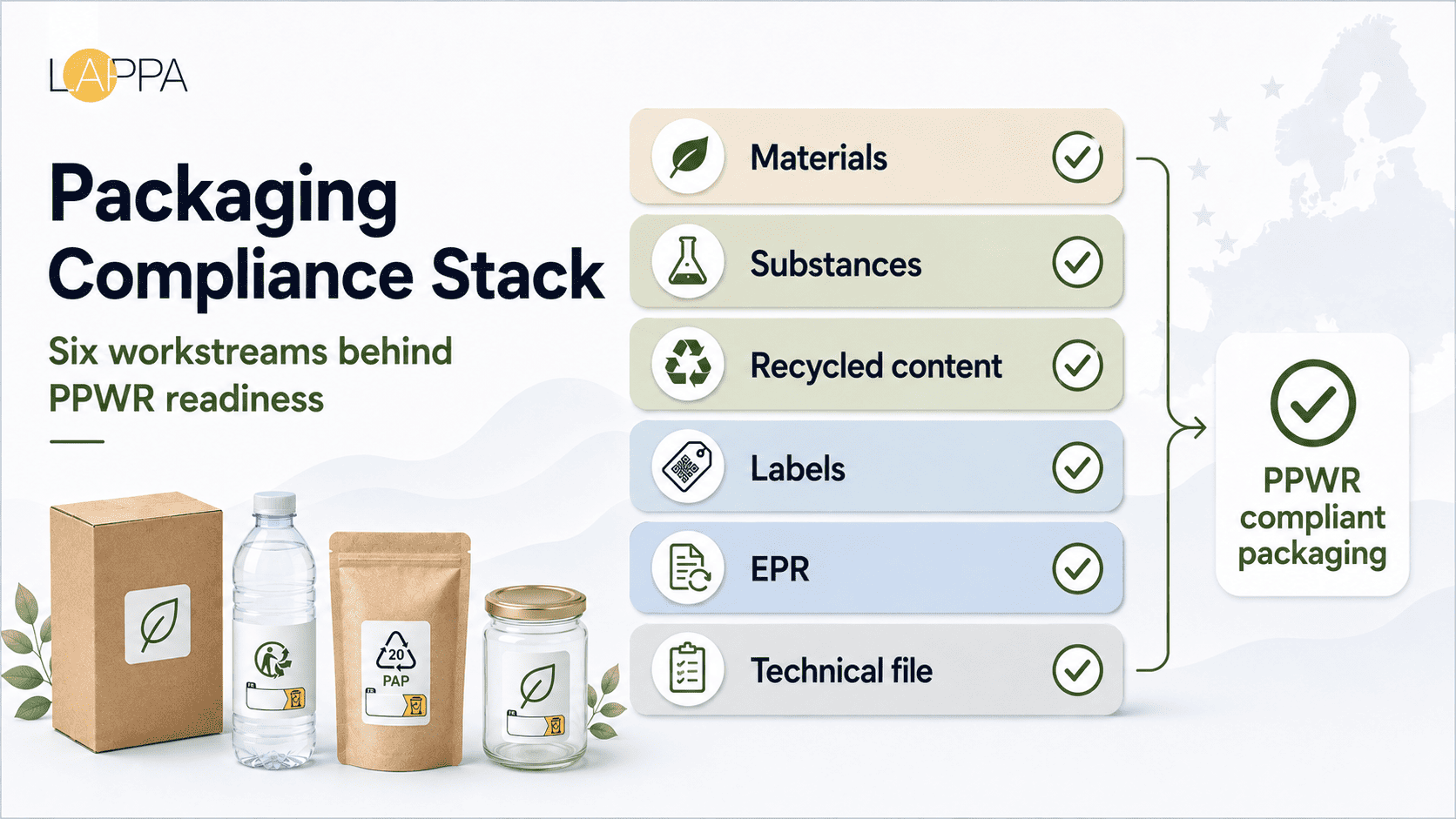
Sorting out your PPWR obligations starts with an identity question rather than a product one: which role, or roles, does this business actually occupy under the text. Manufacturers, importers, distributors, fillers, and marketplace operators each get their own distinct bundle of duties, and it is common for one company to carry two of those bundles at once — the manufacturer who owns the design decisions, and, on the very same packaging, the producer footing the registration bill wherever that packaging first reaches a national market.
Once 12 August 2026 arrived, a fixed baseline of duties became unavoidable:
- Meeting the sustainability rules laid out in Articles 5 through 12, restricted substances and minimisation limits included
- Signing up as a producer in every member state where sales pass the local reporting threshold
- Having an EU Declaration of Conformity on file for each separate packaging format sold
- Holding onto technical records and traceability data for a stretch of five to ten years, the exact length tied to the document type
- Withdrawing any food-contact packaging that crosses the new PFAS ceiling
A second, weightier round of PPWR obligations rolls out in stages beginning 2028 — harmonised labels, minimum recycled content, and a formal recyclability score among them. Businesses that handle the 2026 basics cleanly now tend to describe the later stages as noticeably calmer to work through.
How packaging legislation Europe has changed since 2025
Picture twenty-seven countries running one shared directive and twenty-seven slightly different rulebooks underneath it — that describes packaging legislation Europe depended on right up until 2025. Directive 94/62/EC pointed everyone toward the same destination but left the route entirely up to national governments, and any business selling into several EU countries paid for that freedom with duplicated paperwork, market after market.
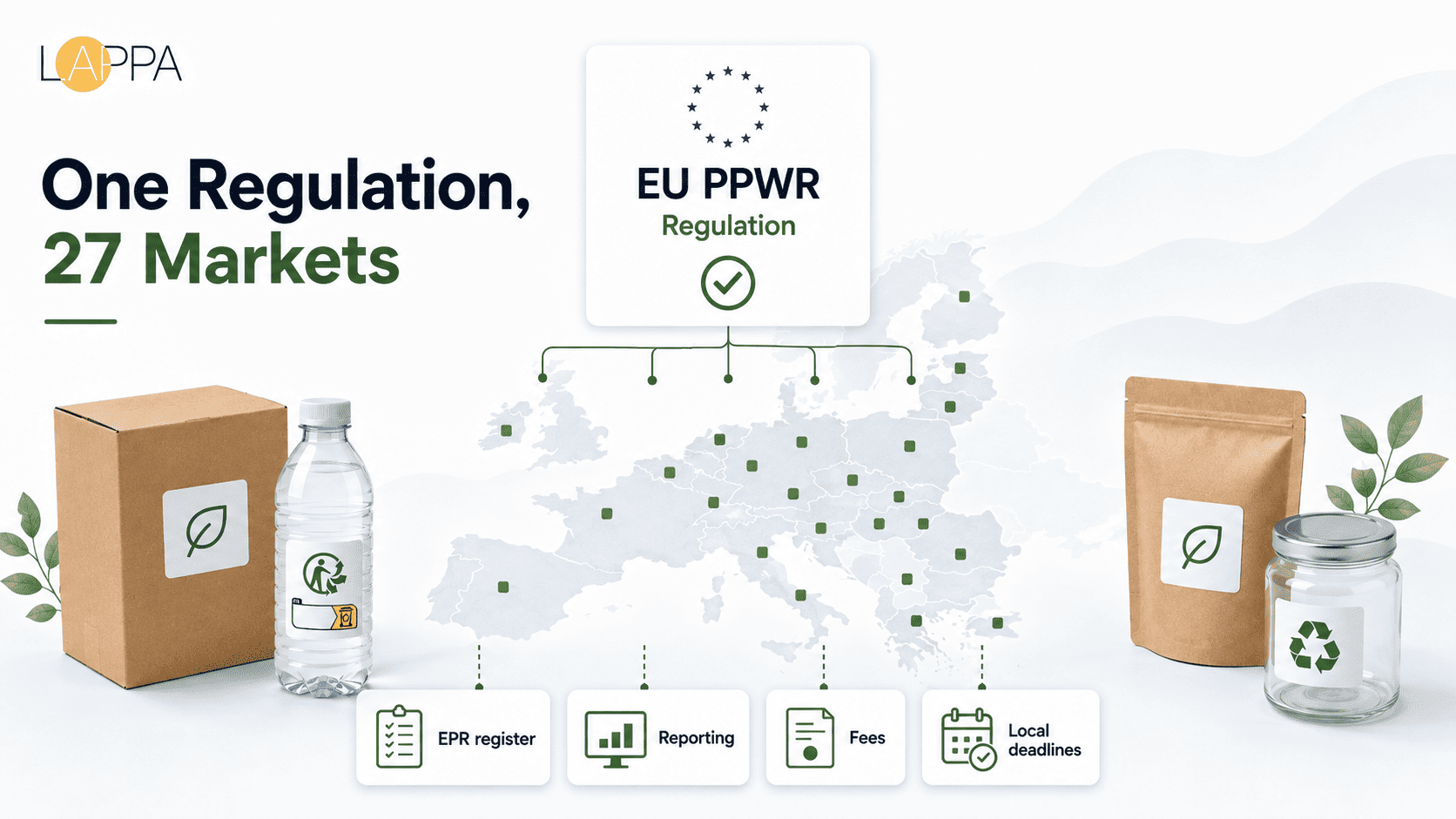
A single directly binding text now closes that gap, even though the administration of producer responsibility itself remains a national job. It helps to think of packaging legislation Europe-wide as two layers stacked on top of one another: an EU-wide layer governing design, substance limits, and conformity checks, and underneath it a national layer still running its own registration process, fee structure, and reporting paperwork. Stepping into a new EU market means clearing both layers on their own terms — satisfying the EU layer buys nothing automatically at the national one.
Eco-design requirements under Article 6 of the PPWR
Market access itself hinges on Article 6. It lays down the eco-design requirements that decide, one format at a time, whether a piece of packaging is allowed anywhere near an EU shelf. The underlying test is simple to state even if it is hard to satisfy: can the recovered material replace virgin raw material at an acceptable quality, and can the format be collected, sorted, and processed without dragging down the recyclability of whatever waste stream it ends up in.
Recyclability is just one entry on a longer list of eco-design requirements, which also takes in:
- Cutting weight and volume back to whatever the product genuinely needs for safe protection, and nothing beyond that
- Removing design tricks whose only job is to make a pack look larger, false bottoms and double walls among the usual suspects
- Clearing minimum recycled-content floors on plastic components, 30 percent for PET contact-sensitive formats being the opening figure in 2030
- Respecting substance-of-concern ceilings, the PFAS limit on food-contact packaging already active since 12 August 2026
- Satisfying reusability criteria on a handful of formats, transport packaging and some grouped formats included
Every single item on that list eventually collapses into one figure — a recyclability grade — which is the next system worth unpacking.
Design for recycling rules and grading criteria
Three letters carry the whole scale: A, B, and C. Fall short of C and the law has a blunt term ready — technically non-recyclable — and that judgment is the backbone of design for recycling as this regulation defines it. The Commission still owes the market delegated acts spelling out exactly how a grade gets calculated, with 1 January 2028 as the legal cutoff for publishing them, even though the letter bands themselves are already locked into the regulation’s own wording.
From 1 January 2030, or twenty-four months past those delegated acts taking effect, whichever lands second, only A, B, or C packaging keeps its place on the EU market. A sharper test arrives on 1 January 2035: recyclability now has to prove itself “at scale,” meaning genuine collection infrastructure actually processes the format rather than a lab merely confirming it could be done. By 1 January 2038, grade C disappears entirely, leaving A and B as the only survivors. Packaging already designed for recycling against current Recyclass expectations sits in reasonably safe territory heading into that stretch, delegated acts or none.
| Milestone | Date | What Changes |
| Delegated acts on grading methodology | 1 January 2028 | Commission sets the technical basis behind grades A, B and C |
| Grade C threshold enforced | 1 January 2030 | Anything scoring below grade C loses access to the EU market |
| Recyclable at scale requirement | 1 January 2035 | Packaging has to move through genuine collection infrastructure |
| Grade C phase-out | 1 January 2038 | Grades A and B are the only ones still allowed |
Want a second opinion on where your current packaging portfolio would land under this grading system? See how Lappa supports the packaging industry.
Packaging Producers Responsibility and EPR registration steps
Packaging producers responsibility is essentially the familiar extended producer responsibility principle, renamed for packaging specifically. Whichever party first puts a piece of packaging onto a given national market inherits producer status for it, and that party ends up covering the bill for collecting, sorting, and recycling it once the packaging becomes waste inside that particular country.
Turning packaging producers responsibility from theory into a repeatable process tends to come down to a short, recurring set of tasks:
- Confirm registration separately in each member state where sales clear the local de minimis line
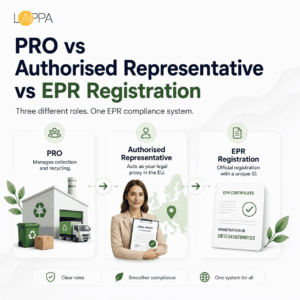
- Line up an EU Authorised Representative wherever the company itself has no legal footing inside the Union
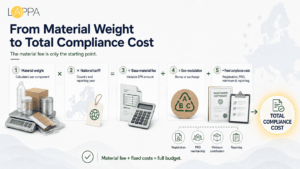
- Submit annual tonnage figures broken down by material category to every national register in play
- Settle EPR fees, which are gradually shifting toward modulation by recyclability grade as the grading framework firms up
- Go back through last year’s filings whenever a redesign shifts a product’s material classification
Something regularly catches smaller sellers off guard: qualifying as a micro-enterprise, meaning fewer than 10 staff and turnover under 2 million euros, does soften certain paperwork demands, yet it does nothing at all to loosen the responsibility of packaging producers to register for EPR in the first place. It is also worth checking whether a representative already appointed for General Product Safety Regulation purposes can simply extend to PPWR duties too, instead of paying for a second, entirely separate appointment.
No single EU-wide producer register exists at present. Registration still runs on a country-by-country basis, each with its own timeline, though a unified system has been floated for somewhere near 2029.
Managing registrations across several EU markets at once is one of the most common friction points. Explore EPR Consolidation or start with EPR Registration directly.
The PPWR implementation timeline from 2026 to 2040
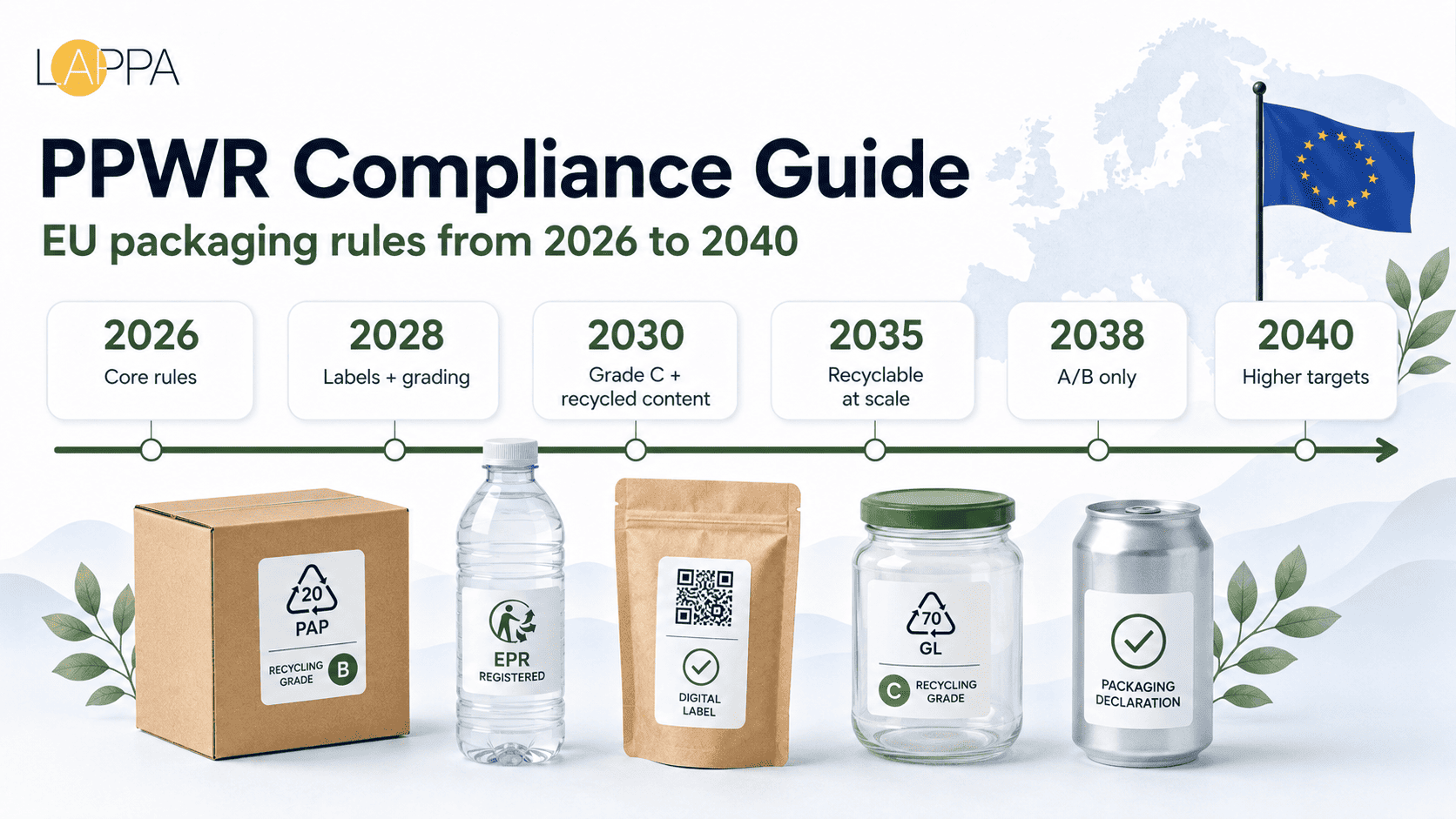
Fifteen years of staggered obligations, not one single cutover — that is the honest description of the PPWR implementation timeline. Treat 2026 as the only date worth watching, and the requirements that arrive quietly later, carrying the heaviest redesign cost, will catch a team unprepared.
| Date | Requirement |
| 12 August 2026 | General application date; PFAS limits for food-contact packaging; core sustainability rules apply |
| 12 February 2027 | Food service outlets must accept a customer’s own reusable container for takeaway food and drinks |
| 1 January 2028 | Delegated acts due on recyclability grading methodology and design criteria |
| 12 August 2028 | Harmonised material composition labelling required on packaging |
| 1 January 2029 | Deposit return systems expected in member states without an existing high-collection alternative |
| 12 February 2029 | Reusable packaging must carry a QR-coded label with reuse information |
| 1 January 2030 | Recyclability grade C minimum; recycled content targets; empty space ratio capped at 50 percent; first reuse targets for beverages and transport packaging |
| 1 January 2035 | Packaging must be recyclable at scale, not only in theory |
| 1 January 2038 | Grade C phased out; only grades A and B remain valid |
| 1 January 2040 | Higher recycled content thresholds and expanded reuse targets take full effect |
Look closely at this PPWR implementation timeline and one pattern jumps out: any redesign aimed at the 2030 line needs sourcing and supplier decisions wrapped up by 2027 or 2028 at the outside, because certified recycled content is not something a supplier can conjure at scale overnight.
Packaging reporting duties and documentation requirements
Design work and paperwork move on parallel tracks here, not one after the other, which makes packaging reporting part of the design conversation from the very start rather than an afterthought. The first document any business needs is an EU Declaration of Conformity, proving a given format genuinely meets Articles 5 through 12 before it reaches anyone’s shelf.
Once that declaration exists, packaging reporting turns into a routine: annual tonnage numbers filed with national registers, technical files laying out exactly how recyclability and recycled content were calculated, and batch-level traceability tying finished stock back to whatever paperwork backs it up. Market surveillance bodies can request any of that during a retention window usually running five to ten years, and the European Commission can demand the complete technical file within as little as ten days should it choose to intervene directly. A Digital Product Passport is also coming, built on much of this same underlying data once the broader Ecodesign framework matures, which is one more reason to get reporting structured properly the first time instead of patching it together later.
Comparing PPWR rules across packaging categories
Not every format feels the same amount of pressure. The table below lines up where the practical burden differs most sharply from one category to the next.
| Packaging Category | Main Obligation | Key Deadline | Practical Risk |
| Contact-sensitive PET plastic | 30% recycled content minimum, rising to 50% by 2040 | 2030 | Supplier certification and food-safety approval for recycled feedstock |
| Flexible multi-layer films | Recyclability grade C or higher | 2030 | Sorting infrastructure gaps make grade C difficult to reach |
| Beverage packaging | 10% reuse within a re-use system, rising to 40% by 2040 | 2030 | Requires deposit or refill logistics most brands do not yet have |
| Transport and e-commerce packaging | 40% reuse, rising to 70% by 2040; empty space capped at 50% | 2030 | Fulfilment processes are often optimised for protection over volume |
| Food-contact packaging | PFAS concentration limits | 2026 | Already active, with no grace period for stock produced after the date |
Common compliance mistakes companies make under the PPWR
A handful of missteps keep resurfacing, review after review, regardless of the industry involved:
- Fixating on 12 August 2026 as the finish line and letting everything scheduled beyond it through 2040 slip out of view
- Registering across most EU markets while overlooking one or two where a local distributor used to quietly handle things
- Calling a format recyclable purely because the raw material happens to be, without ever checking if local sorting lines can process it
- Sitting on redesign work until the delegated acts finally appear, then finding no runway left once they do
- Only discovering, in the middle of a customer audit or a surveillance request, that conformity paperwork for existing packaging never existed
- Reading micro-enterprise status as a blanket exemption from EPR registration, when only specific documentation duties are actually eased
Nearly every one of these traces back to a single habit: treating this regulation as a box to tick once, rather than a standing programme that needs an owner and a recurring check-in built into someone’s calendar.
Practical steps to build your PPWR guide for internal teams
Nobody has to memorise seventy articles of legal text to run this well day to day. What actually helps is a schedule that turns the regulation into a set of recurring tasks with someone’s name attached. A structure that tends to hold up looks something like this:
- A complete map covering every SKU, market, and packaging tier currently in scope
- One named owner for PPWR compliance, kept apart from general sustainability reporting duties
- Verified registration status and reporting cadence for every member state where the business actually sells
- An early, informal recyclability check against current Recyclass or CEN guidance, run ahead of the binding 2028 methodology
- A living document register covering declarations of conformity, technical files, and supplier certificates in one place
- Calendar alerts tied to every milestone across the full timeline, not only the 2026 date
Build a PPWR guides resource like that once, keep it current as fresh delegated acts land, and new hires or new markets stop meaning yet another full explanation of the regulation from scratch.
Need software that keeps registrations, deadlines, and reporting in one place across markets? Explore EPR Reporting Software or check the Packaging Label Manager for labelling compliance.
FAQ
about PPWR compliance



What is the PPWR and which businesses does it apply to
Regulation (EU) 2025/40 is the formal name behind the shorthand PPWR, a directly binding EU law covering packaging design, labelling, reporting, and producer responsibility inside one text. Its reach extends to any business placing packaging on the EU market, whether that business manufactures, imports, distributes, fills, or runs a marketplace, and location outside the bloc changes nothing about that reach. Non-EU sellers frequently end up needing an Authorised Representative inside the Union precisely because company size has never counted as a blanket way out.
When exactly does the PPWR start applying to my packaging
The regulation dates to 11 February 2025 on paper, though nothing was actually enforceable until general application began on 12 August 2026, and no leftover grace period covers packaging placed on sale afterward. Several individually named requirements land later still, recyclability grading, recycled-content floors, and harmonised labelling among them, spread out across 2028 through 2040 depending on which rule is in question. Confusing the 2026 date with every requirement’s own separate deadline is the single most common way a business ends up missing something.
How is a producer defined for extended producer responsibility purposes
In EPR terms, the producer is whichever party first places packaging onto a specific member state’s market, which in most real supply chains simply means whoever fills or packs a product for that particular country. Depending on how that chain happens to be built, the role can land on the manufacturer, the importer, or a distributor. Since the definition resets separately in every country, one company might hold producer status in one member state and lack it entirely in the next, which is exactly why each market deserves its own individual check rather than a single assumption applied everywhere.
What happens if my packaging fails to reach recyclability grade C
Beginning 1 January 2030, or twenty-four months after the relevant delegated acts take effect if that date lands later, anything scoring below grade C is treated in law as technically non-recyclable and forfeits its place on the EU market outright. That consequence reaches back into sourcing and design choices well before the deadline itself, since reworking a format from material selection through to production usually eats up twelve to twenty-four months. Formats built from multiple layers or composite materials carry the heaviest exposure here, and starting the fix earlier rather than later tends to be far less painful.
Do the exact recyclability testing methods already exist
Not in a final, published form. The Commission still owes the market delegated acts covering the recyclability assessment methodology, with 1 January 2028 as the legal deadline, and until that lands the detailed testing protocols remain unsettled. In the meantime, existing frameworks such as Recyclass Design for Recycling guidance offer a reasonably solid working basis, since the design principles underneath them — mono-material construction and sorting compatibility chief among them — are unlikely to be overturned once the official methodology finally shows up.
