


EU Packaging Regulations Explained for Manufacturers and Online Sellers
Every business moving packaged goods into European markets this year faces a compliance reality that did not exist twelve months ago. The EU’s updated packaging rules arrived through Regulation (EU) 2025/40 — formally adopted on 11 February 2025, with binding force across the entire 27-country bloc from 12 August 2026. The old framework, Directive 94/62/EC, handed each member state the authority to write its own version. That model is finished. One text now governs all markets equally, and nothing at national level can override or soften it.
Three questions matter most: who carries legal responsibility, which deadlines are real, and what paperwork and design changes need to happen first.
Who falls under packaging regulations Europe-wide 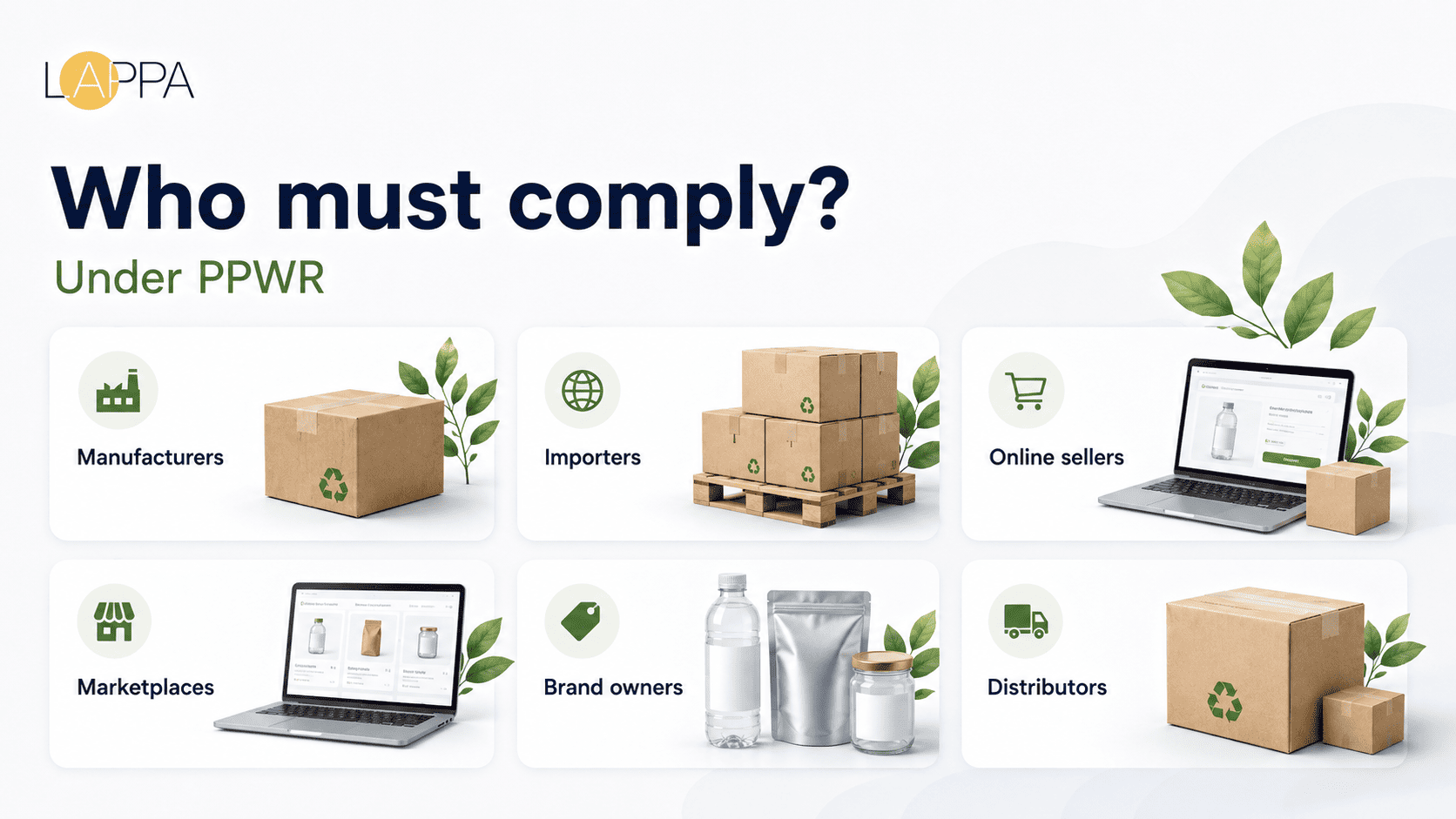
Packaging regulations Europe no longer stop at factory gates or national borders — they follow the product through every hand it passes. Regulation (EU) 2025/40 identifies the following as duty-holders:
- Manufacturers introducing packaged products to the EU market for the first time
- Importers moving goods in from non-EU countries
- Online sellers and direct-to-consumer operations dispatching to EU buyers
- Marketplace platforms that process and ship orders on behalf of third-party merchants
- Brand owners and distributors involved in relabelling or repackaging
- Micro-enterprises — reduced obligations apply, but they do not escape the framework entirely
A foreign registration address changes nothing. Article 4(4) of Regulation (EU) 2025/40 holds any EU-established importer to the same standard as a domestic producer. Where no EU legal entity exists, the company must designate an authorised representative for every individual country it supplies. The reach of Europe’s packaging rules goes further down the volume scale than many expect — a single transaction is sufficient to create a registration obligation in most member states. Everything non-EU businesses need to know about their specific duties is set out in the PPWR compliance guide for non-EU companies.
Day-to-day enforcement of packaging regulations Europe-wide falls to each country’s own market surveillance authority. These bodies operate independently from one another, and no central EU agency carries out inspections.
What the Packaging and Packaging Waste Regulation (PPWR) Requires
The packaging and packaging waste regulation spreads its demands across more than a decade, with distinct tranches of obligation activating at different points. August 2026 opens the first tranche: EPR registration, conformity documentation, removal of PFAS from food-contact packaging, and a hard ceiling of 40% empty space in e-commerce shipments. Material labelling harmonisation arrives in 2028. The year 2030 converts recyclability grades from a voluntary benchmark into a condition of market access, while mandatory recycled content levels for plastic packaging take effect simultaneously. PPWR requirements then continue to tighten on a defined schedule running through 2038.
| Deadline | What kicks in | Who it affects |
| 12 Aug 2026 | EPR registration, conformity dossier, PFAS ban in food-contact packaging, 40% empty-space cap for e-commerce parcels. | All producers, importers, online sellers |
| 12 Aug 2028 | Harmonised material pictograms on all packaging. QR codes on reusable formats. | Manufacturers, brand owners, e-commerce operators |
| 1 Jan 2030 | Recyclability grades A–C required. Minimum recycled content targets for plastics. Bans on listed single-use formats. 50% void-space cap on grouped and transport packaging. | All producers; plastic-heavy operations especially |
| 1 Jan 2038 | Only grades A and B permitted. Grade C phased out. | All producers |
The packaging waste framework connects to Extended Producer Responsibility programmes that several member states have operated for years. Those national schemes predate the PPWR, but the regulation brings their underlying logic into a single shared structure — standardising how producer responsibility is calculated and pushing reporting towards a consistent baseline that applies in all 27 countries simultaneously.
Sustainable packaging regulations — materials, design and recyclability
Sustainable packaging regulations under the PPWR assign every packaging format a recyclability grade between A and E. D and E ratings become grounds for market exclusion on 1 January 2030. Grade C buys time until 2038 before it too is prohibited, leaving only A and B as valid options. The criteria behind this grading system originate in Recyclass Design for Recycling guidance, which Commission delegated acts will render legally enforceable. Those acts — setting out precise thresholds by material type — are scheduled for adoption by 2028. Producers already benchmarking their designs against current Recyclass guidance will face no discontinuity when the binding rules arrive.
Plastic packaging absorbs the sharpest obligations within the Packaging and Packaging Waste Regulation (PPWR). From 2030, each plastic packaging category must contain a defined minimum share of post-consumer recycled material. Rigid formats such as bottles, trays and pots can usually satisfy grade A or B requirements without fundamental structural changes. Multi-layer flexible films incorporating aluminium barriers present a harder problem: current Recyclass criteria place most of them at grade D. Businesses where these materials represent a meaningful proportion of output cannot treat this as a future problem — a concrete substitution plan needs to be operational in 2026. Lead times for supplier changes and tooling adjustments run between one and two years, which makes 2029 too late to start.
Minimisation rules also bite from August 2026. Volume and weight must drop to the functional minimum for product protection. Marketing logic and “perceived value” arguments are explicitly written out as invalid justifications under the PPWR. Supplier declarations for sustainable packaging compliance assessments will have to include substances under REACH and the PPWR Annex. Each time a material changes, the assessment repeats. The sustainable packaging regulations treat documentation as a live obligation, not a one-time filing.
EPR registration under packaging regulations EU
Extended producer responsibility ties the cost of packaging waste management directly to the businesses generating that waste. Fees flow to national producer responsibility organisations in each member state. From 2028, fee modulation based on recyclability grade is expected under the Packaging and Packaging Waste Regulation (PPWR) — a D-grade laminate pouch will carry a higher levy than an A-grade glass bottle.
No EU-wide registration exists. Packaging regulations EU-wide require a separate national filing in every country before goods reach that market. Germany uses LUCID, managed by the ZSVR, which cross-references reported tonnage and flags corrections that can result in back-payments. France routes reporting through CITEO, with tonnage declared at component level rather than finished-product weight. Spain, Poland, the Netherlands, and every other member state run independent systems — each with its own material categories, filing deadlines, and fee schedules.
A recurring compliance gap: companies register in their first two or three EU markets and overlook the rest. Sales to Belgium, Austria, or Sweden carry identical obligations — typically from the first parcel dispatched. The EU packaging compliance framework handles every national market as a separate jurisdiction. Enforcement is national, and a correction issued in one country does not alert authorities in another.
Selling across multiple EU markets? Lappa handles EPR registration, annual tonnage reporting, and fee management from one platform — no more juggling country-by-country systems.
Start EPR registration | EPR reporting software
Labelling and documentation under packaging legislation EU
From 12 August 2028, packaging legislation EU mandates standardised material pictograms on all packaging — icons telling buyers how to separate and dispose of each component. The Commission locks in exact pictogram designs by August 2026. Two years sounds workable, but for any operation running dozens of SKUs through several print suppliers, the practical window is tight. Artwork sign-off, specification updates, and supplier confirmation each take time that teams consistently underestimate.
A parallel requirement comes in 2027: every pack must carry a data carrier — QR code or equivalent — linking to structured sustainability details: material breakdown, recyclability grade, and reuse pathway where it applies. EU packaging law aligns this with the Digital Product Passport under the Ecodesign for Sustainable Products Regulation. The two frameworks are designed to feed the same data layer, not run as separate compliance tracks.
Packaging legislation EU also imposes documentation requirements from August 2026 under PPWR Article 11. Each packaging format on the EU market needs a conformity dossier on file: material data sheets, a written rationale for current dimensions, recyclability assessment findings, and PFAS testing for any food-contact applications. Retention period is ten years. On request from national market surveillance authorities, it must be produced. A significant number of businesses currently hold nothing equivalent for formats already in use — building that dossier before August is an immediate task.
What E-Commerce sellers need to know about packaging regulations in Europe
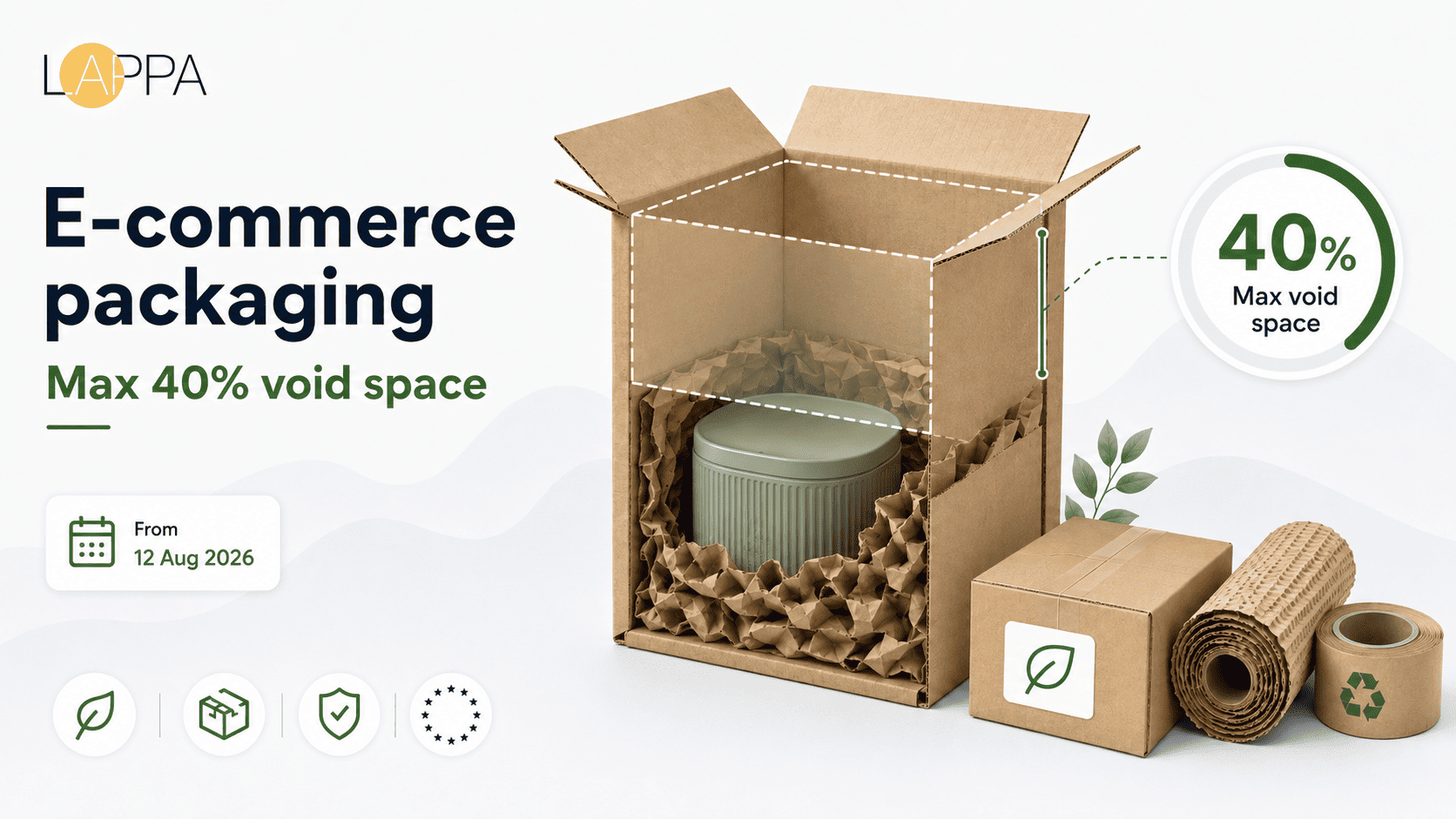
Online sellers carry the same baseline obligations as physical producers and face a few channel-specific additions on top. Packaging regulations Europe-wide set a 40% limit on void space inside e-commerce parcels from 12 August 2026. Filler materials — air pillows, paper padding, bubble wrap — count as empty space under the calculation, not as product volume. Box sizes built around visual shelf appeal or brand perception regularly break this threshold.
Online marketplaces that manage fulfilment for third-party sellers are named as responsible actors under the PPWR. Article 4 eliminates the ambiguity that existed under the old directive — platform operators need to reassess seller agreements and logistics setups with that accountability in view.
For sellers dispatching to five or more EU countries, the core compliance steps are:
- Register for EPR in each national market before first sale. Even low volumes create the obligation. Formats and deadlines vary by country.
- Collect supplier declarations at intake. Material composition, weight, and substance-of-concern confirmation belong in the conformity file from the start — not assembled after an inspector calls.
- Check parcel void versus 40% cap. Review current packaging dimensions and update specifications by August 2026.
- Start revising labels now for the 2028 deadline. Pictogram implementation runs through suppliers, print specs, and artwork approvals — rarely a fast process.
- Run recyclability assessments on all plastic formats. D- or E-grade results call for a substitution or redesign plan confirmed well before 2030.
No EU presence but selling packaged goods into Europe? Lappa provides authorised representative services covering EPR obligations in all EU member states. Get an EU packaging representative
FAQ


Who must comply with EU packaging regulations and from when
The packaging regulations EU framework covers manufacturers, importers, distributors, online sellers, and marketplace operators placing packaging on the EU market. Non-EU companies are included when their goods enter EU territory through an importer. Core obligations apply from 12 August 2026. Recyclability grading, recycled content targets, and reuse requirements phase in progressively through 2030 and beyond.
PPWR has certain requirements that apply specifically to e-commerce businesses
The PPWR will limit void space in e-commerce parcels to a maximum of 40% from August 2026. EPR registration must be obtained in all EU countries where goods are dispatched. Operators distributing more than 1,000 transport packaging units a year will have to put at least 10% of that volume into reusable formats from 2030. Digital labelling (QR codes that link to sustainability data) will be mandatory from 2027.
How do sustainable packaging regulations impact design or material decisions
PPWR sustainable packaging regulations link material choices to a recyclability grading system. By 2030, D and E formats will be banned from EU shelves, and by 2038 only A and B grades will be valid. Minimum recycled content in plastic packaging from 2030, with percentage by category of packaging. Another constraint is imposed by minimisation rules. Packaging volume and weight must remain at functional minimum. These duties together suggest that decisions made in 2026 directly affect the probability of costly redesigns under time pressure closer to 2030.
What documentation does packaging legislation EU require producers to hold
Under PPWR Article 11, packaging legislation EU requires a conformity dossier for each format placed on the market. It covers material composition declarations, a written rationale confirming current dimensions are the functional minimum, recyclability assessment results, and — for food-contact packaging — PFAS test documentation. The dossier is held for ten years and produced for national market surveillance authorities on request. Many businesses hold nothing comparable for formats currently in use.
Does the packaging and packaging waste regulation apply to companies based outside the EU
Yes. The packaging and packaging waste regulation applies to all packaging entering the EU market regardless of where the producer is registered. UK exporters, North American brands, and Asian manufacturers whose packaged goods enter EU territory carry the same EPR registration and conformity obligations as EU-based producers. Companies with no EU establishment must name an authorised representative in each member state where they sell. Non-compliance is enforced by national market surveillance authorities and can result in goods being turned away at EU borders.

