


VAT and customs compliance guide in cross-border trade
This guide covers EU-wide VAT and customs principles. France is used as the primary jurisdictional example where jurisdiction-specific rules apply.
How VAT and сustoms interact in international trade
Finance teams often treat VAT compliance and customs compliance as separate workstreams. Different teams handle them. Different deadlines apply. Different software tracks them. In practice, this separation is a direct source of tax risk in cross-border trade.
Every customs event produces a VAT consequence. The Movement Reference Number assigned to each declaration becomes a required reference in the periodic return. The customs value that determines duties also forms the base on which import VAT is charged. One missed deadline can trigger a liability. One misreported value makes the return wrong before it is filed.
This guide is written for tax, finance, and accounting professionals who need to understand not just what the rules are, but why they interact and where the compliance risks sit. For step-by-step guidance on how goods physically move through customs.

Need help with VAT compliance in cross-border trade? Lappa helps companies manage import VAT, reverse charge, and customs reconciliation across EU member states.
Get a Fee Quote or Book a Free Demo
The structural link between VAT and customs operations
Customs and VAT govern different things at a high level. Customs controls the physical movement of goods across borders: classification, origin, valuation, duties. VAT is a consumption tax applied at each stage of the supply chain.
In cross-border goods transactions, the two systems are structurally linked:
- Customs determines when VAT is triggered. The acceptance of a customs declaration is the event that establishes the VAT point for an import.
- VAT rules determine how the liability is declared and recovered. This covers whether it is paid at the border or self-accounted through a periodic return.
- Customs data, including the MRN, declared value, and duties, is the primary source for VAT reporting. Without it, the return cannot be correctly completed.
Understanding this relationship has direct consequences. It affects how VAT returns are prepared, how cash flow is managed, and what documentation must be retained for audit.
Import VAT calculation and EU import procedures
How the VAT base is determined for imports
When goods enter the EU from a third country and are released into free circulation, import VAT becomes due. Unlike domestic VAT, which is calculated on the invoice price alone, import VAT is applied to a broader base. That base includes:
- The customs value of the goods
- Customs duties and related charges
- Transport and insurance costs up to the EU point of entry
- Commissions and brokerage fees (Article 86, VAT Directive 2006/112/EC)
- Packaging and preparation costs where applicable
- Royalties and licence fees payable by the buyer as a condition of sale
This wider base means import VAT is almost always higher than the invoice price suggests. For businesses importing regularly, even minor errors in customs valuation translate directly into underreported VAT.
Two import VAT regimes in France
Note: France is used here as a primary example. Germany applies Einfuhrumsatzsteuer (EUSt) under a comparable mechanism. The Netherlands offers an Article 23 licence for deferred payment, widely used across Benelux logistics hubs.
ATI (Autoliquidation de la TVA à l’importation) – This is the mandatory standard regime for all VAT-registered importers in France. Since 1 January 2022, ATI applies by default. No special authorisation is needed. Import VAT is self-accounted through the periodic CA3 return rather than paid at the border. VAT-registered importers no longer face a cash outflow at the point of importation. The declaration is made in the return and simultaneously recovered, producing a neutral cash position.
Classic import VAT paid at customs – This mechanism still applies in specific cases:
- Where the importer is not registered for VAT in France
- Where the customs procedure does not permit deferred accounting
- In non-standard or transitional situations
Businesses must confirm which regime applies based on their registration status. Defaulting to ATI without meeting eligibility conditions creates compliance exposure.
Customs duties and their effect on the VAT base
Customs duties are not VAT. They cannot be recovered as input tax. However, they are included in the taxable base for import VAT purposes. Higher duties automatically increase the amount of import VAT due. For businesses importing goods subject to anti-dumping measures or significant tariff rates, this interaction materially affects cash flow even under the ATI regime.
Intra-EU acquisitions and the reverse charge mechanism
How intra-EU trade works for VAT purposes
Intra-EU acquisitions are among the most common cross-border VAT scenarios for EU-based businesses. They are governed by Articles 138 to 139 and Article 200 of Directive 2006/112/EC.
An intra-EU acquisition occurs when goods are purchased from a VAT-registered supplier in one EU member state and physically transported to a buyer registered in a different member state.
The transaction operates as follows:
- The supplier issues an invoice without VAT (zero-rated supply under Article 138), provided the buyer is VAT-registered and the number has been verified
- The buyer self-accounts for VAT at the applicable rate in their country (acquisition VAT under Article 200)
- No customs declaration is required. Goods moving between EU member states do not cross a customs border.
- The transaction must be reported in the EC Sales List by the supplier, and as an acquisition in the buyer’s VAT return.
- The buyer declares the same amount as both output VAT and recoverable input VAT. The net cash impact is zero for fully taxable businesses.
Conditions that must be met to apply zero rating
The zero-rating of an intra-EU supply is conditional. Two requirements must be documented before the invoice is issued.
First, the buyer’s VAT number must be verified in VIES (the EU VAT Information Exchange System). If the number is invalid and VAT is not charged, the supplier bears the liability.
Second, proof of physical cross-border movement must be retained. A domestic sale cannot be treated as an intra-EU supply simply because the buyer is based in another country. Without transport documentation confirming the goods crossed an EU border, the zero-rating is challengeable.
Triangular transactions under article 141
Where three parties in three different EU member states are involved, a simplification applies. If supplier A sells to buyer B, and B sells to buyer C, but goods ship directly from A to C, standard rules would require B to register for VAT in C’s country. Article 141 of the VAT Directive relieves B of that obligation. The VAT liability is shifted to C as the final acquirer. Specific documentation and EC Sales List reporting requirements must be met to use this simplification.
Export VAT rules and zero rating for non-EU shipments
When zero rating applies to EU exports
Exports from the EU to third countries are zero-rated for VAT purposes. The supplier charges no VAT and retains the right to recover input VAT on related costs (Article 146, Directive 2006/112/EC). In practice, this outcome depends entirely on documentation.
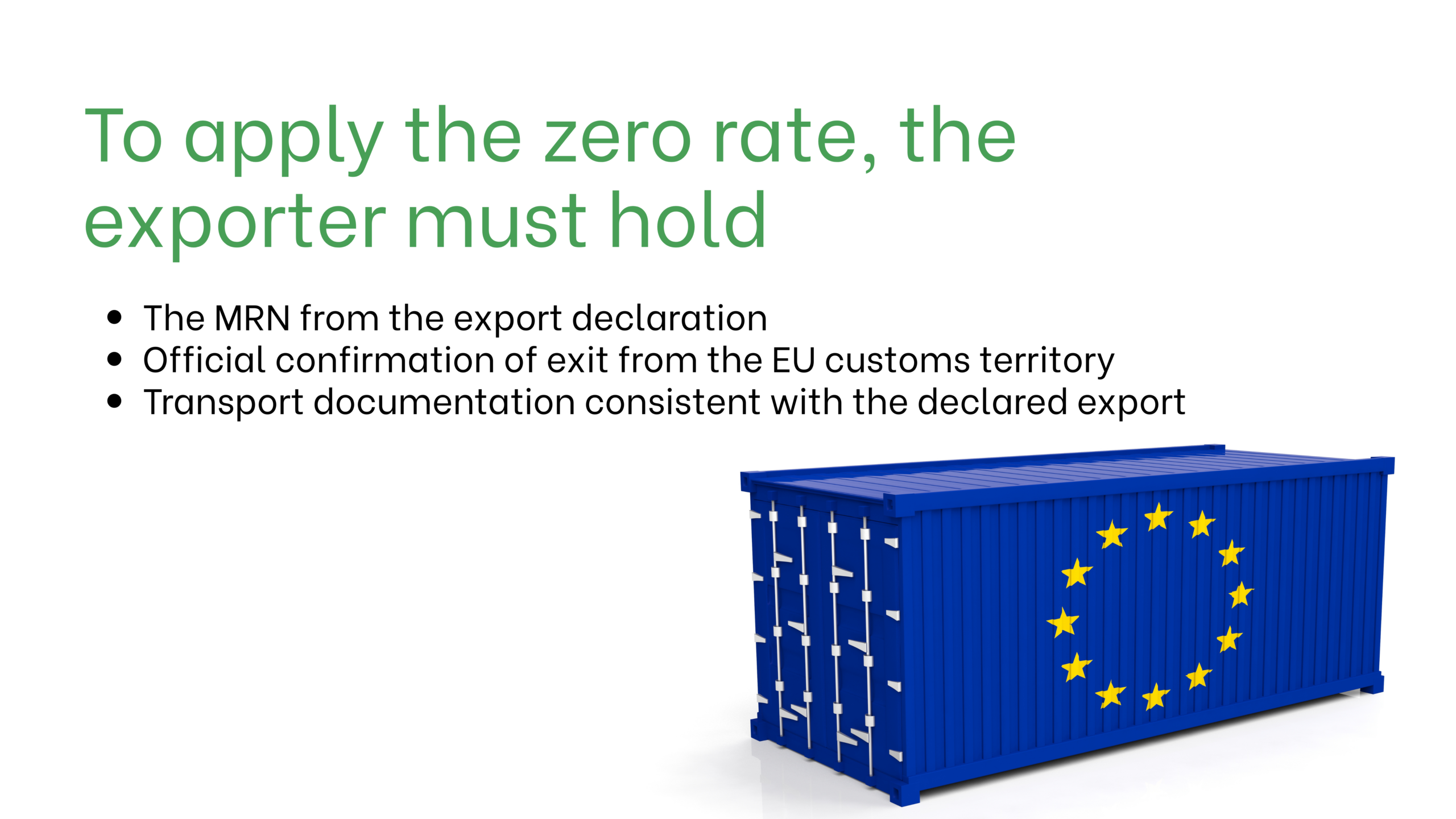
To apply the zero rate, the exporter must hold:
- The MRN from the export declaration
- Official confirmation of exit from the EU customs territory
- Transport documentation consistent with the declared export
The automated export system and digital proof
Since 2021, all EU member states have been required to use the Automated Export System (AES) for export declarations. The MRN generated by AES is now the primary electronic proof of export. Paper-based procedures have been phased out. Exporters must obtain and retain the AES exit confirmation message as standard practice.
The deadline for obtaining export proof
Exporters must obtain proof of exit within a defined period. The standard window is 90 days from the date of the export declaration. Some member states allow up to 150 days. The applicable deadline should be confirmed before shipment.
If proof is not obtained within that period, the export is reclassified as a domestic taxable supply. VAT becomes due retroactively at the standard rate. A routine export transaction can become a significant liability at short notice.
Reverse charge mechanisms in EU VAT compliance
Reverse charge is a structural feature of cross-border VAT. It shifts the obligation to account for VAT from the supplier to the customer or importer. Three main scenarios arise in practice.
Import reverse charge under ATI (France) VAT on imports is self-accounted through the periodic CA3 return. This has been mandatory for all VAT-registered importers in France since 1 January 2022. Output VAT and input VAT entries offset each other in the same period. Both entries must be present.
Intra-EU acquisition reverse charge under Article 200 The buyer self-accounts for acquisition VAT at the rate applicable in their member state. This is an EU-wide mechanism. Both the output and input VAT entries must appear in the return, even though the net position is zero.
Services reverse charge under Article 196 When a business receives services from a foreign supplier, the supplier invoices without VAT. The customer declares and recovers the VAT locally. The supplier must not charge VAT. The customer must not omit the declaration.
A recurring error across all three scenarios is the missing second leg. Either the output VAT entry is absent, or the input VAT entry is absent. Both must be present for the return to be correct.
Special customs regimes for VAT deferral and duty suspension
Customs warehousing and VAT suspension
Goods placed under customs warehouse supervision are not in free circulation. VAT and duties are suspended for as long as the goods remain under customs control. There is no statutory time limit under Article 237 of the Union Customs Code (UCC), but the regime is subject to periodic review. VAT and duties become due only when goods are released for consumption.
Inward processing relief and the discharge requirement
Inward Processing Relief (IPR) allows goods to be imported, processed or manufactured, and then re-exported with VAT and duties suspended throughout. The authorisation period is limited to 24 months under Article 211 UCC. The regime closes with a bill of discharge demonstrating that goods were re-exported or otherwise accounted for. Failure to discharge within the authorised period triggers the full VAT and customs liability retroactively.
Temporary admission for short-term import needs
Goods imported temporarily for exhibition, testing, or professional use can qualify for full or partial relief from duties and VAT under Article 250 UCC, for up to 24 months. The goods must be re-exported without modification. Any alteration or local sale voids the relief.
All three regimes require active tracking of authorisation periods and discharge deadlines. A missed deadline is not treated as a minor administrative lapse. It triggers the underlying customs debt immediately.
VAT base and customs valuation in import declarations
The VAT base for imports is not simply the invoice price. It incorporates customs value, duties, transport, insurance, commissions, packaging, and royalties. This creates a practical challenge: the supplier’s invoice typically shows only the goods price. The additional components must be sourced separately from the customs declaration, transport invoice, and broker cost breakdown.
Errors in customs valuation flow directly into the VAT declaration. An undervalued customs entry produces an understated VAT base. An overvalued entry creates an inflated liability and may require a formal correction. Neither outcome is acceptable in an audit context. Incorrect tariff classification, overlooked value adjustments, and currency conversion timing are the most common sources of error.
VAT return reconciliation against customs declarations
What must be matched each VAT period
Preparing an accurate VAT return for a business that imports goods is a reconciliation exercise between two data sources: the customs system and the accounting system.
For each VAT period, the following checks must be completed:
- Every MRN accepted during the period must be identified and matched to a return entry for the same period
- The taxable base declared in customs must match exactly the base declared in the VAT return
- The correct VAT rate must have been applied to each import
- Under ATI, total import VAT entries in the CA3 must sum to the aggregate import VAT across all MRNs for the period
Discrepancies between customs records and VAT returns are a primary audit trigger in France. Auditors specifically look for mismatches between DEB/DSA import data and CA3 figures, even where the net VAT position is zero.
Step-by-Step MRN to VAT return reconciliation
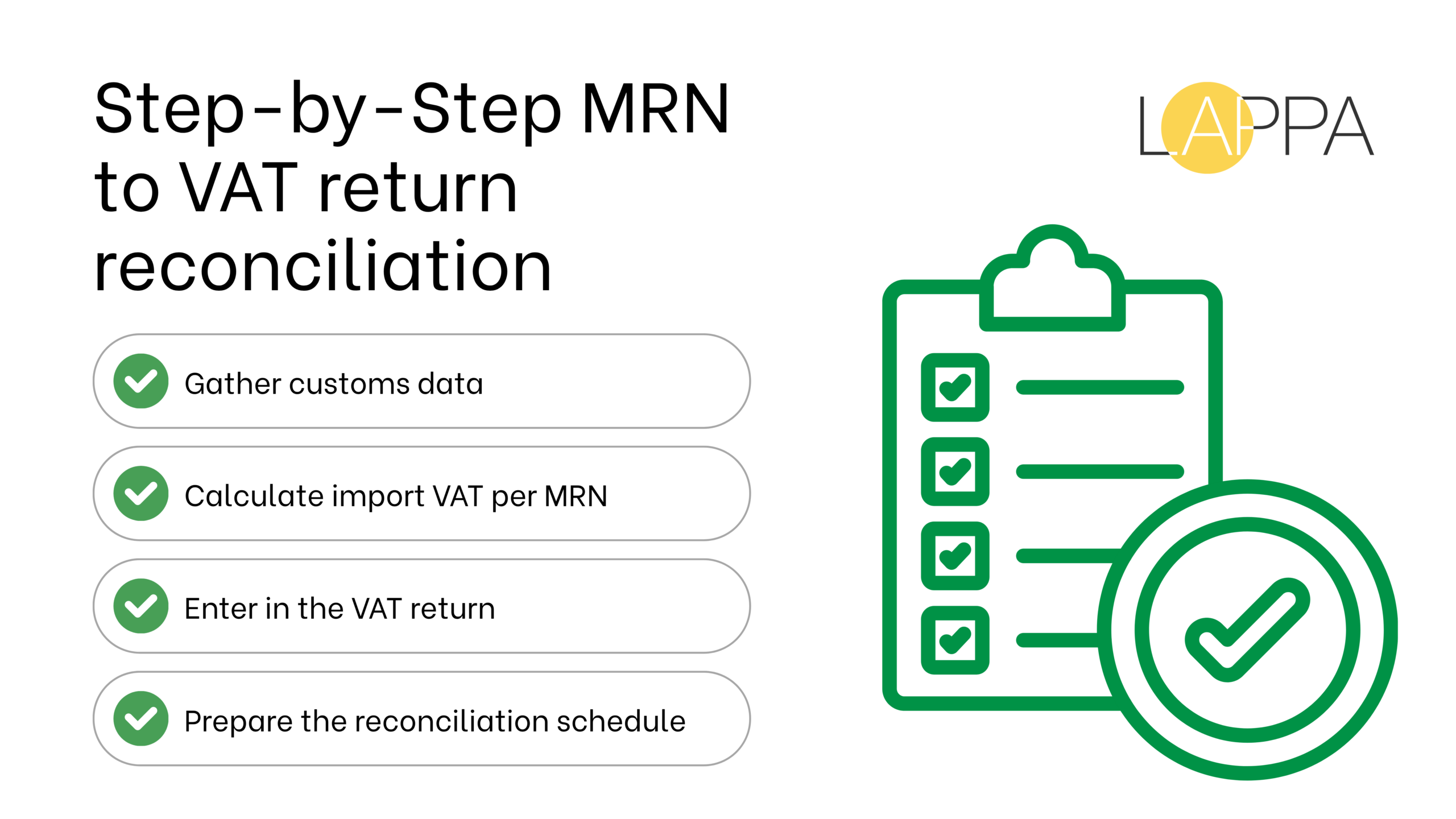
A French importer operating under ATI receives three shipments in March. Each is cleared through customs with its own MRN. The month-end process works as follows.
- Step 1: Gather customs data
The accounts team extracts the three MRNs from the customs system or broker confirmations. For each MRN, they record the date of acceptance, customs value, duties paid, and the computed VAT base: customs value plus duties plus transport and insurance to the EU entry point.
- Step 2: Calculate import VAT per MRN
The applicable VAT rate is applied to each base. Example: MRN-001 shows customs value of €50,000, duties of €2,500, and transport of €1,500. The VAT base is €54,000. At 20%, import VAT is €10,800.
- Step 3: Enter in the VAT return
Under ATI, each import VAT amount is entered as both output VAT and input VAT. The net position is zero. Both lines must be populated. The total must match the sum across all MRNs.
- Step 4: Prepare the reconciliation schedule
The team documents each MRN, its VAT base, the calculated VAT, and the corresponding CA3 line entry. This schedule is retained as supporting documentation and must be available for inspection on request.
Reconciliation errors that appear most often in audits
- MRNs accepted in late December declared in January (period mismatch)
- Transport costs excluded from the VAT base
- Broker-reported customs values differing from the commercial invoice due to currency conversion timing
- ATI entries missing from the output VAT box of the return
VAT treatment by transaction type: Quick reference table
| Transaction Type | VAT Treatment | Legal Basis | Customs Involved | Cash Impact |
| Import via ATI (reverse charge) | Reverse charge via CA3 | Art. 201, Directive 2006/112/EC | Yes | Neutral |
| Import classic (VAT at border) | VAT paid at customs | Art. 201, Directive 2006/112/EC | Yes | Negative (temporary) |
| Export to non-EU | Zero-rated; input VAT deductible | Art. 146, Directive 2006/112/EC | Yes (AES/MRN) | Neutral |
| Intra-EU acquisition | Reverse charge by buyer | Art. 200, Directive 2006/112/EC | No | Neutral |
| Services from abroad | Reverse charge | Art. 196, Directive 2006/112/EC | No | Neutral |
| Customs warehousing | VAT suspended | Art. 237–242 UCC | Yes | Positive |
| Inward processing (IPR) | VAT suspended up to 24 months | Art. 256–258 UCC | Yes | Positive |
| Temporary admission | Full or partial relief | Art. 250 UCC | Yes | Positive |
What effective VAT and customs management looks like in practice
VAT and customs compliance in international trade is not about knowing the rules in isolation. It is about translating customs events into accurate VAT entries, every period, without gaps.
Businesses that handle this well share a clear discipline. They treat the MRN-to-return reconciliation as a monthly control. They verify VIES numbers before issuing zero-rated invoices. They track special regime deadlines with the same attention they give to tax filing dates.
The risks are consistent across businesses: a missing second leg in a reverse charge entry; transport costs excluded from the import VAT base; an export without a retained AES confirmation; a customs warehouse whose discharge deadline passed unnoticed.
None of these failures is difficult to prevent. All of them are costly to correct once a tax audit begins.
The EU’s VAT in the Digital Age (ViDA) package, adopted in 2024, will reshape this landscape from 2030. The EC Sales List will be replaced by real-time digital transaction reporting. E-invoicing mandates will apply across member states. Finance teams managing complex intra-EU supply chains should begin assessing the impact on their ERP systems now.
Glossary of key terms
| Term | Definition |
| AES | Automated Export System. The EU-wide electronic platform for export declarations, mandatory since 2021. |
| ATI | Autoliquidation de la TVA à l’importation. The French import VAT reverse charge mechanism, mandatory since 1 January 2022. |
| CA3 | The standard French periodic VAT return. Used to declare output and input VAT, including import VAT under ATI. |
| CGI | Code Général des Impôts. The French General Tax Code. |
| ESL | EC Sales List. A periodic report on intra-EU supplies of goods and services filed by VAT-registered suppliers. |
| HS Code | Harmonised System code. The internationally standardised goods classification system used for tariff determination. |
| IOR | Importer of Record. The legal entity responsible for correct customs clearance and payment of all duties and taxes. |
| IPR | Inward Processing Relief. A customs regime for importing goods for processing and re-export with suspended duties and VAT. |
| MRN | Movement Reference Number. The unique identifier assigned to each customs declaration by the customs authority. |
| UCC | Union Customs Code. EU Regulation 952/2013 governing customs procedures across all member states. |
| VIES | VAT Information Exchange System. The EU database for verifying VAT numbers of businesses registered in member states. |
Lappa works with companies trading across EU borders to handle VAT registration, import VAT reporting, and ongoing compliance. No guesswork, no gaps. Get a Fee Quote or Book a Free Demo
Frequently Asked Question




What is the difference between import VAT and customs duties
Import VAT is a recoverable tax. It is calculated on the full customs value including duties, transport, and fees. Customs duties are a non-recoverable cost. They are included in the VAT base, which increases the total VAT amount due.
When does the reverse charge mechanism apply in EU cross-border trade
The reverse charge applies in three main situations. First, for imports under ATI in France. Second, for intra-EU acquisitions under Article 200. Third, for services received from foreign suppliers under Article 196. In all cases, both output VAT and input VAT entries are required in the return.
How long does an exporter have to obtain proof of export
The standard deadline is 90 days from the date of the export declaration. Some EU member states allow up to 150 days. If proof is not obtained within that window, the export is reclassified as a domestic taxable supply. VAT then applies retroactively at the standard rate.
What happens if a customs reconciliation error is found after filing
The VAT return must be corrected. The MRN must be matched to the correct period. The taxable base must match the customs declaration exactly. Uncorrected discrepancies are a primary audit trigger in France, even where the net VAT position remains zero.
Which customs regimes allow VAT suspension in the EU
Three regimes provide VAT and duty suspension. Customs warehousing suspends both with no fixed time limit under UCC Article 237. Inward Processing Relief suspends both for up to 24 months under Article 211. Temporary admission provides full or partial relief for up to 24 months under Article 250. All three require active deadline monitoring.Share

