


PPWR and EPR Compliance Requirements for Non-EU Companies Selling in Europe
In October 2023, a mid-size Australian skincare brand received a letter from the Zentrale Stelle Verpackungsregister in Osnabrück. The letter was polite. It informed the company that it had been selling packaged goods into Germany for 22 months without a LUCID registration, that its total packaging weight for those 22 months had been calculated from customs import data, and that a fine of €34,500 was due within 30 days. The brand had no authorized representative EU on file and had assumed, not unreasonably, that EPR was something EU companies dealt with and non-EU companies could safely ignore.
That assumption is wrong, and it keeps costing businesses real money. Germany alone issued over 4,200 formal compliance notices to non-EU sellers in 2023. France’s packaging enforcement authority, the ADEME, ran a cross-border audit programme that year covering 17,000 non-EU e-commerce accounts and found 61% of them non-compliant in at least one respect. The Dutch Inspectie Leefomgeving en Transport cross-references Rotterdam customs manifests against EPR registration records weekly — not annually, weekly.
Two regulatory frameworks generate most of this enforcement activity. The first is Extended Producer Responsibility (EPR), a fee-and-reporting system that has operated at national level across EU member states for decades but has recently gained dramatically sharper enforcement teeth. The second is the Packaging and Packaging Waste Regulation (PPWR), which entered into force in December 2024 and overlays a EU-wide design, documentation, and labelling framework on top of the national EPR systems. Neither asks for your company’s country of incorporation before deciding whether you are subject to it.
What follows is a practical map of both frameworks — what they require, who carries the obligation when your company has no EU address, what a compliant operating structure looks like, and where the traps are that reliably catch non-EU sellers off guard. The numbers and deadlines cited are current as of mid-2025.
Who Must Comply — Defining the Non-EU Seller’s Obligations
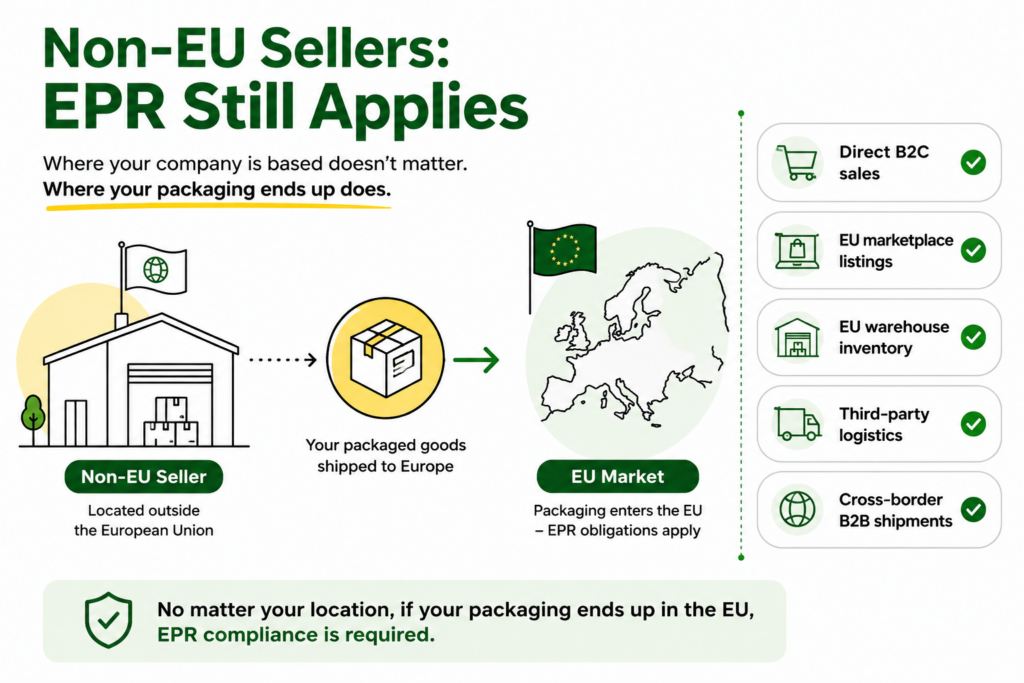
EU packaging regulations reach any company that puts packaged goods onto the EU market, regardless of where it is incorporated, where its warehouse sits, or whether it has a European office. The determining question is not “where are you?” but “where does the packaging end up?”
Six business models consistently generate compliance obligations for non-EU sellers:
- Direct B2C e-commerce to EU consumers. A New York cosmetics brand shipping directly from a US fulfilment centre to addresses in Germany, Austria, and the Netherlands is the “producer” under German, Austrian, and Dutch packaging law. Full stop. The parcels arriving at consumer doors trigger EPR obligations from the day the first one ships.
- Marketplace listings on EU platforms. A Korean electronics seller on Amazon.de faces German VerpackG obligations. Since March 2022, Amazon’s own listing terms require a valid LUCID registration number. Without one, listings are suspended. The platform enforces compliance faster than any regulator.
- B2B wholesale into EU without contractual transfer. A Canadian manufacturer selling components to a Spanish importer retains EPR liability for any packaging that travels with the goods unless the sales contract explicitly assigns producer status to the Spanish buyer. Many contracts don’t say this clearly, and both parties end up liable.
- Fulfilled-by-marketplace with EU warehouse inventory. Goods sitting in an Amazon FBA facility in Poznan or a Zalando hub in Leipzig are considered “placed on the Polish/German market” from the moment they enter the warehouse. Not from the moment they are sold. Stocking EU warehouses without prior EPR registration is a compliance breach from day one.
- Own store with EU third-party logistics. A Taiwanese homeware brand using a 3PL in the Czech Republic to serve European buyers is placing goods on the Czech market. Czech EPR law applies — not whatever law governs the brand’s home country.
- Cross-border B2B without rebranding. An Australian industrial supplier shipping components in original outer packaging to a Belgian manufacturer — if that packaging reaches the end of its lifecycle inside the EU, EPR fee obligations attach, even if no consumer ever handles the packaging directly.
The EU Authorized Representative concept directly addresses scenarios one, two, four, and five. Where the seller has no EU legal entity, member states require a locally accountable representative — a company or individual based in the EU who can be held liable for the non-EU seller’s packaging obligations. Appointing one is not a formality; it is the structural prerequisite for lawful market access.
The complication non-EU sellers routinely underestimate: the 27 EU member states run 27 separate EPR systems with different registration platforms, different PRO markets, different fee structures, and different enforcement agencies. Selling into Germany, France, and Spain means navigating three entirely distinct compliance bureaucracies simultaneously.
How Packaging EPR Works Across EU Member States
France created the world’s first packaging EPR scheme in 1992. Germany’s followed in 1998. By 2004, all EU member states had some version of the system. What took another two decades to develop was enforcement with actual financial consequences for non-domestic sellers — and that shift happened fast, between roughly 2020 and 2023, driven by e-commerce growth, digital customs data sharing, and political pressure from domestic producers who had been paying EPR fees while foreign competitors had not.
The mechanics of packaging EPR are identical in structure across all systems, even if the details vary:
- A producer — or its representative — registers with the national competent authority or its designated registry.
- The producer reports the total weight of packaging placed on the market during the relevant period, broken down b material type: cardboard, plastic, glass, metal, wood, composite.
- Based on those weights, the producer pays annual fees to a licensed scheme operator. Rates vary by material and country; German plastic packaging fees in 2024 ran from €0.40/kg (LDPE film) to €2.10/kg (composite packaging).
- The scheme operator distributes funds to municipalities, waste contractors, and sorting infrastructure to cover the costs of collecting and processing the packaging the producer introduced.
- At period-end — usually calendar year — the producer files an audited data declaration confirming its reported weights. Discrepancies between declared and estimated actual weights attract corrective assessments.
The organisation that sits between the producer and the public recycling infrastructure is the Producer Responsibility Organization, or PRO. Germany licenses nine of them — Landbell, Der Grüne Punkt, Reclay, Interseroh, and five others — and a producer must have an active contract with at least one before placing household packaging on the German market. France takes a different approach: Citeo holds the sole household packaging licence, so every producer selling consumer goods in France contracts with Citeo. Italy’s umbrella body, CONAI, federates six material-specific consortia and functions as the single point of contact for fee calculation. Spain’s Ecoembes handles household packaging; Portugal runs its own Sociedade Ponto Verde system.
The table below compares EPR structures and enforcement parameters across the five largest EU markets:
| Country | Primary PRO(s) | Report Deadline | Fee Basis | Max Penalty |
| Germany | Der Grüne Punkt, Landbell, Reclay (9 total) | 15 May | Weight × material rate | €200,000 + sales ban |
| France | Citeo (household); Léko (industrial) | 31 March | Weight × eco-modulation coefficient | €750,000 |
| Spain | Ecoembes (household) | 31 March | Weight × material rate | €100,000 |
| Italy | CONAI (umbrella, 6 consortia) | 31 March | Weight × material consortia rate | €100,000 |
| Netherlands | Nedvang / PRN | 1 April | Weight × material rate | €820,000 |
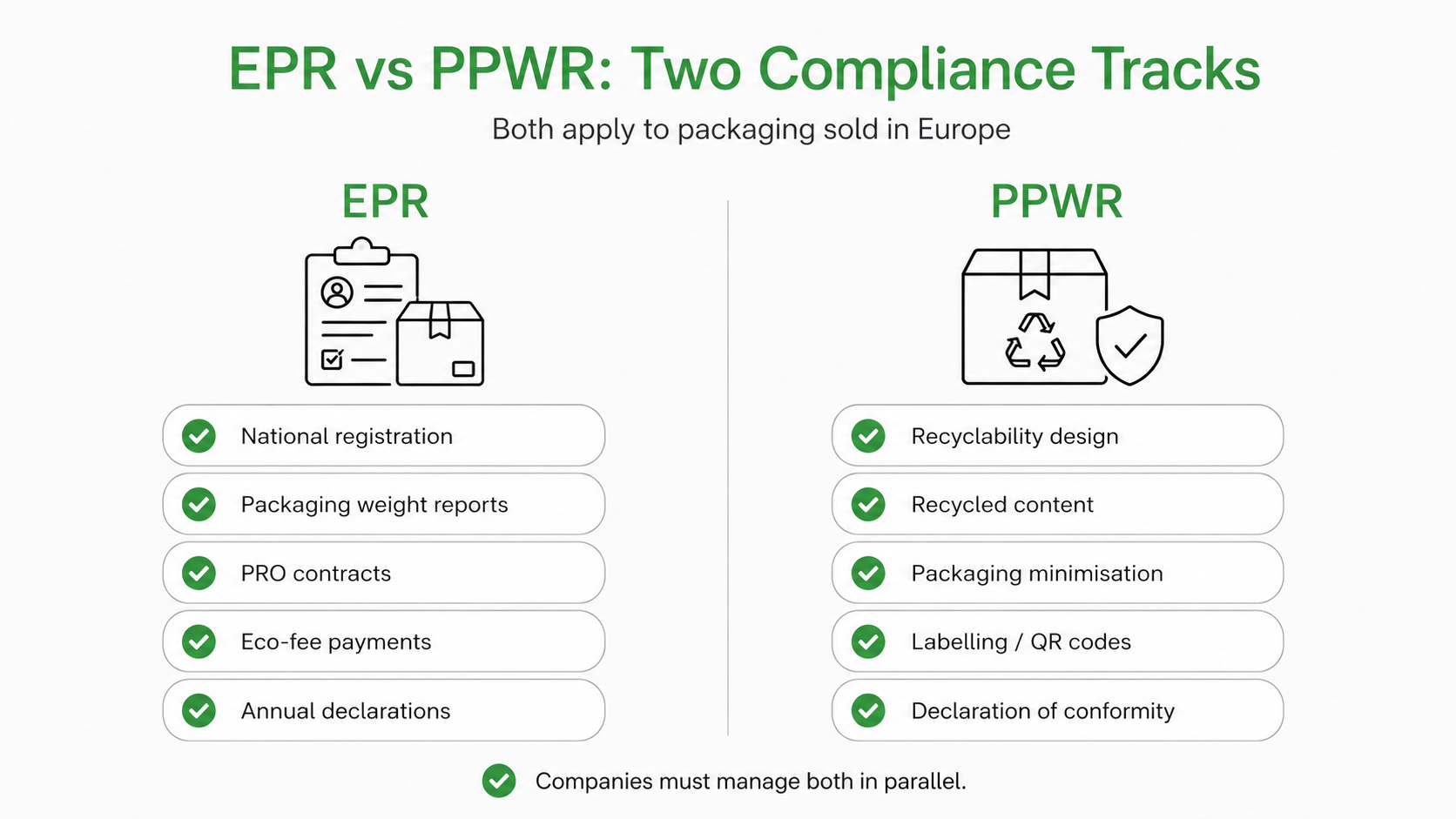
PPWR compliance does not replace any of this. The regulation harmonises definitions, introduces design requirements, and creates new documentation obligations — but the national fee-and-reporting systems continue operating in parallel. A producer navigating both tracks in 2025 is managing EPR registration, PRO contracts, annual weight declarations, and a separate set of PPWR design and documentation records simultaneously.
The Role of an Authorized Representative EU in Your Supply Chain
The catch: most EU member states’ packaging laws require a legal address within the EU for the registered producer. A company incorporated in Singapore or São Paulo does not have one. The solution the law provides is the authorized representative EU — a third party based in the EU who accepts formal legal accountability for the non-EU seller’s packaging compliance obligations.
“Accepts legal accountability” is not rhetorical. Under §9 of Germany’s Verpackungsgesetz, the representative and the non-EU producer are jointly and severally liable. The German authority can pursue either party for unpaid fees, inaccurate reports, or registration failures. The representative’s registered address appears in the public LUCID database. If a German customs official wants to escalate a compliance notice and the non-EU company does not respond, the representative receives the enforcement action. That is why serious providers require indemnity clauses and reserve the right to terminate a mandate if the producer stops cooperating.
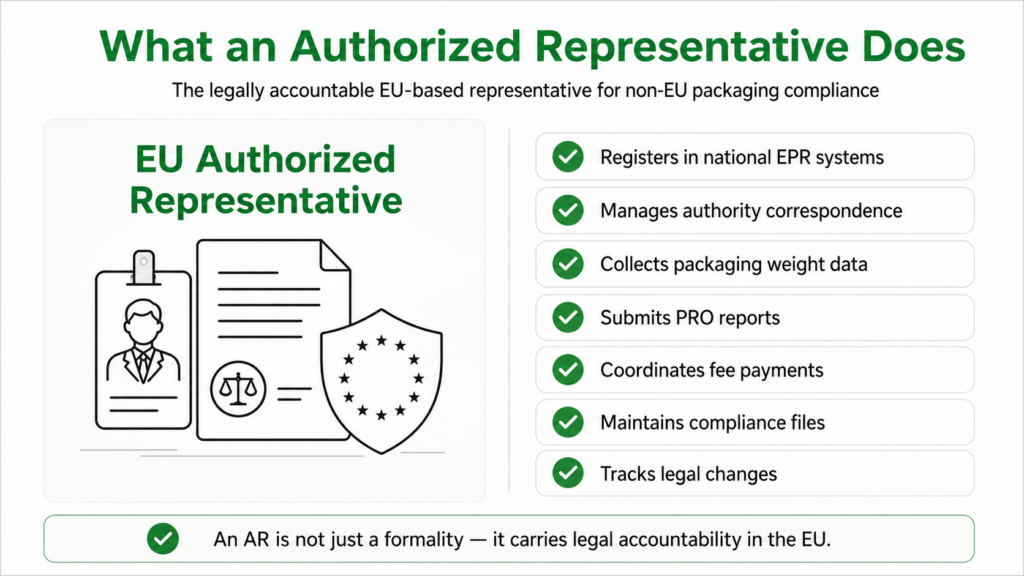
In practice, a full-service authorized EU representative mandate covers:
- Registration in national EPR systems — LUCID in Germany, the AGEC portal in France, SICILYGES in Spain, REPA in the Czech Republic, and equivalent systems in each covered member state
- Regulatory correspondence management — receiving, translating, and forwarding official communications from national authorities to the producer within defined response windows
- Weight data collection and PRO reporting — gathering packaging weight data from the producer, converting it into the format each PRO requires, and submitting declarations by national deadlines
- Fee payment coordination — reconciling PRO invoices against declared weights and managing payment on behalf of the producer
- Compliance file maintenance — keeping a documented record of all registrations, declarations, and fee receipts that can be produced to authorities within 72 hours
- EPR registration in Europe across multiple jurisdictions — coordinating the above across all member states covered by the mandate under a single contractual framework
- Legislative change notification — alerting the producer when new regulations, amended fee schedules, or enforcement guidance materially affect its obligations
When a Mandate Becomes Invalid
Not every authorization agreement does what it promises. A 2024 investigation by the ZSVR in Germany identified 340 representative mandates where the representative had accepted appointments from more producers than it could credibly service — in some cases, more than 2,000 companies listed under a single representative entity with four staff. Authorities in Austria and the Netherlands have run similar audits.
A mandate is legally fragile or practically useless in any of these situations:
- The representative has no physical office — only a virtual address or shared letterbox service
- The mandate contract has no explicit liability clause specifying which legal entity carries joint liability
- The representative cannot demonstrate an active, current registration in the relevant national system — LUCID numbers can be verified publicly
- The producer has never transmitted actual weight data, leaving the representative filing estimates or zeros
- The representative’s mandate document does not reference specific national laws in each jurisdiction it claims to cover
PPWR Compliance — What the New Regulation Actually Demands
The Packaging and Packaging Waste Regulation — Regulation (EU) 2025/40, colloquially PPWR — entered into force on 11 December 2024 and started its phase-in immediately. Unlike the 1994 Packaging Directive it replaces, it is a regulation, not a directive. That means no national transposition. Article 1 of the PPWR applies in identical text in Frankfurt, Warsaw, and Lisbon from its effective date forward.
PPWR compliance spans six distinct obligation categories, each with its own timeline:
- Essential requirements. All packaging must be designed for recyclability, reusability, or energy recovery. Annex IV of the regulation sets minimum recyclability grades (A through E) by packaging format. Grade E packaging — effectively non-recyclable — will be prohibited from 2030 for most categories.
- Recycled content minimums. Plastic packaging must contain at least 30% post-consumer recycled (PCR) material by 2030. By 2040, the threshold rises to 65% for most plastic formats. Contact-sensitive food packaging has separate and lower targets, but still has targets.
- Packaging minimisation. The empty-space ratio in transport and secondary packaging is capped at 40%. This directly affects e-commerce outer boxes where product-to-box-size ratios are high — a common issue for soft goods and fragile items shipped with void fill.
- Labelling and QR codes. From 1 January 2028, all packaging on the EU market must carry a harmonised recyclability label and a machine-readable code (QR or similar) linking to the producer’s EPR registration data and material composition. This will require packaging artwork changes across entire product ranges.
- Reuse targets. Beverages, fresh produce, e-commerce outer packaging, and certain food service formats face mandatory reuse or refill targets starting in 2030. The specifics are being finalised in delegated acts through 2026.
- Restricted and prohibited substances. PFAS are banned from food-contact packaging by 2026. Bisphenol A restrictions tighten in the same period. Producers will need material declarations from their packaging suppliers confirming compliance.
The PPWR declaration of conformity sits at the intersection of these requirements. Every producer or importer placing packaging on the EU market must maintain a signed declaration confirming that the packaging meets the essential requirements of PPWR Article 6 and Annex IV. The document must reference the harmonised technical standards applied (EN 13428, EN 13430, EN 13431, EN 13432), identify the manufacturer and its EU representative, and carry version control so auditors can tell whether it has been updated after packaging changes. Retention period: ten years.
Here’s where it gets tricky for multi-market sellers: the declaration must be available in the official language of each member state where the packaging is placed on the market. A brand selling into six EU countries needs six language versions. National market surveillance authorities can demand the document within 72 hours. Running short of time to translate it is not accepted as a mitigating factor.
EPR Registration Europe — A Step-by-Step Walkthrough
EPR registration Europe-wide is not a single application to a single office. It is a parallel series of national processes, each with its own portal, its own data requirements, and its own timeline. The sequence below maps the German process — the one with the most enforcement activity and the steepest learning curve — with specific notes on where France and Spain diverge.
- Classify all packaging by channel. Separate household packaging (anything that reaches a consumer) from commercial and industrial packaging (stays in the B2B chain). Germany’s VerpackG requires registration and reporting for both categories, though only household packaging triggers fee obligations with most PROs. France and Spain focus almost entirely on household packaging.
- Measure packaging weights by material. For every SKU, calculate the weight in grams of each packaging component by material type. A standard retail product might carry: 62g cardboard outer, 18g LDPE inner bag, 4g PET label. This data drives fee calculations directly. Auditors in Germany and France regularly cross-reference declared weights against import manifests and purchase records.
- Register in the national system before first sale. In Germany: lucid.verpackungsregister.org. Registration takes one to three business days and must be completed before the first unit enters the German market. In France: the AGEC portal, combined with Citeo’s producer registration. In Spain: direct registration with Ecoembes. All three issue a registration number that must appear on invoices, marketplace listings, and PPWR documentation.
- Contract with a licensed PRO. In Germany, select any one of the nine licensed PROs and execute a participation agreement. Rates vary — Landbell has historically offered competitive terms for high-volume multi-material packaging, while some smaller PROs offer lower minimum fees for companies with modest volumes. In France, contracting with Citeo is not optional: it holds the household packaging licence. In the Netherlands, a collective agreement model operates through Nedvang.
- Submit the initial weight declaration. First-year entrants typically submit an estimated forward-looking figure, with a reconciliation against actual sales at year-end. German registrations activated mid-year require a partial-year declaration covering the months of active market presence.
- Pay PRO fees from the invoice. Invoices from PROs arrive in Q1 for the prior calendar year’s declared volumes. Germany’s 2024 blended average across material types ran approximately €0.35/kg. Composite and multi-material packaging attracts the highest rates — up to €2.10/kg for some composite formats.
- File the annual audited compliance report. Germany’s deadline is 15 May. France and Spain require submission by 31 March. A professional audit is required from year two in Germany and from year one in France. Missing a deadline triggers automatic penalty proceedings — the ZSVR issues late-filing notices within 72 hours of the deadline passing.
The EU Authorized Representative manages steps 3 through 7 under a full-service mandate. Some producers handle LUCID registration themselves and outsource only the PRO contracting and annual reporting — workable, but it introduces handoff risk at the data transfer point, which is exactly where discrepancies most commonly originate.
Registration timeline comparison across the three largest markets:
| Country | Registration Platform | Activation Time | First Report Due | Audit Required |
| Germany | LUCID (ZSVR) | 1–3 business days | 15 May (prior year data) | Yes, from year 2 |
| France | AGEC / Citeo portal | 5–10 business days | 31 March (prior year data) | Yes, from year 1 |
| Spain | Ecoembes portal | 3–7 business days | 31 March (prior year data) | Spot audits only |
Packaging Compliance EU — Costs, Timelines and Common Traps
Let’s talk numbers. Packaging compliance EU-wide for a company selling into five member states runs to roughly €8,000–€20,000 in one-time setup costs (representative appointments, initial registrations, first-year reporting) and ongoing annual costs that scale with packaging volume. A brand placing 50 tonnes of household packaging across Germany, France, and Spain in a year might pay €15,000–€25,000 in total annual PRO fees. A brand placing 300 tonnes might pay €90,000–€130,000. The fee burden is real but predictable — if you know what you’re declaring.
The genuine cost risks are not in the fees. They are in what happens when the process breaks down:
- Late registration. Germany treats the day you first ship packaging into the German market as the compliance start date. A brand that began selling in January and registered in April was non-compliant for three months. The ZSVR retroactively calculates fees for that period and adds a fine — typically €5,000–€30,000 for first-time violations, depending on volumes.
- Systematic underreporting. France’s ADEME ran a major packaging EPR audit in 2023 covering non-EU e-commerce sellers. It found that a significant portion of companies that were registered had been under-declaring packaging weights — some accidentally, using wrong conversion factors; some deliberately. Total penalty notices from that audit exceeded €12 million.
- B2C versus B2B misclassification. Selling retail-ready products to EU distributors who then resell them does not necessarily move the EPR obligation to the distributor — it depends on whether the packaging is in its final form at the point of sale and whether the contract assigns producer status. Many wholesale contracts don’t address this, leaving both seller and buyer exposed.
- PRO contract termination. A Producer Responsibility Organization can terminate a participation agreement for non-payment or persistent data failures. When that happens, the producer’s EPR registration effectively becomes inactive — the LUCID entry stays but the compliance standing lapses. Sales continuing after termination are non-compliant from day one of the lapse.
- Over-reliance on marketplace compliance tools. Amazon’s EPR compliance programme covers some packaging types in some markets — but not all, and not automatically. Sellers who upload a LUCID number to Seller Central and assume full coverage are frequently surprised to discover their self-fulfilled orders or certain packaging categories fall outside the scope of what Amazon administers on their behalf.
Three-year cost comparison for a mid-size importer selling into Germany, France, and Spain:
| Scenario | Year 1 Total Cost | Year 3 Total Cost | Penalty Exposure | Risk Level |
| Fully compliant from day one | €12,000–€22,000 (setup + fees) | Annual fees only | Negligible | Low |
| Registered late — year 2 start | Retroactive fees + €8,000–€35,000 fine | Annual fees | Moderate | Medium |
| Never registered | Zero initially | Accumulating liability | €50,000–€750,000 | Sales ban likely |
Choosing and Vetting Packaging Compliance Services
The market for packaging compliance services has expanded sharply since 2021 — dozens of providers now offer some version of EPR registration and representative services for non-EU companies. Quality varies enormously. Some providers run robust legal structures with country-specific staff, licensed PRO relationships, and audit-grade reporting systems. Others are essentially one-person intermediaries with a network of sub-contractors they have never audited themselves.
Seven questions reliably separate the serious providers from the ones that will create more problems than they solve:
- Can you show us active LUCID registration numbers for three current clients in Germany? A provider that hedges this question or offers to show you “sample documentation” instead of live registration numbers is a provider whose actual registration infrastructure is unverified.
- Which legal entity accepts joint and several liability in each jurisdiction? The entity named in the mandate contract must be the entity registered in the national system. Sub-contracting through a shelf company that holds no PRO contracts is a structural failure mode we see regularly in provider audits.
- How does weight data flow from us to you, and what is the audit trail? A provider that accepts spreadsheets by email with no versioning creates a data integrity problem. When an authority requests your declared weights, the question is whether you and your provider can produce identical figures from the same source. If the answer is uncertain, the system has a gap.
- Do you have references from clients outside the EU, specifically in our sector? Managing packaging compliance for an EU-based retailer and managing it for a non-EU e-commerce seller are not the same task. The tax residency, currency, time zone, and data transfer logistics are all different.
- How quickly do you notify clients of regulatory changes? PPWR is generating delegated acts, implementing acts, and national guidance notes continuously through 2025 and 2026. A provider whose communications are quarterly newsletters is operating on a lag that will leave you behind regulatory timelines.
- Are PRO fees, representative fees, and administration charges itemised separately? Bundled annual invoices make it impossible to verify whether the fees declared to your PRO match what you paid. Itemised pricing is the baseline for any serious compliance relationship.
- What is the termination and mandate transfer process? Switching providers should require no more than 30–90 days’ notice and should include the provider’s cooperation in transferring registrations, PRO contracts, and mandate documentation. Providers who resist reasonable exit terms are providers whose data management you should suspect.
PPWR Declaration of Conformity — What Goes in the Document
The PPWR declaration of conformity is not a form you download and fill in. It is a technical document you draft, sign, and maintain — and keep current for ten years. Market surveillance authorities across the EU can request it within 72 hours. If you cannot produce it, or if it references technical standards your packaging does not actually meet, you face injunction proceedings and potential sales suspension.
A legally complete declaration contains:
- Manufacturer identification: legal name, full registered address, and — where the manufacturer is outside the EU — the name and address of the authorised EU representative
- Packaging description: material type(s), dimensions, weight, intended use, and the product category it serves
- Applicable standards: EN 13428 (prevention at source), EN 13430 (recyclability), EN 13431 (energy recovery suitability), EN 13432 (compostability) — as relevant to the packaging type. Not every standard applies to every packaging format; the declaration should specify which apply and why.
- Conformity statement: a signed declaration that the packaging meets the essential requirements of PPWR Article 6 and, where relevant, the recycled-content thresholds of Article 7
- EPR registration references: registration numbers for each member state where the packaging is placed on the market — Germany LUCID number, French AGEC registration, etc.
- Version control: document version number, issue date, and date of last revision — essential for demonstrating that the declaration was updated when packaging changed
- Signatory: name, title, and signature of the person taking legal responsibility for the declaration’s accuracy
Packaging compliance EU obligations require a fresh declaration — or at minimum a formal revision — whenever the packaging design changes in a way that affects its recyclability grade, material composition, or weight. A packaging supplier swap that changes the cardboard grade, a shift from virgin to recycled-content plastic, an added PFAS-free coating: all of these require a declaration update.
We see this happen often: a brand launches in 2025 with a properly drafted declaration. In 2026 its packaging supplier changes the film specification to reduce costs. Nobody updates the declaration. In 2027 a French market surveillance inspector requests it, finds a material discrepancy, and issues a formal notice requiring product withdrawal pending correction. The correction takes six weeks. The cost of the disruption dwarfs whatever savings the supplier change delivered.
EU Authorized Representative — Liability, Contracts and Red Lines
The EU Authorized Representative function in packaging law borrows its structure from the Regulation (EU) 2019/1020 product market surveillance framework, where designated EU representatives for non-EU manufacturers carry documented liability for compliance failures. In packaging, the same principle applies: the representative is not an agent who helps you comply — it is an entity that stands jointly liable with you before national enforcement authorities.
Any contract between a non-EU producer and its packaging representative that omits these five elements is incomplete:
- Jurisdiction specification: explicit listing of each member state covered, with reference to the specific national law that creates the obligation (§9 VerpackG for Germany, Article L541-10 Code de l’environnement for France, etc.)
- Mandate scope: clear delineation of whether the representative handles registration only, registration and reporting, or full fee management — and which packaging categories are included
- Producer indemnification: explicit indemnification by the producer for any liability the representative incurs as a direct result of inaccurate, incomplete, or late data provided by the producer
- Exit and transfer procedure: notice periods (typically 30–90 days) and a defined process for transferring all registrations, mandate documentation, and PRO contracts to a successor representative without interruption to compliance standing
- Data obligations: the format, frequency, and deadline by which the producer must supply packaging weight data — and the consequences if those obligations are not met (typically: representative’s right to terminate with shortened notice)
Three red lines that make a representative contract either unenforceable or dangerous:
- A contract that names coverage for “all EU countries” without specifying national laws per jurisdiction. Unenforceable in most member states. Each national obligation requires explicit contractual acknowledgement.
- A contract signed by a representative that cannot show active, verifiable registrations in named national systems. LUCID registration numbers are publicly searchable. If the provider cannot give you a live registration number before you sign, it is not actively representing producers in Germany.
- No indemnification clause at all. Any legitimate provider will insist on being indemnified by the producer for liability arising from the producer’s own data failures. A provider that accepts liability without indemnification either does not understand its exposure or has no intention of responding when that exposure crystallises.
EPR registration for European markets is most efficiently managed when a single representative handles all jurisdictions through country-specific sub-mandates, rather than five separate providers for five countries. The coordination failures that emerge from multi-provider structures — mismatched weight declarations, inconsistent fee payment records, gaps in regulatory correspondence — generate audit risk that is entirely avoidable.
Producer Responsibility Organization — How to Pick the Right One
Your Producer Responsibility Organization contract is not a commodity purchase. The PRO you select determines your fee calculation methodology, your reporting portal, your certificate of participation (which authorities use to verify active compliance), and your exposure if the PRO itself faces regulatory sanctions. In markets with multiple licensed PROs, the selection deserves serious analysis.
In Germany, where nine PROs compete for contracts, the key differentiators are:
- Fee rates by material. Rates vary by as much as 30% between PROs for the same material category. For a company placing 100 tonnes of mixed plastic packaging annually in Germany, a 30% rate difference represents a meaningful cash cost. Request fee schedules for all nine licensed PROs and model your annual fee against each before signing.
- Portal functionality. Your packaging compliance services provider or your internal team will use the PRO’s reporting portal for quarterly or annual data submissions. Portals range from modern, API-integrated systems to legacy tools that require manual CSV uploads. If you manage dozens of SKUs across multiple markets, portal quality affects real operational time.
- Certificate issuance speed. When an authority in Germany or elsewhere requests proof of active compliance, the PRO must issue a certificate of participation confirming that you are registered, current with fee payments, and in good standing. Ask prospective PROs how quickly they issue certificates — anything beyond 48 hours is operationally problematic.
- Material stream coverage. Most large PROs handle all material types, but some have better infrastructure for speciality categories — wood packaging, composite materials, beverage cartons. If your product range includes unusual packaging materials, verify coverage explicitly before contracting.
In monopoly or near-monopoly markets, the selection decision does not exist — Citeo in France, CONAI in Italy, SPGV in Portugal. But the contracting process still takes time and requires accurate master data from day one. Errors in the initial Citeo registration (wrong company name format, incorrect material classifications) create reconciliation problems that persist for years because the data becomes the baseline for all future fee calculations.
Packaging compliance EU harmonisation under PPWR will eventually reduce the number of separate PRO contracts a multi-market producer needs to manage. The regulation’s 2028 digital registry is designed to create a single data submission point. Until that infrastructure is operational and tested, the current multi-PRO, multi-country management structure is the operating reality.
Country-by-Country Differences That Catch Importers Off Guard
The EU harmonises a great deal, but not EPR enforcement culture. Each member state’s packaging regulator has its own enforcement priorities, its own detection methods, and its own appetite for pursuing non-EU sellers specifically. The country profiles below reflect where non-EU businesses most commonly get surprised.
Germany runs the most automated enforcement system in Europe. The ZSVR database is publicly queryable by anyone — including Amazon’s compliance team and the platform operators of Otto, MediaMarkt, and About You. Any marketplace operator wanting to verify your compliance simply searches LUCID. Beyond the database, customs data from Germany’s Zollkriminalamt is cross-referenced against LUCID registrations quarterly. A non-registered importer showing up in customs records triggers a formal notice automatically. Germany also registers service packaging (takeaway containers, delivery bags) and transport packaging as separate categories from retail packaging — a distinction many logistics-heavy brands miss entirely.
France combines EPR enforcement with an aggressive product sustainability agenda. Its sorting instructions obligation — mandatory on-pack guidance in French telling consumers how to sort the packaging — predates PPWR’s harmonised label and remains separately enforceable. Citeo’s eco-modulation fee structure actually rewards recyclable packaging with lower rates: switching from a PVC blister to a cardboard alternative can reduce French PRO fees by 40–60% for the same packaged product.
The Netherlands has Europe’s highest EPR penalty ceiling — €820,000 for non-registration — and an enforcement authority, the ILT, that actively cross-references Rotterdam customs records against the PRN registration database. Goods landing at Rotterdam without a Dutch PRN registration number on file generate ILT notices within weeks. The Dutch market is small relative to Germany and France, but its enforcement speed is unmatched.
Poland updated its packaging law in 2023 to align with PPWR and simultaneously strengthened enforcement against non-EU sellers. Polish customs and the Chief Inspectorate of Environmental Protection issued 847 compliance orders to foreign sellers in the first half of 2024, with fines averaging PLN 35,000 (approximately €8,000). Poland has become a significant logistics hub for Central and Eastern European e-commerce, which means many brands are placing packaging on the Polish market without realising it.
Austria runs a dual-PRO system through ARA and Interseroh Austria. PPWR declaration of conformity checks are being integrated into the ARA registration process, and Austrian customs has started requesting declaration documents at the point of import for packaging-heavy product categories since Q1 2025. The Austrian market is relatively small, but its proximity to Germany means many companies active in Germany are also inadvertently placing packaging on the Austrian market through third-party distributors.
The EU Authorized Representative mandate must be calibrated to these country-specific enforcement environments. A representative with deep knowledge of Germany but only generic familiarity with Dutch or Polish requirements will miss obligations that are routine in those markets and expensive to fix retrospectively.
Enforcement Trends — Fines, Market Bans and Border Seizures
Between 2019 and 2025, EU packaging enforcement shifted from a system where penalties for non-EU sellers were theoretically possible but practically rare, to one where automated detection has made non-compliance genuinely risky at scale. Three structural changes drove the shift:
Digital customs integration. The EU’s Import Control System 2 (ICS2), phased in from 2021 to 2024, requires advance cargo data for all shipments entering the EU — including e-commerce parcels. This data is now being cross-referenced against EPR registration databases by several member state authorities. Germany was first, running a 2023 pilot that generated over 3,400 enforcement letters from a single data-matching exercise across 12 product categories.
Marketplace listing enforcement. Under the Digital Services Act, large online platforms face direct liability for enabling non-compliant sellers. Amazon, Zalando, and bol.com now require valid EPR registration numbers as a condition of active listings in Germany, France, the Netherlands, and Spain. The enforcement mechanism here is faster than any regulatory process: non-compliant sellers lose listing access in days, not months. For a brand dependent on European marketplace revenue, that is a more immediate risk than a fine.
PPWR market surveillance authority. The PPWR grants national market surveillance bodies the explicit power to inspect packaging, demand PPWR declaration of conformity documents, and issue injunctions. The first six months of 2025 saw 14 formal injunctions issued against non-EU sellers in Germany and France under PPWR, each requiring either product withdrawal or compliance documentation within 30 days.
Packaging compliance services that include active regulatory monitoring — not just annual reporting — are positioned differently in this environment. A service that flags an ICS2 data match before the official notice arrives, or that responds to a 72-hour declaration request without requiring the producer to locate and translate the document themselves, is providing genuine risk management rather than administrative processing.
The brands that have avoided enforcement action consistently are not the ones with the most complex compliance structures. They are the ones that registered before selling, kept their weight declarations accurate, maintained current PPWR documentation, and built their representative mandate to cover the markets where they actually have volume. The compliance architecture is not that complicated once it is in place — the difficulty is almost always in doing it before the first notice arrives rather than after.
Frequently
asked question


Does every non-EU seller need an authorized representative EU, or only large companies above a revenue threshold
No turnover threshold applies. Any company placing packaged goods on the EU market triggers EPR registration obligations, regardless of size or revenue. Germany’s VerpackG has a de minimis exemption from fee payment for producers placing under 25kg of household packaging per year — but registration is still required even below that threshold. The representative obligation kicks in as soon as you place goods on the market, not at any sales volume above zero.
Can one provider act as both a packaging compliance service and an EU authorized representative
Yes, and the most operationally efficient structure usually involves a single provider doing both. The critical verification is that the provider holds the relevant legal authorisations in each jurisdiction it claims to cover, and that the representative mandate contract explicitly names the legal entity carrying liability in each country. Bundling is efficient; the risk is in assuming that a provider offering both services has actually constructed both properly in each market.
What happens to EPR registration if a PPWR declaration of conformity is found non-compliant during a market surveillance inspection
The two systems are legally independent. An EPR registration number in LUCID remains valid even if a PPWR inspection finds a conformity failure. However, a PPWR non-conformity finding typically results in a mandatory withdrawal of the non-conforming packaging from the market pending remediation — which means the product cannot be sold during the correction period. EPR fees already paid for that packaging are not refunded, and the registration obligation continues unchanged.
How often do PRO fee schedules change, and will I get advance notice
Most Producer Responsibility Organizations publish updated fee schedules in Q3 or Q4 each year, effective 1 January of the following year. Rate changes of 10–25% between years are common when collection and sorting infrastructure costs shift. Some PROs offer fixed-rate contracts for high-volume producers that lock rates for two to three years — worth negotiating if your packaging volumes are large and predictable.
Does PPWR compliance apply to packaging used only in B2B transactions, not in consumer products
PPWR applies to all packaging placed on the EU market without exception — consumer, commercial, or industrial. Transit packaging, outer shipping containers, and reusable bulk packaging all fall within scope. The essential requirements and the PPWR declaration of conformity obligation apply to all categories, though recycled-content targets and reuse mandates are phased differently for industrial versus household packaging formats.

