

EPR for Electronics by Country: EEE Registration Thresholds Across the EU and UK
EPR for Electronics by Country – EEE Registration Thresholds Across the EU and UK
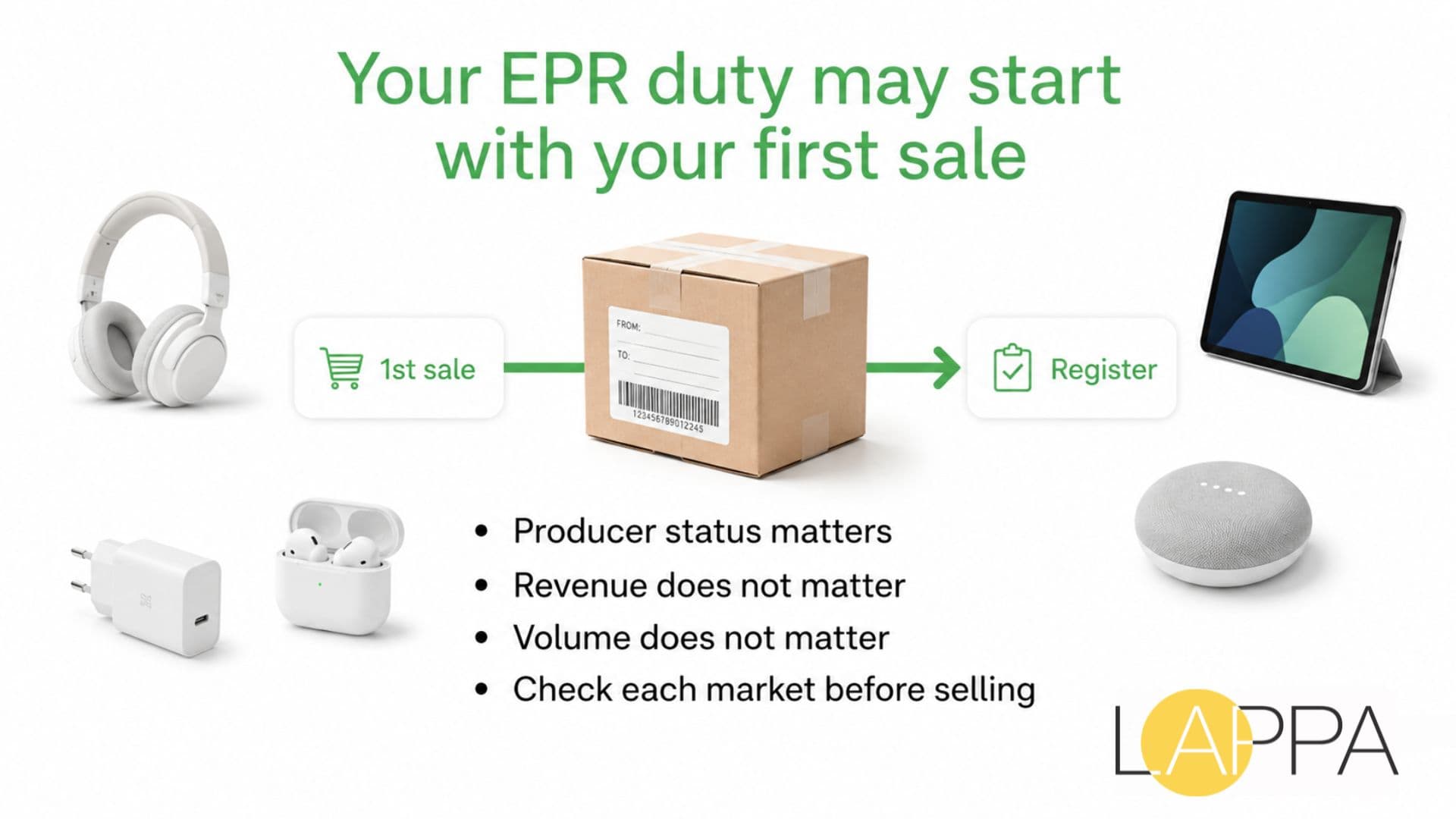
Cross-border sellers of electronics often search for a numeric EPR threshold: a turnover figure or unit volume that triggers EPR registration. The search is understandable, but for most markets it leads to the wrong conclusion. Under EEE and WEEE rules across the EU and UK, there is no de minimis threshold. EPR registration is required from the moment you meet the definition of a producer or distance seller in that country, which in practice means the first unit sold.
The compliance question is not “when do I hit the threshold?” It is “am I already considered a producer in this market?” For many cross-border sellers, the honest answer is yes, and they have been since their first sale.
Key takeaways:
- For EEE/WEEE, the EPR registration threshold in the UK and across the EU is effectively zero: registration is required from the first unit if you meet the producer or distance seller definition.
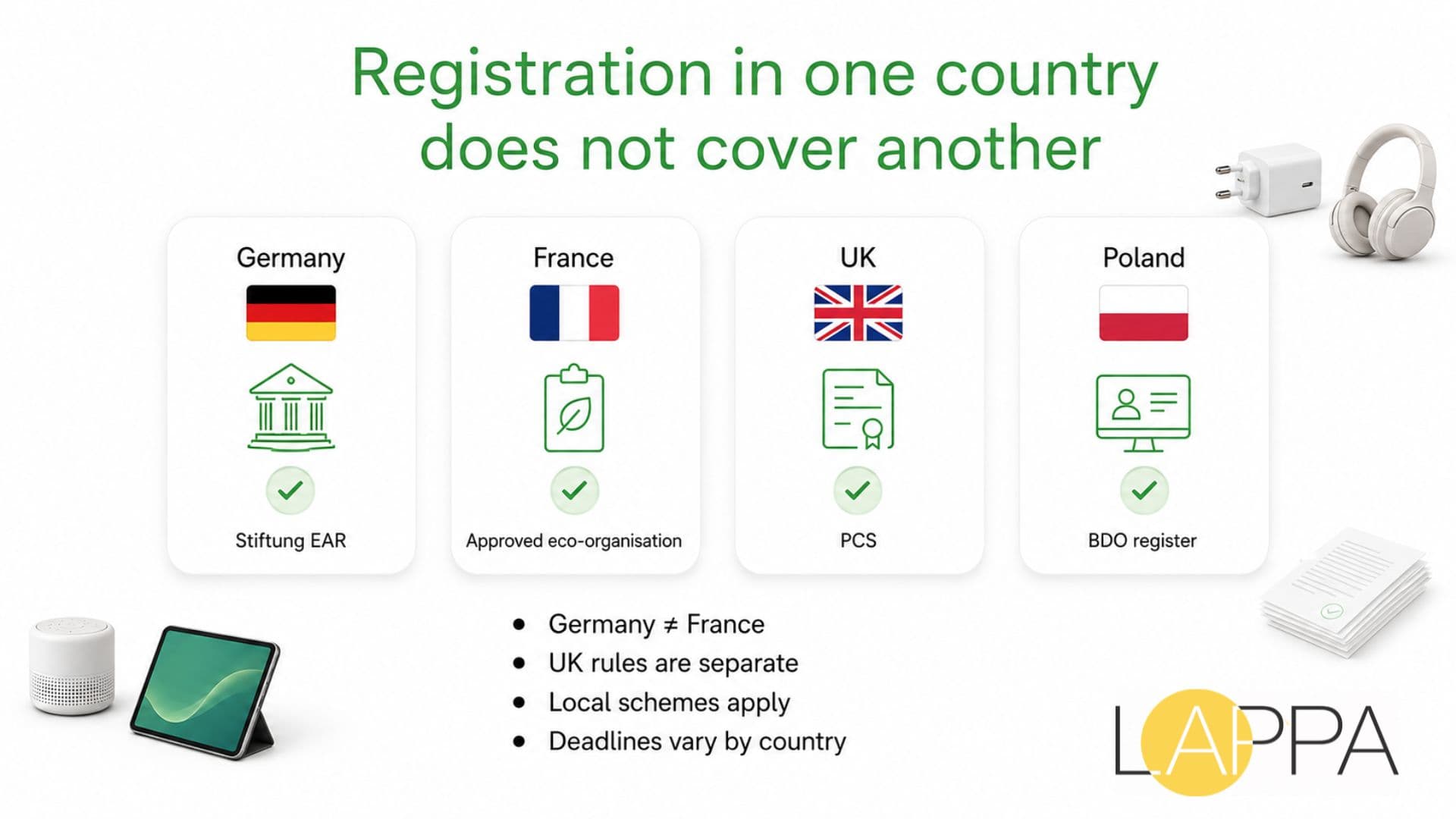
- Registration is country-by-country. Registering in Germany does not cover your obligations in France, the Netherlands, or anywhere else.
- 2025-2026 changes have made this more urgent: UK online marketplace operators became producers for non-UK sellers of household EEE from 12 August 2025, and non-EU sellers may need authorised representatives in each target EU country by 12 August 2026.
This guide maps the EPR registration position across key EU markets and the UK, explains what actually triggers the obligation, and helps sellers prioritise action before penalties or marketplace disruption hit.
EEE Registration Thresholds by Country – Quick Reference
The table below answers the core query directly. For every country listed, the EEE/WEEE EPR registration threshold is effectively zero: registration is required from the first unit placed on the market if you meet the producer or distance seller definition under local law. The variation between countries is not in the threshold amount but in who bears the obligation, whether an authorised representative is required, and how reporting is structured.
|
Country |
EEE Registration Threshold |
AR Required for Non-Established Sellers |
Register With |
|
United Kingdom |
None (first unit) |
No (OMP may absorb obligation for household EEE from Aug 2025) |
Producer Compliance Scheme (PCS) |
|
Germany |
None (first unit) |
Yes |
Stiftung EAR |
|
France |
None (first unit) |
Yes |
ADEME-approved eco-organisation |
|
Netherlands |
None (first unit) |
Yes |
RVO / approved compliance scheme |
|
Italy |
None (first unit) |
Yes |
RAEE register (CdC RAEE) |
|
Spain |
None (first unit) |
Yes |
MITECO / approved SIG |
|
Poland |
None (first unit) |
Yes |
BDO register |
|
Sweden |
None (first unit) |
Yes |
Naturvårdsverket / approved system |
|
Belgium |
None (first unit) |
Yes |
Recupel / approved system |
|
Austria |
None (first unit) |
Yes |
EAK (Elektroaltgeräte Koordinierungsstelle) |
|
Czech Republic |
None (first unit) |
Yes |
ISOH register |
|
Hungary |
None (first unit) |
Yes |
MOHU / approved system |
As Lappa’s EPR thresholds guide confirms, the EEE/WEEE registration threshold across covered jurisdictions is zero. This is a fundamental difference from EPR for packaging , where some countries still apply turnover or tonnage thresholds before registration is required.
The practical implication: if you have already shipped a single unit of EEE to a consumer in Germany, France, or Poland, your EPR registration obligation likely began with that sale. The table above covers the primary ecommerce destinations; the same zero-threshold logic applies across all EU member states implementing the WEEE Directive, including those not listed above.
For country-specific registration steps and reporting requirements, see the EPR registration service and individual country guides.
What Actually Triggers EEE Registration
The absence of a numeric threshold does not mean the obligation is vague. EEE/WEEE EPR registration is triggered by producer status, not by revenue, volume, or marketplace turnover. Under both UK law and the EU WEEE Directive, “producers” include a broad range of business activities that cross-border ecommerce sellers routinely carry out.
Who qualifies as a producer under WEEE rules
You are likely treated as a producer, and therefore subject to registration, if you do any of the following in relation to EEE sold to end-users in a given country:
- Manufacture and sell EEE under your own brand name
- Import EEE into the country from another country (including from outside the EU or UK)
- Rebrand EEE by placing your own name or trademark on it, regardless of who manufactured it
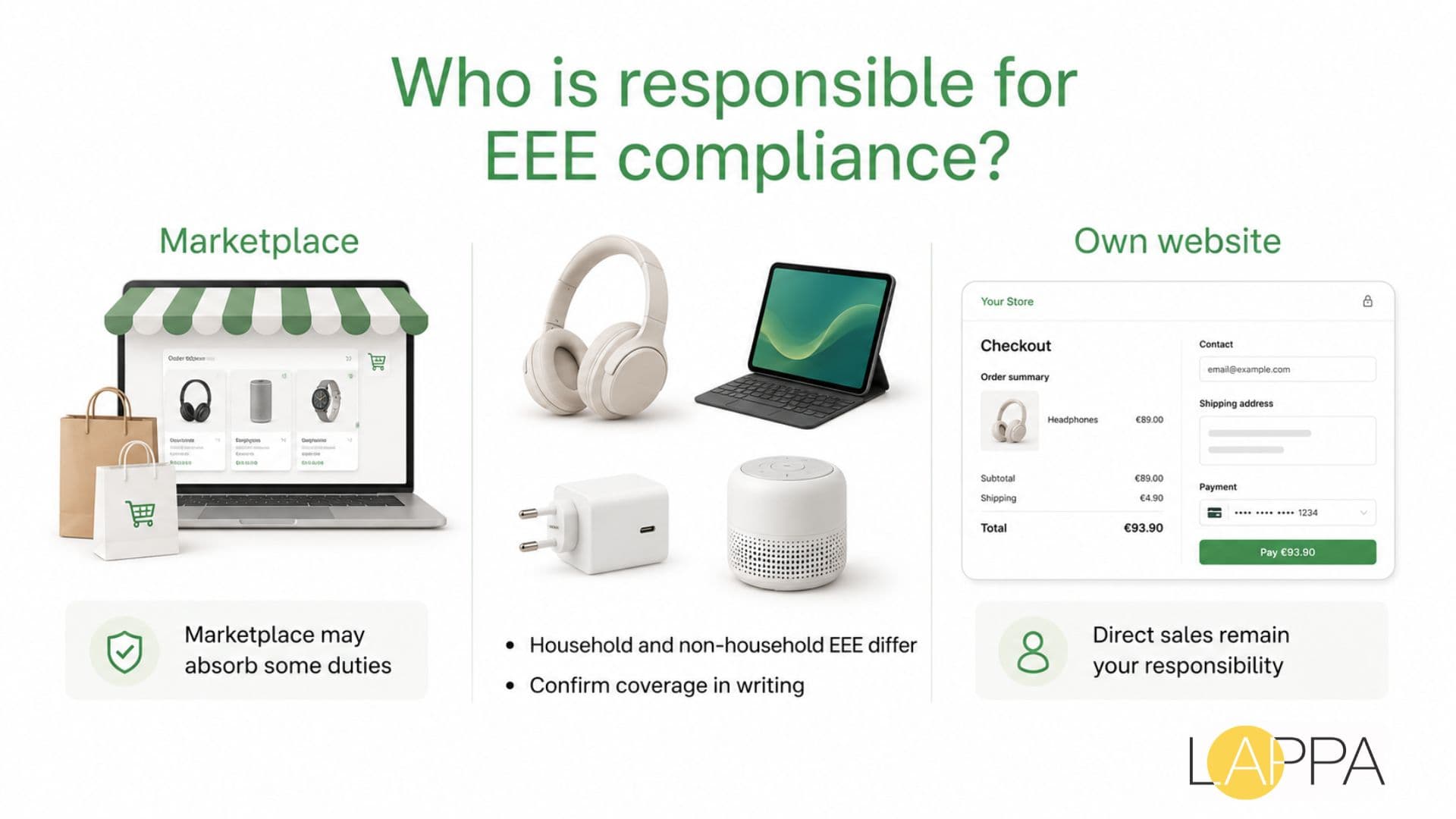
- Distance sell EEE directly to private households, including via your own website or a marketplace where the marketplace does not absorb the obligation
- Place EEE on the market for the first time in that country, even if another party handles fulfilment
As Lappa UK EPR guide notes, producers include “manufacturers, importers, rebranders, and distance sellers to end-users.” This definition is intentionally wide.
Why mixing EPR regimes causes mistakes
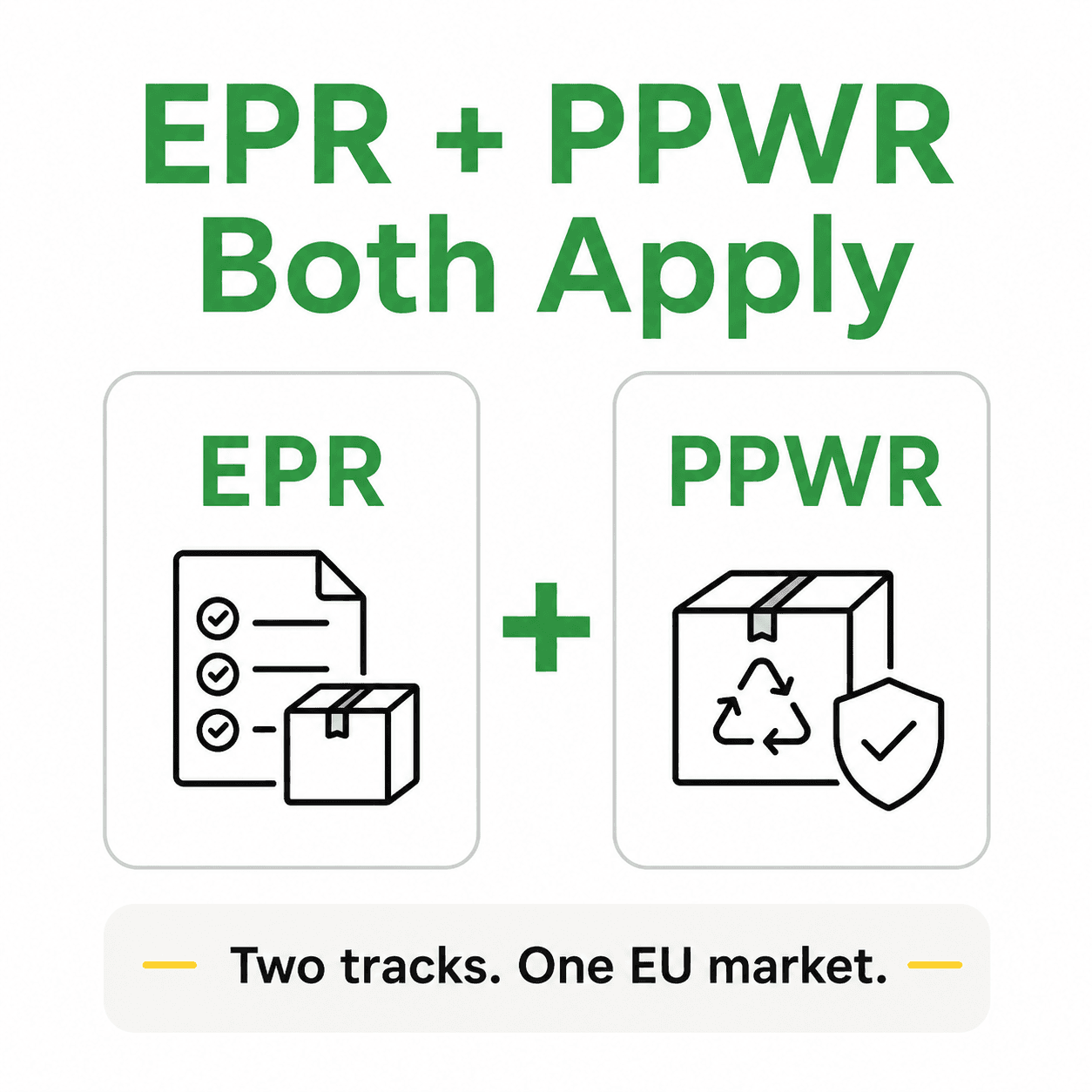
This is where sellers frequently go wrong. EPR for packaging in several EU countries still applies turnover or tonnage thresholds before registration is required. EEE/WEEE does not. A seller who has correctly identified that they are below a packaging threshold in, say, the Netherlands, may incorrectly assume the same logic applies to their electronics obligations. It does not — Extended Producer Responsibility rules for electronics and for packaging are governed by separate directives, and the EEE obligation starts from the first unit regardless of volume. The two regimes are separate, and the EEE obligation starts from the first unit regardless of volume.
Country Nuances That Change Your Obligations
A zero threshold does not mean identical obligations everywhere. Even where the registration trigger is the same, the mechanics of compliance differ significantly between countries. Understanding these differences is what separates a compliant multi-market operation from one that is registered in one country and exposed everywhere else.
The key variables that differ by country
- Registration is country-by-country, not EU-wide. As compliance specialists consistently emphasise, “EPR is managed country by country, not EU-wide” and “registering in one country does NOT cover sales in another.” A seller registered in Germany for EEE has no coverage in France, Italy, or Poland. Each country requires its own EPR registration with its own national register or approved compliance scheme.
- Authorised representatives are mandatory for non-established sellers in most EU countries. If you do not have a legal establishment in the country where you are placing EEE on the market, you will typically need to appoint a local authorised representative (AR) to act on your behalf. This is not optional. The under extended producer responsibility rules, the AR takes on legal responsibility for your compliance obligations in that country. Non-EU sellers expanding into the EU should factor AR appointment into their market-entry timeline.
- Classification of household vs non-household changes reporting obligations. The EU WEEE Directive segregates EEE into 10 categories, and whether a product is household or non-household EEE determines the reporting streams that apply, and the periodicity of reporting. Incorrectly classifying products is one of the most common failures identified by specialists. Under the EU WEEE Directive, EEE is divided into 10 separate categories, and whether a product falls under the household or non-household category of EEE determines which reporting streams are applicable and at what frequency. Misclassification of products is one of the most common compliance failures, specialists say.
- Labelling must comply with EN 50419:2022. Products placed on the EU and UK market must carry the crossed-out wheelie bin symbol in accordance with the EN 50419:2022 standard. Non-compliant labelling can trigger enforcement action independently of registration status.
Important note: Directive (EU) 2024/884 required EU member states to implement updated WEEE-related rules by 9 October 2025.
UK Spotlight – The Change on 12 August 2025
Recent changes in UK for online marketplaces took a change from 12 August 2025. From that date, online marketplace operators (OMPs) became classified as producers under UK WEEE regulations for household EEE sold by non-UK sellers on their platforms.
What this means in practice
|
Question |
Answer |
|
Which sellers does this affect? |
Non-UK sellers of household EEE using UK online marketplaces |
|
Does the OMP take on all obligations? |
For household EEE sold via the OMP, yes: the marketplace registers and reports |
|
What about non-household EEE? |
Non-household EEE sold via OMPs is not covered; the non-UK seller retains the obligation |
|
What about direct-to-consumer sales (own website)? |
The seller remains the producer and must register independently |
|
When must new businesses register? |
Within 28 days of the first sale, per UK Government guidance |
|
When do registrations renew? |
Annually, by 1 January each year |
Reporting cadence by producer type
The UK also differentiates reporting frequency based on producer size:
- Small producers (below the large producer threshold): annual reporting, submitted by 31 January
- Large producers of household EEE: quarterly reporting
- Large producers of non-household EEE: annual reporting
As ERP UK has noted, the OMP change creates significant data management demands: “Sudden inclusion creates reporting gaps; unprepared OMPs risk non-compliance fines.”
The risk for sellers: do not assume the marketplace has absorbed your EPR registration obligation without confirming it in writing. The OMP rule applies to household EEE only, and the UK Government is explicit that non-compliance risks unlimited fines and prosecution. Sellers with mixed product ranges spanning household and non-household EEE need to verify their position for each product category separately.
For a full breakdown of UK WEEE obligations, see the UK EPR/WEEE guide.
Common Mistakes That Lead to Fines or Sales Disruption
The compliance failures that result in penalties are rarely exotic. They follow predictable patterns that sellers can identify and correct before enforcement action or marketplace disruption forces the issue.
The most frequent EEE compliance failures
- Assuming a threshold exists and waiting. The single most common error. Sellers delay EPR registration until sales volume grows, not realising the obligation started with their first sale. By the time they investigate, they may have years of unregistered activity to remediate.
- Treating EU registration as a single task. Registering in one EU country and assuming it covers the rest. It does not — Extended Producer Responsibility is administered nationally, and each country is a separate obligation with a separate register, separate scheme fees, and separate reporting deadlines.
- Misclassifying product categories. Placing a product in the wrong WEEE category changes which reporting stream applies and can result in faulty registrations.
- Failure to include electronics in the proper category
- The whole process is not finishing only on registration. It is required to report weights and types of EEE Waste – and each country has their own deadlines.Find each country specific information on Lappa’s EPR Guide. Some jurisdictions might have up to €200,000 fines for improper filling of EPR reports.
The EPR for EEE complete guide covers the full scope of obligations and recycling requirements for sellers who want a deeper reference.
How to Prioritise Registration Across Markets
Knowing that EPR registration is required from the first unit in every market is useful. Knowing where to act first is what makes compliance manageable. The priority matrix below helps sellers sequence their registration work based on risk exposure.
Registration priority matrix
|
Priority |
Scenario |
Action |
|
Immediate |
Already selling EEE to consumers in a country with no registration in place |
Register now; assess historic exposure |
|
Immediate |
Selling non-household EEE via a UK marketplace (not covered by OMP rule) |
Register with a PCS independently |
|
Immediate |
Selling directly to EU consumers without an authorised representative |
Appoint an AR; begin registration |
|
High |
Planning to enter a new EU market in the next 6 months |
Complete registration before first sale |
|
High |
Non-EU seller without EU establishment targeting multiple EU countries |
Appoint ARs by 12 August 2026 per the |
|
Medium |
Selling household EEE via a UK marketplace (OMP absorbs obligation) |
Confirm OMP coverage in writing; retain records |
|
Review |
Selling via EU marketplace |
Verify whether marketplace absorbs obligation per local rules |
Three practical steps before expanding into new markets
- Review your product categories and labelling. Check which WEEE category each product falls under and check that packaging and product labelling is compliant with EN 50419:2022 before entering a new market. Check if you are a producer in each target country based on your business model: importing, branding, distance selling or manufacturing.
- Take a look at your product categories and labelling. Before entering a new market, determine the WEEE category of each product and ensure that product and packaging labelling is compliant with EN 50419:2022
- Treat EPR and VAT as a single market-entry checklist. Both are registration obligations that apply from the first sale and both can block marketplace access if missed. Handling them together — especially for sellers whose company operates across both EEE and EPR for packaging categories — reduces the risk of entering a market compliant on one front but exposed on the other. The EPR reporting platform and Authorised representative service can centralise both obligations.
The Real Threshold Is Readiness
For EEE, the threshold question resolves quickly: in the UK and across the EU, it is the first unit. Extended producer responsibility does not begin when your sales volume becomes significant — it begins with your first transaction as a producer. What varies is not when the obligation starts but how complex it is to meet across multiple countries simultaneously.
The sellers who manage this well treat EPR registration as a market-entry prerequisite rather than a post-launch task. They verify producer status before their first sale in each country, appoint authorised representatives where required, and keep EPR and VAT compliance in the same operational workflow rather than managing them separately.
Steps recommended to check before you make a new market entry:
- What is your status in the targeted countries?
- Is your EEE correctly classified by WEEE category (household vs non-household)?
- Do your products carry a compliant EN 50419:2022 WEEE label?
- Have you appointed an authorised representative in each EU country where you lack local establishment?
- For UK sales via marketplace: has the OMP confirmed in writing that it covers your product category?
If any of these remain unresolved, the exposure is live.
Book a compliance consultation to map your EPR and VAT obligations across your target markets and establish a clear registration timeline.
Frequently Asked Question
No. One EPR registration does not cover all EU countries. EPR is managed nationally, so registering in Germany does not cover France, Italy, Poland, the Netherlands, or other EU markets.
Lappa helps businesses manage EPR compliance country by country, so sellers can register in the correct markets, meet local reporting deadlines, and avoid assuming that one registration covers the entire EU.