


France Professional Packaging EPR 2026 and What Businesses Must Do to Stay Compliant
France is rewriting the rules for professional packaging. A new extended producer responsibility scheme starts July 1, 2026.It covers wrapping and containers used between businesses, not those sold to households. Companies that manufacture, import, or sell packaged goods now carry direct legal duties. Many never registered with a producer scheme before. The change comes from Decree No. 2025-1081, published November 17, 2025. A detailed specifications order followed on December 2, 2025. Together, these texts replace the catering container scheme running since March 2024.
Not sure how this affects your business? Get a free quote or book a demo to map your obligations with a specialist.
France’s new professional packaging EPR rules starting July 2026
The new scheme is called EPRO, short for emballages professionnels. It absorbs the catering packaging REP from 2024. Coverage now extends to far more packaging types. From July 1, 2026, four categories sit inside its scope. They are sales, grouping, transport, and specific containers. The decree entered into force January 1, 2026. Registration and contribution payments start operationally on July 1.
Professional packaging covers goods packaged for sale, grouping, or transport between businesses. Any professionally packaged product moving strictly between companies counts. Household packaging stays under the existing Citeo system. Packaging already covered by another scheme stays out of scope. That includes electronics and batteries. Lappa’s compliance specialists handle these scope questions daily. Misclassifying even one packaging line creates real exposure later.
Four packaging categories fall within EPRO’s scope:
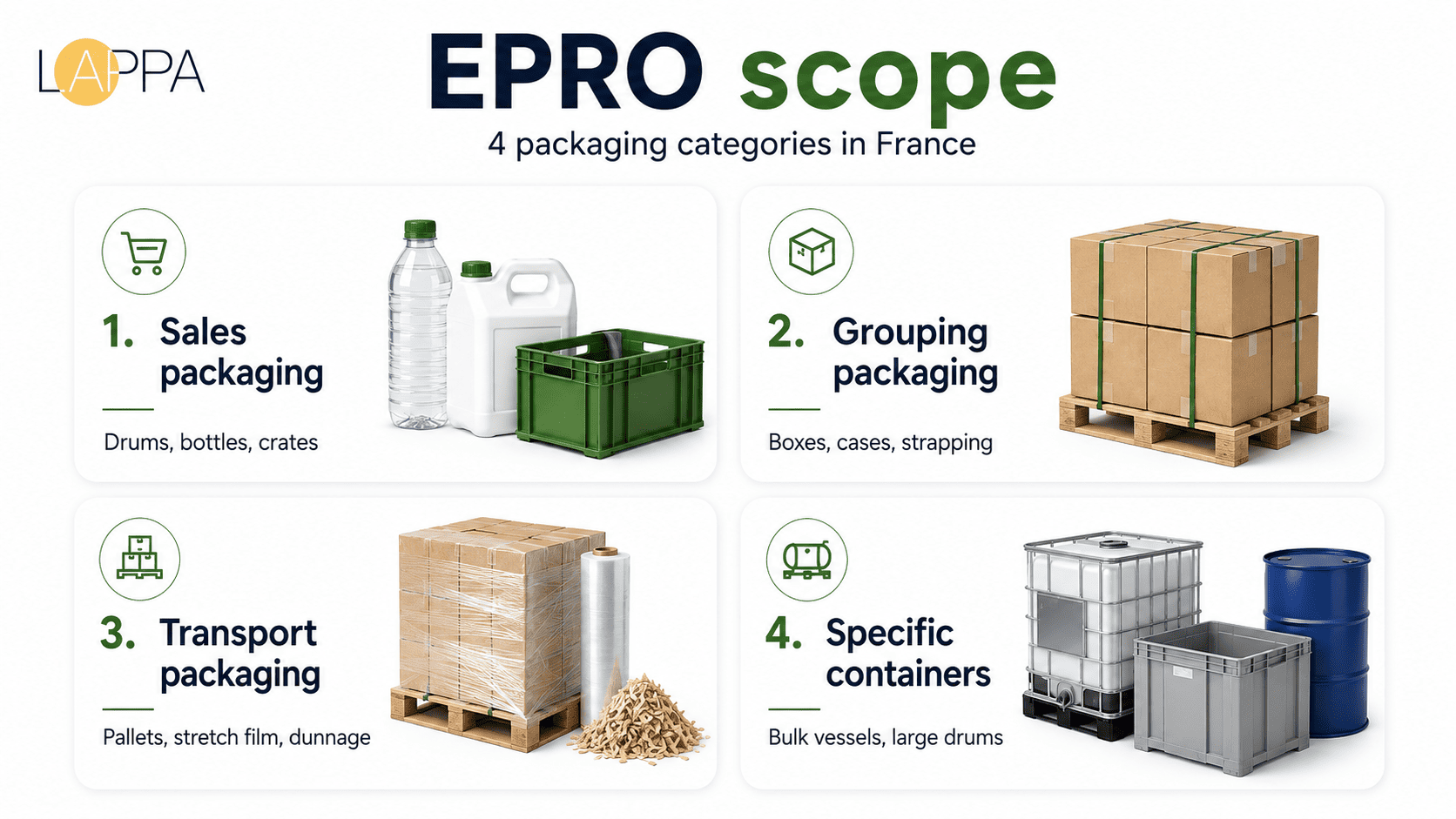
- Sales: drums, jerricans, crates, pots, flasks, bottles, and cardboard sacks, excluding items sold online to private consumers
- Grouping: cardboard boxes, cases, and strapping used to bundle several sold units together
- Transport: pallets, stretch film, and protective dunnage used to move goods through the supply chain
- Specific containers: bulk vessels, crates and plastic boxes over 15 litres, and drums or jerricans over 29 litres
Packaging producer responsibility under the new EPRO scheme
Packaging producer responsibility now applies far more broadly. French law calls the responsible party a metteur sur le marché. That means whoever first places packaged goods on the French market. For transport packaging, that includes manufacturers and importers. Brand owners who commission production count too. For sales and grouping packaging, the same logic applies. Also anybody who brings in pre-packed stuff.
This packaging producer responsibility comes with four duties. Businesses must eco-design their packaging where feasible. They must declare the volumes placed on the market. They must pay an eco-contribution based on materials used. They must pass their unique producer identifier to clients. Skipping any step still counts as non-registration.
| Aspect | Restauration Packaging REP, until June 30, 2026 | Professional Packaging EPR, EPRO, from July 1, 2026 |
| Scope | Food packaging used by catering professionals only | Sales, grouping, transport, and specific packaging, all sectors |
| Approved eco-organisms | Citeo Pro only | Citeo Pro, Twiice, and Léko |
| Legal basis | Decree 2023-162, July 2023 specifications order | Decree 2025-1081, December 2025 specifications order |
| Reporting | One annual declaration, one eco-organism | Transition filing through June, full EPRO reporting from July |
Packaging data management and traceability across the supply chain
Packaging data management is the hardest part of this transition. Before any declaration goes in, a business needs clear data. It must know exactly what packaging it places on the market. It needs quantities and supplier details too. That data usually sits scattered across procurement, logistics, and finance. These systems were never built to talk to each other.
Good packaging data management starts with mapping flows early. Map flows between factories, suppliers, and customers before July. Companies that wait until the declaration window opens often find gaps. They discover missing weight figures or unclassified container types. Treating data management for containers as a living register removes most of that risk.
EPR reporting requirements and key compliance deadlines
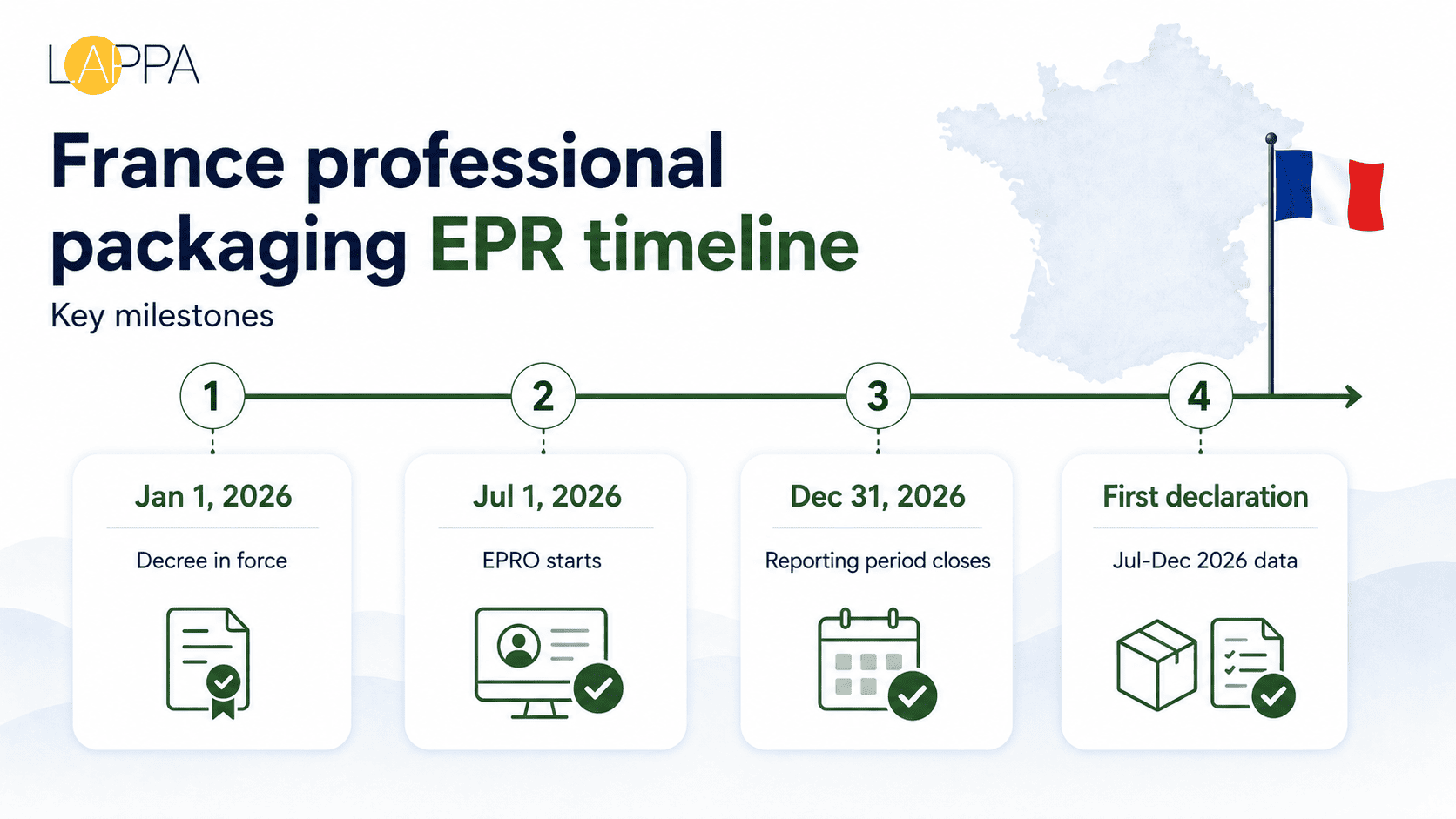
EPR reporting requirements under EPRO follow a tight calendar. Companies already registered for the catering scheme keep declaring to Citeo Pro through June 30, 2026. That covers the first half of the year under the old rules. From July 1, every affected business needs a signed contract with Citeo Pro, Twiice, or Léko.
The first EPRO declaration covers packaging placed on the market between July 1 and December 31, 2026. Ignoring the reporting requirements for EPR carries real financial exposure. National authorities can issue administrative fines reaching several thousand euros. That applies to businesses that never register or file incomplete declarations.
Businesses preparing for the deadline should work through six concrete steps:
- Confirm whether the business qualifies as a metteur sur le marché
- Map every packaging flow between suppliers, sites, and customers
- Contact Citeo Pro, Twiice, or Léko before July 1
- Collect material, weight, and volume data for every packaging type
- Build a process for ongoing eco-contribution declarations
- Assign clear ownership across procurement, logistics, and compliance
Tracking eco-contributions and reporting cycles across France and the rest of the EU gets complicated fast. See how Lappa’s EPR Consolidation works or explore the EPR Reporting Software built for cross-border tracking.
How the EU packaging and packaging waste regulation frames the French scheme
France’s move is not happening in isolation. The EU Packaging and Packaging Waste Regulation, Regulation (EU) 2025/40, already requires national producer responsibility systems. It repealed the older 1994 packaging directive, with no transposition delay across the bloc. The EU Packaging and Packaging Waste Regulation’s Article 48 is exactly where that obligation lives.
Seen against that backdrop, France’s wider scheme looks like early alignment with Brussels. The Commission wants consistent recyclability grading and recycled content thresholds, plus full chain accountability for material waste. Schemes already covering commercial wrappings will adapt faster once remaining delegated acts land.
Packaging sustainability regulations and the real cost of non-compliance
Packaging sustainability regulations under the new specifications order set firm material targets. By 2028, recycling rates must reach 70 percent for steel and 50 percent for aluminium. Paper and board must hit 75 percent, plastic 50 percent, glass 70 percent, wood 25 percent. Targets climb again by 2030. Reuse rates must hit 40 percent for most transport packaging.
These packaging sustainability regulations work through eco-modulation, not flat fees. Eco-contributions rise or fall with recyclability, recycled content, and source reduction. Heavier, harder-to-recycle materials simply cost more per declared tonne. Getting the sustainability regulation for packaging wrong does more than risk a fine. It quietly inflates the cost of every shipment going forward.
July 1, 2026 is close. Businesses that map their professional packaging now, register early, and treat reporting as routine will clear the transition without surprises.
FAQ about


What changes for businesses under France's EPR from July 2026
France folds professional packaging into one national scheme called EPRO from July 1, 2026. Any business placing sales, grouping, or transport packaging on the market must register with an approved eco-organism. It must meet the EPR reporting requirements on time and pay eco-contributions by material. Companies inside the old catering-only scheme must sign a fresh contract. No previous registration carries over automatically.
Who counts as a producer under the new packaging producer responsibility rules
A producer, or metteur sur le marché, is whoever first places packaged goods on the French market. That covers manufacturers, importers, and brand owners commissioning wrapping under their own name. For transport materials specifically, importers and order-givers carry the same container producer responsibilities as manufacturers. That holds even when they never touch production themselves.
How does the EU Packaging and Packaging Waste Regulation affect France's EPR rules
Regulation (EU) 2025/40 requires every EU country to run a producer responsibility system under Article 48. France’s professional packaging extension answers that requirement directly, moving ahead of neighbouring markets that have not yet widened their own schemes.
What packaging sustainability regulations apply to professional packaging materials
The EPRO specifications order sets material-specific recycling targets through 2030. It ties eco-contributions to recyclability and recycled content. Heavier, harder-to-recycle formats cost more per declared tonne. Reusable transport packaging and verified recycled content both reduce the contribution owed.
What if a company does not collect and communicate its packaging data
Ignoring registration or filing incomplete declarations exposes a business to administrative fines. Those fines can reach several thousand euros. It also creates friction with clients who expect a valid producer identifier on file. Weak packaging data management slows down audits, since records must be rebuilt after the fact.

