

France EPR Packaging Labeling Requirements Guide
Selling packaged goods in France comes with a specific set of legal requirements — and most businesses don’t realise how detailed they are until an audit or marketplace suspension lands. This EPR guide walks through what’s required right now: which symbols to put on your boxes, which recycling codes to use, how household packaging is defined, and what the PPWR adds from August 2026.
What is EPR France — your EPR guide to key facts
France has been running producer responsibility schemes since the early 1990s — long before most EU countries got started. The core idea behind extended producer responsibility hasn’t changed: if you put a product on the market, you’re on the hook for dealing with the waste it generates. What has changed is the scope. Today it covers almost everything.
The legal framework rests on Decree 92-377, updated by the AGEC Law (Law 2020-105) and a 2024 Packaging Order. Taken together, EPR France is now probably the most wide-ranging producer responsibility scheme in the EU. The 2025 expansion added industrial and commercial B2B flows — so it’s not just about consumer goods anymore.
Day-to-day EPR compliance runs through approved Producer Responsibility Organisations. CITEO handles most household packaging. Adelphe covers wine and spirits. Léko offers an alternative. ADEME oversees the system.
Ready to register your company for France’s EPR packaging scheme? Let us handle your EPR registration — we’ll take care of the paperwork so you can focus on your business.
What is EPR compliance and what does it actually require
A lot of businesses ask what is EPR compliance exactly — and the short answer is that it’s three things at once. You register with a PRO and pay eco-fees based on what you put on the market. You put the right label on every packaging component. And every year you file a declaration covering every packaging type you’ve sold into France.
Getting registered is just the start. I’ve seen companies with valid CITEO membership still get flagged because they hadn’t put the Triman on their boxes — that’s what EPR compliance actually looks like in practice. PROs field questions about what is EPR compliance from new registrants constantly, and the answer always comes back to the same three-part picture.
Currently mandatory labels — what French law requires now
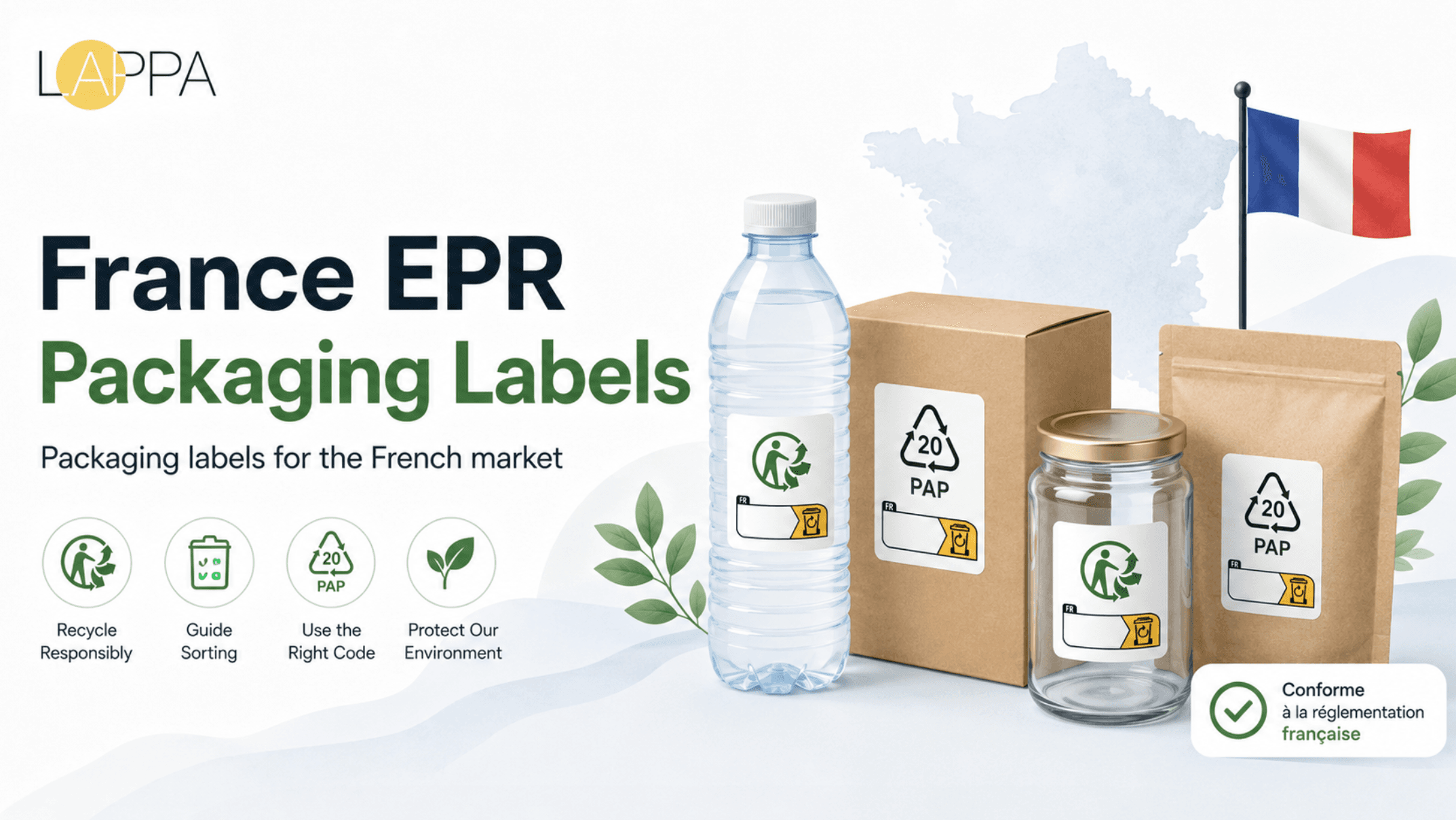
Four symbols are legally required on packaging sold in France. Each carries its own rules on placement, size, and permanence. This EPR guide section covers all four in detail.
|
Label / Symbol |
What It Does and Where It Must Go |
|
Triman logo |
France’s own recycling symbol — unique in the EU. The Triman signals that the item belongs in the sorting stream. It must appear on the product, the packaging, or the product page for online sellers. Applies to packaging, electronics, textiles, and batteries. |
|
Info-tri sorting instruction |
Displayed alongside the Triman. Tells consumers which bin to use for each component. Must be in French. E-commerce sellers must also display it on product pages. |
|
Material recycling code (e.g. PAP 20) |
Numeric codes that identify what a packaging component is made of. PAP 20 is corrugated cardboard. PET 1 is standard plastic bottles. Each separable component needs its own code. Full list in Section 3. |
|
Crossed-out wheeled bin |
Required on all electrical equipment and batteries. Signals separate collection at end of life. Since August 18, 2025, must cover at least 3% of the battery’s largest side. Cap: 5 × 5 cm. |


Triman and info-tri — placement rules
Both symbols must be permanent. Print them on the box or engrave them on the product. For e-commerce, the product listing page is a valid alternative. A sticker that peels off does not satisfy the indelibility rule.
Multi-component packs need separate treatment. A cardboard box with a plastic insert needs the Triman and a recycling code on each part. CITEO’s technical guidelines specify minimum symbol sizes for different surface areas.
Penalty exposure: Missing Triman: up to €15,000 per infraction plus €20,000 per day until corrected. Failure to register with a PRO: up to €100,000.
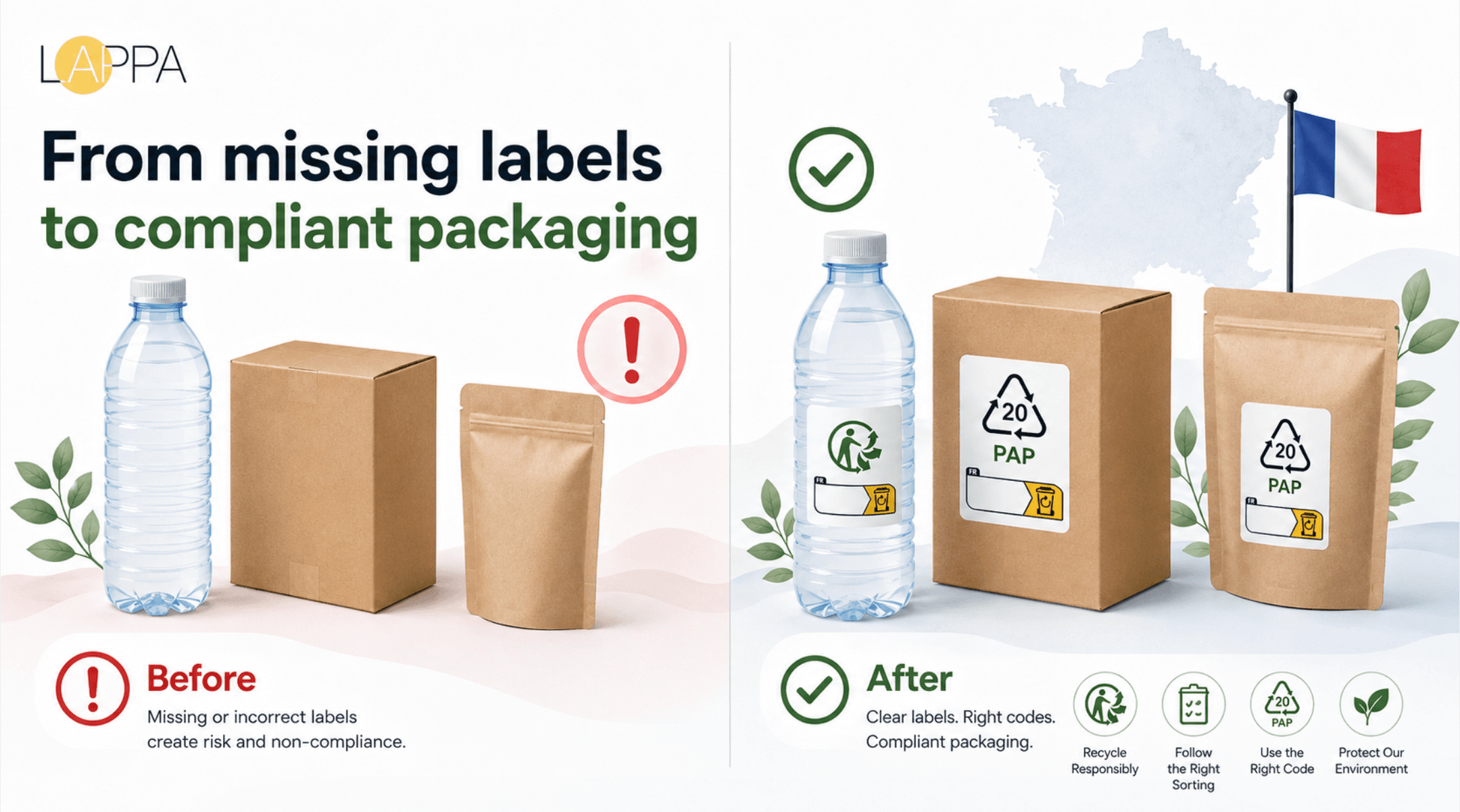
Have questions about France’s packaging labeling requirements or the Triman logo? Book a free demo and our experts will walk you through everything you need to know.
Material recycling codes — complete reference
Recycling codes identify what a packaging material is made of. They must appear on every component. Accurate coding also feeds into your annual PRO declaration — wrong codes trigger ADEME audits.
Paper and cardboard (PAP)
|
Code |
Code and Material |
Typical Uses |
|
|
PAP 20 — Corrugated cardboard |
Shipping boxes, e-commerce outer packaging |
|
|
PAP 21 — Paperboard |
Folding cartons, cereal boxes, product boxes |
|
|
PAP 22 — Paper |
Bags, wrapping paper, tissue paper, leaflets |


Plastics
Annual declarations require breakdown by polymer type. Marking everything as “plastic” without a specific code is not acceptable under EPR France rules.
|
Code |
Code and Material |
Typical Uses |
|
|
PET 1 — Polyethylene terephthalate |
Drink bottles, food trays, blister packs |
|
|
HDPE 2 — High-density polyethylene |
Detergent bottles, milk jugs, caps |
|
|
PVC 3 — Polyvinyl chloride |
Cling film, rigid packaging (restrictions apply) |
|
|
LDPE 4 — Low-density polyethylene |
Plastic bags, shrink wrap, squeezable bottles |
|
|
PP 5 — Polypropylene |
Yoghurt pots, bottle caps, margarine tubs |
|
|
PS 6 — Polystyrene |
Food containers, cups (recyclability concerns) |
|
OTHER 7 |
Other / mixed plastics |
Multi-layer, composite plastics |


Glass, metals, and composites
|
Code |
Code and Material |
Typical Uses |
|
|
GL 70 — Clear glass |
Bottles, jars |
|
|
GL 71 — Green glass |
Wine bottles, glass jars |
|
|
GL 72 — Brown / amber glass |
Beer bottles, medicine bottles |
|
|
ALU 41 — Aluminium |
Cans, foil lids, aerosols |
|
|
FE 40 — Steel |
Metal tins, food cans, steel aerosols |
|
C/PAP 80-84 |
Paper / cardboard composite |
Drink cartons (Tetra Pak-type) |


EPR France registration and extended producer responsibility — who must comply
Extended producer responsibility means the cost and organisation of end-of-life waste management falls on the business that first put the product into circulation — not on taxpayers or local councils. France takes this seriously. Registration isn’t something you sort out after your first few sales; it has to happen before you ship anything at all.
There’s no minimum order size — one parcel to one French customer is enough to trigger the rules. That surprises people. The scope of extended producer responsibility is intentionally wide. Once you’re registered, EPR France registration gives you an IDU — a membership number you’ll need to share with every French marketplace and trading partner. Amazon and Zalando both check for it. No IDU, no listing.
|
Business Type |
PRO to join |
Key obligation |
|
French manufacturers |
CITEO (main household), LEKO (alternative), Adelphe (wine/spirits) |
Register, declare packaging weight and materials annually |
|
EU importers |
CITEO or LEKO |
Same obligations as French manufacturers |
|
Non-EU distance sellers / e-commerce |
CITEO or LEKO (via authorised rep) |
May appoint an authorised representative in France |
|
Online marketplaces |
Not a producer (unless own-brand) |
Must verify seller compliance |
Household packaging vs professional packaging
When French EPR launched, household packaging was basically the whole story — anything a consumer takes home and eventually throws out. Since January 2025, there’s a second stream for B2B flows, and from July 2026 it comes with its own green levies. Two separate systems, two separate declarations.
The practical problem is that many businesses sell both ways. A pallet going to a retailer and the same product mailed directly to a home need to sit in different declaration buckets. Mixing them up is by far the most common error we see in multi-channel accounts.
Annual data reporting — what you must declare
Data reporting isn’t optional and it isn’t a formality. Every year by 31 May you file a declaration with your PRO covering the total weight of every packaging type you placed on the French market, split by material. Your eco-fees are calculated directly from those numbers. Get them wrong — whether by accident or otherwise — and you’re looking at an ADEME audit. Deliberate underreporting has ended PRO contracts before.
Non-EU sellers — deadline approaching: Appointing a French authorised representative is voluntary until August 12, 2026. After that date, the PPWR makes it mandatory. The representative holds a French SIREN number and manages all registration, reporting, and eco-fee payments.
PPWR — what the EU packaging regulation changes
New rules by packaging type — August 2026 obligations
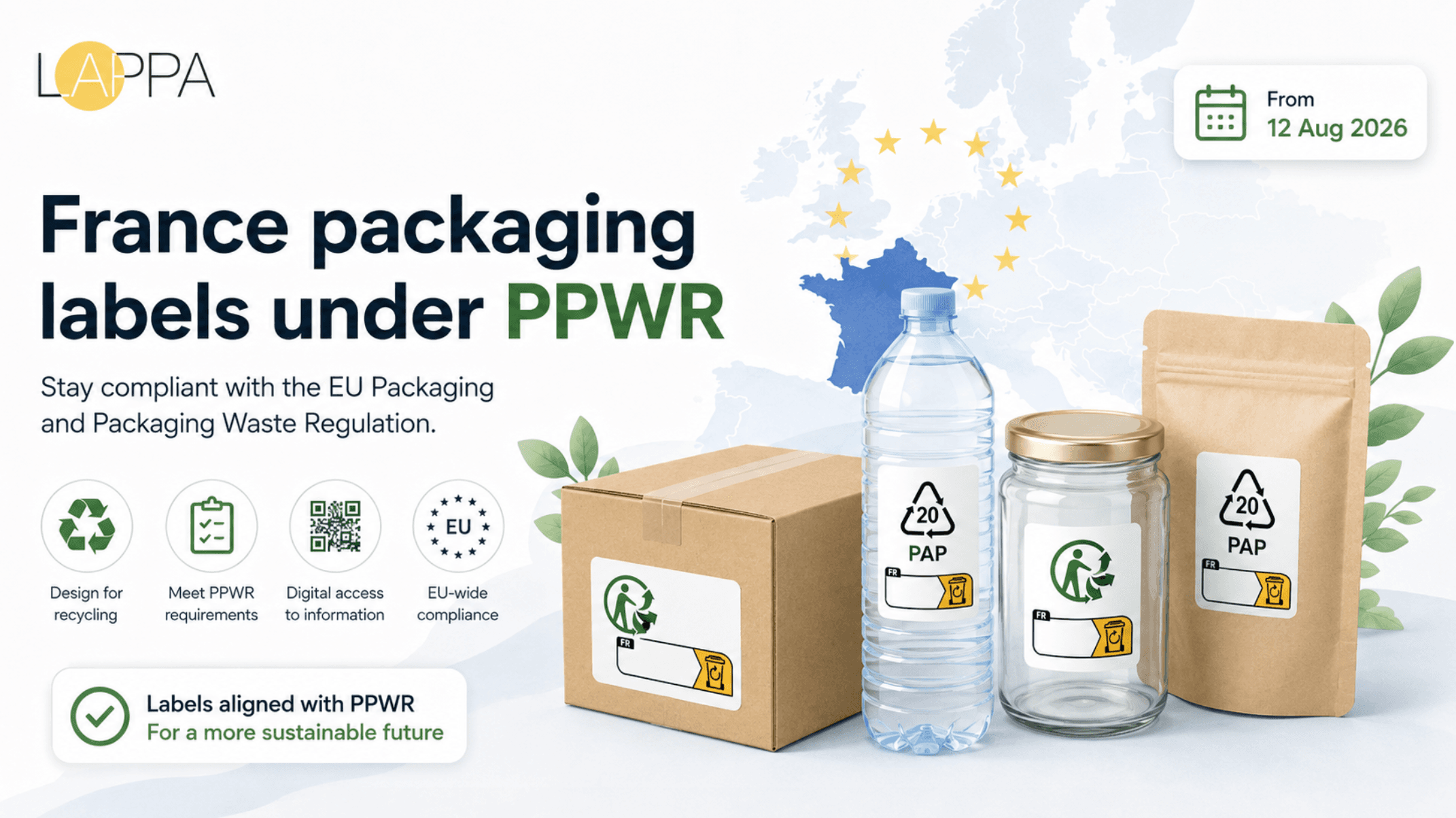
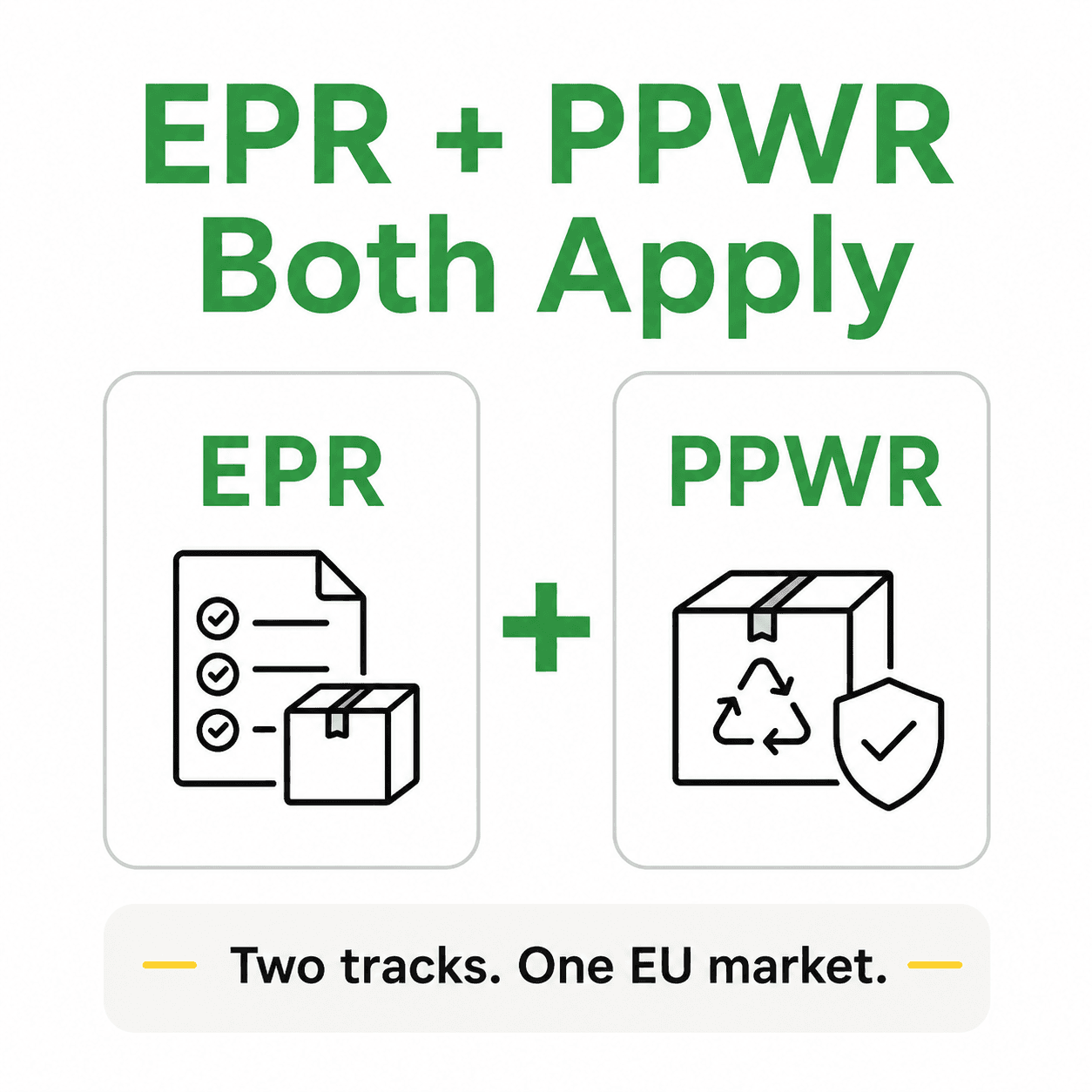
Regulation EU 2025/40 came into force on February 11, 2025, and it starts applying in full across all EU member states on August 12, 2026 — France included. Unlike a directive, it doesn’t need to be transposed into national law; it just applies directly. It replaces the old Directive 94/62/EC that’s been governing packaging rules since 1994. French EPR rules don’t disappear — they stay, and the PPWR sits on top of them.
|
New Obligation (from Aug 12, 2026) |
What It Means in Practice |
|
Declaration of Conformity (DoC) |
Every packaging type needs a signed EU Declaration of Conformity and a technical file. The brand owner or importer signs it. Request documentation from your supplier now — no grace period after August 12. |
|
PFAS ban — food-contact packaging |
Per- and polyfluoroalkyl substances banned above specified limits in any food-contact packaging. Check grease-resistant papers and food wrappers immediately. |
|
Heavy metal limits |
Lead, cadmium, mercury, and hexavalent chromium must stay below 100 mg/kg combined. Request test certificates from your manufacturer. |
|
Packaging minimisation |
Packaging must be as small and light as technically possible. Excess empty space is restricted. Document justifications for current dimensions. |
|
EPR fee modulation |
CITEO and Léko must adjust fees based on recyclability, recycled content, and reusability. Poorly designed packaging will cost more. |
Full compliance timeline
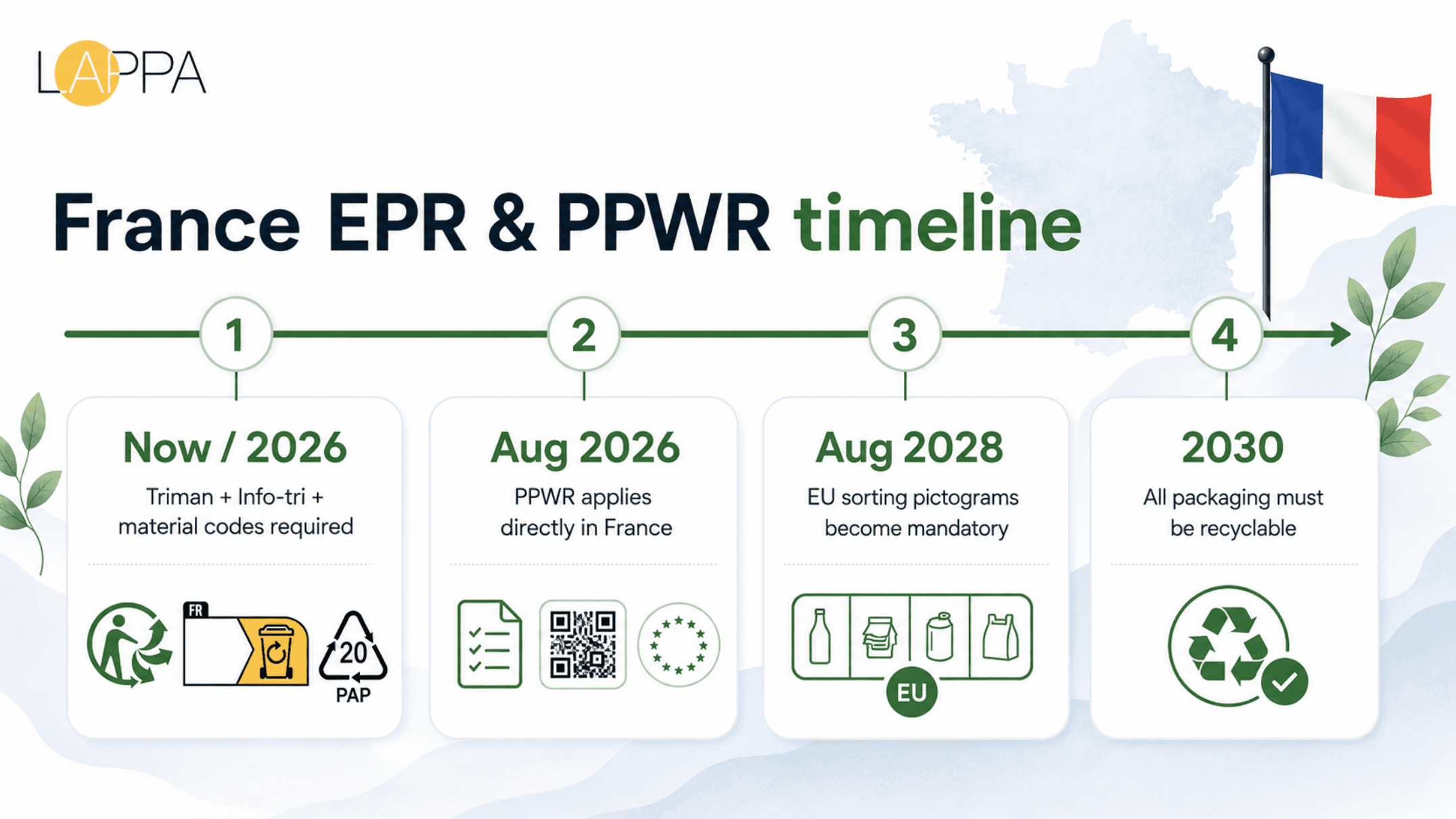
|
Now (2026) |
Triman + Info-tri + material codes required |
|
June 14, 2026 |
Sell-off deadline for pre-PPWR labelled stock |
|
Aug 12, 2026 |
PPWR core obligations — DoC, PFAS ban, minimisation |
|
Aug 18, 2026 |
Battery QR codes mandatory |
|
Sep 27, 2026 |
Stricter green claims rules |
|
2027 |
Producer registers + refill rules |
|
Aug 12, 2028 |
Harmonised EU sorting pictograms mandatory |
|
2030 |
All packaging must be recyclable |
Triman vs the future EU harmonised label
No other EU country has its own mandatory recycling symbol — France is the outlier here. The Triman has been compulsory since 2015, and it’s worked well. The problem is that in 2028 the EU is rolling out a single harmonised set of sorting pictograms for all 27 member states, and at that point France’s symbol becomes redundant. The exact cutover date hasn’t been published yet, but the direction of travel is clear.
|
Period |
France requirement |
EU PPWR requirement |
|
Now to Aug 2026 |
Triman + Info-tri mandatory. Material codes mandatory. |
PPWR not yet in force for labelling. Prepare DoC. |
|
Aug 2026 to Aug 2028 |
Triman + Info-tri still mandatory. Material codes required. |
DoC, chemical limits, minimisation in force. Commission publishes harmonised pictogram specs. |
|
Aug 2028 onward |
Transition to harmonised EU labels (exact date TBC by French authorities). |
Mandatory EU-wide sorting pictograms. Same symbols across all 27 member states. One label for the whole EU. |
The practical advice: if you’re reprinting packaging artwork anyway, leave room for both the Triman and the incoming EU pictogram. The Commission has until August 2026 to publish the harmonised specs, so you’ll have enough lead time to update designs before the 2028 deadline.
Action checklist — before the deadlines
Immediate priority
- Complete EPR France registration with CITEO, Léko, or Adelphe — obtain your IDU number
- Confirm Triman logo and Info-tri appear on every component reaching French consumers
- Apply the correct recycling codes to all components — PAP, PET, ALU, and plastic codes
- Request Declaration of Conformity documents from your packaging supplier for every packaging type
- Audit food-contact packaging for PFAS; request heavy metal test certificates
- Share your IDU with every French marketplace — Amazon, Zalando, and others require it
- If based outside France, appoint an authorised representative now
- Register separately for the professional packaging EPR stream if supplying B2B packaging in France
Near-Term (2026–2028)
- Allocate QR code space in packaging artwork — mandatory for batteries from August 2026
- Track EU harmonised pictogram specifications — expected publication August 2026
- Keep household packaging and professional packaging data separate throughout the year
- Submit annual EPR declaration to your PRO by 31 May each year
The EU Packaging and Packaging Waste Regulation (PPWR) is coming. Get your company PPWR-ready with our authorized representative service — so you’re ahead of the curve, not scrambling at the deadline.
Frequently asked questions
Yes, and this catches a lot of small businesses off guard. There's no minimum volume under French EPR law — send one parcel to one French address and the rules apply to you. EPR France registration has to be in place before you start selling into France, not after the fact. If your IDU is missing when a marketplace checks, you're looking at suspension. Non-compliance fines can reach €100,000.