

Greece EMPA Packaging Labeling Requirements Guide
Selling packaged products in Greece means dealing with real labeling obligations. Producers who ignore them face registration blocks and market issues. This guide covers labels on packaging for the Greek market. Getting them right matters — both commercially and legally.
The national EPR system runs through EOAN, the Greek packaging authority. Registration is not optional for producers placing packaged goods on the market. Volume reporting and financial contributions to recovery are core duties.
All data here reflects publicly available compliance guidance. Nothing in this guide constitutes legal advice.
Verify your specific situation with a qualified specialist in Greece. Book a demo
What labels on packaging must show
Packaging in Greece speaks to three audiences at once. Consumers read it to sort waste. Waste facilities use codes to process materials. Regulators check labels on packaging against EPR filings.
One thing to clarify: Greece has no mandatory EMPA consumer logo. France requires the Triman — Greece does not. The Greek system relies on EU material codes and optional marks. The EOAN producer number stays in business documents, not on packs. Greece has its own compliance logic — different thresholds, specific PRO requirements, and reporting rules that catch foreign producers off guard. Our full Greece EPR guide covers registration steps, volume thresholds, fees, and what changes once you start selling at scale.
Recyclability claims carry legal weight here. Where local facilities cannot process a material, skip the recycling symbol. No exceptions — this applies across all types of packaging labels.
Main types of packaging labels
Label categories differ from each other in function and legal standing. Some identify material composition. Others signal scheme membership. The right combination depends on product, market, and material.
EU material identification codes
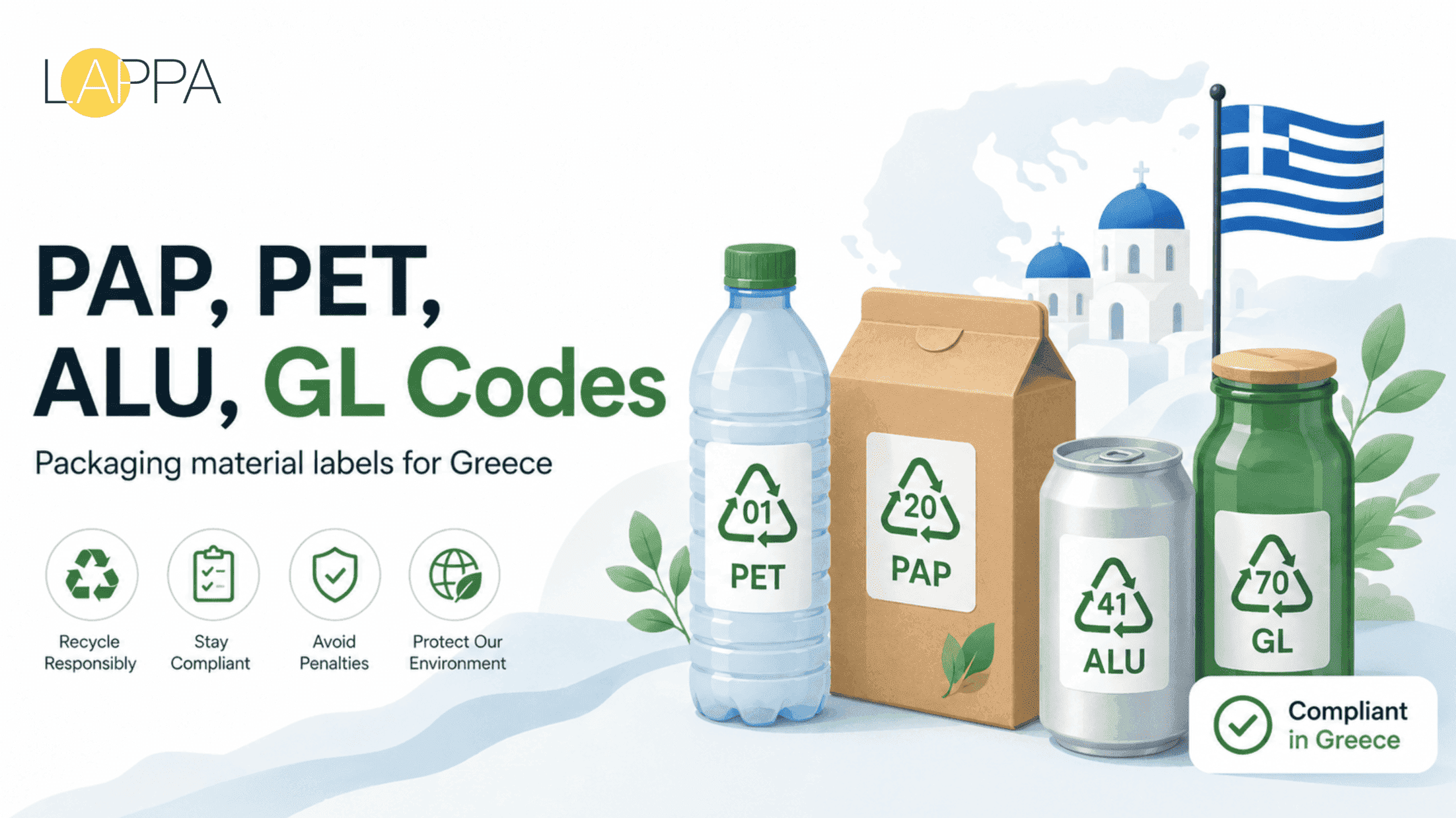
Material codes are core types of labels in packaging in the EU. Each code maps a specific material to a standardized identifier. Waste handlers rely on these codes to route materials correctly.
|
Material group |
Common codes |
Packaging examples |
Notes |
|
Plastics |
01 PET, 02 HDPE, 03 PVC, 04 LDPE, 05 PP, 06 PS, 07 OTHER |
Bottles, trays, films, caps |
Label each component separately |
|
Paper / Cardboard |
20 PAP, 21 PAP, 22 PAP |
Cartons, boxes, sleeves |
Most common for secondary packaging |
|
Metals |
40 FE, 41 ALU |
Steel cans, aluminium cans, foil |
ALU is fully recyclable |
|
Glass |
70 GL, 71 GL, 72 GL |
Clear, green, brown containers |
Code depends on glass colour |
|
Composites |
Codes 80–99 |
Multi-layer cartons, laminated packs |
Consider component labeling if separable |
A single product may need more than one code. Bottle body and cap often differ in material. Each component needs its own identifier. Composite formats with multiple inseparable layers take codes from the 80–99 range.
The Green Dot symbol
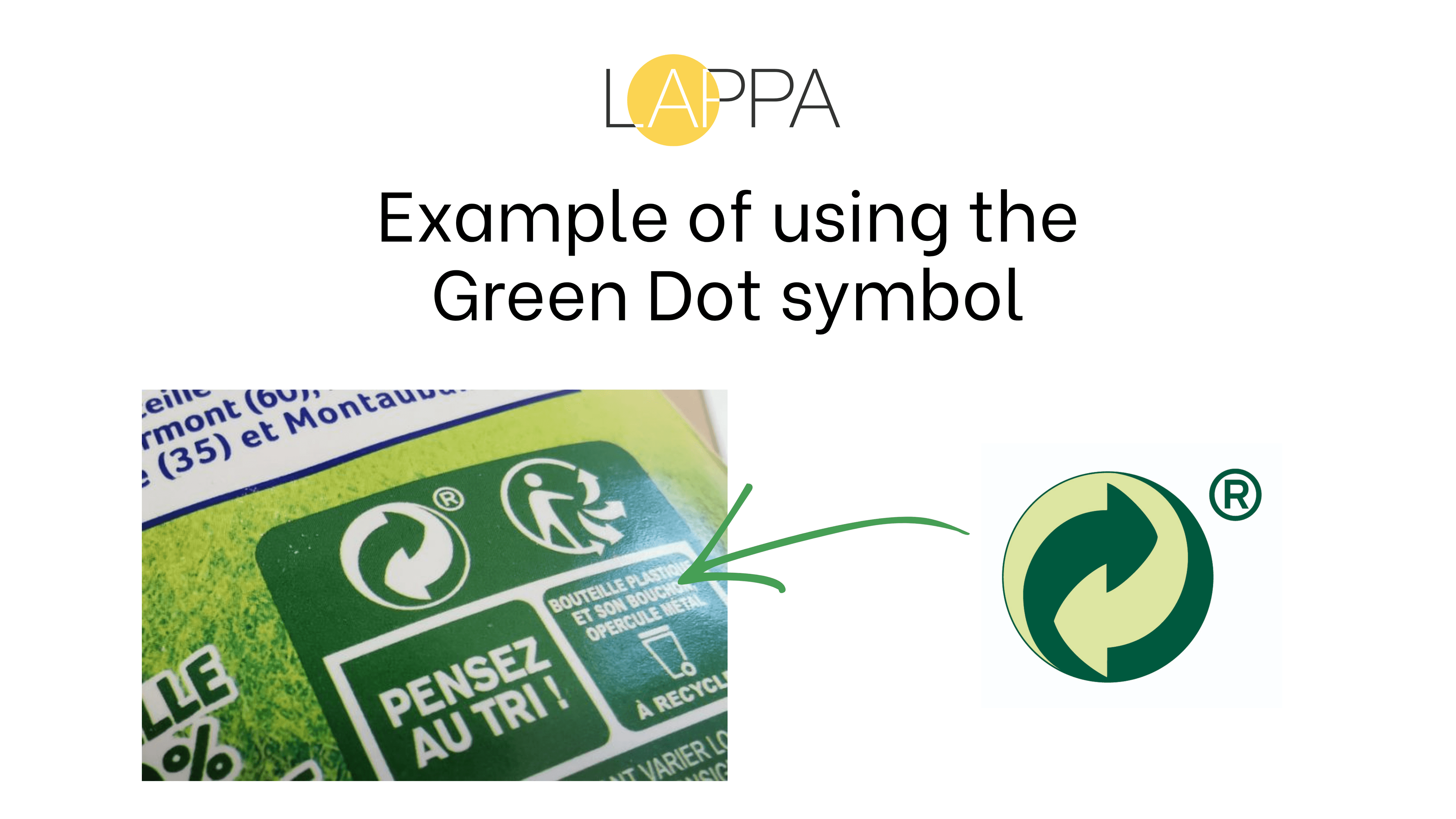
Many producers confuse the Green Dot with a recyclability mark. It is not. The symbol confirms a financial contribution to a recovery scheme. Nothing more. In Greece, carrying it requires a valid license.
Proportions and visual form must stay unchanged. The mark needs to remain clear and legible on the finished pack. Licensing bodies typically set a minimum visible size of around 10 mm. Unauthorized use creates both legal exposure and reputational damage.
The Mobius Loop
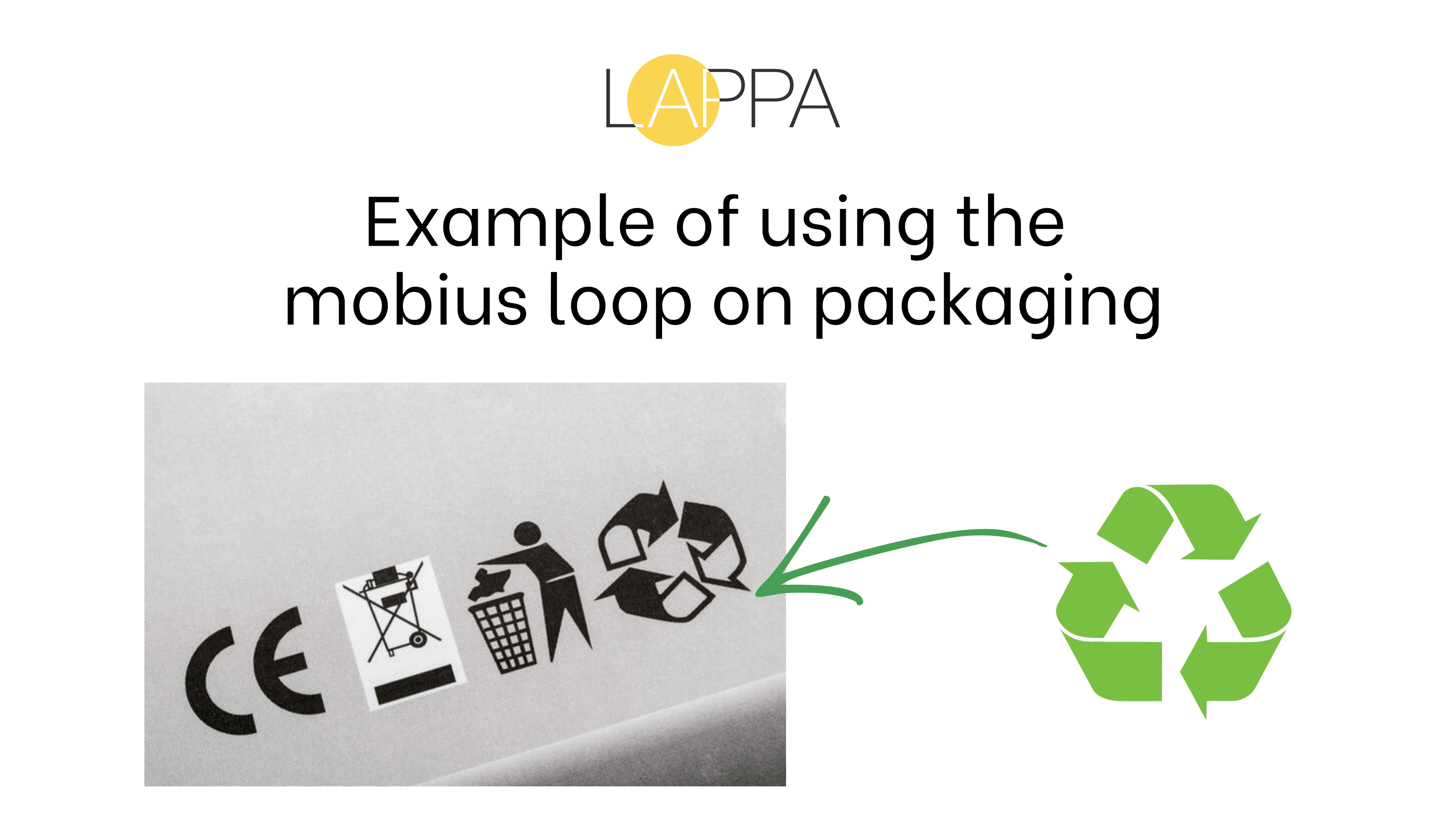
The Mobius loop is among specific types of labels in packaging. It signals recyclability or a declared recycled content percentage. It does not guarantee a product will be recycled anywhere.
Before adding this symbol, confirm local Greek infrastructure can process the material. Inaccurate claims fall under both Greek and EU law. Enforcement has intensified in recent years — the risk is real.
Labels meaning packaging symbols explained
Understanding labels meaning packaging symbols matters. Different marks carry different legal weight. Consumers, waste handlers, and customs officers each read the pack differently.
|
Symbol |
What it means |
Status in Greece |
When to use |
|
Material code (e.g. 01 PET) |
Identifies material for sorting |
Recommended — EU standard |
On each packaging component |
|
Mobius loop |
Recyclability or recycled content share |
Common practice — not mandatory |
Only where local systems can process it |
|
Green Dot |
Financial contribution to recovery scheme |
Optional — license required |
Only with valid authorization |
|
EOAN producer number |
EPR registration identifier |
Required in commercial documents |
Invoices and B2B documentation |
Labels valid in France may carry no meaning in Greece. The Triman is French — it adds noise on Greek packs. Use only marks recognized under Greek and EU rules.
Producers checking labels meaning packaging symbols often discover unlicensed marks. Removing them is a straightforward step toward cleaner compliance.
EPR system and EMPA registration in Greece
The EPR system shifts recovery costs onto producers — not municipalities. In Greece, EOAN administers this framework. Every producer bringing packaged goods to market must register and report.
The EMPA number generated through registration is not a consumer mark. It lives in invoices, contracts, and customs declarations. Confusing backend EPR data with packaging design creates label clutter. It also triggers unnecessary compliance queries.
Reporting under the Greek EPR framework covers packaging weight by material. Producers submit this data annually. Fees follow from reported volumes. Accurate records directly affect what a company pays. Getting registered with a Greek PRO and filing your first packaging report involves more moving parts than most producers expect — material categorization, fee calculation, and annual submissions all run on tight schedules.
Lappa handles EPR registration and ongoing reporting for producers entering the Greek market, so the administrative side stays off your plate.
What registration and annual reporting involve:
- Register with an authorized producer responsibility organization (PRO)
- Submit packaging volume data by material category each year
- Pay into the national collection and recovery fund based on reported volumes
- Maintain internal records of packaging placed on the Greek market
- Quote the EOAN producer number in all commercial documents and invoices
- Reassess obligations whenever entering a new product category
Types of labels in packaging by format
The right types of labels in packaging shift with the format. Material, structure, and product category all influence the choice. These examples reflect standard practice in Greece.
Cardboard boxes take PAP 20 or PAP 21, depending on board grade. If the packaging is recyclable through local systems, add the Mobius loop. Green Dot inclusion requires a valid license covering the Greek market.
Plastic bottles take a body code: 01 PET or 05 PP. A different-material cap gets its own identifier. Two materials, two codes — that is the standard approach.
Films and flexible pouches are trickier. Most fall under 04 LDPE or 07 OTHER. Recyclability claims rarely hold up given current Greek infrastructure. Aluminium formats carry ALU 41 alongside a recycling mark.
Glass containers take GL 70, 71, or 72 depending on colour. A metal or plastic lid needs its own code. Composite packs with inseparable layers use the 80–99 composite code range.
Compliance checklist for packaging labels
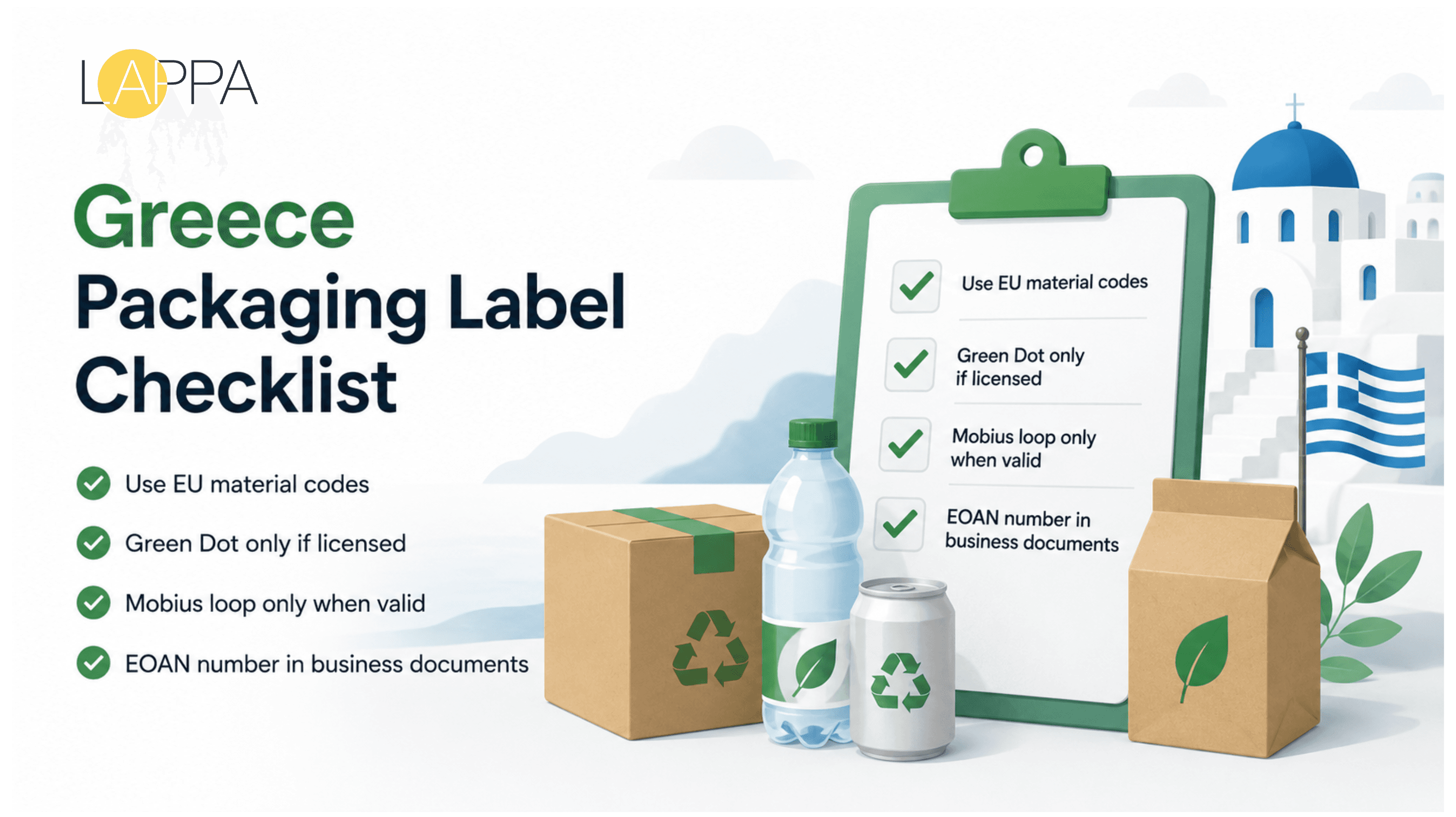
Running a pre-launch check on labels on packaging saves time later. The list covers key EPR and labeling checkpoints for the Greek market.
- Map every packaging component and confirm the material for each
- Assign the correct EU material identification code to every separable part
- Verify that any Mobius loop claim is supported by local processing data
- Check Green Dot licensing status before including the mark
- Remove any EMPA or EOAN logos not explicitly required or licensed
- Place the EOAN producer number in invoices and trade documentation
- Apply sector-specific rules for electronics, batteries, chemicals, and food
- Drop any labels borrowed from other EU markets that carry no Greek obligation
Label decisions and EPR obligations interact in ways that aren’t always obvious from the rules alone. If you want to talk through your specific packaging setup or check where your Greek compliance currently stands, book a call with our team — we work with producers across the EU and can give you a straight answer.
Sector specific labeling requirements
General packaging rules set the baseline. Several product categories carry an additional layer on top. Producers in these sectors must check both rule sets. Both apply before going to market in Greece.
Electronics packaging operates under WEEE. Batteries have dedicated labeling and collection rules of their own. Chemicals fall under CLP and REACH. These specify precise warning marks and hazard communication requirements.
Food contact materials need the fork-and-glass symbol to confirm suitability. Cosmetics follow EU Cosmetics Regulation — ingredient disclosure and person identification. Medical devices are governed by MDR provisions.
Sector rules add to EPR system obligations across all these categories. They add to material codes. They never replace labels on packaging rules in this guide.
Questions on Greece packaging labeling
No requirement exists for a consumer-facing EMPA or EOAN mark in Greece. The producer number belongs in commercial paperwork — invoices and contracts. It is not a packaging label element.