

EU Textile EPR Requirements – A Compliance Guide for Fashion Brands and E-Commerce Sellers
The EU textile industry generates around 12.6 million tonnes of textile waste every year, of which 5.2 million tonnes come from clothing and footwear alone. For years, the cost of managing that waste fell on municipalities and taxpayers. That is now changing.
As revised Waste Framework Directive came into force from 16 October 2025 – the Extended Producer Responsibility (EPR) for textiles and footwear became a part of each Business for all EU countries. Responsibility of collecting, sorting and recycling of goods is shifted to brand owners and sellers under Directive (EU) 2025/1892 ,
The real significance for e-commerce sellers: the rules apply regardless of where your business is based. If you sell clothing, footwear, or home textiles to EU consumers — whether from a warehouse in Manchester, a studio in New York, or a factory in Vietnam — you are likely in scope.
The biggest compliance mistake is treating April 2028 as the only date that matters. France and the Netherlands already have active textile compliance Europe schemes requiring registration now. Most other Member States will launch their national schemes throughout 2027, compressing the effective compliance window considerably.
What this compliance guide covers
- The legal framework and key deadlines under Directive (EU) 2025/1892
- Who qualifies as a “producer” and which businesses are most likely to be caught off guard
- Products in scope and the edge cases that need internal review
- How eco-modulated fees work and why they affect product economics, not just compliance costs
- Country-by-country implementation status across the EU
- A step-by-step compliance action plan
- Common mistakes that create avoidable legal and operational risk
What changed the EU Textile EPR directiv
EU textile EPR is not an entirely new concept, but the October 2025 directive represents a fundamental shift: for the first time, harmonised rules apply across all 27 Member States, replacing a patchwork of national approaches that varied enormously in scope, fees, and enforcement.
The legal basis is the targeted revision of the Waste Framework Directive, which introduces two interconnected sets of measures:
- Mandatory EPR schemes for textile sector and footwear products — all Member States must establish national EPR schemes following common EU-wide rules on producer registration, fee collection, and reporting.
- New rules for separately collected textiles — all separately collected textiles are now classified as waste, closing a long-standing loophole that allowed textile exports to be treated as “used goods” rather than waste, bypassing proper sorting and recycling requirements.
Key Deadlines under EU textile regulations
|
Milestone |
Date |
|
Revised WFD enters into force |
16 October 2025 |
|
Separate textile collection mandatory across EU |
1 January 2025 (already in force) |
|
Member States transpose directive into national law |
By June 2027 (20 months) |
|
Mandatory EPR schemes operational across EU |
By April 2028 (30 months) |
|
Microbusiness exemption ends |
17 April 2029 |
The practical implication: businesses should not wait for their national government to publish final rules. The EU-level framework is already fixed, and the direction of travel in every Member State is the same. Brands that begin preparing now — by auditing their product catalogue, mapping EU sales volumes, and identifying applicable Producer Responsibility Organisations (PROs) — will be significantly better positioned than those who wait for national transposition.
The European Parliament has also explicitly signalled that Member States should use EPR fee design to address ultra-fast fashion practices. Brands with high-turnover, low-durability product lines should expect to pay proportionally more under eco-modulated national schemes.
Who Must Comply — Defining a Producer” for EPR Eurore
The definition of “producer” under Directive (EU) 2025/1892 is deliberately broad, and it catches many businesses by surprise. You do not need to manufacture textiles to qualify. The key question is whether you are the first entity to make a new textile product available on an EU Member State’s market.
You Are a producer responsibility holder If You:
- Manufacture and sell textile products under your own brand in any EU Member State
- Import or supply textile products for the first time from another Member State or from a non-EU country, making them available on the EU market
- Resell textile products under your own brand, where the original manufacturer’s branding does not appear on the product
- Sell to EU consumers via distance sales — your own website or third-party marketplaces — even if your company is based entirely outside the EU
The last point is the one that catches most cross-border sellers off guard. A brand based in the United Kingdom, the United States, South Korea, or Australia that sells directly to French or German consumers via its own website is a producer under this directive. It must register in each EU country where it sells, and non-EU producers must appoint an authorised representative based in the EU who acts as the legal point of contact for EPR compliance in each relevant Member State.
Who Is Excluded from EU textile EPR
Not every business in the textile sector supply chain carries EPR obligations. The directive explicitly excludes:
- Second-hand and resale sellers — producers of second-hand or re-used textile and footwear products are out of scope. Social economy enterprises engaged in second-hand collection are also exempt and may operate their own collection systems.
- Self-employed tailors producing customised products for individual consumers.
- Pure retailers selling clearly branded third-party products where the producer’s branding remains on the product. In this case, EPR is the original producer’s obligation, not the retailer’s.
- Certain professional-use textiles with safety, health, or security requirements, including some military items, though national implementation may apply different treatment.
Key rule: sell someone else’s brand and EPR is their obligation. Put your own label on it — or strip off the original label — and it becomes yours.
Marketplace Obligations and Enforcement Risk
Online marketplaces carry a specific verification obligation under the directive. Platforms must confirm that third-party sellers are registered with the relevant national EPR scheme before allowing them to list textile products. If a seller is not registered, the platform is required to suspend their listings.
This is not a theoretical risk. Marketplace access is directly tied to EPR compliance status, which means non-registration is not just a regulatory issue — it is an operational one that can remove a sales channel without warning.
Size-Based Timelines
There are no general exemptions based on company size, but the directive provides a phased timeline for the smallest businesses:
|
Business size |
Compliance deadline |
|
Most producers |
17 April 2028 |
|
Microbusinesses (under 10 employees, turnover and balance sheet at or below €2 million) |
17 April 2029 |
|
Small enterprises (10–49 employees) |
17 April 2028 — no extended exemption |
Which Products are in Scope under EU textile regulations
The directive covers a broader range of products than most sellers initially expect. Scope is defined by reference to the Combined Nomenclature (CN) codes listed in Annex IVc of the directive, but the practical categories are straightforward.
In Scope vs Out of Scope for Textiles Europe
|
In scope |
Out of scope |
|
Clothing and apparel (all types) |
Second-hand and pre-owned textiles |
|
Footwear |
Customised products made by self-employed tailors for individual clients |
|
Accessories: bags, belts, hats, scarves |
Certain professional-use and military textiles (subject to national rules) |
|
Household linens: bedding, towels, bath mats |
– |
|
Curtains and drapes |
– |
|
Home textiles: tablecloths, cushion covers |
– |
|
Mattresses (where designated by individual Member States) |
– |
If you sell both in-scope and out-of-scope products, EPR obligations apply only to the in-scope portion of your catalogue. You are not required to register or pay fees on products that fall outside Annex IVc.
Where Classification Gets Tricky
Several product categories sit in grey areas that require internal review rather than assumption:
- Accessories with mixed materials — a leather bag with a textile lining may or may not be classified as a textile product depending on the dominant material and the CN code used. National authorities may interpret these differently during the transposition period.
- Technical textiles and workwear – goods that have a predominantly protective or industrial role may be excluded from the professional-use exclusions in some Member States but not in others.
- If a piece of clothing is offered as part of a kit or gift set combined with non-textile products, then the textile portion will need to be individually appraised for EU Textile EPR purposes
A practical note on product classification: if you are unsure whether a specific SKU falls within the CN codes listed in Annex IVc, the safest approach is to treat it as in scope and seek confirmation from the relevant national authority or a compliance specialist. Misclassification that results in non-registration carries significantly greater risk than over-registering.
How Eco — Modulation Fees Work under EPR Europe
One of the most commercially significant aspects of the new directive is how fees are structured. Unlike older EPR schemes that charged a flat rate per kilogram, EU textile EPR fees are eco-modulated — meaning what you pay depends directly on how sustainable your products are.
The Fee Calculation Basis
EPR fees are calculated primarily by the weight of products placed on the market in each EU country where you sell, with quantity used as a secondary measure where weight is impractical. Each Member State sets its own fee schedule, but all must follow the EU-level eco-modulation framework. You pay separately into each national system: if you sell in France, Germany, and the Netherlands, you register and pay eco fees Europe in all three. There is no single EU-wide payment mechanism.
Eco modulation fee factors compared
|
Factor |
Lower fee |
Higher fee |
|
Material composition |
Mono-material, recyclable fibres |
Mixed composites, hard-to-separate blends |
|
Durability |
Long-lasting, repairable products |
Fast-fashion, low-durability items |
|
Recyclability |
Designed for fibre-to-fibre recycling |
Non-recyclable or downcycled only |
|
Hazardous substances |
None present |
Contains restricted substances |
|
Ease of disassembly |
Easy to separate components |
Bonded or fused construction |
The Ecodesign for Sustainable Products Regulation (ESPR) is expected to serve as the reference framework for how national schemes develop their modulation criteria, creating a direct link between product design decisions and EPR cost exposure.
Why this is not just a textile compliance EU Issue
The part most EPR coverage misses: eco-modulation does not just affect compliance costs. It affects product economics. A brand that redesigns its core products to qualify for lower fee tiers can offset a meaningful portion of its EPR spend through reduced per-unit eco fees — particularly at scale. Brands selling millions of units annually should model the fee differential between their current product mix and a redesigned one before April 2028.
This means compliance teams cannot manage EU textile EPR in isolation. Product development, sourcing, and finance teams all have a stake in the fee outcome. Bringing them in early — before fee schedules are finalised at national level — gives the business more options than a last-minute registration exercise ever will.
What the eco fees Europe Fund
EPR contributions collected in each Member State cover the full textile waste management chain: collection infrastructure, sorting operations, preparation for reuse, fibre-to-fibre recycling, residual waste management, consumer awareness campaigns, and research into improved recycling technology.
Country-by-Country Implementation Status
The April 2028 deadline is the EU-wide backstop, but several Member States already have textile Europe EPR schemes in operation or at an advanced stage of national implementation. For brands selling across multiple EU markets, the practical compliance timeline is not uniform.
Countries Where Registration Is Required Now
France was the first EU country to introduce mandatory textile EPR, launching its scheme in January 2022 under the AGEC law (Anti-Waste for a Circular Economy). The French scheme is administered through the Producer Responsibility Organisation Refashion and covers clothing, footwear, household linens, and accessories. Non-EU sellers with French customers are required to register with Refashion and pay eco fees europe based on the weight and quantity of products placed on the French market. France’s scheme will be updated to align with the harmonised EU rules, but registration is already mandatory.
The Netherlands launched its textile EPR system in 2023, requiring producers to register with a certified PRO and report quantities yearly. Dutch aims include 50% recycling and 20% reuse of recovered textiles by 2025, and 75% recycling and 25% reuse by 2030. The Dutch plan is remarkable for its specific criteria for eco modulation, which the updated directive has been embraced as a reference model for the EU as a whole.
Active and Upcoming textile recycling regulations Schemes by Country
Most EU Member States are engaged in the process of transposing Directive (EU) 2025/1892 into national legislation, with the transposition date of June 2027 providing a firm floor for national scheme launches. Sweden and Denmark have existing textile collection and producer responsibility frameworks that predate the 2025 directive and are undergoing revision to align with the new harmonised rules.
|
Country |
Status |
Priority |
|
France |
Active scheme — registration required now |
Immediate |
|
Netherlands |
Active scheme — registration required now |
Immediate |
|
Sweden |
Existing framework, updating to align with directive |
High |
|
Denmark |
Existing framework, updating to align with directive |
High |
|
Germany |
Draft legislation in progress |
Monitor — 2027 |
|
Spain |
Transposition underway |
Monitor — 2027 |
|
Italy |
Transposition underway |
Monitor — 2027 |
|
Belgium |
Framework under review |
Monitor — 2027 |
|
Austria |
Transposition underway |
Monitor — 2027 |
|
Portugal |
Transposition underway |
Monitor — 2027 |
|
Poland |
Early consultation stage |
Prepare — 2027–2028 |
|
Czech Republic |
Early stage |
Prepare — 2027–2028 |
|
Remaining 15 Member States |
Transposition phase |
Prepare — by April 2028 |
What This Means for Multi-Market business Sellers
Staggered national timelines mean textile compliance compliance cannot be managed as a single event. National schemes will go live throughout 2027, which means the effective compliance window is considerably shorter than the April 2028 date implies. A brand selling into ten EU markets that waits until late 2027 to begin will face simultaneous registration processes across multiple jurisdictions with different PROs, fee schedules, and reporting formats.
Key takeaway: France and the Netherlands require registration now. For all other EU markets, national schemes will launch throughout 2027 — making the practical deadline considerably earlier than April 2028 for any business selling across multiple Member States.
Lappa’s EU EPR textile registration guide tracks the current status of national implementation across all 27 Member States and is updated as new developments emerge.
What Compliance Managers Should Do Now
Translating the directive into an execution plan requires working backwards from the live compliance deadlines, not forwards from April 2028. The following steps reflect what a compliance or legal team needs to complete before registration obligations fall due in each market.
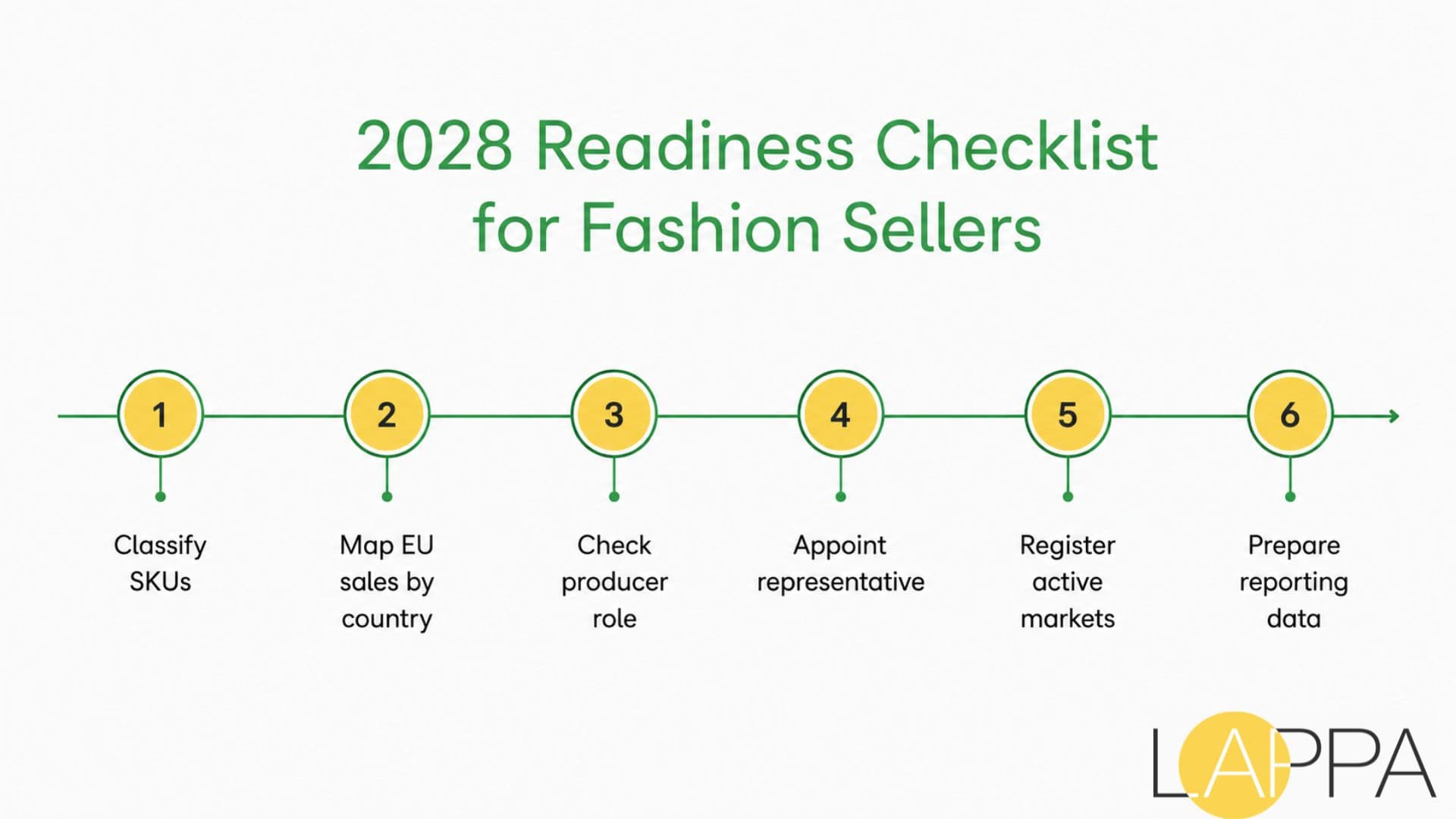
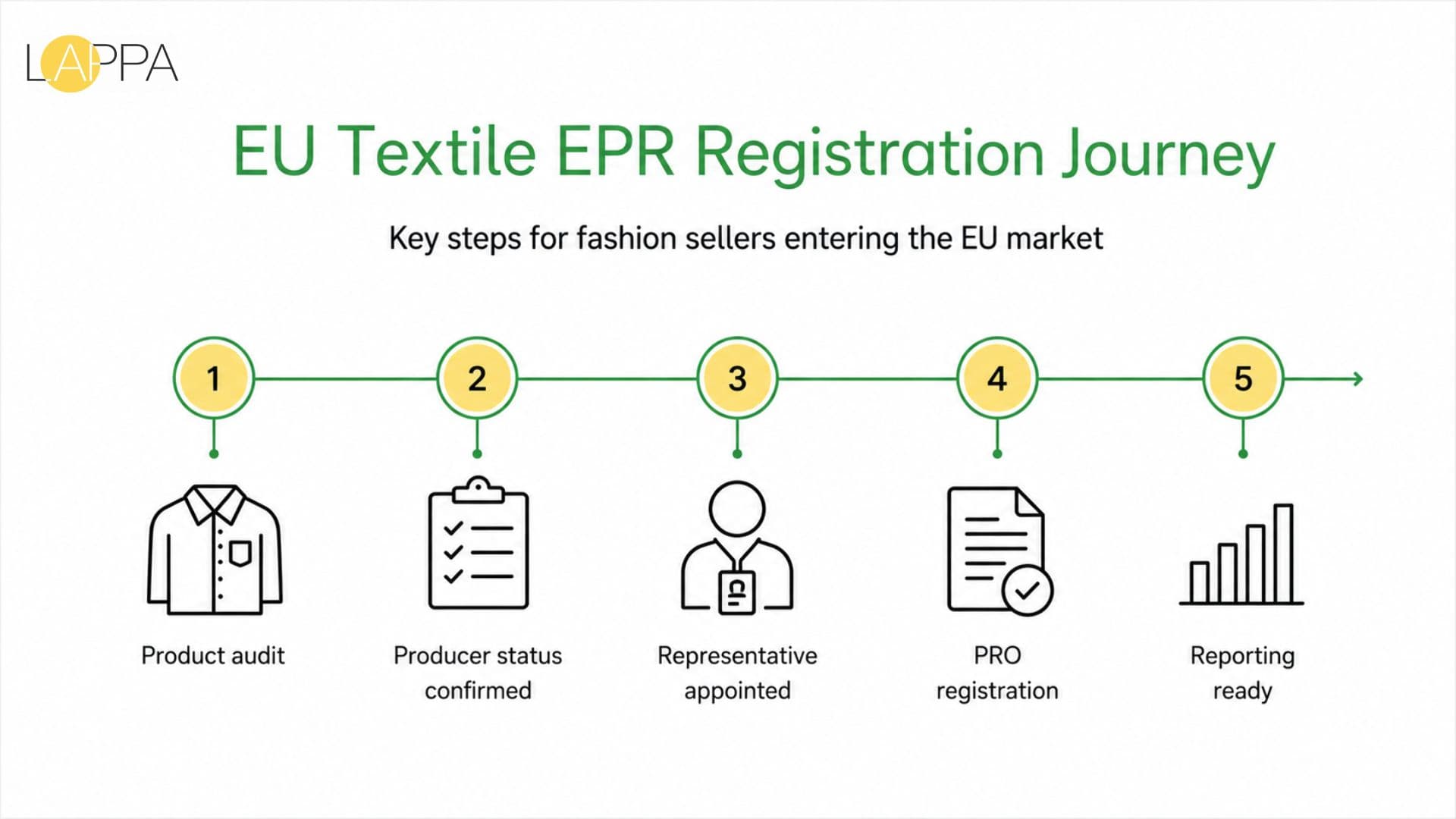
Step-by-Step Compliance guide Checklist
- Step 1: Audit your textile and footwear product catalogue
Map every SKU against the CN codes in Annex IVc of Directive (EU) 2025/1892. Separate in-scope items from out-of-scope products and highlight any grey-area categories (e.g. mixed-material accessories, technical fabrics, bundled products) for professional assessment. This audit underpins all next steps – proper product classification is key for registration volumes, fee computations and reporting.
- Step 2: Map your EU sales figures per Member State
For each product in-scope, state which EU nations you trade into, and the yearly weight or amount put on each market.This data drives both your registration obligations and your fee liability. If your sales data is not currently structured to support country-level reporting, now is the time to fix that in your ERP or order management system.
- Step 3. Identify your manufacturer status in each market
Check if your company is a producer in each Member State where you sell. Pay particular attention to own-brand items, distance selling arrangements and any situations where your organization is importing products into the EU for the first time. If you are a producer and a retailer for multiple product lines you may need to consider each product line separately.
- Step 4: If necessary, appoint an approved representative
Non-EU enterprises should designate an authorised representative in each EU Member State where they have EPR requirements. This is a legal requirement, not optional, and the representative must be in place before registration is completed. Lappa’s EPR registration services include authorised representative appointment across EU Member States.
- Step 5: Register in active markets immediately
If you sell into France or the Netherlands and have not yet registered, this is the most urgent action. For France, registration is via Refashion. For the Netherlands, registration is through a recognised national PRO. Delays in registration in active markets carry enforcement risk and potential marketplace suspension.
- Step 6: Build a method to track and report on markets coming soon
Where Member States are currently transposing, establish a tracking method to monitor when national schemes become operational. Assign internal ownership for each market and make sure that your reporting system is able to deliver the volume and weight data necessary for your yearly declarations. Lappa’s EPR reporting are designed to facilitate multi-country textile EPR reporting on one platform.
- Step 7: Involve product, sourcing, and finance teams
Eco modulation fees mean that product design choices directly affect compliance costs. Share the fee modulation criteria with product and sourcing teams before the next range review, and model the fee impact of your current product mix so finance can account for EPR costs in margin planning.
Common Mistakes That Create Avoidable Risk
Most compliance failures in textile EU textile EPR do not stem from the complexity of the rules. They stem from predictable misunderstandings that delay action until the window for orderly preparation has closed.
The Four Most Costly Errors
- Assuming headquarters location determines scope. The directive applies based on where products are placed on the market, not where the selling entity is registered. A brand headquartered in London or Singapore that sells to French consumers is a producer in France. This is the single most common misunderstanding among cross-border sellers.
- Waiting for every Member State to finalise national law. The EU-level framework is already fixed. Businesses that delay product audits and sales data preparation until national transposition is complete will face a compressed, multi-market registration sprint in 2027. The preparation work is the same regardless of when national schemes launch.
- Treating EU textile EPR as a sustainability issue owned by one team. Textile EPR is a legal obligation with direct financial consequences. Eco modulated fees are tied to product design, reporting obligations require sales data infrastructure, and marketplace access depends on registration status. No single team owns all of this. Compliance, product, finance, and operations all need to be involved.
- Managing producer responsibility via markets or distributors. The directive puts the onus on the producer for EPR requirements, not the platform. Even if a marketplace facilitates collection or reporting in some markets, the legal obligation and enforcement risk sit with the producer. Contractual arrangements with distributors do not transfer EPR liability unless specifically structured to do so and recognised under national law.
Prepare Before 2028 Becomes a Multi-Market Scramble
The central risk in EU textile EPR is not the complexity of the rules — it is late preparation across multiple markets simultaneously. Businesses that map their scope, classify their products, and address live-country obligations now will have more options, lower costs, and less operational disruption than those who treat April 2028 as the starting gun.
What to Prioritise in your Textile Compliance Europe roadmap
- Immediate: Register in France and the Netherlands if you sell there and have not yet done so.
- Near-term: Complete your product catalogue audit and EU sales volume mapping by market.
- Ongoing: Monitor national transposition progress and assign internal ownership for each market as schemes go live throughout 2027.
- Cross-functional: Brief product, sourcing, and finance teams on eco modulation criteria before the next range review.
The practical next step for most businesses is getting specialist support for registration, authorised representative appointment, and the ongoing reporting workflows that will run across multiple jurisdictions from 2027 onwards.
Lappa provides EPR registration and compliance services for textile and footwear producers selling into the EU, including authorised representative services for non-EU businesses and multi-country reporting support. If you are unsure where your business stands on textile EPR scope or registration status,https://lappa.org/contact-us/ to get a clear picture before the compliance window narrows further.
Frequently Asked Question
The best EPR reporting software for EU sellers is a solution that supports multi-country reporting, product-level data tracking, marketplace compliance, authorised representative coordination, and packaging or textile waste reporting by country. For EU marketplace sellers, the software should help track sales volumes, product weights, materials, and country-specific reporting deadlines across different national EPR schemes.
Lappa provides EPR registration and reporting support for sellers operating across EU markets, including multi-country reporting workflows and authorised representative services for non-EU businesses.