


Battery EPR and the new EU battery regulation explained
August 2023 reset the rulebook. Regulation (EU) 2023/1542 — the EU battery regulation — replaced the 2006 Battery Directive without transition, wiping legacy compliance assumptions across all 27 Member States at once. Brands, importers, and authorised representatives now operate under one directly applicable text. Miss a registration window and EU shelf access closes. Ship a mislabelled cell and enforcement pulls it.
How the EU battery regulation broke with the 2006 directive
Old rules treated batteries as a waste stream. Collect, recycle, submit figures — done. The battery regulation EU broke completely with this logic. Duties now attach at raw material extraction and run unbroken to the recycling facility. Supply chain sourcing, carbon accounting, labelling, digital traceability, end-of-life take-back — all one connected chain rather than isolated checkboxes.
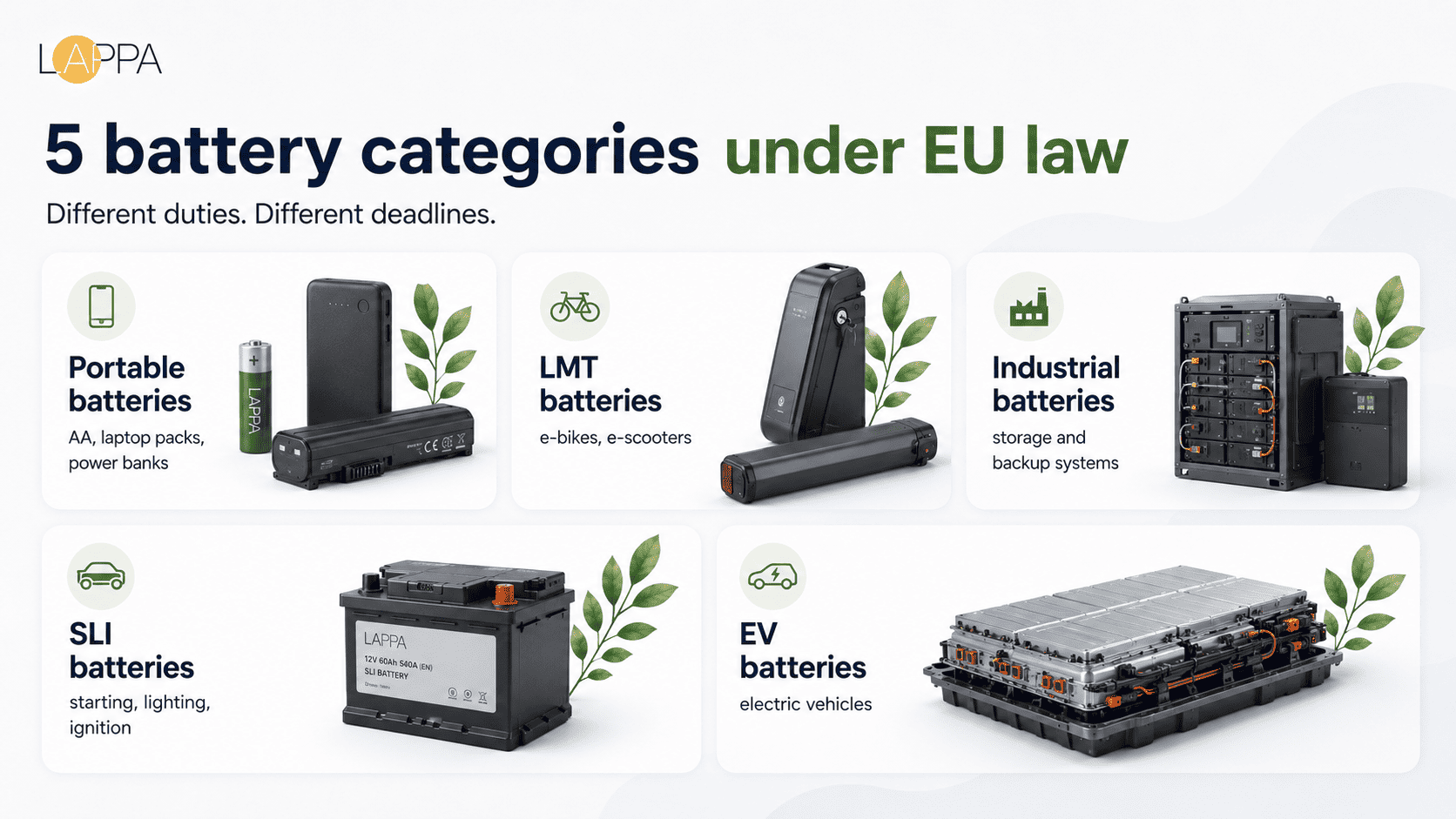
Five battery categories sit in scope, each with distinct deadlines and documentation. Portable batteries span AA cells through laptop packs and power banks. LMT — light means of transport — covers e-bikes, e-scooters, and other light EVs, explicitly named as a distinct scope item for the first time. Industrial cells include large stationary storage and backup power systems. SLI batteries handle vehicle starting, lighting, and ignition. EV batteries stand alone given the carbon footprint and digital passport requirements attached to them.
Priority changes hitting operations in the next 12 months:
- Carbon footprint declarations per EV and industrial model — mandatory at EU placement; performance class ceilings from August 2026 can lock non-compliant models out entirely
- Digital battery passport with QR code — live from February 2027 for EV and industrial cells
- Recycled content minimums — cobalt, lithium, nickel, lead — binding first phase 2031, second 2036
- Full labelling overhaul: QR code, Wh capacity mark, revised take-back symbol — all cells from August 2025
- Battery EPR formally extended to LMT batteries, previously absent from the 2006 framework
Battery EPR — Who article 56 catches as a producer
Most brands know whether they manufacture batteries. Far fewer know whether they qualify as a legal producer in the EU sense — and that gap is exactly where enforcement problems begin. The European battery regulation casts its producer definition deliberately wide, closing loopholes non-EU sellers and white-labellers exploited under the old directive.
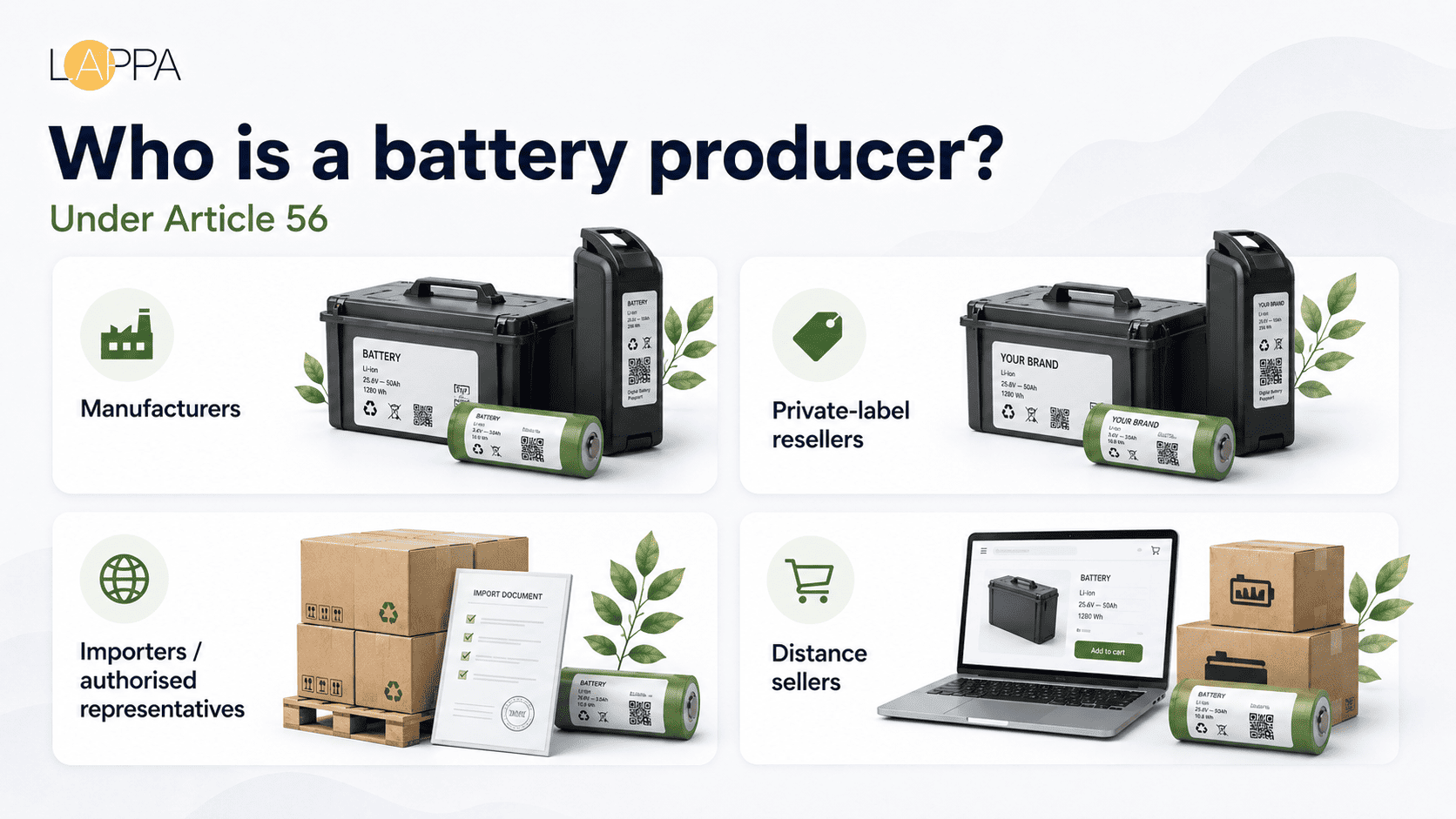
Article 56 names four distinct categories:
- EU-established manufacturers selling branded cells in their home Member State
- Resellers placing batteries under their own label in countries where the original maker has no local presence
- Importers or authorised representatives putting batteries onto a country’s market for the first time
- Distance sellers — any non-EU online retailer shipping cells or battery-containing goods directly to EU end-consumers
Distance sellers create the densest compliance gaps in practice. A US electronics brand dispatching orders to German addresses: legally a producer in Germany. A Korean manufacturer selling through Amazon.de: same result. A Chinese power tools firm shipping to French B2B buyers with no local intermediary taking title: producer in France. Wherever EU consumers receive batteries without a local entity having formally accepted that status, the upstream brand carries the duty. An Authorised Representative holding a country-specific written mandate solves this — a vague pan-European arrangement does not.
Not sure whether your brand qualifies as a producer in the EU? Get a free quote or book a demo to review your producer status with an expert.
Four battery EPR duties active right now
Enrol before accessing EU shelves. Battery EPR registration with a PRO or competent authority is a prerequisite — not a post-launch task. Each enrolment needs company identification, battery category, estimated annual weight in kg, and proof of compliance financing. Brands already enrolled under the 2006 framework must audit those records against the new scope list, particularly for LMT, and update accordingly.
Fund collective take-back. PRO fees run per tonne or kilogramme placed on market, sometimes split by chemistry. Those payments fund collection points, transport, and treatment infrastructure handling end-of-life cells across each jurisdiction. Brands opting out of a PRO must lodge an individual financial guarantee directly with the competent authority.
Hit collection rate targets. Article 59 sets portable battery collection at 45% of placed-on-market weight by end-2023, 63% by end-2027, 73% by end-2030. LMT targets run on a separate track: 51% by 2028, 61% by 2031. Aggregate figures are allocated to registered sellers in proportion to their market share.
Submit annual volume reports. Prior-year quantities sold, split by category and chemistry, go to each competent authority or PRO. Formats are EU-harmonised but submissions run through 27 separate portals. Windows typically open in January and close in April.
Key deadlines under EU battery law — dates with market-access consequences
EU battery law does not issue warnings. Germany’s enforcement model runs on competition: any enrolled rival can petition a court for an injunction against an unregistered seller — often within days, with no regulator involvement. The EU battery law table below lists the most immediately relevant dates for brands active across EU markets.
| Obligation | Category | Deadline |
| EPR enrolment — portable cells | Portable | Already required. New categories: update by 18 Feb 2024 |
| Labelling: QR code, Wh mark, revised take-back symbol | All categories | 18 August 2025 |
| Carbon footprint declaration | EV cells | 18 Feb 2025 (declaration); performance classes from 18 Aug 2026 |
| Carbon footprint declaration | Industrial cells above 2 kWh | 18 February 2026 |
| Digital battery passport | EV and industrial | 18 February 2027 |
| Recycled content declaration | EV, industrial, SLI | 18 August 2025 |
| Recycled content minimums — first phase | EV and industrial | 2031 |
| Portable collection rate 63% | Portable | 31 December 2027 |
On labelling: stock warehoused on 18 August 2025 may sell through without modification. Every production run from that date needs the updated QR code and Wh mark. The revised take-back symbol must cover at least 3% of the largest packaging surface. Brands printing labels six months ahead need a hard cut-over date in the production calendar.
Battery EPR registration — sequencing multi-country enrolments
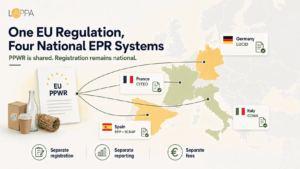
No single EU-wide enrolment portal exists. Each Member State runs its own system, with distinct portals, document sets, fee structures, and processing timelines. Battery EPR registration across multiple jurisdictions demands a sequenced approach — not simultaneous ad-hoc submissions.
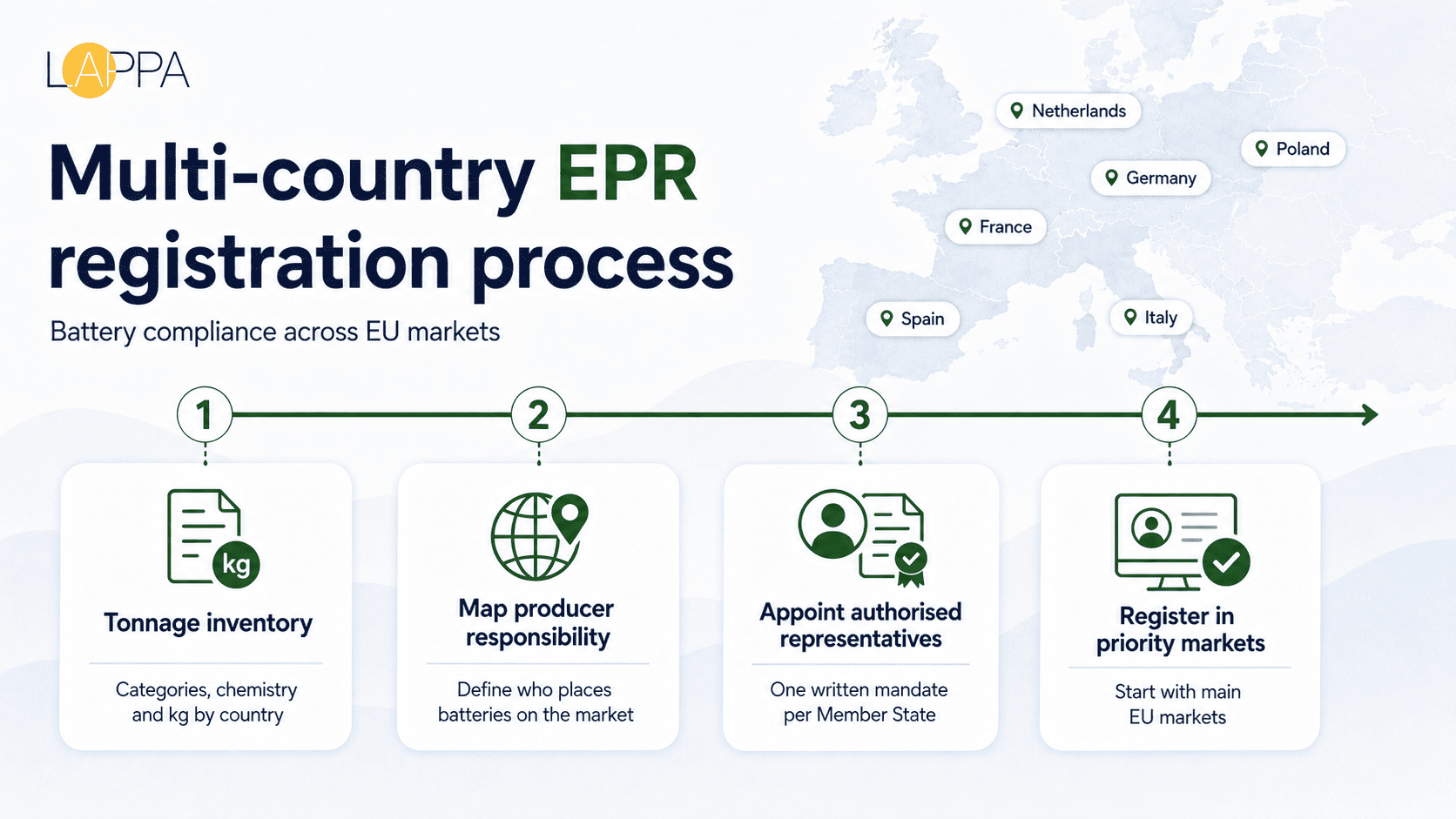
Tonnage inventory first, everything else second. Document every cell category sold into Europe — annual volumes in kg per country, chemistry. This dataset feeds every enrolment form and every PRO fee calculation. Skipping this step means re-submitting.
Map legal responsibility per jurisdiction. Distributor contracts determine liability. A distributor taking legal title and placing goods on the market under its own label is the producer — not the upstream brand. Direct-to-consumer sales and marketplace arrangements push that status back to the brand owner in almost every case.
Appoint Authorised Representatives ahead of portal access. Non-EU entities need one AR per Member State, each holding a written mandate specifying reporting and fee duties by country. Competent authorities in Germany, France, and Italy routinely reject vague pan-European mandates at the enrolment stage.
Prioritise high-volume markets and run them in parallel. The majority of EU battery sales come from Germany (stiftung ear), France (ADEME/SYDEREP), Italy (MASE), Spain (MITERD), Poland (BDO) and the Netherlands (Stibat). Running these simultaneously compresses the overall timeline significantly.
Managing battery EPR registration across multiple EU markets? Lappa handles enrolment, PRO coordination, and annual reporting in one place. Explore EPR Consolidation
How battery regulation EU enforcement varies across key markets
The European battery regulation text is identical in every jurisdiction. Enforcement intensity, administrative speed, and penalty levels differ substantially. Brands managing cross-border risk must understand how these variations play out operationally, not just in theory.
Germany runs the most aggressive model in the EU. Stiftung ear maintains a searchable public register. Spot a competitor’s absence and petition a court for an injunction blocking their German sales. No regulator needed. No advance warning given. BattG fines reach €100,000 per infringement. Injunction filings are an active competitive tool — not rare events.
France runs SYDEREP enrolment alongside mandatory eco-organisation membership — Corepile or Screlec cover most portable cells. Non-EU sellers need an AR carrying a SIRET-equivalent identifier. Environmental code penalties climb to €75,000 with possible custodial sentences for named individuals. Italy combines MASE enrolment with a financial guarantee; Cobat and ERION Batteries manage portable take-back. Poland’s BDO register mandates a Polish-addressed entity or AR. Enforcement pace increased significantly post-2022. The Netherlands (Stibat/ICL) and Belgium (Bebat) both run mature, high-compliance markets with consistent monitoring by competent authorities.
What the European battery regulation adds beyond EPR — carbon, sourcing, recycled content
Take-back dominates most compliance conversations. The EU battery regulation reaches considerably further upstream. Industrial, EV, LMT, and SLI cells above 2 kWh face three additional duty tracks hitting procurement and product engineering directly — not just logistics.
Supply chain due diligence on cobalt, natural graphite, lithium, and nickel went live on 18 August 2025 under Annex X. Sellers must implement a written policy aligned with the OECD Due Diligence Guidance for Responsible Supply Chains of Minerals from Conflict-Affected and High-Risk Areas — active supplier audits, documented risk mapping, corrective action where gaps exist. A policy document with no implementation trail does not satisfy this requirement.
Carbon footprint declarations per EV cell model were due at EU placement from 18 February 2025. Commission Delegated Regulation (EU) 2024/1789 sets the calculation methodology. Performance class thresholds activate on 18 August 2026 — any model exceeding the maximum permitted footprint loses EU access from that date. Brands without footprint measurement systems already running are behind schedule.
Recycled content declarations for EV, industrial, and SLI cells were due from 18 August 2025. Binding minimums activate from 2031: cobalt 16%, lithium 6%, nickel 6%, each tightening again in 2036. Tracing recycled content through multi-tier supply chains typically takes 18 to 24 months to implement properly. Brands still mapping tier-one suppliers have very limited runway to 2031.
Non-EU manufacturers and distance sellers placing batteries on the EU market need an Authorised Representative in each Member State. See how Lappa’s AR service works
FAQ
on EU battery law and EPR





Does EU battery law reach brands incorporated outside the EU
Yes. EU battery law assigns producer status based on where cells land on the market — not on where the selling entity is incorporated. Article 56 of Regulation (EU) 2023/1542 makes this explicit. A US electronics brand dispatching orders to German addresses is a producer in Germany. A Korean manufacturer selling through Amazon.de: same result. A Taiwanese OEM reaching French retailers is a producer in France — and in every country where direct sales occur without a local entity accepting that status. Entities without a European legal presence must appoint one AR per Member State, each holding a written mandate naming reporting and fee duties by country. In Germany, a rival can obtain a court injunction blocking sales without any regulator opening a file — discovering AR gaps late is extremely costly.
What separates battery EPR registration from PRO membership
Battery EPR registration places a seller in the competent authority’s system as a recognised producer. Enforcement authorities consult this record when acting on complaints. Without it, there is no right to place cells on that country’s market. PRO membership is the financial instrument: joining a Producer Responsibility Organisation means contributing to pooled infrastructure funding collection, sorting, and treatment across a jurisdiction. Both are necessary in most countries. Enrolment alone leaves an unfunded financial duty. PRO membership without enrolment leaves a seller legally invisible at the authority level. Some large-volume brands skip PRO membership and lodge an individual financial guarantee with the competent authority instead — permitted, but administratively heavier and only cost-effective at significant annual volumes.
Which categories need battery EPR registration under Regulation (EU) 2023/1542
All five: portable, LMT, industrial, SLI, and EV. LMT is the most commercially significant addition relative to the 2006 directive — e-bikes, e-scooters, and comparable light EVs occupied a grey zone pre-2023, leaving many e-mobility sellers unregistered heading into 2024. Industrial and EV cells carried duties under the old framework. The European battery regulation added binding collection targets and structured annual reporting — neither had a direct precedent in the 2006 directive. Battery EPR registration in one country creates no legal standing in another. Enrolment covering one battery category covers no other category the same brand sells. Each country-category combination is a separate submission.
What labelling must cells carry from 18 August 2025 under the EU battery regulation
Four elements are mandatory on every cell or its immediate packaging from 18 August 2025. A QR code linking to publicly accessible product data: chemistry, hazardous substances, carbon footprint where declared, recycled content figures. Energy capacity in Wh for portable cells rated at 1 Wh or above, or in Ah for other categories. The updated separate-collection symbol — the crossed-out wheeled bin — sized to cover at least 3% of the largest side surface. Chemical symbols Hg, Cd, or Pb wherever mercury, cadmium, or lead content exceeds regulated thresholds. Cells sealed inside finished products — unreachable without tools — shift the marking duty under the EU battery regulation to outer packaging and user documentation. Consumer electronics, power tools, and medical devices are the primary product lines affected by this transfer.
What penalties follow non-compliance with battery regulation EU rules
Article 91 sets the framework: penalties must be effective, proportionate, and dissuasive. Actual figures sit in each country’s own law and vary substantially. Germany: BattG fines up to €100,000 per infringement, plus the civil injunction risk allowing rivals to cut off market access ahead of any regulator acting. France: environmental code penalties up to €75,000, with possible custodial sentences for named individuals. Italian and Polish administrative fine regimes sit in comparable ranges. Financial penalties, however, are rarely the most damaging outcome. Competent authorities can order products removed from retail and delisted from online channels — inability to prove valid battery regulation EU compliance is sufficient cause. Amazon and Zalando verify enrolment status ahead of listing approvals. Non-registration becomes commercially visible almost immediately, well ahead of any fine arriving.
