


7 points you need to know about the IOSS and customs reform from July 1, 2026
Strategic insights and operational readiness for cross-border E-commerce
Executive Summary
The European Union is introducing comprehensive structural updates to its cross-border e-commerce framework under Council Regulation (EU) 2026/382. Effective July 1, 2026, the traditional €150 customs duty exemption is removed, replaced by a streamlined flat-rate tariff system and enhanced product data tracking. This article provides a professional analysis of the seven critical aspects businesses must understand to adjust their international supply chains, compliance workflows, and software configurations.
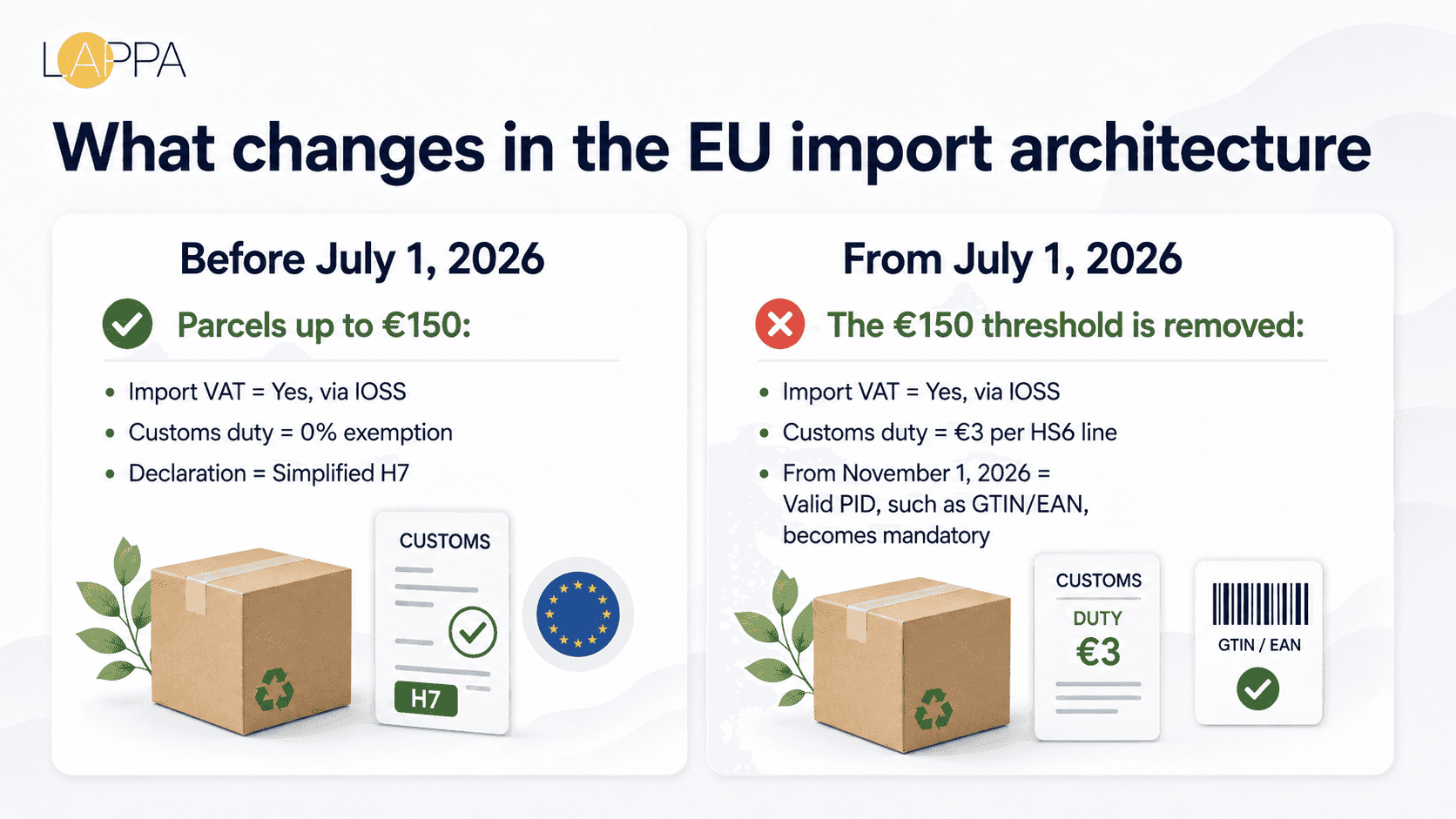
1. Complete removal of the €150 threshold
Starting July 1, 2026, the long-standing €150 de minimis threshold for customs duty exemptions on B2C imports will no longer exist within the European Union. While the 2021 e-commerce reform successfully applied import VAT to all low-value goods, customs duties remained exempt for parcels under €150. Under the updated regulations, every commercial package entering the EU from a third country will be subject to standard customs processing and duty obligations, completely eliminating the distinction based on low transaction values.
2. Introduction of the €3 flat-rate duty
To prevent operational delays and minimize processing complexities across European customs checkpoints, a simplified flat-rate duty is being implemented. From July 1, 2026, until June 30, 2028, a flat fee of €3 will apply to low-value consumer shipments. This transitional measure provides international merchants and postal networks with a straightforward, predictable cost structure before the EU transitions fully to the highly automated EU Customs Data Hub system planned for 2028.
3. The per-item (HS6 line) calculation mechanism
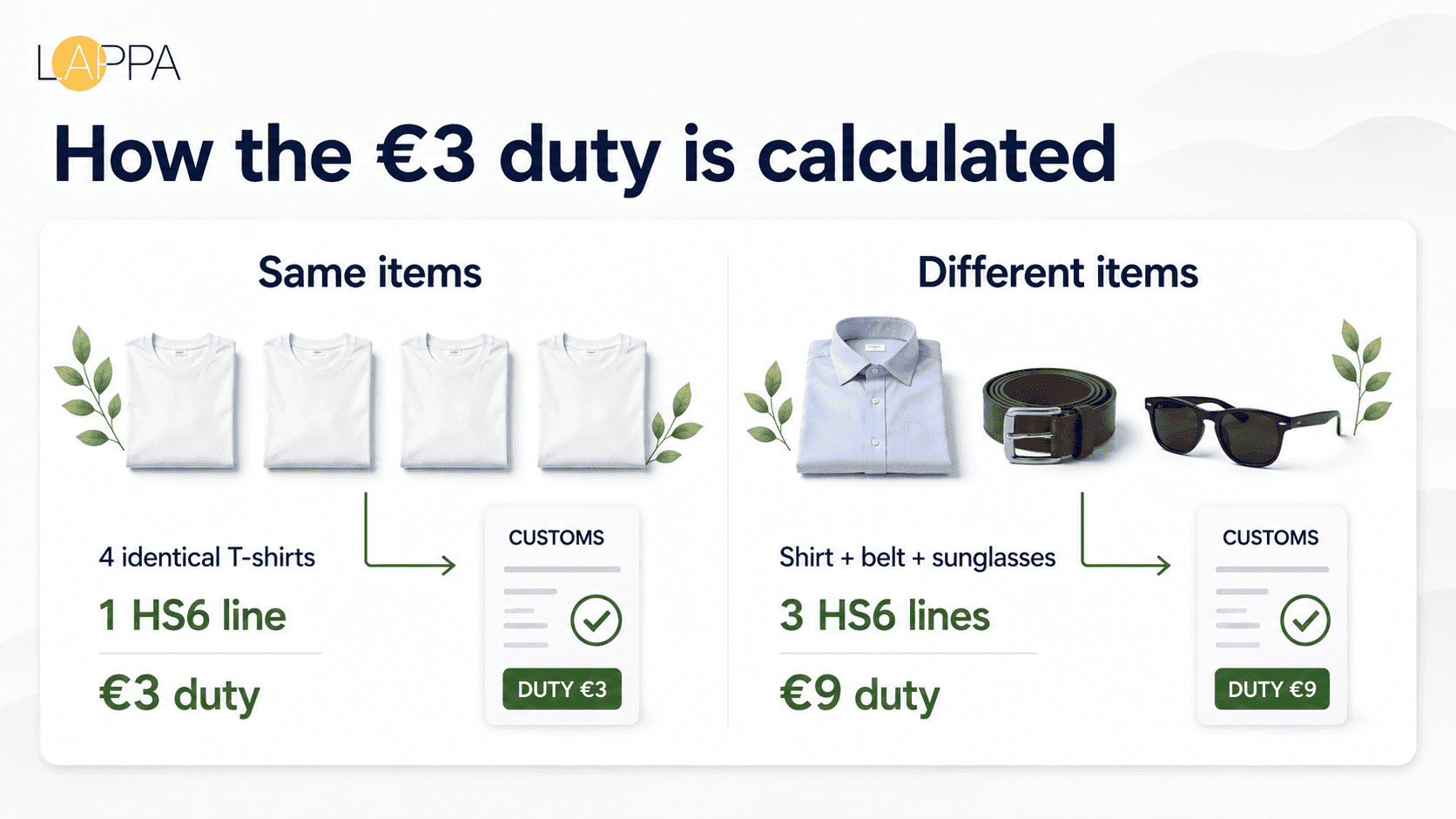
An essential technical characteristic of the €3 flat rate is that it is assessed per unique item line within the electronic customs declaration, rather than per physical box or overall order. Item lines are classified based on the 6-digit Harmonized System (HS6) tariff code.
- Single HS6 Line: A package containing multiple identical items (e.g., four cotton shirts) shares the same HS6 code, generating one line in the declaration. The total flat duty remains €3.
- Multiple HS6 Lines: A package containing different types of goods (e.g., a shirt, a leather belt, and a pair of sunglasses) requires three distinct HS6 classifications. This creates three separate lines in the declaration, resulting in a total duty of €9 (€3 × 3), even if the combined monetary value is low.
4. Why IOSS handles VAT, not customs duties
A key operational distinction must be maintained between import taxes and customs duties. The Import One-Stop Shop (IOSS) registration framework—whether maintained via Latvia, France, or other regional tax portals—remains strictly a mechanism for collecting, reporting, and remitting import VAT at checkout. IOSS cannot be utilized to declare or clear customs duties. Because the €3 flat rate is a distinct customs duty, it is administered directly at the physical EU border by customs authorities, meaning the VAT and customs tracks operate in parallel.
5. Navigating the transition from DAP to DDP models
To ensure an optimal and seamless delivery experience for consumers, international businesses are encouraged to transition from Delivered Duty Unpaid (DAP/DDU) to Delivered Duty Paid (DDP) shipping terms. Under a DAP approach, the regional postal or courier service must collect the €3 duty, along with standard carrier administrative handling fees, directly from the consumer prior to final delivery. Shifting to a DDP model allows e-commerce platforms to calculate the duty dynamically during online checkout, integrate it into the initial transaction, and settle it transparently via their logistics provider’s billing account.
6. Mandatory product identifiers (PID) by November 2026
While the flat-rate duty begins in July, a secondary data compliance milestone occurs on November 1, 2026. From this date, providing valid Product Identifiers (PIDs) within the electronic H7 customs dataset becomes mandatory. Acceptable PIDs include Global Trade Item Numbers (GTIN), EAN, or UPC barcodes. These identifiers allow automated customs verification systems to validate that the electronic declaration matches global product databases, facilitating expedited green-channel clearance for compliant shipments.
7. Operational readiness checklist for E-commerce platforms
Achieving full compliance with the 2026 requirements involves straightforward technical updates. Merchants should focus on updating catalog structures to ensure all SKUs carry correct 6-digit HS codes, adjusting checkout software to aggregate and multiply the €3 fee based on unique HS6 lines, and coordinating with logistics networks to guarantee automated DDP data transmission. Proactive alignment ensures that international delivery networks continue to operate efficiently without delays at the border.
Key compliance milestones timeline
|
Milestone date |
Core regulatory change |
Strategic business impact |
|
July 1, 2026 |
Abolition of €150 limit. Implementation of €3 flat duty per HS6 line. |
Pricing updates required at checkout to avoid margin reduction. |
|
November 1, 2026 |
Mandatory submission of Product Identifiers (GTIN/EAN) in H7 dataset. |
Requires inventory data synchronization with courier electronic logs. |
|
July 1, 2028 |
Transition to EU Customs Data Hub and multi-tier category tariffs. |
Long-term transition to structured percentage-based category buckets. |
Ready to update your checkout for the €3 flat duty? Get a free quote or book a demo to configure your IOSS and customs compliance with an expert.
FAQ EU Customs Reform 2026
The €3 flat duty applies to all B2C consignments with an intrinsic value up to €150 imported from non-EU countries under Council Regulation (EU) 2026/382. B2B shipments going to VAT-registered recipients follow standard customs duty rates instead. Goods covered by preferential trade agreements may retain reduced rates — but only if VAT was not collected via IOSS and the declaration uses the standard H1 form, not H7.