

Consolidated
EPR Eco-Fee Payments
Across Europe
Lappa provides consolidated eco-fee management and dedicated EPR support for businesses operating internationally, helping you settle producer responsibility obligations accurately and on time across Europe, the United States and other global markets. Our EPR support covers registration, reporting and settlement in one place.
All your EPR eco-fee payments — in one place
Compliance costs are complex because each country, and in the United States each state, invoices differently: a different currency, a different schedule, and a different producer responsibility organisation behind each one. Handled separately, this becomes a recurring administrative project for your finance team rather than a one-off task. Lappa centralises each eco-fee obligation you owe across Europe and the US, with automated invoice tracking and proactive deadline alerts.
We monitor fee calculations, contribution terms and confirmations across each scheme you are registered with, giving you a clear, unified view of what is due, to whom, and when — so nothing is ever missed in any market, and every invoice is checked against your own reported data before you sign off on it.
Complete EPR payment services
with L'EPR
Think of it as one EPR consultant relationship covering every eco-fee obligation you owe, wherever it is due.
- Centralised tracking of every compliance invoice and due date across all your registered countries and US states
- Fee calculation review across all your EPR fee payments, checking invoiced amounts before you sign off
- Multi-region processing across Europe, the United States, the UK, and other global markets from one platform
- Centralised handling of packaging, WEEE fees, and battery obligations
- Consistent material management across each scheme, so nothing falls through the cracks
- Full reconciliation and record-keeping, matching every transaction to its confirmation and reporting period

Lappa
payment services
include
Invoice tracking across all regions
EPR consultant support included
Centralised transaction processing
Deadline alerts and reminders
Market access protection
WEEE fees and battery costs
Material management across schemes
Recycling compliance tracking
EPR payment process with Lappa
Core elements of payment management with Lappa
Global
EPR payment
coverage
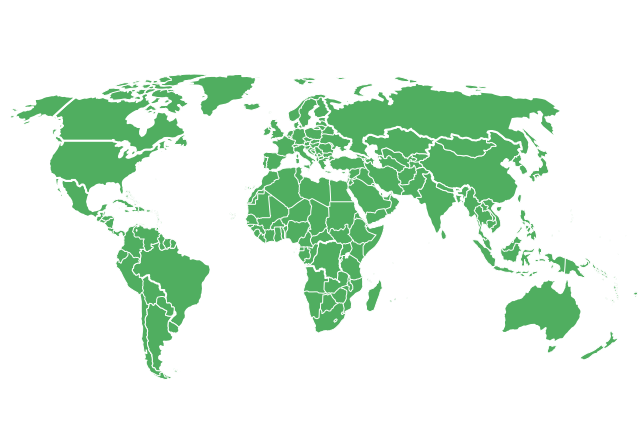
In Europe, Lappa manages compliance obligations across Germany, France, Italy, Spain, and other EU member states, plus the United Kingdom with its own packaging and WEEE rules. In the United States, packaging extended producer responsibility is not a single federal law but a growing set of individual state programs, including California, Colorado, Oregon, Minnesota, Maine, Maryland and Washington, most of which route producer contributions through the Circular Action Alliance as the designated organisation. Each EU country and each US state runs its own EPR-system, with its own producer definition, reporting calendar and rate schedule.
How each
EPR-system
differs
With Lappa, each jurisdiction on both sides of the Atlantic is managed from one unified platform — without separate local providers for each scheme. We ensure consistent invoice checks, aligned approval workflows, and centralised records.
Consistent material management underpins accurate reporting in every scheme you’re registered with.
Consolidated processing also strengthens your recycling compliance, since every settlement is checked against the same reported data your recycling targets rely on.
This coverage also protects your market access, since a late settlement in one country can put your registration status at risk there.
L'EPR
for eco-fee payments
A centralised EPR payment service for eco-fee management across Europe and the US.
Automated calculation checks
Centralised invoice and deadline calendar
A cost-effective EPR payment service
Why choose Lappa for
EPR support
- One unified platform delivering EPR payment services across Europe, the US, UK, and other regions simultaneously
- All product streams supported, including packaging, WEEE fees, and battery costs, in one service
- Automated deadline tracking with proactive alerts for each invoice and EPR pay on behalf arrangement
- One dedicated EPR consultant relationship instead of a separate local contact in every country or state
- Transparent, cost-effective pricing that scales with the number of markets you operate in
- Protecting your market access as you expand into new countries or states
- Single-country focus requiring a separate provider for each scheme, country, or US state
- Manual invoice tracking with a high risk of missed deadlines
- Limited support for paying EPR fees on your behalf, often bundled awkwardly with unrelated services
- Complex, per-country pricing that scales unpredictably as you add markets
Seamless EPR integration for your business
Lappa connects to the e-commerce platforms, ERP systems, and accounting tools you already use, so transaction data and confirmations flow into your existing finance workflow instead of a separate spreadsheet. This also keeps every obligation linked to the EPR reporting and EPR registration data it was calculated from. So your finance team stays fully supported on EPR from day one.





Learn more about EPR
Centralised EPR compliance
How Lappa brings registration, reporting and settlements together, supporting recycling compliance for companies operating across several European markets at once.
read moreEPR fee calculator
Get an early estimate of what your packaging cost, WEEE fee, or battery obligation might look like before you register in a new market.
read moreEPR guides
Detailed breakdowns of registration, reporting and settlement requirements by country and product category.
read moreWhat our customers say about us

Anna K.
Finance Director
Before working with Lappa, our accounts payable team was juggling invoices from nine different producer responsibility organisations, each with its own currency, format and due date. Nobody owned the calendar, so deadlines lived in someone’s inbox rather than a shared system, and we had already missed one deadline in Poland simply because the notice landed in a shared mailbox nobody was monitoring that week. Beyond the near miss, the sheer volume of admin was wearing our small team down: reconciling nine different spreadsheets every quarter, chasing confirmations that never arrived, and explaining to auditors why two of our records didn’t quite match. Lappa now tracks every obligation we owe across Europe in one calendar, checks each invoice against our reported volumes before it ever reaches my desk for sign-off, and keeps a full reconciliation trail we can hand straight to our auditors. It has turned a stressful quarterly scramble into a routine we barely think about anymore, and it freed up roughly half a day a week that used to disappear into spreadsheet reconciliation alone. It also means we now run our EPR admin more cost-effectively than before.

Marco D.
Head of Compliance
We manufacture small electrical appliances and sell packaging and WEEE volumes into more than a dozen EU countries, which used to mean separate arrangements for two completely different obligations in every single market, run by two different people who rarely talked to each other. Our packaging costs sat in a separate spreadsheet, our WEEE costs in another, and nobody had a single view of what the business actually owed across the group at any given moment. Lappa’s team mapped exactly which schemes applied where, set up pay on behalf arrangements for the countries where we have no local finance presence, and gave us a single dashboard instead of chasing each EPR payment separately across a dozen separate files. The clarity alone has been worth the switch: our finance director can now answer “what do we owe this quarter” in under a minute instead of a day of digging, and we have not had a single disputed invoice since we moved everything through Lappa.

Isabelle R.
Group Financial Controller
Expanding into new European markets always came with the same fear: another local provider, another process to onboard, another set of terms our team had to learn from scratch, usually under time pressure right before launch. Every new country used to add roughly two weeks of internal setup before we even understood who to pay and when. With Lappa, adding a new country to our coverage is now a configuration step rather than a procurement project, and our last two market entries took days rather than weeks to get running. Their team verifies every calculation against our own reporting data before we approve anything, which caught a mismatched material classification in our German invoice within the first month, something our previous provider had missed for two consecutive years. That single catch alone justified the decision to consolidate, and managing materials consistently across every market has brought even more peace of mind.
Tomás V.
VAT and Environmental Taxes Manager
As an importer bringing battery-powered consumer goods into the EU, we did not fully understand how battery obligations, packaging costs and our authorised representative’s role fit together until Lappa walked us through it properly, in plain language rather than legal jargon. They were careful to explain that using their service does not remove our own responsibility as producer, which we appreciated, because some other providers we spoke to were vague on exactly that point, and one had implied the opposite outright. Now everything runs through one consolidated process, with proof of settlement stored centrally for every period, and our internal audits close in a fraction of the time they used to take. We also finally have a clear answer, in writing, for exactly where legal responsibility sits versus where Lappa’s operational role begins, and it has kept us recycling-compliant across every battery market we sell into.
Sophie L.
Head of Sustainability and Compliance
Our sustainability team, not finance, used to end up chasing invoices because nobody else had visibility into the deadlines, and it was never formally anyone’s job, which meant things quietly slipped through the cracks more often than we liked to admit. Lappa’s centralised tracking gave us a single place to see all EPR payments due across our markets, with alerts that reach the right person automatically instead of whoever happens to open the right mailbox that week. Reconciliation against our reported packaging and WEEE volumes is now handled for us, cutting what used to be a two-day quarterly exercise down to about an hour of review. We have finally been able to hand day-to-day tracking back to finance where it belongs, and our sustainability team can focus on actual design and recyclability work again instead of chasing paperwork.