


What Is PPWR and How It Differs from EPR
What is PPWR and its legal scope
Regulation (EU) 2025/40 entered into force on 11 February 2025. Most obligations apply from 12 August 2026. The question of what is PPWR now has a direct answer: it is a binding EU law covering every type of packaging placed on the EU market — plastic, paper, glass, metal, wood. It applies identically in all 27 member states. No national adaptation, no delays.
PPWR replaces Directive 94/62/EC. Under the directive framework, individual states could develop their own legal approach. Unlike the previous directive, PPWR applies uniformly across all EU member states.
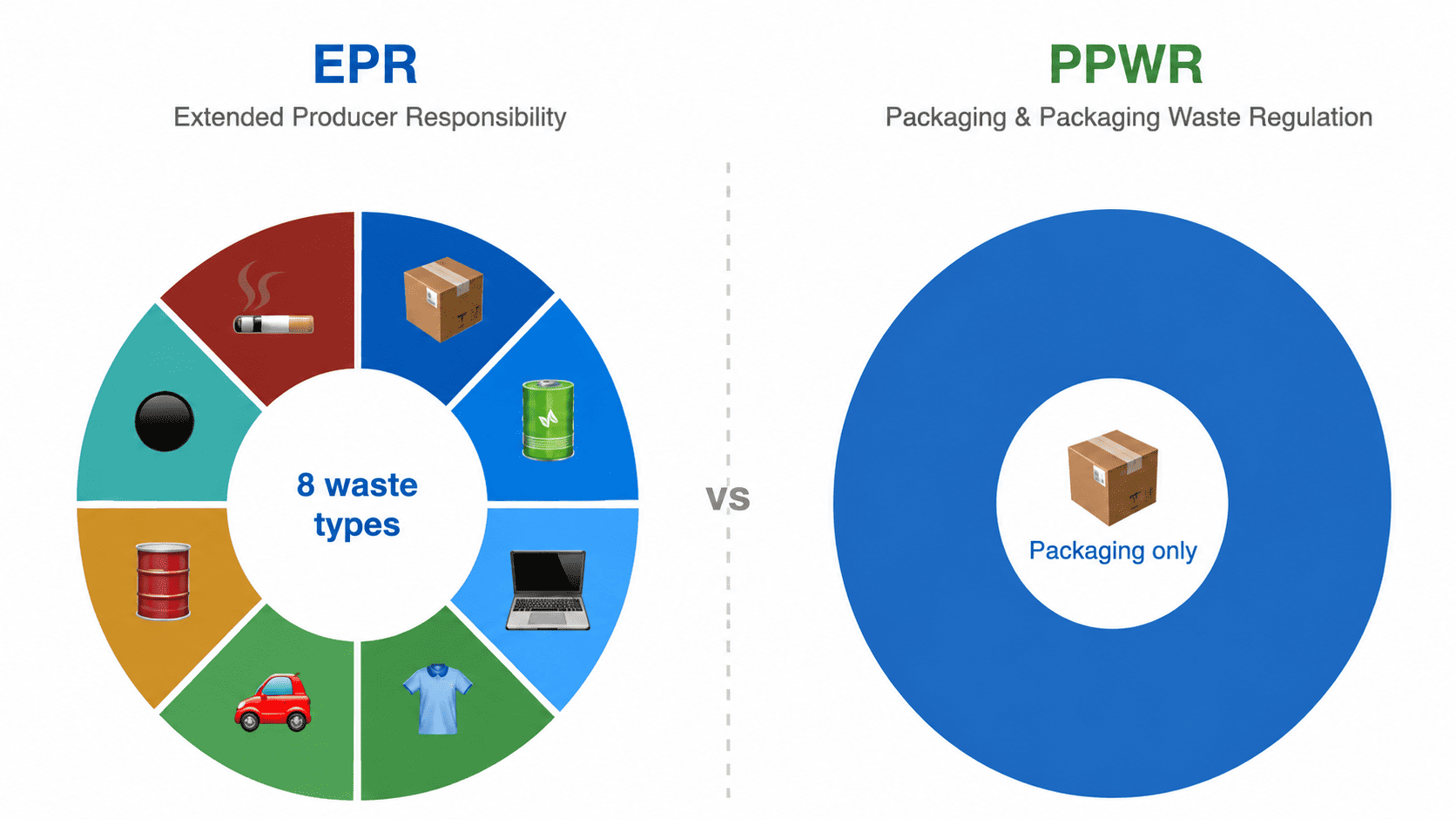
Understanding what is PPWR as a legal form is the starting point. The next step is how it interacts with EPR, which has financed EU packaging waste management for over a decade. Both apply. Neither replaces the other.
What is PPWR regulation and why it replaces the old directive
To understand what is PPWR regulation in legal terms: it is Regulation (EU) 2025/40, adopted in December 2024 and published in January 2025. The old Packaging Directive 94/62/EC will be fully repealed 18 months after PPWR’s entry into force.
Packaging waste per person shall decrease by 5% by 2030, 10% by 2035 and 15% by 2040 in relation to the 2018 level. EU packaging refuse grew over 20% in the past decade; without intervention, a further 19% rise was projected by 2030.
Legal certainty is a direct benefit of knowing what is PPWR regulation as a regulation rather than a directive. One authoritative text applies from Lisbon to Tallinn. No country-specific version, no local transposition delay.
What is EPR and how it operates across EU member states
The answer to what is EPR is straightforward: Extended Producer Responsibility shifts packaging waste costs from municipalities to companies placing goods on the market. Collection, sorting, recycling — producers pay through an eco-contribution.
EPR is reinforced by the Waste Framework Directive 2008/98/EC, the EU Battery Regulation 2023/1542, the WEEE Directive 2012/19/EU, and Regulation (EU) 2025/40 itself. Every EU country runs its own local scheme: 27 separate registries, 27 fee structures, 27 reporting formats.
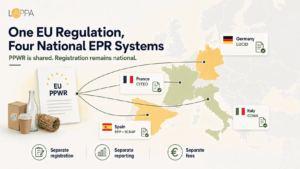
Brands selling in France, Germany, and Poland simultaneously manage three separate EPR registrations — CITEO, LUCID, and Poland’s own system. That is the operational reality of what is EPR today: ten target markets mean ten parallel compliance tracks.
What is a EPR system in practice
Most compliance teams first encounter the question of what is a EPR system when entering a new EU market. It is a national infrastructure: register the company, report packaging volumes placed on the market, pay the eco-contribution. That fee funds physical collection and recycling in-country.
Each country’s architecture differs. LUCID requires material-level reporting in Germany. CITEO is a private PRO managing collection contracts with local authorities in France. Thresholds, reporting periods, and data formats vary widely.
Knowing what is a EPR system in each target market before the first shipment is not optional. Missing a registration means operating illegally. Late registration triggers backdated fees from the original market-entry date.
EPR covers product categories well beyond packaging:
- Packaging — plastic, paper, glass, metal, wood, composite
- Batteries — from consumer cells to EV traction batteries
- Electronics — governed by WEEE Directive 2012/19/EU
- Textiles — covered by national EPR laws in a growing number of states
- End-of-life vehicles, tyres, oils and lubricants
- Single-use plastics — cigarette filters, fishing gear and others
EPR Fee benchmarks across key EU markets (2024–2025)
Fee levels differ sharply by country. The table below provides indicative eco-contribution ranges for mixed-plastic consumer packaging — the highest-cost stream in most schemes:
| Country / PRO | Plastic (€/kg, indicative) | Paper/Cardboard (€/kg) | Glass (€/kg) |
| France / CITEO | 0.40–0.65 | 0.08–0.15 | 0.03–0.06 |
| Germany / LUCID | 0.55–0.90 | 0.10–0.18 | 0.04–0.07 |
| Spain / ECOEMBES | 0.25–0.50 | 0.07–0.13 | 0.03–0.05 |
| Poland / BDO | 0.20–0.45 | 0.06–0.12 | 0.02–0.04 |
| Italy / CONAI | 0.30–0.55 | 0.08–0.14 | 0.03–0.06 |
Note: Rates are approximate and change annually. Verify current tariffs directly with each PRO before filing declarations.
PPWR (Packaging Waste Regulation) vs EPR side by side
Packaging waste regulation under PPWR and EPR covers the same material — packaging — but from different legal angles. EPR sets financial responsibility at end of life. PPWR sets design responsibility at point of production.
| Criteria | EPR — country-level systems | PPWR — Regulation (EU) 2025/40 |
| Legal form | Directive 2008/98/EC + national laws | Directly applicable regulation — no national adaptation |
| Waste streams | Packaging, batteries, WEEE, textiles, ELV, tyres, oils, SUPs | Packaging and packaging waste only |
| Obligations fall on | Producers (importers, brand owners) | Manufacturers (design) + Producers (eco-tax) |
| Labelling | Country-specific in each of 27 states | Unified EU label from Aug 2026; harmonised symbols from Aug 2028 |
| EPR fee structure | Country rates — CITEO (FR), LUCID (DE), ECOEMBES (ES) etc. | Eco-modulated, mandatory across all 27 states — recyclable = lower fee |
| Authorised rep | Required in some countries, not others | Mandatory for all non-EU manufacturers from Aug 2026 |
| Producer registry | 27 separate national databases | Single EU registry replaces all from 1 Jan 2029 |
| Harmonisation | Low — different rules, thresholds, datasets per country | High — identical packaging rules across entire EU |
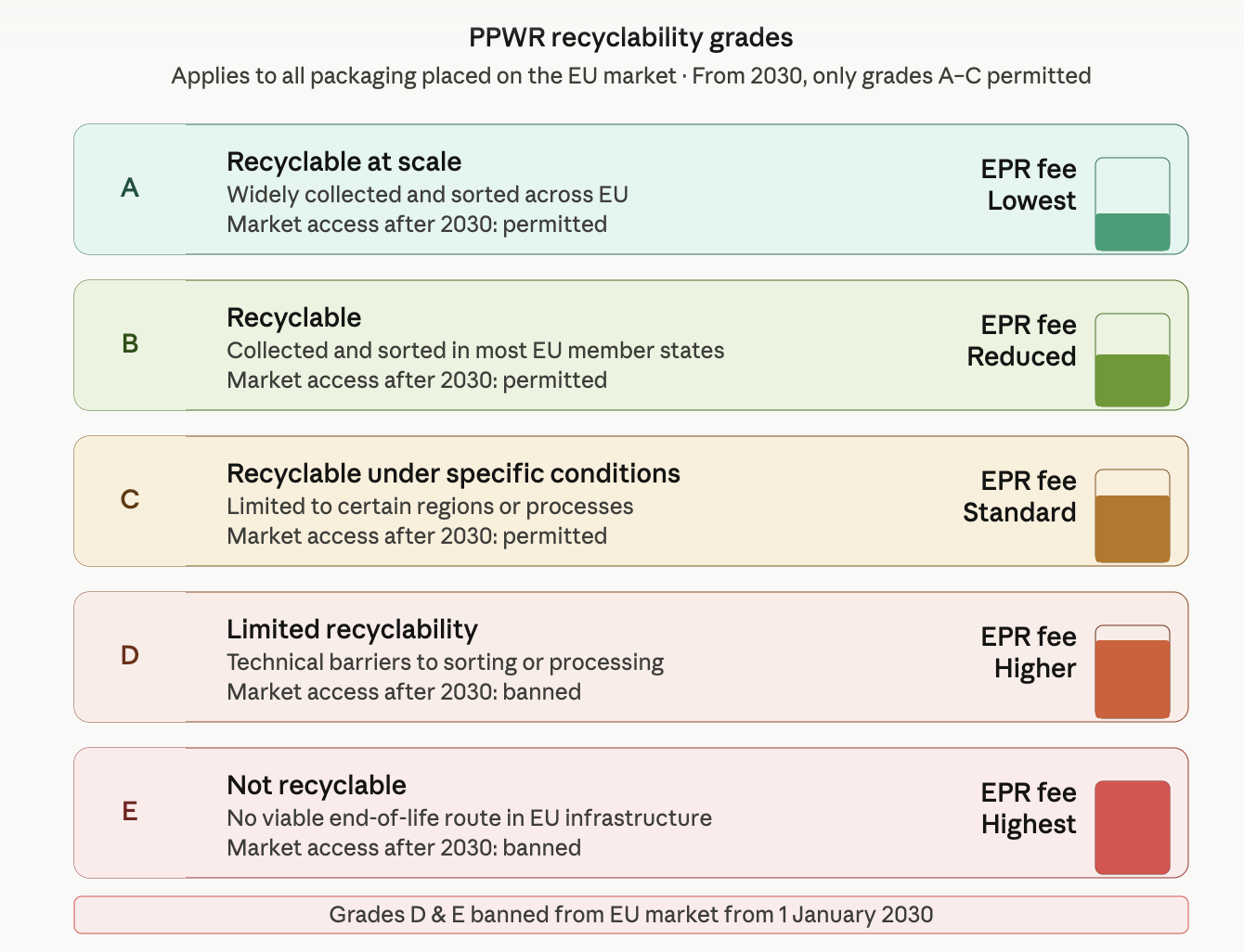
The eco-modulated fee row deserves attention. Under PPWR, all national EPR schemes must apply eco-modulation tied to recyclability grades. Class A or B materials attract lower fees. Grade D costs more — and from 2030 cannot be sold in the EU at all.
A company that redesigns packaging to reach grade B recyclability does not just meet packaging waste regulation requirements — it also reduces its annual EPR eco-contribution across all 27 markets simultaneously.
PPWR requirements and the compliance timeline
The full set of PPWR requirements phases in between 2026 and 2040. No single compliance cliff — deadlines are staggered.
| Date | Obligation | Who |
| 12 Aug 2026 | Composition rules; unified label; Declaration of Conformity; authorised rep; PFAS ban in food contact (25 ppb/substance, 250 ppb total); 40% void-space limit | All manufacturers and producers |
| Feb 2027 | HORECA must allow customers to bring their own containers for takeaway refills | HORECA sector |
| Aug 2027 | QR code labelling required — recyclability, material composition, sorting instructions | All packaging manufacturers |
| Feb 2028 | Takeaway operators must offer food and drinks in reusable packaging within a formal reuse system | HORECA, food service |
| Aug 2028 | Harmonised recycling symbols mandatory; recyclability grade methodology operational | All packaging manufacturers |
| 1 Jan 2029 | Single EU producer registry replaces LUCID, CITEO, ECOEMBES and all national databases; deposit return systems (DRS) live in all member states | All producers, national authorities |
| 1 Jan 2030 | All packaging must grade A–C (min. 70% recyclable by weight); recycled plastic content targets apply; 5% waste reduction vs 2018; B2B transport reuse quotas; Annex V single-use bans | All manufacturers, producers, HORECA |
| 31 Dec 2035 | Packaging waste reduction: 10% vs 2018 | EU member states |
| 31 Dec 2040 | Packaging waste reduction: 15% vs 2018; recycled plastic content up to 65% for some formats | All manufacturers and producers |
Two August 2026 obligations are often overlooked. First, PFAS in food-contact containers: restrictions apply where any single PFAS exceeds 25 ppb or total content exceeds 250 ppb. Companies using grease-resistant coatings on paper plates, takeaway boxes, or fast-food wrappers must audit components before the deadline.
Second: the 40% void-space limit. From August 2026, packs may not contain more than 40% unused volume unless technically necessary for product protection. Oversized e-commerce boxes with excess filler will not comply.
The recyclability grading framework is the most complex of all PPWR obligation categories. Grades A–E apply to all formats. From 2030, only A, B, and C — at least 70% recyclable by weight — may enter the EU market. The European Commission must publish the grading methodology by 1 January 2028.
Understanding recyclability grades A to E in practice
The grading methodology is still being developed, but PPWR’s recitals signal the likely criteria. Understanding the direction now lets businesses start redesign cycles ahead of the 2028 publication date.
| Grade | Recyclability status | Market access after 2030 | EPR fee impact |
| A | Recyclable at scale — widely collected and sorted across EU | Permitted | Lowest eco-contribution |
| B | Recyclable — collected and sorted in most member states | Permitted | Reduced eco-contribution |
| C | Recyclable under specific conditions or in limited regions | Permitted | Standard eco-contribution |
| D | Limited recyclability — technical barriers to sorting or processing | Banned from 2030 | Higher eco-contribution until ban |
| E | Not recyclable — no viable end-of-life route in EU infrastructure | Banned from 2030 | Highest eco-contribution until ban |
Formats most at risk of landing in D or E: multi-layer flexibles combining incompatible polymers, metallised films, black carbon-pigmented plastics (invisible to near-infrared sorting), and mixed-material laminates where component separation is technically infeasible at commercial scale.
Packaging law EU and the distinction between manufacturer and producer
The new packaging law EU framework separates two legally distinct roles: manufacturer and producer. PPWR assigns different obligations to each. A single company often holds both simultaneously — but the duties do not overlap.
Manufacturer obligations under PPWR
The manufacturer is the entity that commissions and controls the container design — typically the brand owner. Under PPWR, the manufacturer handles conformity assessment, technical documentation, and the Declaration of Conformity. All formats must be conformant to composition, recyclability and labelling standards before the first shipment.
A Declaration of Conformity and technical file are legally mandatory under PPWR — required before the first shipment, not retrospectively. Entities outside the EU must appoint an authorised representative within the EU by August 2026.
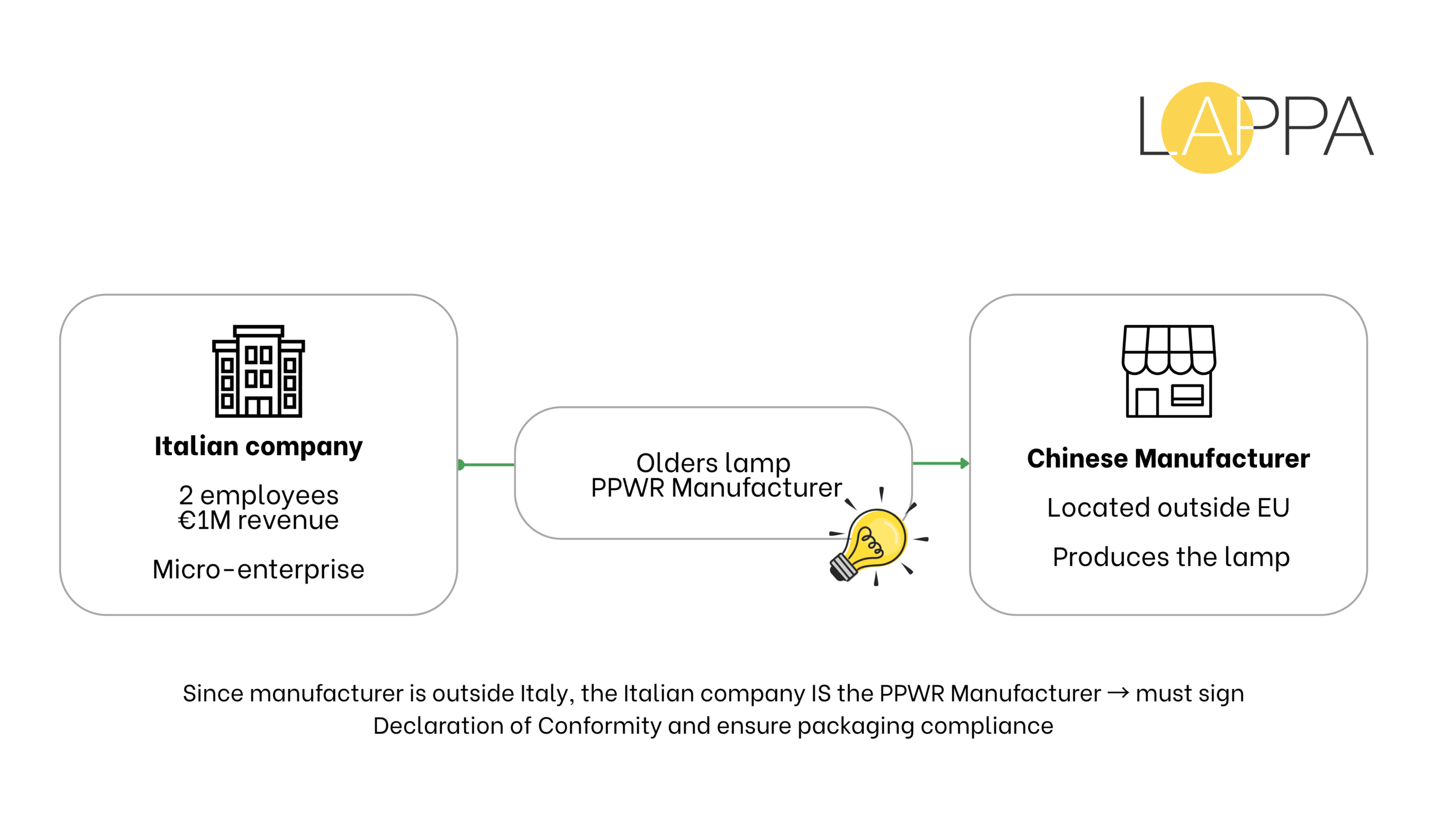
A microenterprise exemption applies to manufacturer duties (not EPR duties). Qualifying criteria: fewer than 10 employees, annual turnover or balance sheet below €2 million, and the pack supplier located in the same EU member state as the brand. The exemption does not apply if the supplier is in another jurisdiction — including another EU state.
Concrete example from the regulation: an Italian business with 8 employees and €1.5M revenue orders containers from a Chinese factory. A microenterprise by size — but the supplier is not in Italy. Under PPWR, the Italian company is treated as the manufacturer. Full obligations apply.
Producer obligations and EPR registration
Under packaging law EU, the producer is the company placing the final packaged product on the EU market — typically an importer or brand owner. The producer registers in each EU country, reports volumes, and pays the eco-contribution.
No size-based exemption exists for producers. A two-person importer entering France must register with CITEO and pay the eco-tax. The obligation applies to companies of any size.
When a microenterprise is a Producer
For producers, there are no exemptions from EPR registration or payment of the eco-tax for micro-enterprises.
What is the PPWR changing for EPR harmonisation
Compliance teams ask regularly about what is the PPWR actually changing for EPR, given that national schemes remain in place. Three concrete changes apply to all country-level systems:
Unified container label from August 2026. Harmonised recycling symbols follow in August 2028. Country-specific label versions are no longer permitted. One design works across all 27 markets.
Eco-modulated EPR fees tied to PPWR recyclability grades become mandatory in every national scheme. Fee levels stay country-specific; the calculation method is now standardised. Container design directly affects eco-tax cost in every EU country simultaneously.
Single EU-level producer registry from 1 January 2029. National databases — LUCID, CITEO, ECOEMBES — are replaced. One registration covers all 27 member states.
On the reuse side, what is the PPWR introducing goes beyond labelling: reuse targets for transport and sales packaging from 2030, HORECA reusable container obligations from February 2028, and deposit return systems in all member states by January 2029.
The 2026–2029 compliance window runs two years. Packaging changes for PPWR design and labelling must run alongside active national EPR registrations. Both workstreams overlap.
Compliance checklist for manufacturers and producers before August 2026
Eight steps cover core actions before the first enforcement date:
- Determine your role. Manufacturer, producer, or both? The answer depends on supply chain position and where packaging is sourced.
- Audit containers to PPWR composition rules. Materials, additives, PFAS in food contact formats, void space ratios. Anything exceeding 40% without technical justification must be redesigned.
- Assess recyclability grade. Map formats to the A–E scale. Grades D and E cannot be sold in the EU from 2030. Starting redesign now avoids a forced withdrawal.
- Issue the Declaration of Conformity. Manufacturers shall prepare this document and keep a technical file. Producers must check that it exists before putting goods on the market.
- Implement PPWR labelling. Unified baseline from August 2026. Harmonised recycling symbols from August 2028. Review all country-specific label designs.
- Appoint an authorised representative if the manufacturing entity is outside the EU. Prerequisite for market access from August 2026.
- Maintain national EPR registrations. PPWR does not replace national eco-tax obligations until the single registry goes live in January 2029.
- Model eco-modulation impact. Calculate how current container formats will affect EPR eco-contribution once recyclability grades are published. Higher grade = lower fees across all 27 markets.
Both frameworks apply and neither is optional
EPR and PPWR address different stages of the packaging life cycle. EPR manages end-of-life financing. PPWR governs design, documentation, and marking at point of production. They complement each other; both are mandatory.
The shift from directive to regulation means design standards are now identical across the entire EU. The eco-contribution still differs from country to country. The database stays local until 2029. But the design baseline is the same from Germany to Sweden to Poland.
Pack development cycles run 12–18 months. The first fixed deadline is August 2026. The window is narrowing.
Frequently Asked Question



What is PPWR and when does it take effect
PPWR is the Packaging and Packaging Waste Regulation — Regulation (EU) 2025/40 — in force since 11 February 2025. Most provisions apply from 12 August 2026. It replaces Directive 94/62/EC and applies directly across all 27 EU member states. It combines packaging design, labelling, composition, recycled content targets, reuse quotas, and producer registration in one harmonised framework.
What is PPWR regulation compared to the old Packaging Directive
Many businesses ask what is PPWR regulation compared to Directive 94/62/EC. The directive required each country to transpose the law, producing 27 versions with varying enforcement standards. PPWR is a regulation: one law, applied identically everywhere. It introduces mandatory recyclability grades, recycled content targets, reuse quotas, PFAS restrictions, and a single EU producer registry. Where the directive treated packaging waste as a volume problem, PPWR treats it as a design problem.
What is EPR and does it still apply after PPWR
EPR — Extended Producer Responsibility — remains fully in force after PPWR takes effect. PPWR harmonises the packaging-specific aspects of EPR but does not replace national registration obligations. Producers must still register in each EU country, report volumes, and pay eco-contributions. After 2029, what is a EPR system going to look like will be much simpler: a single EU-level producer registry replaces all national databases by 1 January 2029.
Does packaging waste regulation under PPWR apply to all packaging types
Packaging waste regulation under PPWR applies to all packaging placed on the EU market — plastic, paper, cardboard, glass, metal, wood, composite materials. It covers consumer, grouped, transport, and e-commerce packaging. If a container holds, protects, or transports a product sold in the EU, PPWR applies.
What are the PPWR requirements businesses must meet before August 2026
The PPWR requirements applying from 12 August 2026 are: packaging composition compliance (materials, additives, heavy metals, PFAS); the 40% void-space limit; the unified labelling baseline; the Declaration of Conformity; and technical documentation. Non-EU manufacturers must appoint an authorised representative. On the packaging law EU side, these obligations apply to manufacturers. Recyclability grade requirements and Annex V single-use bans phase in from 2028 and 2030 — but testing and redesign must begin significantly earlier.
