Furniture & Bulky Waste EPR: What Brands Must Do
As we usually say in our posts – Extended Producer Responsibility is growing! EPR laws are working in the United States and the European Union. And now type of EPR is expanding- now it is more than packaging and electronics. Manufacturers now have more topics to take care of carefully. Brands that do business in regulated markets need to know what the furniture EPR compliance requirements are. The ones who were slow and still investigating about packaging – will have more topics to find out. Governments want to deal with the growing problems of getting rid of large household items like mattresses, sofas, and other large items. Here is what we will explain you about.
The main danger you want to find is – furniture brands that don’t register will face big fines and won’t be able to sell their products. As always – European markets were the first to use new frameworks, and US is looking and working on the have the similar pace . New laws chances for brands to make compliance easier across different areas. Companies that take the initiative to make sure their furniture meets EPR standards are in a better position than their competitors, who are rushing to meet deadlines. This complete guide explains will help you to know more about Furniture and Matresses EPR.
Understanding Furniture EPR Compliance Frameworks
Important to all to understand how fast developing EPR relatively to the beginning.
The origin of furniture EPR compliance began in France in 2013 with the creation of Eco-mobilier – the official producer responsibility organization. This new system showed that planned ways of managing furniture waste streams.
After France came Belgium, where Valumat started with mattresses and then moved on to other kinds of furniture.
Instead of broad frameworks, the United States uses laws that only apply to certain products to make sure that furniture EPR is followed. The Mattress Recycling Council in California runs the oldest program in the country. It has kept millions of mattresses out of landfills since 2016. Connecticut and Rhode Island set up systems that were similar and focused on mattresses. The US furniture EPR compliance scene isn’t as well-organized as it is in Europe yet, but it’s getting better little by littlу – we recommend to subscribe for our newsletter not to lose updates.
European Union Harmonization Efforts
Waste Framework Directive isnt’t pushing countries to make mattresses mandatory, but gives member states the power to add mattresses and furniture to their EPR programs, along with required textile programs.
What is new, that it isn’t Belgium of France who is leading this process.
Portugal is in the head of full producer responsibility for furniture and mattresses starting from 2026. Hungary’s current system already includes furniture through environmental product fees. Meanwhile France has the most developed system, which includes both household and professional furniture as well as mattresses.
Sellers who are looking for a ways to sell cross-border will face a lot of rules, which vary from state and country – there is no a single standard for EPR compliance. Time and research can be hard for small and medium companies – here where we can help
Lappa helps brands keep track of their furniture EPR compliance in multiple jurisdictions by providing centralized reporting and fee management services.
Mattress streams have problems that are different from other types of EPR.
Mattress streams have problems that are different from other types of EPR.
Each year, over 30 million mattresses are thrown away in Europe and more than 18 million in the United States. Traditional waste infrastructure has trouble with big, low-density items that need special transport and processing. 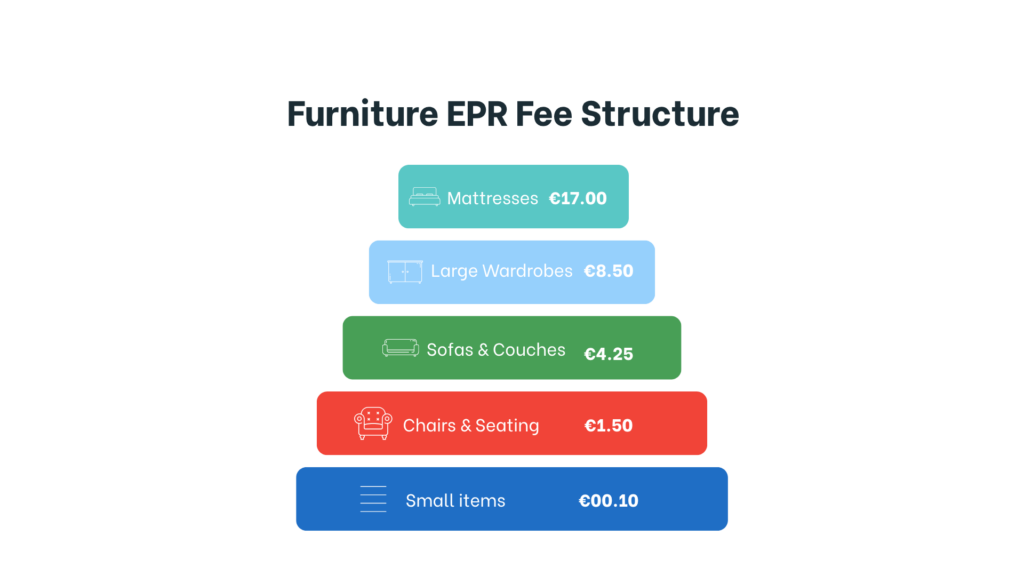
The idea is that Mattress EPR rules fix these problems in the system by paying for collection networks and building facilities specifically for recovering foam, steel, and textiles.
Belgium’s Valumat system shows that mattress EPR rules are being followed well. Current collection rates are 60% and goals are to reach 80%. Environmental fees prices are different, range can start from €4.25 for children’s mattresses up to €17 for big adult beds. These fees pay for collection points across the country, specialized dismantling operations, and infrastructure for recovering materials. The economic model works because financing from producers takes the place of taxes from cities.
| Country/State | Program Name | Mattress Fee Range | Collection Rate |
| Belgium (Flemish Region) | Valumat | €4.25 – €17.00 | 60% (target 80%) |
| Netherlands | RetourMatras | €10.50 – €12.50 | ~70% |
| France | Eco-mobilier | €8.50 – €17.00 | 65% |
| California USA | Mattress Recycling Council | $10.50 | 75% |
| Connecticut USA | Mattress Recycling Council | $11.75 | 68% |
The Netherlands is the most innovative country in the world, and RetourMatras runs automated disassembly systems that process 1.5 million mattresses a year.
Chemical recycling of flexible polyurethane foam gives back about 20,000 tons of recycled material to manufacturing supply chains. This circular approach shows that mattress EPR rules can have real environmental effects instead of just being symbolic. Brands that use recycled materials from these streams get discounts on eco-modulation fees.
Material Recovery Challenges and Solutions
One thing to keep in mind : moisture contamination ruins up to half of the mattresses that are collected, making them not good for recycling. And this is a big thing!
Foam and fabric parts can get damaged beyond repair if they aren’t stored correctly during collecting and transit.
More and more, mattress EPR rules say that mattresses must be stored dry and picked up within a certain amount of time. Producers need to think about these operational limits when they design take-back programs.
Composite construction makes it harder to take things apart because bonded foam-textile layers don’t come apart easily. New mattresses have memory foam, latex, springs, fire barriers, and several layers of fabric that need to be taken apart by hand.Due to high cost of labor, recycling is hard. Fee structures need to take these processing costs into account in a realistic way, not just assume that materials can be easily recovered.
Bulky Waste Producer Responsibility Expands Rapidly
As more people buy furniture, waste systems can’t handle the extra weight – they weren’t designed for this amount. Sofas, wardrobes, and dining sets need special care, so traditional curbside collection can’t pick them up. As the governments of Europe and the US explore for long-term methods to pay for trash collection, plans are starting to come together for holding big trash producers responsible. This is a great big deal in the economics of waste management, because basically it changes who’s going to pay for it – it takes the cost off taxpayers and puts it onto manufacturers. In 2024, France’s Eco-mobilier recycled 1.7 million tonnes of discarded furniture, and was able to recycle 97% of it all. It demonstrates a way in which major generators of waste can take responsibility on a larger scale, by providing collection points, sorting centres, and material recovery operations throughout an entire country. It’s apparent that the manufacturer is bearing the costs of providing these services, by prominently displaying eco-fees on product invoices. The transparency of the fees enables consumers to understand the liability of the manufacturers.
What is included and what is not
It’s hard to figure out what furniture is because there are some circumstances that need more regulation clarity.Belgium has built-in furniture, while France has different fee structures for professional and household furniture. Hungary’s framework for bulky waste producer responsibility includes outdoor furniture and garden tools. It’s tricky to put kitchen cabinets into one category because they can be either furniture or building materials, depending on how you put them up.
Furniture and WEEE rules must be followed by products that have electrical parts.You have to register LED-lit wardrobes, motorized recliners, and adjustable beds in more than one system and pay extra fees for each one. Brands need to carefully go through all of their products to find the ones that meet both sets of requirements.Programs that hold people who make a lot of waste accountable are giving more and more precise guidance for hybrid items, but the manner they do this is different in different places.
Requirements for Getting Rid of Furniture Change the way businesses work
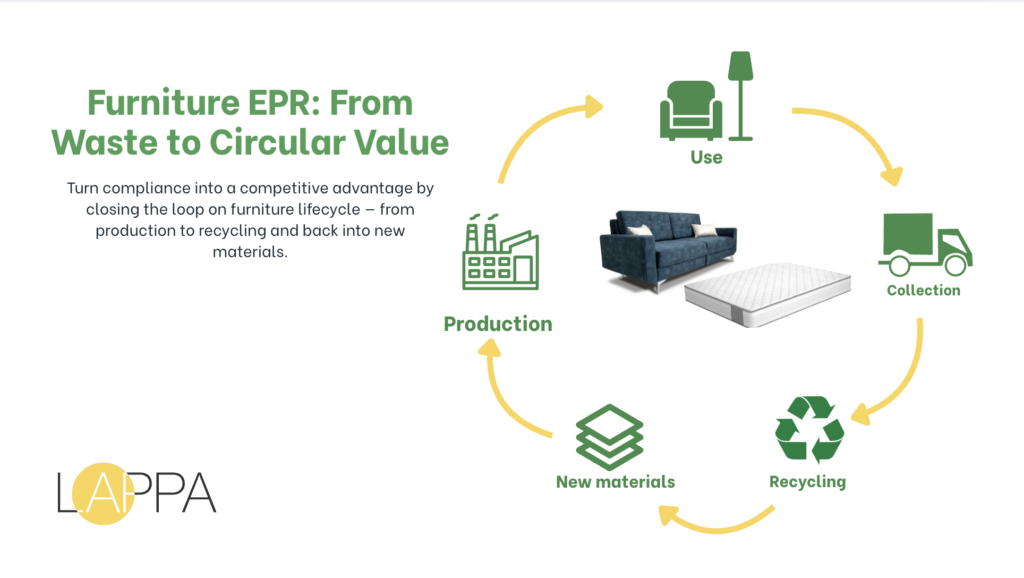
Furniture businesses have to pay for getting rid of their products because of producer responsibility. Manufacturers have always just bothered about manufacturing and transporting things, not what happens to them after they are no longer useful. Now, when you throw away furniture, you have to think about its whole life cycle, from the time it was designed to the time it is used by a consumer. This change in thinking leads to new ideas in modular construction, choosing materials, and designs that are easy to fix.
Retailers are now obligated to establish collection systems or partner with existing ones to meet take-back requirements. Large retailers benefit from their established logistics networks, whereas online sellers often struggle with reverse logistics. When it comes to furniture disposal, the minimum number of collection points is determined by the local population.
Design for Disassembly Incentives
Eco-modulation fee structures give extra money to design choices that make it easier to recycle materials. More and more, furniture disposal rules include performance-based pricing, which means that simple construction costs less. Products that use mechanical fasteners or mono-materials instead of adhesives can get discounts.Manufacturers who invest in circular design cut their annual compliance costs by a lot.
Belgium’s system adds extra fees to furniture that needs special help to be taken apart. Upholstered items with stapled components face higher fees than screw-assembled wood furniture. These financial signals enable teams that build products make items that can be reused. So, laws about how to get rid of furniture become market forces that assist the circular economy expand instead of merely being a problem for enterprises.
How to Navigate the EPR Registration Furniture Portal
It’s hard for brands that do business in more than one area because the process of registering is highly different in each place. In France, you have to register your furniture through ADEME’s public web. In Belgium, meanwhile, each region has its own method. In Germany, the LUCID database is for furniture that has electronics in it.Knowing how to register EPR furniture in each jurisdiction helps avoid costly delays and gaps in compliance.
| Jurisdiction | Registration Portal | Deadline | Annual Fee Range |
| France | ADEME / Eco-mobilier | Before first sale | Variable by product |
| Belgium (Flemish) | Valumat | Before market entry | Per unit fees |
| Hungary | NAV (National Tax Authority) | Quarterly reporting | Weight-based EPF |
| Portugal | National waste management system | 2026 implementation | TBD by regulation |
| Germany (WEEE furniture) | LUCID / EAR | Before first sale | Per unit registration |
The Mattress Recycling Council in California runs simple EPR registration systems for covered mattresses. Brands sign up online, give sales projections, and pay quarterly fees based on how many units they actually sell.
Not only Califrnia, we have a Connecticut as well. Connecticut has a shared council infrastructure. However, even though the fees are the same, e.g Rhode Island has separate systems that need separate registration. Brands that operate in more than one state need to keep track of their obligations across different platforms.
Documentation and Reporting Requirements
Authorities want detailed information about the composition of materials, the weights of units, and the number of sales. Furniture portals that register EPRs need technical specs that are often more detailed than what supply chains can easily provide. Brands need to set up systems to collect this information during the product development process. Adding new information to old catalogs takes a lot of time and is prone to mistakes.
Annual reporting deadlines converge, creating a real crunch for compliance teams. Belgium’s Flemish region, for instance, has a different schedule than France, which demands submissions by April 30th.If you don’t register your EPR furniture by the deadline, you’ll have to pay more and more each day. Lappa’s unified platform automatically tells brands about incoming duties in different jurisdictions, which makes sure that filings are always on time.
Furniture take-back programs need to be planned out very well
You need to know a lot about logistics and be willing to pay money to make furniture take-back services work well. Collection networks need to be able to cover a lot of ground and still make money.
Urban areas have a higher collection density than rural areas, which means that strategic trade-offs must be made. More and more, furniture take-back programs use the stores that already exist as collection points.
In mature markets, where third-party specialists collect payments on behalf of producers, partnership models are the most common. In France, Eco-mobilier works with cities, towns, and social economy groups to create networks that are both public and private. This way of doing things makes sure that everyone is covered while spreading out the expenditures. Belgium’s Valumat also works with retailers and companies that deal with waste. Furniture take-back programs work better when they are bigger, because they can use economies of scale to make things work better for everyone.
Consumer Communication and Participation
For a collection to be successful, people need to know about it and take part. France requires clear labels that tell customers that they can return items for free. Communications at the point of sale must explain how furniture take-back programs work and where customers can return items. QR codes that link to location finders are becoming more common on digital channels in addition to physical signs.
For a collection to be successful, people need to know about it and take part. France requires clear labels that tell customers that they can return items for free. Communications at the point of sale must explain how furniture take-back programs work and where customers can return items. QR codes that link to location finders are becoming more common on digital channels in addition to physical signs.
Mattress Recycling Obligations Drive Innovation
Because of the stable funding streams that mattress recycling obligations create, processing infrastructure is moving quickly. Specialized facilities are being built with machines that can separate foam, springs, and textiles. The automated systems in the Netherlands can process one mattress every 90 seconds, which is a high throughput that is necessary for the business to be profitable. The certainty that mattress recycling laws provide about the rules is what makes people want to invest in this infrastructure.
Key Steps for Mattress Brands
- How to avoid a fee – sign up for any relevant EPR programs before entering the market for the first time. Have concerns what to choose – choose Lappa.
- To find our what is your fee category refer to size of product
- Keep a strict control of moisture during the storage
- It is highly recommended to design products in a such way that it will be easy to taken apart with mechanical parts instead of glueless
- Specify recycled content that is eligible for eco-modulation discounts.
- Work with logistics companies that offer integrated take-back services during delivery operations.
- Material recovery rates set the prices for new mattress recycling requirements.
To have a system working – money required. Programs can charge less to producers when get more items back at a higher rate. We can call this method “performance-based”. It encourages improvements to save money.
Furniture EPR Fees Structure and Cost Management
Fee calculation can be done in different ways and take a big strategic part for cost management. E.g France EPR Fees range from 0.1 Euro for a small furniture and up to 15 Euro for a big furniture. In Hungary, weight-based methods charge fees based on the weight of each type of material. Knowing how these structures work makes it possible to make accurate cost predictions and price changes.
Understanding these frameworks allows for precise cost forecasts and adjustments to pricing.
Eco-modulation introduces variable pricing that incentivizes environmentally conscious design. The Furniture EPR fees are lower for items made from recycled materials, items made from only one material, or pieces that can be taken apart.Conversely, complex composite products or those containing hazardous flame retardants incur additional fees. These incentives, in turn, influence the sequence in which designers develop their products as they strive to minimize costs.
| Product Category | Base Fee (France) | Eco-Modulation Range | Annual Volume Impact |
| Small furniture (< 5kg) | €0.10 – €0.30 | ±20% | Low materiality |
| Seating (non-upholstered) | €0.80 – €1.50 | ±25% | Medium impact |
| Upholstered seating | €3.00 – €6.00 | ±30% | Significant driver |
| Large storage (wardrobes) | €8.00 – €15.00 | ±35% | Major cost factor |
| Mattresses (standard) | €8.50 – €17.00 | ±25% | Critical category |
Belgium’s rules about showing fees clearly mean that furniture On consumer invoices, EPR fees show up as separate line items. People are more likely to change their buying decisions when they can see prices. Companies need to establish a balance between how much it costs to follow the rules and where they stand in the market. Volume discounts don’t happen very often because programs figure out charges based on the number of units instead of the total tonnage.
Ways to Lower Costs
Timing market entrants to line up with the phases of implementing regulations might help keep an eye on competitors while delaying costs. . In some places you can lose this benefit if you have to pay for things you did not do on time. For example if you register late in France you have to pay money that goes all the way back to January 2021. It is better for your company and your money to think ahead and plan for furniture EPR fees of waiting until you have to pay them.
Compliance Partnership with Lappa Makes Running Multiple Markets Easier
It is hard for companies that do not know how to handle furniture and bulky trash EPR in places. Lappa is very good at making sure companies follow the rules. They help with everything from signing up to reporting and paying fees. The platform makes things easier by putting together rules from countries in the US and Europe.
Lappa collects data automatically which works with the systems that companies use to plan and manage their work. This helps get the information needed to report to the government. The people at Lappa watch for changes in the laws and tell companies about their responsibilities, before the deadlines. This helps prevent mistakes from happening, which often happens to companies when the rules change quickly. Lappa also has tools that help companies see how much furniture EPR will cost, depending on the products they make and the new markets they want to enter.
Help and Services
Lappa helps with signing up by showing companies how to fill out applications the first time. They explain how to use websites that’re only available in certain areas. Lappa has solid relationships with ADEME, LUCID, EAR, and other agencies, which speeds up approvals and keeps things from becoming stuck. The quarterly reporting compilation gathers sales data from all markets and makes sure that reports are issued in the proper way. Fee calculation services make ensuring that payments are proper. This eliminates both fines for not paying enough and waste from paying too much.
Using eco-modulation benefits, strategic consulting helps brands improve their products so they can charge less. Lappa gives complete support, which includes:
- Managing registrations in both the European and US markets with a central dashboard for keeping track of them
- Automated data extraction from ERP systems that makes it unnecessary to do compliance reporting by hand
- Proactive regulatory monitoring that tells brands about new duties before critical deadlines pass
- Making sure that payments are proper so that there are no fines for not paying enough or wasting money by paying too much
- Advice on picking materials that strike a balance between environmental goals and ways to cut compliance costs
- Portfolio analysis to determine the best chances to make circular design changes that will minimize yearly expenses
- Lappa can offer full compliance solutions because they know a lot about a lot of things, such regulatory concerns and the concepts of a circular economy.
- Looking ahead and making strategic suggestions
Future Outlook and Strategic Recommendations
In the next few years, EPR for furniture and large waste will grow in more areas and cover more types of products. We already can see it started in France and Belgium in Europe and in California in USA. Since that moment there are more US states that are likely to start mattress programs, and furniture programs. European countries will raise the minimum standards that all member states must meet very soon .Brands should expect their rules to get stricter, not easier.
EPR compliance requirements will rise, which will lead to more investments in processing infrastructure. For sure this fees will be added on the final price to be paid by customer. But is not that easy and homework needs to be done.
The requirements for collection rates will go up from the current 60–70 percent to 80 percent and then to 90 percent. To reach these big goals, the producer needs more money and the logistics network needs to grow. The fees for furniture EPR will go up by the same amount, but eco-modulation discounts will be given to the most interesting approach.
Here is a thing: digital product passports might work with furniture EPR systems to allow for more detailed tracking of material flows – sounds great.
Blockchain-based verification could check claims about recycled content and keep track of products as they go through different stages of their lives. This new approach will lead to automating some tasks and making people more responsible. We encourage people to take care of EPR as soon as possible. Time will work on your side.
Brands need to stop seeing furniture EPR as a danger and start seeing it opportunity to overtake competitors. Producer responsibility frameworks favor businesses that design for circularity, have open supply chains, and get customers involved in take-back programs. More and more, standing out in the market depends on showing that you care about the environment beyond what the law requires.