EPR Compliance for Amazon and Other Marketplaces
The rules for selling things online have changed a lot. Millions of online sellers in Europe, the UK, and elsewhere are now affected by Amazon’s extended producer responsibility rules, as well as similar rules on eBay and other sites. It’s no longer optional to understand these responsibilities; they’re an important part of running an online business that is both legal and sustainable.
This guide tells e-commerce sellers everything they need to know about EPR, including what it is, what product categories it covers, how major marketplaces enforce it, and what you can do right now to stay compliant.
What Extended Producer Responsibility means for Online shopping
Extended producer responsibility is a policy that holds manufacturers, importers, and sellers financially responsible for how their products are handled after they are sold. In real life, this means helping with take-back programs, recycling facilities, and waste management systems, usually through a registered compliance scheme or a national producer register.
EPR is especially important for e-commerce businesses because they often import goods directly from other countries and may be the first sellers of those goods in a given national market. That status means that there are now registration, reporting, and financial obligations that weren’t there ten years ago.
The main idea behind EPR is simple: whoever makes money selling something should also pay for part of the cost of getting rid of it in a safe way. This idea is now part of the law in the EU, the UK, and more and more in North America.
Important types of products EPR rules apply
EPR doesn’t apply to all things sold online. Regulations target products that harm the environment when disposed of. The following are the most common types of regulations:
- Packaging materials include cardboard, plastic, glass, metal, and composite materials.
- WEEE stands for “Waste Electrical and Electronic Equipment.” This includes things like consumer electronics, appliances, cables, and batteries.
- Batteries and accumulators include batteries for cars, batteries for the home, and batteries for portable devices.
- Textiles, like clothes, shoes, and linens for the home, in some EU member states
- Tires can be bought on their own or put on cars.
- Furniture is allowed in some places, like France and some German Länder.
- Packaging EPR is the most important duty for e-commerce sellers because almost every order that is shipped needs some kind of packaging material. Electronics and batteries come in second, especially for sellers in the consumer technology space.
What Amazon requires for Compliance
Since 2021, Amazon’s rules for compliance have grown a lot. The marketplace now actively collects EPR registration numbers from sellers in regulated markets, especially in Germany, France, Spain, Italy, and the UK. If you don’t give a valid registration number, your account could be suspended or your listing could be hidden.
Sellers on Amazon’s Seller Central platform must enter their EPR registration numbers for each country and product category that applies to them. Amazon then sends these numbers to national authorities as part of its own compliance reporting. This means that the marketplace is a middleman for data between sellers and regulators, and it takes this job very seriously.
Depending on the country of sale, the following are some of the rules that Amazon sellers must follow when it comes to EPR:
- For each type of product, sign up with the national producer register or a certified compliance scheme.
- Before listing products that are affected, give Amazon your registration number(s) through Seller Central.
- Make sure your registration covers the number of products you really sell, and update your estimates every year.
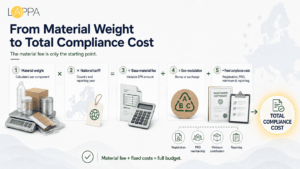
- Pay your compliance scheme the EPR fees that apply to you. These fees usually depend on the type and weight of the material.
- Keep records of your registration and fee payments in case you need to show them to an auditor.
Amazon has made compliance easier in some ways by working with compliance service providers in a number of markets, but the seller is still legally responsible.
The table below shows the most important EPR registration requirements for each major Amazon marketplace.
| Marketplace | Main EPR Category | Register With | Deadline |
| Amazon Germany (DE) | Packaging, WEEE | LUCID / ear | Before first sale |
| Amazon France (FR) | Packaging, WEEE, Textiles | ADEME-approved eco-org | Before first sale |
| Amazon UK | Packaging (>50 tonnes/yr) | Environment Agency | Annual registration |
| Amazon Spain (ES) | Packaging, WEEE | MITERD register | Before first sale |
| Amazon Italy (IT) | Packaging, WEEE | National register | Before first sale |
EPR on eBay and Other Online Shopping Sites
Amazon has been the most aggressive in enforcing EPR obligations, but when you compare Amazon and eBay, you can see that eBay has taken a similar approach in regulated markets. For certain types and amounts of products, eBay France, eBay Germany, and eBay UK all require sellers to give EPR registration numbers.
In this case, the main difference between Amazon and eBay is how strictly they enforce their rules. Amazon’s automated systems are better at finding and removing listings that don’t follow the rules. eBay usually relies more on sellers to declare themselves, but this is changing as the EU’s Digital Markets Act ecosystem puts more pressure on platforms to follow the rules.
Etsy (for sellers in Germany and France), Zalando (for fashion and packaging), and Cdiscount (for French sellers) are some of the other platforms that have EPR compliance frameworks. It’s clear that any major e-commerce site that works in a regulated market is making sure that its sellers follow EPR rules when they sign up and when they are monitored.
How EPR Software makes It easier for online sellers to follow the rules
It is a lot of work to keep track of EPR obligations by hand in different markets, product categories, and reporting periods. This is when specialized EPR software becomes very useful for e-commerce businesses that want to grow.
EPR software usually has a few main features that make it easier for sellers to follow the rules.
- Automated registration tracking: The program keeps track of your registration status in all key markets and lets you know when it’s time to renew or when it has run out.
- Sales volume reporting: The platform receives information from your marketplace accounts and calculates out how many products can be reported by country and type of material.
- Calculating fees: The software uses the current rates from compliance schemes to figure out your EPR contribution fees. This helps you establish a budget that is correct.
- Storing documents: It’s easy to access to the place where all the certificates, registration numbers, and payment records are maintained.
- A compliance calendar with reminders for reporting deadlines, which are very different in each EU member state
Some well-known EPR software companies that help online sellers are Lizee, Compliance Bureau, Novasoft, and a number of tools that work with Amazon’s service provider network. When looking at your options, make sure they cover the specific markets you sell to and work with your current order management systems.
Amazon seller rules: knowing the law
You should know the difference between Amazon’s own seller rules and those that come from EU or national law. The law, specifically national versions of EU directives like the Packaging and Packaging Waste Directive (94/62/EC and its amendments) and the WEEE Directive (2012/19/EU), creates EPR obligations.
These legal rules are what Amazon’s own rules are based on. When Amazon asks for your LUCID number in Germany or your Citeo registration in France, it is not just following its own business rules; it is also following the law. This means that even if Amazon didn’t ask for registration numbers, people would still have to register by law.
Not following the rules can lead to real legal problems, not just listing suppression. If you don’t register your packaging under the VerpackG law in Germany, you could be fined up to €200,000. French officials can tell companies to take products that don’t meet the rules off the market. The Environment Agency will take legal action against UK sellers who don’t register when they go over registration limits.
A Step-by-Step Guide for E-Commerce sellers to follow to comply with EPR
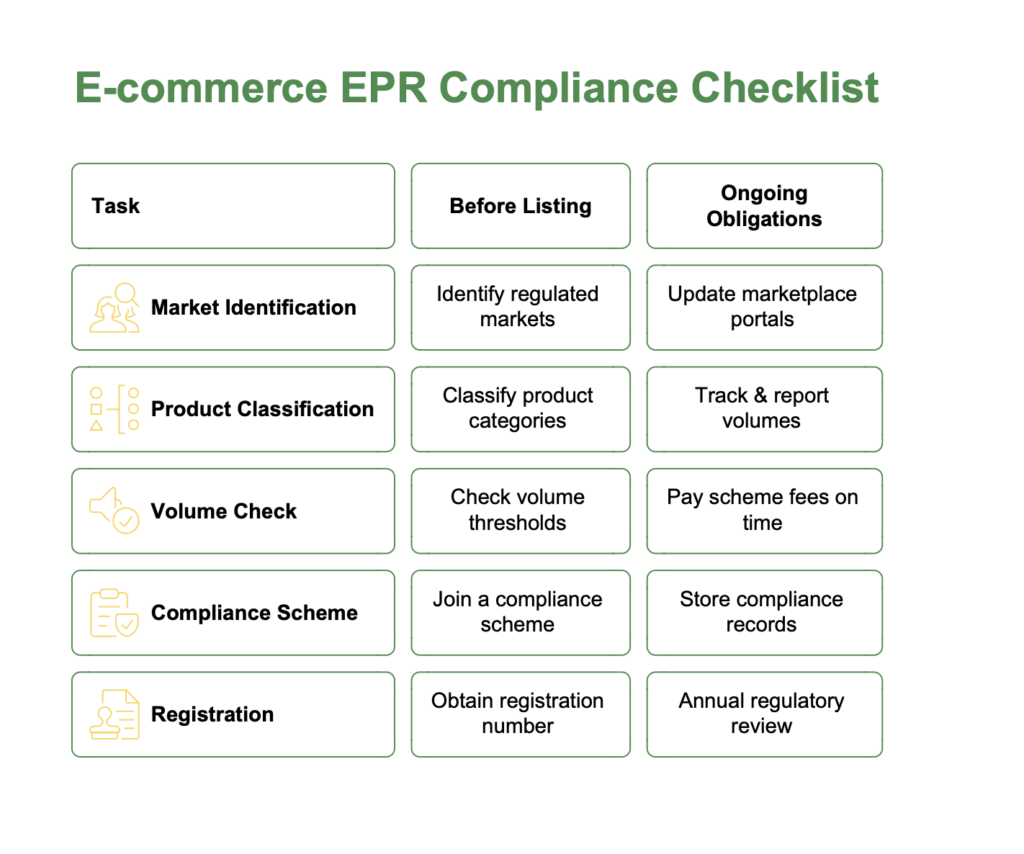
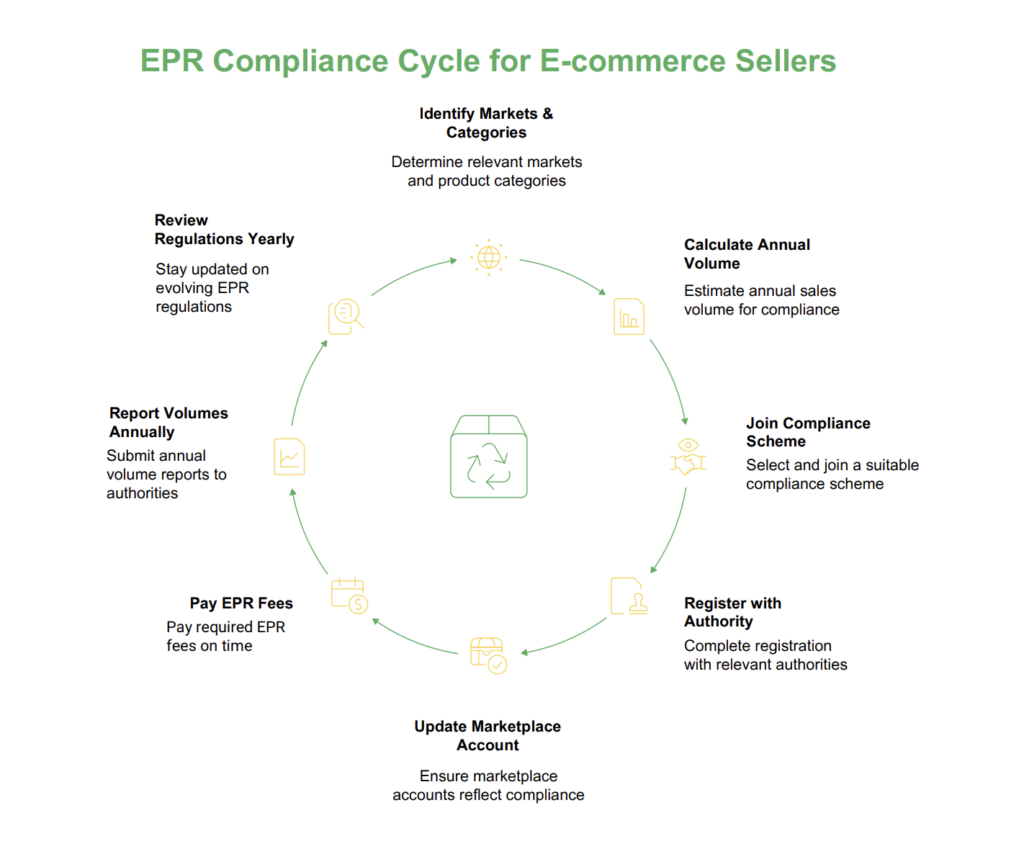
If you take a methodical approach, the path to full EPR compliance is doable. Most e-commerce sellers who are just starting out or are already doing business in regulated markets should follow these steps:
- Find out where your customers are located and compare that to the countries that have active EPR systems.
- Sort your products into groups based on what kinds of products you sell and whether they fall under EPR rules in each market.
- Figure out your volume by guessing how many of each type of product you sell each year to see if you meet the thresholds.
- You can either join a collective compliance scheme (which is most common for small and medium-sized businesses) or, in some markets, set up your own compliance system.
- Sign up with the right authority. If you’re already selling, do it right away; if you’re not, do it before your first sale in that market.
- To update your accounts on the marketplace, log in to Amazon Seller Central, eBay, or the compliance portal for the platform you use and enter your registration numbers.
- Set up reporting: make a plan for how to keep track of sales and send regular reports to your compliance scheme.
- Review every year: EPR rules change quickly, so make sure to have an annual compliance review to catch any new laws.
Germany and France should be the first places that sellers in the EU focus on, because these are the markets with the most active enforcement and the most e-commerce activity. After Brexit, the UK is a separate regime and packaging that is above the legal limit needs to be registered separately.
The table below shows the main differences between collective and individual EPR compliance approaches.
| Factor | Collective Scheme | Individual System |
| Setup complexity | Low — join an existing scheme | High — build own infrastructure |
| Cost structure | Per-tonne fee to scheme | Full system costs borne by seller |
| Suitable for | SMEs and mid-size sellers | Large enterprises only |
| Reporting burden | Scheme handles regulatory reporting | Seller reports directly to authority |
| Flexibility | Limited — scheme rules apply | High — tailor to business needs |
Common mistakes e-commerce sellers make with EPR
Even sellers who mean well often have trouble with EPR compliance. Businesses can avoid making expensive mistakes by knowing what the most common ones are.
One common problem is not reporting sales numbers accurately. EPR fees are based on how much regulated material is put on the market. If you don’t give an accurate number, either by mistake or on purpose, you could be in trouble financially and legally. It is important that your order management system and your compliance scheme share accurate data.
Another error people make is assuming that management is about having power when it isn’t. Amazon’s sharing of data with compliance programs is helpful, but it doesn’t take the place of the seller’s own registration. The platform gets your registration number, but it doesn’t register you.
Cross-border complexity is the third thing that makes things hard. A seller who is registered for packaging EPR in Germany does not automatically follow the rules in France, Spain, or the Netherlands. Every jurisdiction has its own register, rates, and schedule for reporting. Using EPR software that works in more than one country greatly lowers the chance of missing obligations that are specific to each country.
Finally, a lot of online sellers don’t know the difference between a producer and a distributor. In some EPR systems, a distributor who brings goods into the EU is They are considered the producer for EPR purposes, even if they did not make the product. This is especially important for sellers who buy from China or other countries outside the EU.
Lappa makes EPR rules easy to follow. We register, report, and ensure your avoidance of costly fines — all in one place. Get a Fee Quote | Book a Demo
FAQ
If I only sell a few things on Amazon, does EPR still apply
Different countries and product categories have different thresholds. There is no minimum amount of packaging EPR in Germany; it applies to the first unit sold. In the UK, packaging EPR only applies to businesses that make more than £2 million a year and send out more than 50 tonnes of packaging. Don’t just assume you’re below the limit; check the exact threshold for each market and category.
Can I use the same EPR registration number on more than one Amazon marketplace
No, EPR registration is only valid in one country. Your LUCID number from Germany is only good in Germany. Your French eco-organism registration is good for all of France. You must register separately for each country that regulates your type of product.
What are the potential consequences if I sell on Amazon without providing an EPR registration number
Amazon will usually hide or take down the listings that are affected. If the omission is found by national authorities instead of the platform, you could be fined, told to take products off the market, or even charged with a crime in serious cases. The risks are high enough that EPR compliance should be a requirement for selling in regulated markets.
Is the price of EPR software worth it for a small online store
EPR software usually pays for itself in time and fewer mistakes for sellers who work in three or more regulated markets. If you’re a seller in one or two markets and only have a few products to sell, using spreadsheets and calendar reminders may be enough, but only if you do it very carefully. The case for dedicated EPR software gets much stronger as your business grows.
How often do rules about EPR change
A lot. The EU’s Packaging and Packaging Waste Regulation (which replaces the 1994 Directive) makes significant changes that will happen in stages between 2025 and 2030. There is also a review of the WEEE Directive. National implementations are still changing. E-commerce businesses operating in regulated markets should subscribe to updates from relevant authorities or utilize a compliance service that monitors changes on behalf of its clients.