6 steps a brand selling in the EU must take to comply with PPWR as a Manufacturer
If you are a brand selling products in the EU, one of the easiest mistakes to make under the PPWR is to assume that packaging compliance belongs only to your packaging supplier or only to your EPR team. In many cases, it does not. If the packaging carries your brand, or if you decide how that packaging is designed, you may be the manufacturer under the PPWR even if somebody else physically produces the box, bottle, pouch, or mailer. 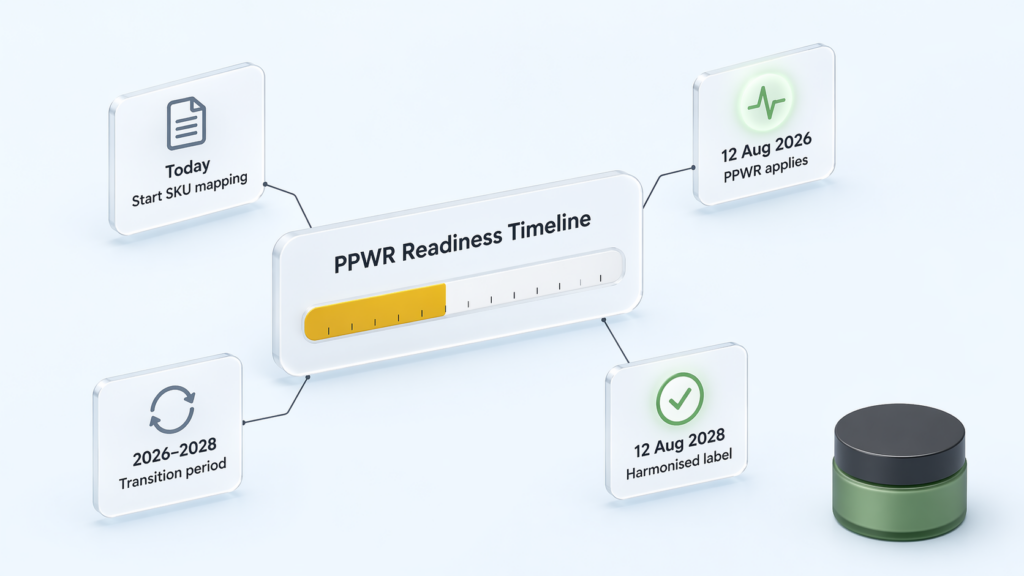
And there is another point brands should not leave until the last minute: label planning. The PPWR applies from 12 August 2026, and the Commission is supposed to adopt the implementing acts for harmonised packaging labels by that date. The mandatory harmonised waste-sorting label on packaging comes later — from 12 August 2028 or 24 months after the implementing acts, whichever is later — but that does not mean brands can wait. Packaging artwork, print specifications, packaging inventories, and market-by-market label logic often take a long time to change. The official guidance also says Member States will not be allowed to keep national labels next to the EU harmonised labels after that deadline.
So if you are a brand owner, the practical approach is simple: treat label-readiness as an early packaging project, not as a final design tweak.
Start with label planning, not just legal analysis
For many brands, the first operational PPWR question is not “Do we have a legal issue?” but “How much packaging artwork and packaging data will we need to change?” The Commission guidance says the packaging labelling rules in Article 12 are harmonised, and that the specifications for the waste-sorting labels are to be set in implementing acts. That means brands selling across several EU countries should start mapping their packaging SKUs now, identifying where local sorting instructions are used today, and planning how those packs will transition to the future EU label model.
Example: Australian clothing brand. Imagine an Australian fashion brand selling branded jackets into France, Germany, and Spain. Today, it may use different packaging artwork according to current country specific requirements , size stickers, and country-specific recycling or sorting prompts on garment bags, boxes, and e-commerce mailers. Under the PPWR approach, that brand should already be thinking about how to standardise those packaging layouts for the forthcoming harmonised EU label regime, because repacking or redesigning dozens of SKUs at the last minute is expensive. This example is an illustration based on the PPWR label framework and the guidance on textile-related packaging.
Check whether your brand is the PPWR manufacturer
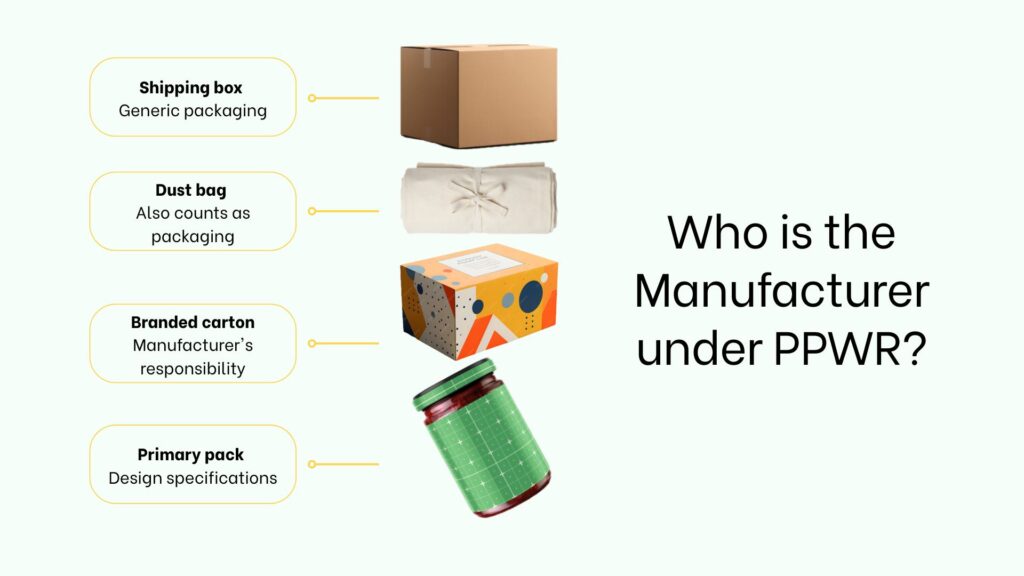
Under the Commission guidance, the key question is not who physically manufactures the packaging material. The real questions are who had the packaging or packaged product designed or manufactured under its own name or trademark, and who decides the design specifications. If the packaging carries your name or trademark, the starting assumption is often that you are the manufacturer. If there is no brand name, the analysis shifts toward who ordered the packaging and defined its specifications.
That is why many brand owners become manufacturers under the PPWR even when they outsource production.
Example: South Korean cosmetics brand. Imagine a South Korean skincare brand selling face cream into the EU in a branded jar, carton, insert, and shipping box. A third-party supplier may physically produce each packaging component, but if the cosmetics brand decides the packaging design, chooses the format, and sells the product under its own brand, it will often be the manufacturer for PPWR purposes. This example is an illustration of the guidance’s manufacturer test.
Separate manufacturer obligations from producer obligations
This is where many businesses get confused. The manufacturer and the producer are not the same role under the PPWR. The manufacturer is responsible for ensuring conformity with the packaging sustainability and labelling requirements. The producer is the operator relevant for EPR in the Member State where the packaging is first made available and expected to become waste.
So a brand may be the manufacturer EU-wide, while producer status can still depend on which country the packaging is first made available in and where it is expected to become waste. In practical terms, this means PPWR conformity work and EPR registration/financing work should be treated as related but separate compliance streams.
Manufacturer vs producer under the PPWR
The table below is based on the guidance file you uploaded.
| Point | Manufacturer | Producer |
| Definition | The operator treated as the manufacturer of the packaging or packaged product. In practice, this is not necessarily the company that physically makes the packaging, but the one that orders it and decides the design specifications, usually under its own name or trademark. | Any manufacturer, importer, or distributor who makes packaging or packaged products available for the first time in the Member State where it is present, or directly to end users in another Member State. |
| Quantity | One economic operator EU-wide. | The operator identified by first making available in the Member State where the packaging is expected to become waste. Examples: Importer, Producer, online seller |
| Main function | Ensures conformity of the packaging with sustainability and labelling requirements. | Pays eco-tax for waste sold (placed) in a Member State |
| Registration | Don’t need EPR registration | Need EPR registration |
Fix your EU setup before products are placed on the market
If your business is outside the EU, your corporate setup matters. The guidance says that a non-EU manufacturer with only a branch in the EU cannot simply rely on that branch as if it were a separate EU legal entity. In that situation, the business may need to incorporate an EU subsidiary or appoint an authorised representative for packaging manufacturers, where required by the Member State in which the packaging or packaged products are first made available.
This is especially relevant for non-EU brands entering the EU for the first time.
Example: if the South Korean cosmetics brand sends goods to several EU distributors or B2B buyers. Brand is a Manufacturer and must appoint an AR in the EU to be compliant with the new packaging regulation.
Gather packaging data and make the packaging compliant
Once you know you are the manufacturer, the next step is operational. You need the packaging data, specifications, and supplier information required to assess compliance with the applicable packaging requirements. That means reviewing the packaging composition, design, labelling, and the supporting records that will feed into your compliance file and declaration of conformity. The manufacturer is the operator responsible for conformity with the relevant packaging requirements, so this cannot be pushed entirely onto the supplier.
This is also the moment to review packaging that may look secondary but still matters legally. The guidance notes, for example, that dust bags for shoes and garments can count as packaging when they are used for containment, protection, handling, delivery, or presentation of products to the end user. So fashion and footwear brands should not focus only on outer cartons and ignore textile accessories or protective packaging elements.
Prepare the declaration of conformity and place the goods on the market correctly
The declaration of conformity is a core part of the manufacturer’s compliance work. The Commission guidance says it must be drafted by the manufacturer based on supplier information, or by an authorised representative appointed by written mandate. But even where an AR helps draft it, the manufacturer remains legally responsible for the packaging’s compliance.
There is also a practical timing point brands should understand. For imported goods, your earlier file says the relevant timestamp for first placing on the market is the release for free circulation at the end of the customs procedure. That is the point at which brands need to be comfortable that their packaging compliance work is in place. Your file also notes that recyclability conformity assessment under Article 38 and Annex VII does not have to be performed until the delegated acts under Article 6(4) enter into force, with the later application timing described there.
For a brand selling into the EU, the PPWR is not just about waste fees and not just about packaging artwork. It is about identifying whether you are the manufacturer, planning early for the forthcoming harmonised label regime, making the packaging compliant, and preparing the declaration of conformity before goods are placed on the market. If you get those pieces right early, the rest of the rollout becomes much easier.
If you have questions or need consultation, you can book a demo with our team or contact Lappa directly