Extended Producer Responsibility Introduction
When an ecommerce brand ships packaged products to European consumers, the law classifies that brand as a producer under extended producer responsibility regulations. This classification applies regardless of company size, monthly revenue, or how minimal the packaging appears. The Digital Services Act requires Amazon and other major marketplaces to suspend listings of non-compliant sellers, and Amazon's DSA risk assessments proactively blocked 99% of non-compliant listings in 2024. This enforcement makes compliance necessary for continuous revenue.
This guide provides a thorough walkthrough that explains which obligations apply to ecommerce brands and how rules differ across EU member states. It also explores what marketplace enforcement actually looks like. Finally, it explains how to build a practical compliance operation that scales across markets.
Extended Producer Responsibility for Ecommerce
Extended producer responsibility serves as a legal obligation that shifts the financial burden of waste management from municipalities to the companies that place products on the market. Any business that packages, imports, or distributes goods bears the cost of collecting, sorting, recycling, and disposing of those materials after consumers discard them. The principle holds the entity that profits from putting packaged goods into circulation responsible for end-of-life disposal costs.
The legal definition of "producer" captures virtually every ecommerce seller operating in Europe. A brand qualifies as a producer even when it ships a single unit in a poly mailer to a German customer. Monthly revenue, company headcount, and packaging volume do not change this classification. The regulation treats a startup with €200 monthly marketplace revenue the same way it treats a multinational corporation that transports containers of inventory across borders.
EPR for ecommerce represents a structural shift in how European governments assign waste costs. The 2024 EPR Industry Report shows that over 52% of respondents sell to five or more EU countries simultaneously. This volume of cross-border activity requires an organized system because each country enforces its own rules, deadlines, and penalties. Brands treat compliance as operational infrastructure to maintain marketplace access.
Product Categories and Obligations
Multiple product categories carry independent registration and reporting requirements, and a single item sold online can fall under several of them at once. A single material type rarely covers the entire scope of obligations. Businesses map their specific product catalogs against these categories to build a confident compliance operation.
Most ecommerce sellers encounter packaging obligations first because nearly every shipped product involves some form of wrapping, boxing, or cushioning material. The regulatory net also extends to electronics, batteries, single-use plastics, and an expanding list of consumer goods. For example, a wireless earbud product sold in branded cardboard triggers packaging obligations for the box, Waste Electrical and Electronic Equipment obligations for the electronics, and battery obligations for the lithium cells. Each of these three categories requires a separate registration, separate data reporting, and separate fee payments in every country where the product sells.
This layering of obligations requires compliance planning at the product level rather than the company level. Businesses map every catalog item against the applicable categories in each destination market to protect themselves against enforcement actions and fee miscalculations.
Packaging Rules
Packaging serves as the most universal trigger because every physical product ships inside a container or wrapper. Primary packaging surrounds the product itself. Secondary packaging groups units together for handling. Transport packaging protects goods during shipping. Most European markets include all three layers under their EPR compliance Europe obligations.
The Global Waste Index estimates that global packaging waste reached 434.5 million tonnes in 2025. Ecommerce contributes a growing share of that total, and regulators respond with stricter rules. For example, markets like France require registration with an approved Producer Responsibility Organization for every gram of packaging material entering the market. The soundness of reported data directly affects fee accuracy and audit outcomes.
Electronic Equipment and Battery Regulations
The Waste Electrical and Electronic Equipment Directive requires separate registration for any product that runs on electricity or contains electronic components. This category covers more than just laptops and televisions. A USB-C charger, an LED desk lamp, or a fitness tracker each qualifies independently and demands its own compliance filings.
Battery regulations add another compliance layer. Products that contain lithium-ion cells, button batteries, or rechargeable power packs trigger registration under battery-specific schemes. These overlapping requirements multiply the number of registrations needed per country for EPR for ecommerce operations that sell consumer electronics. The safety implications of improper battery disposal drive strict enforcement, and regulators treat missing registrations as violations regardless of unit volume.
Emerging Product Categories
The regulatory scope continues to expand across the continent. The European Union textile framework targets producer-funded collection and recycling obligations by 2027, and several member states already draft national implementation rules. France operates the most mature example in Europe because it has managed a textile scheme through Re_fashion since 2007.
Single-use plastics represent another active category. Germany's Einwegkunststofffondsgesetz law requires registration on the DIVID platform and levy payments that began in 2025. Furniture and mattress obligations exist in France and await consideration in other markets.
Ecommerce brands often face multiple obligations simultaneously when their product lines cross into these emerging categories. A clothing brand that sells t-shirts in poly bags already faces packaging and textile obligations, and the list of covered materials grows with each legislative cycle.
Fragmented Landscape Across Member States
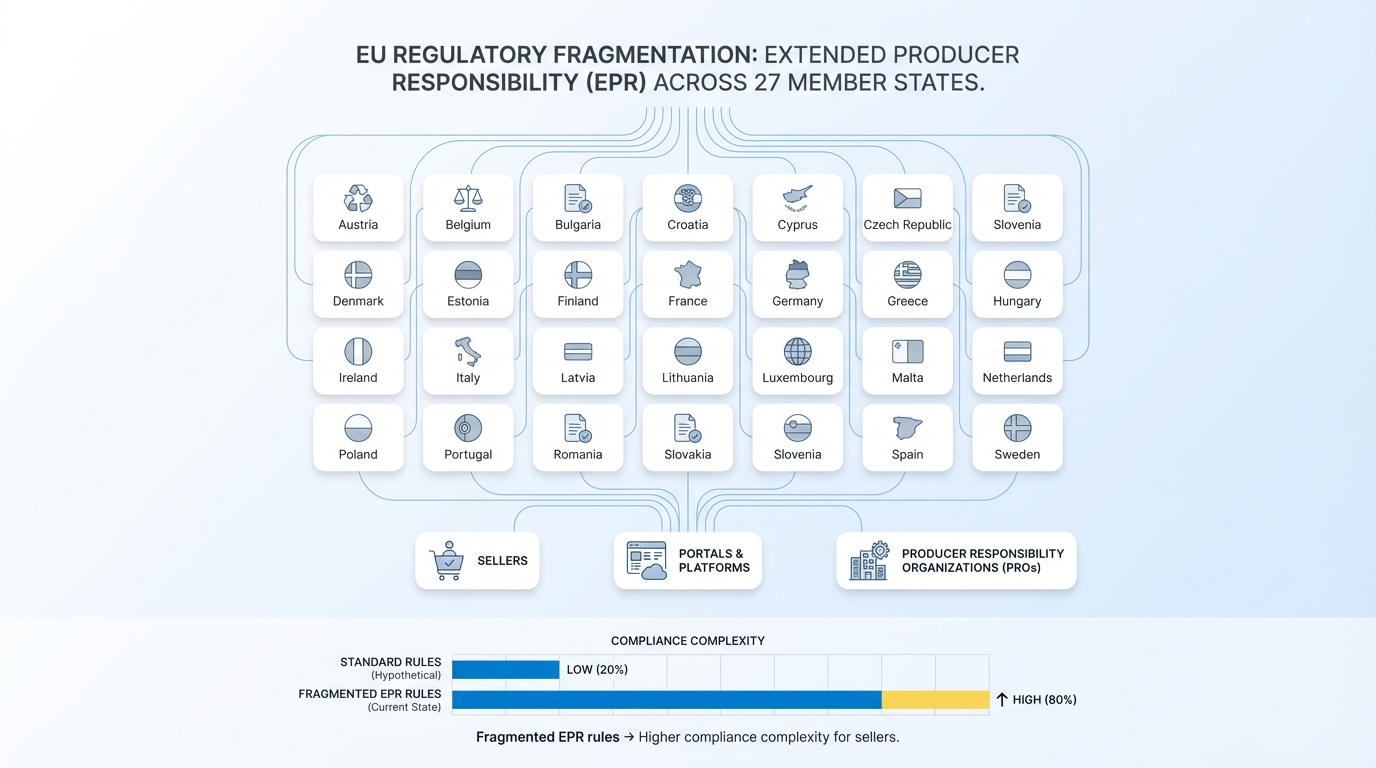
The extended producer responsibility framework presents a single principle applied through 27 different national implementations, and no two countries handle it the same way. Each member state maintains its own registration portal, approved organizations, reporting formats, and enforcement mechanisms. Functional compliance operations navigate this landscape with precision to avoid regulatory fines.
Regulatory systems in Germany illustrate the compliance complexity. Sellers register through the LUCID portal operated by the Zentrale Stelle Verpackungsregister and simultaneously contract with a dual-system organization for fee payment. France requires registration with CITEO or another approved body, and it mandates Triman logo placement on packaging. Spain routes compliance through Ecoembes, Italy operates through CONAI, and the Netherlands uses Afvalfonds Verpakkingen. Each system features distinct data fields, material classification rules, and submission formats.
Why Cross-Border Packaging Compliance Is So Difficult and Expensive
Reporting obligations differ in frequency and granularity across borders. Some countries require quarterly volume declarations broken down by material type and weight, while others accept annual submissions. Fee structures vary by material, and the same kilogram of plastic film costs different amounts depending on whether it enters the German, French, or Spanish market. Labeling mandates compound the challenge because a package that is legal in Germany may violate French or Portuguese requirements.
The financial consequences of incorrect filings carry severe penalties. Violations of Germany's Verpackungsgesetz law can result in fines up to €200,000 for single breaches, and regulators cross-reference marketplace sales data against registration records. Unlike Value Added Tax that offers a centralized mechanism for cross-border filing, the compliance framework lacks an equivalent centralized system. Every country demands independent compliance management.
Producer Hierarchy and Fulfillment Liability
Extended producer responsibility attaches to the entity that places a packaged product on the market, and the legal hierarchy determines exactly who that entity is. The brand owner or importer holds this obligation in most ecommerce scenarios. Clear identification of the responsible party provides trust in the compliance structure and prevents costly misattribution.
A common misconception about fulfillment providers causes significant compliance issues. Sellers that use third-party fulfillment often assume that the fulfillment platform absorbs liability because the platform physically packages and ships the product. The brand owner actually remains the legal producer and must report the primary product packaging along with the secondary and transport packaging applied during fulfillment. Fulfillment platforms do not register on the seller's behalf, report packaging volumes, or pay fees for third-party inventory.
Why Fulfillment Providers and Dropshippers Still Carry Packaging Compliance Risks
Third-party logistics providers operate under the same principle. A warehouse that stores, picks, and ships inventory acts as a service provider rather than the legal producer. The brand retains full responsibility for all packaging materials used throughout the fulfillment chain unless a specific contractual arrangement transfers liability.
Dropshippers face a distinct scenario in cross-border trade. A reseller becomes the producer under local law when that reseller imports goods from outside the European Union or first makes products available to consumers within a specific member state. Digital Services Act Article 30 requires online platforms to verify registration information before enabling distance contract sales, and this mandates marketplaces to check whether the selling entity holds valid registrations. Each selling entity must register independently because relying on a manufacturer's existing registration lacks legal validity.
Packaging Regulation and Deadlines
The Packaging and Packaging Waste Regulation represents a major overhaul of European packaging rules, and its deadlines shape current compliance planning. The regulation entered force in February 2025, and most provisions will apply from August 12, 2026. The framework enters a new phase under these rules because the regulation replaces the patchwork of national transpositions with a directly applicable European Union regulation.
Key requirements include packaging minimization rules that cap empty space at 50% for ecommerce and transport packaging. All packaging must become recyclable by 2030 through interim milestones. Eco-modulation fees create direct financial incentives for packaging optimization. Heavier, multi-material, and harder-to-recycle packaging incurs higher costs under this system. Lighter, single-material, recyclable packaging qualifies for reduced fees, and these fee differentials turn packaging design decisions into compliance cost decisions.
Why Non-EU Sellers Must Appoint Authorized Representatives Before August 2026
The Authorized Representative requirement serves as an urgent provision for sellers based outside the European Union. Packaging Waste Regulation Article 40 mandates that any producer without a physical establishment in a member state must appoint an Authorized Representative in each country where products are sold by August 12, 2026. This representative assumes legal responsibility for registration, reporting, and fee payment. Producers lose the legal basis to place packaged products on those markets if they fail to appoint a representative before the deadline.
This deadline provides certainty about upcoming enforcement timelines. Companies use the current operational window to appoint representatives, negotiate contracts, and transfer registration data. Brands based outside the European Union face market access restrictions if they miss the August 2026 deadline. Preparation helps businesses maintain market access and complete compliance requirements on time.
Marketplace Enforcement and Seller Suspensions
The Digital Services Act (DSA) turned marketplaces into compliance gatekeepers and exposed them to penalties of up to 6% of global annual revenue for failure to verify seller obligations. This financial threat gives platforms like Amazon every reason to enforce extended producer responsibility requirements aggressively rather than issue polite reminders.
Amazon's approach reflects this pressure. Sellers who fail to provide valid EPR registration numbers face product listing removal, and the process does not follow a graduated warning sequence. Listings disappear, and funds freeze during suspension. Reinstatement requires complete compliance documentation. This documentation can take weeks to assemble if the underlying infrastructure was not already in place. The soundness of a seller's compliance setup determines whether recovery takes days or months.
eBay, Etsy, and other platforms build similar verification systems, though enforcement rigor varies. EPR compliance for Amazon and other marketplaces functions as a safety gate for market access. Suspensions halt revenue generation and lower organic search ranking. Marketplace algorithms penalize dormant listings, and this penalty complicates revenue recovery after reinstatement. Maintaining compliance prevents these operational disruptions and preserves visibility.
Multi-Country Compliance Workflow
Administrators manage EPR compliance Europe across multiple jurisdictions through a specific operational sequence, and each step feeds the next. The European Commission estimated that administrative compliance burdens can reach 4,000 hours annually for large companies. That figure reflects the precision this workflow demands when companies scale it across countries, product categories, and shifting regulations.
The core process runs in six stages:
-
Companies identify the obligation scope and map every country where products sell or inventory sits. Then, they determine which EPR categories apply in each jurisdiction.
-
Administrators register with national authorities and approved producer responsibility organizations through the relevant portals, such as LUCID in Germany or CITEO in France. They also execute the required contracts.
-
Teams build a packaging bill of materials for every SKU that documents material types and weights across primary, secondary, and transport packaging layers. This documentation includes packaging applied by fulfillment providers.
-
Software tracks placed-on-market volumes, links each sale to its packaging data, and calculates total material weights per country.
-
Administrators submit volume reports and pay eco-contribution fees according to each jurisdiction's format, schedule, and material-based fee structure.
-
The system retains all registration confirmations, contracts, reports, and payment receipts to ensure multi-year audit readiness.
This workflow operates continuously, and it does not act as a one-time project. Sales volumes shift, packaging designs change, and regulations update over time. Companies manage compliance effectively when they run these six stages as a permanent operational cycle.
Common Compliance Mistakes Sellers Make
Extended producer responsibility violations rarely stem from deliberate evasion. Most errors happen because companies misunderstand how the regulations work, and these mistakes accumulate into audit exposure and financial penalties. Familiarity with the most frequent failures provides certainty about what to watch for when companies build an EPR for ecommerce compliance operation.
The mistakes that surface most often follow predictable patterns:
-
Assumption of small size exemptions. No revenue floor or volume threshold exempts sellers from registration in most EU countries. Germany's LUCID registration remains free of charge, and this eliminates any cost-based argument to skip it. The obligation exists from the first unit sold.
-
Misclassification of packaging materials. When companies report a laminated composite as "cardboard" or mislabel a plastic film type, they skew fee calculations and create discrepancies that auditors flag.
-
Omission of FBA secondary packaging. Fulfillment by Amazon applies its own shipping materials, and companies must include those weights in volume reports. A failure to include them produces systematic underreporting across every order.
-
Confusion over the B2B versus B2C distinction. Some countries apply different rules depending on whether the buyer is a business or consumer. When sellers blend these flows in a single report, they create gaps that do not offer refuge during an audit.
-
Treatment of compliance as a one-time registration. Registration opens the door. Ongoing reporting, fee payments, and record retention keep it open. When companies let any of these lapse, they trigger the same enforcement as those who never register at all.
-
Reliance on a manufacturer's existing registration. Each selling entity must register independently. Sellers cannot share or reuse supplier registrations, and marketplaces verify the selling entity's own credentials.
A unified compliance structure addresses these six mistakes, and automation supports this process.
System Scalability
Manual compliance tracking works until it fails, and the breaking point arrives faster than most companies expect. When a seller manages three countries with 50 SKUs, that seller faces hundreds of data points per reporting cycle. Companies must route each data point to different portals in different formats on different deadlines. Spreadsheets buckle under this weight because they cannot enforce data integrity, flag missed deadlines, or adapt when a country changes its reporting requirements mid-cycle.
A Eunomia Research & Consulting study found that micro-enterprises estimated EPR compliance costs at €260 annually,, while large companies reported costs reaching €400,000. The difference does not only involve scale. Larger operations generate exponentially more data points, and each one represents a potential error that compounds across jurisdictions. When companies place trust in manual processes, that trust erodes as the number of markets, SKUs, and regulatory changes grows.
As regulators tighten EPR compliance in Europe for 2026, companies often adopt automation. A dedicated compliance platform consolidates registration management, packaging data tracking, volume reporting, and fee calculation into a single workflow. Administrators replace manual data entry and spreadsheet reconciliation with system oversight and exception management. Compliance software helps teams manage regulatory requirements across jurisdictions and prevent marketplace suspensions.
Conclusion
To summarize, a unified system helps companies handle registration, data tracking, reporting, and fee payment across multiple jurisdictions simultaneously. This system allows businesses to meet marketplace verification requirements. A unified system also prepares organizations for the August 2026 Authorized Representative deadline.
Structured software replaces manual processes. As upcoming improvements in 2026 show, extended producer responsibility regulations require companies to consolidate tasks into a single workflow. This consolidation helps companies maintain market access and comply with reporting requirements. Companies manage these regulatory demands when they review their internal processes and implement dedicated platforms.