Introduction
Extended Producer Responsibility requires businesses that place packaging on a market to assume accountability for its entire lifecycle. This requirement makes epr regulations an operationally complex compliance challenge in international trade. The European Union introduced the Packaging and Packaging Waste Regulation to standardize these rules across member states. However, national systems still diverge significantly. This divergence creates a layered matrix of legal requirements that catches many companies unprepared.
The August 12, 2026 compliance deadline approaches rapidly, and major marketplaces already enforce documentation checks. This early enforcement turns a future regulatory concern into an immediate business priority. Companies typically contact compliance service providers directly for case studies and market data to understand the full scope of their responsibilities. The following sections detail the European and national requirements, identify the responsible parties, and examine the compliance costs. Finally, the text explains how to build an infrastructure to manage these requirements across multiple markets.
What EPR Means Why It Exists For Ecommerce Sellers
Extended Producer Responsibility (EPR) operates on a straightforward principle. Whoever places packaging on a market bears financial and operational accountability for its entire lifecycle, from collection and sorting through recycling. This obligation originally targeted manufacturers and large-scale producers, but EPR regulations have expanded well beyond that scope. Businesses that place packaged products on EU territory for the first time now carry the same responsibility. The shift reflects a broader push toward environmental safety and protection across the supply chain, not just at the point of production.
The regulatory foundation traces back to the Packaging and Packaging Waste Directive (94/62/EC). This directive allowed each Member State to interpret obligations differently. That patchwork framework created inconsistencies across borders and left enforcement gaps. The European Union addressed this when it adopted the Packaging and Packaging Waste Regulation (PPWR 2025/40). This regulation entered into force on February 11, 2025, and applies from August 12, 2026. Unlike the old directive, the PPWR applies directly across all 27 Member States, and this shift changes how businesses approach compliance and regulatory harmonization.
PPWR: How EU-Wide Harmonization Changes Everything
The distinction between a directive and a regulation matters more than it might seem at first glance. A directive required each Member State to transpose requirements into national law. This transposition produced 27 different interpretations of the same underlying rules. The PPWR is a regulation that applies directly and uniformly, and this gives businesses something closer to certainty when they evaluate EU EPR laws across borders.
It standardizes producer definitions, mandates that all packaging achieve recyclability by 2030, sets minimum recycled content targets for plastic packaging, and bans per- and polyfluoroalkyl substances (PFAS) in food contact packaging with no stock exhaustion exemption.
Why New EU Guidance Still Leaves Producer Responsibility Unclear
The European Commission published guidance on March 30, 2026, that clarified producer definitions, micro-enterprise exemptions, and authorized representative requirements. The Europen trade group responded and stated that the guidance still lacks the legal certainty and operational clarity that businesses urgently require. This gap between regulation and practical precision underscores the challenge.
A standardized EPR data set introduced in February 2026 established uniform data fields, master data requirements, and audit trail specifications, and these standardized data requirements apply across all Member States. The framework tightens across all Member States, and identifying the responsible producer remains the hardest operational detail to resolve.
Who Qualifies as "Producer" Under PPWR
The PPWR defines a "producer" as any manufacturer, importer, or distributor established in a Member State who makes packaging or packaged products available for the first time on that Member State's territory. This definition is where many international businesses discover their EPR obligations for the first time. The location of first availability determines which entity qualifies as the producer and which Member State holds jurisdiction. Manufacturing location and shipping origin do not matter. What matters is where packaged goods first enter a national market.
Why Branch Offices and VAT Registrations Do Not Satisfy PPWR Requirements
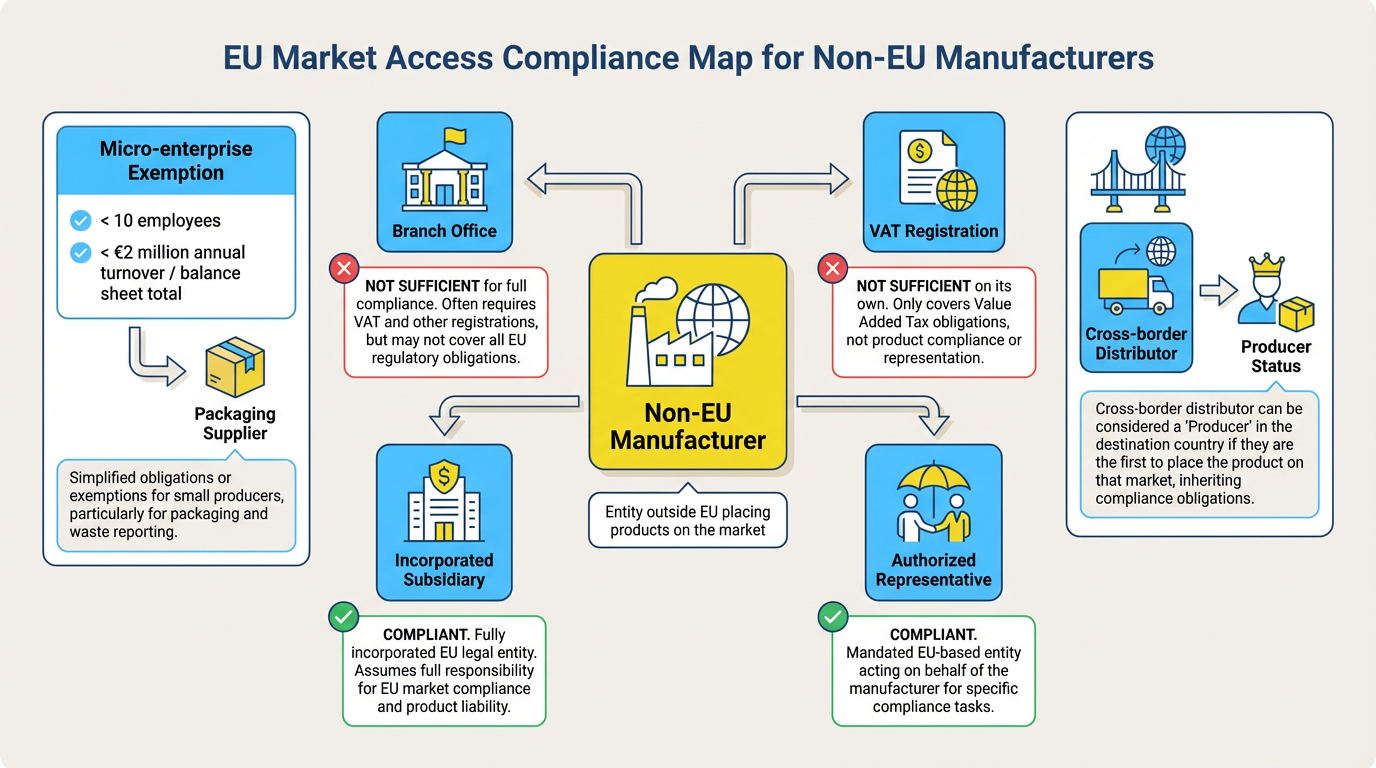
Non-EU manufacturers with only a branch office in the EU face a specific challenge. A branch does not constitute "establishment" under the PPWR. These businesses must either incorporate a subsidiary with independent legal personality or appoint an authorized representative. VAT registration alone does not qualify. The trust businesses place in VAT as a proxy for regulatory standing is misplaced here, and the soundness of any compliance strategy depends on how early businesses understand this distinction.
A micro-enterprise exemption exists for brand owners that employ fewer than ten people with an annual turnover under €2 million. When such a brand owner sources packaging from a supplier in the same Member State, the supplier becomes the responsible manufacturer. This exemption does not apply in reverse. For cross-border distributors, the practical implication is direct. When cross-border distributors import packaged goods into an EU Member State, this action automatically triggers producer status regardless of business size or fulfillment model, and they must manage these responsibilities across different national systems.
Country-by-Country EPR regulations: Where Harmonization Ends
Despite the PPWR's push toward uniformity, Member States retain discretion over fee calculation methods, reporting formats, compliance timelines, and scope definitions. This retained national authority means a company that distributes through five EU Member States must manage five separate registrations, five fee structures, and five reporting schedules. The confidence that harmonization will simplify everything evaporates once operational details surface. Setup costs run approximately £995 per country for Waste Electrical and Electronic Equipment (WEEE) and £195 per country for packaging EPR, and these setups include ongoing monthly management fees. Multi-country annual costs can reach £50,000 to £75,000 before companies even factor in waste management fees. The comfort of a single EU-wide system remains aspirational, not actual.
Fee disparities across countries compound the challenge. Identical packaging materials carry different per-ton costs based on the jurisdiction, and these differences reflect local recycling infrastructure, waste management capacity, and policy priorities. Businesses understand these variations better when they examine specific national systems and review the strict requirements in Germany.
Germany's Stringent LUCID Registry
Germany operates one of the most actively enforced packaging compliance regimes in Europe through its LUCID registry. The Zentrale Stelle Verpackungsregister (ZSVR) maintains this registry. Under German eu epr laws, companies must register personally. Authorized representatives cannot register on behalf of companies. Amazon Germany already suppresses listings from companies that lack valid LUCID numbers. This suppression makes the registration a prerequisite for market access. The strict packaging regulations require precision for everything from material classification to volume reporting, and this strict approach differs entirely from the system in France.
France's EPR obligations
France's Citeo system manages packaging compliance through fee methodologies and reporting timelines that differ from Germany's framework. Registration and compliance management operate independently, and companies cannot assume that compliance with German requirements will cover French ones. The Citeo compliance framework uses its own material weight categories and fee calculations. Reporting deadlines follow a distinct annual schedule. Companies achieve certainty in French compliance when they engage with Citeo's specific requirements from the start, and they must apply this dedicated approach to other European markets.
Other European Markets
Spain, Italy, and the Benelux countries each introduce their own variations. Spain's ECOEMBES system defines covered packaging differently than Germany or France. Italy's CONAI operates with consortium-based fee structures that vary by material type. The Netherlands applies its own scope definitions and reporting cadence. Companies that expand into multiple European jurisdictions discover that each market requires dedicated attention. Companies build trust with national regulators when they meet specific local requirements rather than present a generalized compliance posture, and they must also satisfy the strict compliance checks that major marketplaces now enforce.
Marketplace Enforcement Gatekeeping
Major marketplaces have shifted from passive platforms to active enforcers of EPR regulations. Amazon, eBay, and similar platforms now verify seller EPR documentation and compliance status before they allow product listings. Non-compliant businesses face account suspension, offer blocking, and payment withholding. Martin Hillenbrand represents the Landbell Group, and he stated that marketplace sellers must make sure their products comply with local laws. This compliance means they need a registration for their packaging, a registration for their electronic devices, and a registration for their batteries.
Why Marketplaces and Logistics Providers Now Enforce EPR Compliance
Fulfillment service providers and third-party logistics (3PL) warehouses must also verify client EPR compliance, and they can refuse to process orders for non-compliant businesses. This creates a layered safety net where both the marketplace and the logistics provider serve as enforcement checkpoints. Cure periods for compliance deficiencies typically range from 14 to 30 days before permanent deplatforming occurs. The protection these verification layers provide to consumers and regulators comes at a direct cost to businesses that have not prepared their documentation.
This documentation includes valid registration numbers, proof of fee payment to Producer Responsibility Organizations (PROs), and up-to-date reporting confirmations for every market where goods are listed, and companies must secure these items according to a strict regulatory timeline.
Critical Compliance Timeline for Sellers
The Packaging Waste Regulation rolls out in phases, and each phase introduces distinct epr obligations that build on the previous one. Retailers can prioritize these requirements when they review the final milestones.
The key dates break down as follows:
-
August 12, 2026: Design compliance, technical documentation, declarations of conformity, and PFAS ban enforcement take effect. Existing stock receives no transition period.
-
January 1, 2027: Digital marking becomes mandatory. QR codes or equivalent digital carriers must appear on all packaging and link to producer-maintained databases.
-
June 1, 2029: The first harmonized EPR reporting cycle begins and requires submissions to national registers using the standardized data format.
-
January 1, 2030: Recyclability classifications (class A, B, and C ratings) become mandatory, and minimum recycled content targets for plastic packaging activate.
-
2030–2040: Progressive reuse and refill obligations phase in across sectors.
The August 2026 deadline carries the most immediate weight because it triggers enforcement without a grace period for clearing old inventory. Retailers who have not begun material assessments face a compressed timeline. Companies build confidence in their readiness when they start with PFAS audits and packaging design reviews, and then add digital marking infrastructure and data systems. Companies prevent wasted effort on later-stage requirements when they follow the correct sequence, and they must immediately focus on their data quality.
Data Quality Audit Readiness
The February 2026 standardized data set turned data quality from a best practice into an explicit compliance metric under EPR regulations. Incorrect or incomplete reports can now trigger sales restrictions, rather than just administrative follow-ups.
The standardized data set demands traceable calculation methods for every reported figure. Companies must document how they determined packaging quantities, what assumptions they applied, what data transformations occurred between source systems and final reports, and when they made any modifications. Companies require versioned data storage so that auditors can reconstruct the reporting chain from raw sales data through to the final submission. Auditors expect companies to capture every packaging type and disaggregate it by material composition, weight, recyclability classification, and the specific Member State of first market entry.
Why Auditable Data Systems Are Essential for EPR Compliance
Documented interfaces between Enterprise Resource Planning systems and reporting platforms represent another explicit requirement. Sellers cannot manually export a spreadsheet, adjust figures, and upload the result without a clear record of each step. The interface itself must be auditable. The connection between where sales data originates and where compliance reports land needs formal documentation, version control, and change logs.
Data quality failures cascade quickly. A single misclassified material type can distort fee calculations across an entire reporting period, trigger plausibility checks from national registers, and create discrepancies that auditors flag for deeper investigation. Compliant data infrastructure requires months of integration work, and companies expose themselves to significant financial penalties when they fail to build this infrastructure.
Penalties Enforcement Risks
The financial consequences of failing to meet EU EPR laws extend well beyond registration fees. Maximum penalties vary by jurisdiction but generally exceed €100,000 per violation. Germany, France, and several other Member States have demonstrated their willingness to enforce these penalties against both domestic and foreign sellers.
The enforcement landscape includes several layers of risk:
-
Direct regulatory fines: National authorities impose penalties for missing registrations, late reports, or inaccurate data submissions. These fines compound per violation per market.
-
ECGT Directive penalties: The European Consumer Green Transition Directive takes effect on September 27, 2026, and it adds fines up to 4% of annual turnover for non-compliant sustainability claims that overlap with packaging recyclability representations.
-
Class-action exposure: The EU Representative Actions Directive enables consumer organizations to bring collective claims against non-compliant companies, and this creates litigation risk alongside regulatory penalties.
-
Marketplace deplatforming: Losing access to Amazon, eBay, or similar platforms eliminates revenue streams even when authorities have not issued formal fines.
Marketplaces increasingly act as enforcement gatekeepers and can suspend seller listings immediately when registration or reporting obligations are missing. This observation reflects the practical reality. Marketplace deplatforming acts as a faster and more commercially damaging enforcement mechanism than regulatory proceedings. The soundness of any compliance strategy depends on treating marketplace verification requirements with the same seriousness as regulatory obligations. Companies protect themselves against these risks when they prepare documentation proactively rather than scramble after a suspension notice arrives, and they need a centralized compliance infrastructure to manage this work across multiple countries.
Why Centralized Compliance Infrastructure Is Essential
The matrix of multi-country registrations, distinct fee structures, country-specific reporting formats, and marketplace verification requirements creates an administrative burden that manual processes cannot sustain at scale. For example, a seller operating across five EU Member States manages five separate registrations, five fee payment schedules, five reporting deadlines, and five sets of documentation requirements. Manual tools like spreadsheets and email reminders break down under this weight.
Compliance technology platforms address this because they integrate EPR registration management, data collection, data aggregation, jurisdiction-specific report generation, and submission tracking into a single system. These platforms pull sales data from ERP or marketplace integrations, apply country-specific calculation rules, and generate reports that meet the format of each national register. This safety margin protects against missed deadlines or misclassified materials, and it justifies the investment for any operation that spans more than two or three markets.
Why Authorized Representatives and Integrated Data Systems Matter for Cross-Border Compliance
Retailers must also appoint authorized compliance representatives in each destination country. Remote sellers without legal establishment in a Member State need qualified partners who understand national regulatory expectations, can communicate with local authorities, and can respond to compliance inquiries on the seller's behalf. The selection of these representatives matters. A representative who lacks deep knowledge of a specific country's EPR obligations creates a false sense of refuge rather than actual compliance coverage.
Integration between EPR compliance systems and operational sales data is not optional under the documented interfaces mandate. The data must flow from transaction to report with an auditable trail. Companies that build this infrastructure now convert compliance into an operational capability that prepares them for long-term success across all European markets.
Conclusion
In summary, cross-border EPR regulations require ongoing operational discipline because countries constantly update their rules and regulators strictly enforce these requirements. Companies that invest in centralized compliance systems, accurate data infrastructure, and qualified authorized representatives scale across European markets. Businesses face financial penalties and lose market access when they manage compliance individually for each country. Organizations prepare for the future when they treat compliance as strategic infrastructure rather than a cost center. As a next step, businesses evaluate dedicated compliance platforms like automated EPR reporting software that unify registration, reporting, and fee management across target markets.