Introduction
The Packaging and Packaging Waste Regulation establishes a single environmental framework to replace decades of fragmented national rules across member states. Under this new law, producers manage country-specific registers, distinct fee structures, and different reporting systems in every country where they sell goods. These producers face problems with localized enforcement because the implementation deadline in August 2026 leaves little time for preparation.
Businesses also struggle with incomplete implementing acts and lack the legal certainty they require from the available guidance. Furthermore, sellers encounter strict enforcement from marketplace platforms. For example, Amazon blocked 99% of non-compliant listings in 2024. Companies that follow extended producer responsibility EU frameworks face major regulatory issues that disrupt their operations. The following sections detail the legal requirements and the persistent national differences that shape cross-border compliance.
Navigating extended producer responsibility eu Rules for Online Sellers
Extended producer responsibility (EPR) serves as a legal obligation that shifts the financial and operational burden to manage end-of-life products and packaging from municipalities to the companies that place those goods on the market. Under the Packaging and Packaging Waste Regulation (PPWR), the definition of "producer" extends well beyond manufacturers with physical EU warehouses. For distance sellers, the party that offers a product directly to an end user becomes the producer in the member state of that end user, regardless of where the seller incorporates or where the shipment originates.
This broad definition pulls e-commerce brands into compliance obligations across multiple product categories simultaneously. Packaging falls under the PPWR. Textiles now carry separate obligations through the Directive 2025/1892. Batteries have their own regime under the EU Battery Regulation. Electronics remain governed by the Waste Electrical and Electronic Equipment (WEEE) Directive. Each category operates through its own registration portals, fee structures, and reporting timelines.
Why Cross-Border EPR Compliance Becomes More Complex in Multiple EU Markets
The scale of cross-border sales compounds this challenge. A 2024 EPR Industry Report found that over 52% of respondents sell to five or more EU countries simultaneously. For those businesses, EPR represents a web of parallel obligations multiplied across destination markets rather than a single obligation. Even though EPR is mandatory, significant uncertainty persists within the industry about how schemes work in practice, what costs apply, and what obligations companies face in each country. Companies build confidence in a compliance strategy when they map each product category against each target market before they file a single registration form. That mapping exercise starts with the PPWR framework itself, and this framework sets the broadest and most immediate set of requirements.
PPWR Framework: Key Obligations Starting August 2026
Regulation EU 2025/40 entered into force on February 11, 2025, and its substantive obligations begin on August 12, 2026, after an 18-month transition period. This timeline leaves little room for delay. Businesses face a compressed window to build the EPR compliance infrastructure if they have not started to prepare.
The core EPR requirements are straightforward in principle but demanding in practice. Producers must register in national producer registers in every member state where they place packaging on the market. They must report packaging volumes and material types to Producer Responsibility Organizations (PROs). They must pay EPR fees that regulators calculate by material, weight, and recyclability. And they must conduct conformity assessments and prepare EU Declarations of Conformity for their packaging.
The European Commission estimated that administrative compliance burdens can reach 4,000 hours annually for large companies. That figure alone explains why certainty around operational requirements matters so much. Yet the Commission released guidance only in April 2026, and packaging trade groups responded that it still falls short of the operational clarity businesses need. Confidence to meet the August deadline depends on how companies understand three specific obligation layers. These layers include registration and reporting mandates, PFAS restrictions, and design-for-recyclability criteria.
Core European EPR Registration and Reporting Mandates
National producer registration forms the foundation of compliance. Each member state operates its own portal, and producers must submit company details, packaging descriptions, and volume declarations through country-specific procedures. Volume reporting typically occurs quarterly or annually because jurisdictions have different rules, and it requires granular data on packaging material types, weights, and formats.
Fee calculations vary by country but generally follow a weight-times-material-rate formula, and they include eco-modulation adjustments for packaging that scores well on recyclability. Producers must also prepare EU Declarations of Conformity. These formal documents affirm that their packaging meets the regulation's sustainability and safety standards.
For smaller operators, these obligations still carry meaningful costs. A Eunomia Research & Consulting study estimated EPR compliance costs at €260 annually for micro-enterprises, and this figure excludes time spent to navigate multiple national systems. Companies achieve certainty about total compliance costs when they calculate fees across every market individually. This calculation process also prepares them to address specific material restrictions like the upcoming PFAS ban.
PFAS Restrictions on Food-Contact Packaging
One obligation arrives with zero flexibility. Restrictions on per- and polyfluoroalkyl substances (PFAS) for food-contact packaging take effect on August 12, 2026, and they offer no transition period to sell through existing non-compliant stock. Any food-contact packaging that contains PFAS above permitted thresholds becomes illegal to place on the EU market from that date forward.
This means brands cannot rely on the warehouse inventory that they sell down. Products still must comply even if companies package them before the deadline and sell them after it. Early audits of the entire packaging supply chain help brands that sell food or beverages across EU markets identify PFAS content. Reformulation or supplier changes for food-contact materials take months, and testing and certification add additional lead time.
The confidence that a packaging portfolio is PFAS-compliant depends on proactive supplier engagement and third-party testing, and it does not rely on material safety assumptions from historical specifications. This rigorous material evaluation also supports the upcoming design-for-recyclability standards.
Upcoming Design-for-Recyclability Criteria
Beyond PFAS, the PPWR introduces design-for-recyclability criteria, calculation methodologies, and digital labeling rules. These EPR requirements reshape packaging decisions, but the specific standards remain unfinished. The European Commission is still finalizing the delegated and implementing acts that define assessment grades, minimum recycled content thresholds by material type, and the technical specifications for digital labels. These digital labels likely use QR codes to link to product-specific environmental data.
This regulatory incompleteness creates a planning gap. Brands cannot fully redesign packaging to optimize recyclability scores without exact grading criteria. They cannot calculate recycled content contributions without confirmed methodologies. And they cannot implement digital labels without finalized technical standards.
The absence of certainty does not prevent preparation. Brands establish data systems early so they can adapt to final criteria once regulators publish them, and they avoid a wait for perfect information that arrives only after the August 2026 baseline obligations are already in force. These systems also help them navigate persistent national differences.
Country Differences Persist Despite Harmonization
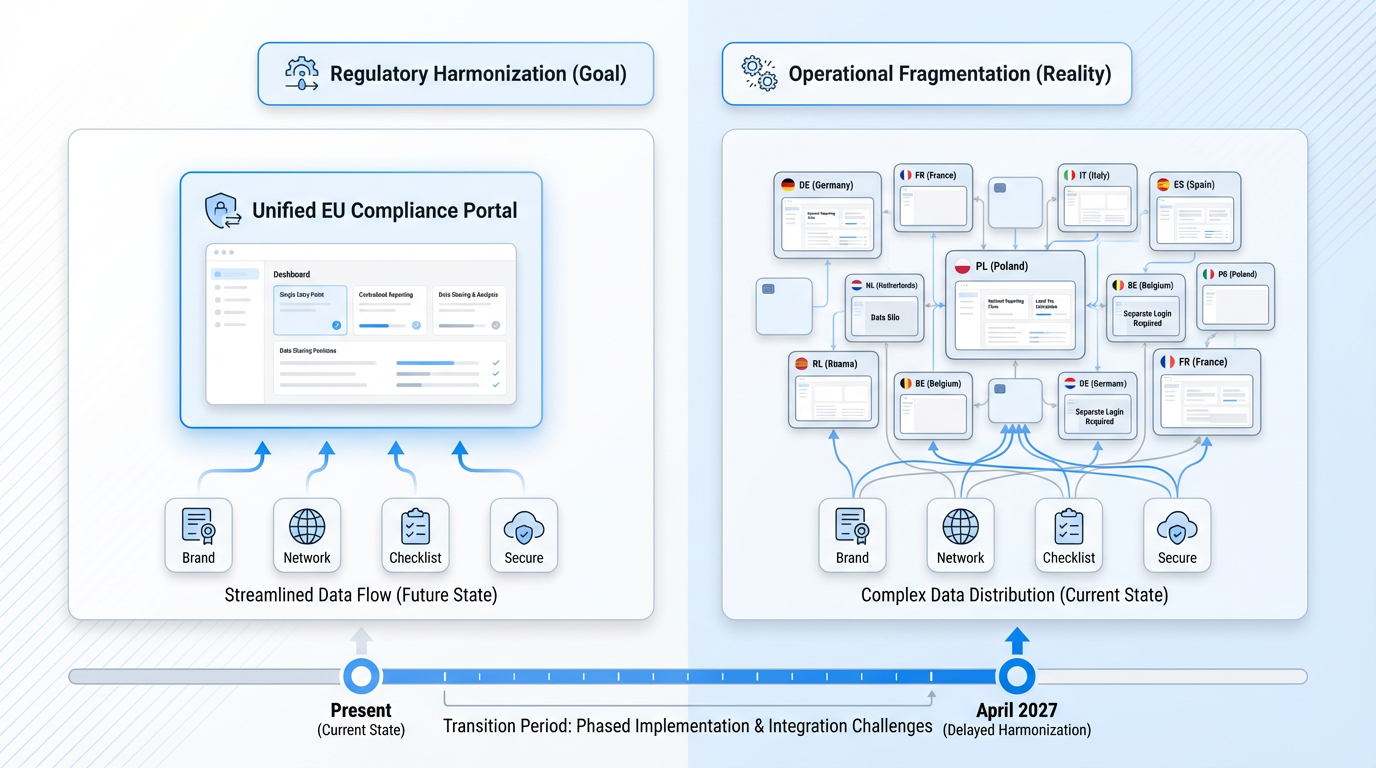
The PPWR is an EU regulation, and this status allows it to apply directly in all member states without national transposition. In theory, this creates an expectation of a uniform compliance landscape. In practice, extended producer responsibility EU rules remain operationally fragmented because the regulation delegates significant implementation discretion to national authorities.
No single EU-wide registration portal exists. Each member state operates its own portal with its own procedures, data fields, language requirements, and verification processes. A harmonized registration format is not expected until April 2027 at the earliest, and this delay forces brands that sell across multiple markets today to navigate 27 distinct systems.
How Registration Systems and Fee Structures Differ by Country
The practical differences create distinct requirements across markets. Germany manages LUCID registration through the Zentrale Stelle Verpackungsregister, and the process remains free of charge while it operates through a competitive multi-PRO system where producers choose among licensed compliance schemes. France channels most packaging compliance through CITEO and other authorized bodies, and it enforces fee structures that incorporate eco-modulation penalties for packaging that scores poorly on recyclability. Furthermore, Spain, Italy, the Netherlands, and Poland each maintain their own registration portals, fee methodologies, and reporting calendars.
Fee structures illustrate the fragmentation most clearly. Member states retain control over how regulators calculate EPR fees, how they apply eco-modulation, and what recyclability assessment methodologies they use. The same cardboard box generates different cost exposure in Berlin than in Paris, Madrid, or Warsaw.
Why Exemption Thresholds and Product Categories Create Additional Complexity
Small-producer exemption thresholds add another layer of complexity. Revenue or tonnage thresholds that trigger full EPR obligations vary by country, and this variation creates situations where a brand qualifies for exemption in one market but faces full obligations in another. This cliff effect means certainty about compliance status requires a market-by-market analysis rather than a single EU-wide determination. A proper map of obligations demands country-specific legal review, and the next wave of harmonization efforts aims to reduce this exact workload. However, this workload currently increases when brands sell products that fall under separate regulatory layers for textiles and batteries.
Textile and Battery Compliance: Parallel Regulatory Layers
Packaging compliance alone does not cover the full european epr landscape. E-commerce brands that sell clothing, footwear, or battery-powered devices face additional regulatory regimes that operate on their own timelines and through their own national systems.
The Waste Framework Directive Amendment entered into force in October 2025 and requires separate EPR registration for textiles in each member state where companies sell products. The rule states explicitly that companies that sell in four countries must register in four countries. France already operates Re_fashion as its textile EPR scheme, and the Netherlands, Belgium, and Sweden have each launched their own programs with different procedures and requirements. Member states have until June 2027 to transpose the directive into national law, and full operational schemes must be in place by April 2028, and the first full annual reporting cycle starts in 2029. Active brands must work with fragmented, nationally defined processes because the harmonized registration format that regulators target for April 2027 covers packaging, and it ignores textiles.
Why Battery and Packaging Rules Create Overlapping EPR Obligations
The EU Battery Regulation creates a parallel EPR framework for batteries with its own producer definitions, reporting requirements, and lifecycle obligations. Digital Battery Passports become mandatory from February 2027 for industrial batteries over 2 kWh and electric vehicle batteries. The infrastructure that companies need to generate and maintain these digital records takes an estimated 12 to 18 months to build, and non-compliant batteries face market access restrictions. E-commerce brands that sell battery-powered devices discover that packaging EPR, battery EPR, and potentially textile EPR all apply simultaneously, and each framework uses different data models and reporting timelines.
Teams achieve certainty when they understand how these parallel regimes intersect and establish data systems that serve all of them. The confidence to sell freely across EU markets depends on a strategy that treats these overlapping obligations as a single integrated challenge rather than isolated regulatory events. This integrated strategy must also account for how EPR fees vary across different countries.
How EPR Fees Vary Across Countries and Impact Costs
EPR fees function as market signals that reflect actual system costs for collection, sorting, processing, and recycling in each member state. The same cardboard shipping box generates a different cost exposure in Germany than it does in France or Spain because each country prices its waste management infrastructure differently. Material type drives the largest fee differentials. Rigid plastics typically cost several times more per kilogram than corrugated cardboard, and flexible films fall somewhere in between. These spreads follow the logic of recyclability, and materials that are harder to sort and reprocess cost the system more. Producers absorb that cost through higher fees.
Eco-modulation amplifies these differences. France's EPR system already penalizes packaging that scores poorly on recyclability, and Germany's competitive multi-PRO model creates fee variation among compliance schemes within the same market. The United Kingdom's Recyclability Assessment Methodology rates packaging from GREEN to RED, and RED-rated formats incur surcharges that escalate from 20% in 2026 to 100% by 2028. These EPR requirements mean a single product line sold across five markets can generate five distinct fee profiles.
Why Detailed Packaging Data Is Essential for Controlling EPR Costs
Total EPR cost exposure depends on granular packaging data that matches against each country's fee methodology. Brands that invest in this mapping optimize packaging designs strategically. This helps reduce fees in their highest-volume markets rather than absorb penalties passively. Non-compliance carries its own financial risk. Violations of Germany's Verpackungsgesetz can result in fines up to €200,000 for a single breach, and this figure dwarfs any fee optimization savings lost through delay. These strict financial penalties prompt many cross-border sellers to appoint local authorized representatives.
Authorized Representative Debate for Cross-Border Sellers
The European EPR framework requires foreign producers without a physical establishment in a member state to appoint an Authorized Representative in each country where they sell. Article 40 of the Packaging and Packaging Waste Regulation codifies this obligation with an August 12, 2026 effective date.
The European Commission then proposed suspending this requirement until 2035 through the Environmental Omnibus package. The proposal triggered strong industry opposition. A German compliance organization named VERE e.V. argued that authorized representatives serve as a vital element to ensure effective environmental and market regulation across Europe. The organization warned that without legally responsible local representatives, free-riders from around the world would sell into EU markets without fear of enforcement. A coalition of European industry organizations echoed this concern on March 11, 2026, and called on the EU to mandate legally responsible representatives for foreign e-commerce sellers before 2028 to protect fair competition.
Why Businesses Are Preparing for Stricter Rules Before the Final Decision
The feedback period on the suspension proposal closed in May 2026, and the outcome remains pending. This leaves sellers in a difficult position. Appointing authorized representatives across multiple markets requires contracts, costs, and due diligence on the representative's legal capacity. However, skipping the appointment risks non-compliance if the suspension fails to pass. The legislative process must conclude to bring clarity. Brands prepare for the stricter interpretation to build their compliance infrastructure instead of waiting for regulatory relief. They also monitor marketplace platforms because these platforms enforce compliance independently.
Marketplace Platform Enforcement as Compliance Pressure Point
Marketplace platforms serve as de facto compliance gatekeepers, and their enforcement often moves faster than government regulation. Amazon, eBay, and Zalando now require EPR registration numbers as a listing condition in most EU markets and delist sellers who cannot provide valid proof. This creates a three-layer compliance structure. Government regulations define the legal obligations, marketplace policies determine market access, and professional compliance infrastructure bridges the gap between the two.
The EPR requirements that platforms impose do not always mirror official government rules precisely. Amazon may require registration documentation in formats or timelines that differ from what a national register demands, and sellers must satisfy both layers simultaneously. Confusion often surfaces when platform-assessed EPR charges do not appear to match actual regulatory fee obligations, and this leaves sellers uncertain about whether they pay twice or pay correctly.
Why Growing Enforcement and Platform Rules Increase Compliance Pressure
This enforcement pressure arrives against a backdrop of escalating waste volumes. The Global Waste Index estimates that global packaging waste reached 434.5 million tonnes in 2025, and EU regulators view platform accountability as an important method to reduce that figure. Cross-border fulfillment rules and mandatory "ships-from" disclosures continue to tighten, and this raises landed costs and extends delivery timelines.
Marketplace compliance requires monitoring platform policy updates alongside regulatory developments. Brands treat platform requirements as a separate compliance layer to avoid sudden listing suspensions during peak selling periods. They require a practical roadmap to manage these multiple regulatory and platform layers effectively.
Practical Compliance Roadmap and Harmonization Horizon
The operational complexity of extended producer responsibility EU obligations calls for a structured approach rather than reactive scrambling.
Brands that sell across multiple EU markets benefit from a sequenced roadmap that builds compliance infrastructure methodically:
-
The first step involves determining producer status under the PPWR in each target market to identify the party making packaging first available on the market in each member state.
-
The process requires mapping all packaging materials, weights, and formats across the full product portfolio, as 30 to 70 percent of relevant packaging data often appears missing or inconsistent at the start.
-
Sellers register with national producer registers in every country where they sell products, and they budget for separate registration procedures, languages, and documentation requirements per market.
-
Businesses establish PRO relationships or contract consolidated compliance service providers to choose between self-managing, using marketplace on-behalf services, or engaging specialized third parties based on volume and market complexity.
-
Companies implement centralized packaging data management infrastructure that feeds reporting to multiple national systems from a single data model.
-
Organizations monitor the August 12, 2026 deadline and prepare for PFAS restrictions, design-for-recyclability criteria, and digital labeling requirements as implementing acts finalize.
Beyond 2026, the EU's planned Circular Economy Act aims to simplify reporting obligations, prevent national divergences, and digitalize compliance processes. A proposed unified data model with the manufacturer as a single point of entry could reduce the multi-country registration burden over time. Digital Product Passport requirements will layer additional data obligations on top of EPR, but current infrastructure can serve both purposes. The EU customs reform removes the €150 duty threshold from July 2026, and this compounds the compliance workload further. Understanding future harmonization helps justify the investment in flexible data systems today. Brands build adaptable compliance architecture ahead of these changes to ensure their infrastructure scales rather than requires costly rebuilds as new requirements arrive.
Conclusion
To summarize, harmonization through the Packaging and Packaging Waste Regulation represents a significant step forward, but it does not simplify daily operations immediately. Companies face 27 separate compliance environments with different fees, thresholds, and enforcement approaches, and parallel textile and battery regulations compound this issue. Businesses that invest early in centralized data infrastructure and proactive monitoring turn compliance into an advantage. Organizations face higher risks if they delay action because platforms tighten enforcement and August 2026 obligations take effect. They require dedicated software to manage this complexity, and hiring an EPR authorised representative helps them handle local obligations. Ultimately, companies build a stronger foundation when they treat the current fragmentation of extended producer responsibility eu rules as a temporary but operationally decisive challenge.